 Xenonstack Glossary
XenonStack GlossaryWhat Is a Data Mesh? Four Principles Explained
Key takeaway
- A data mesh is a decentralised architecture where domain teams own data as products. See the four principles and how it differs from a data fabric.
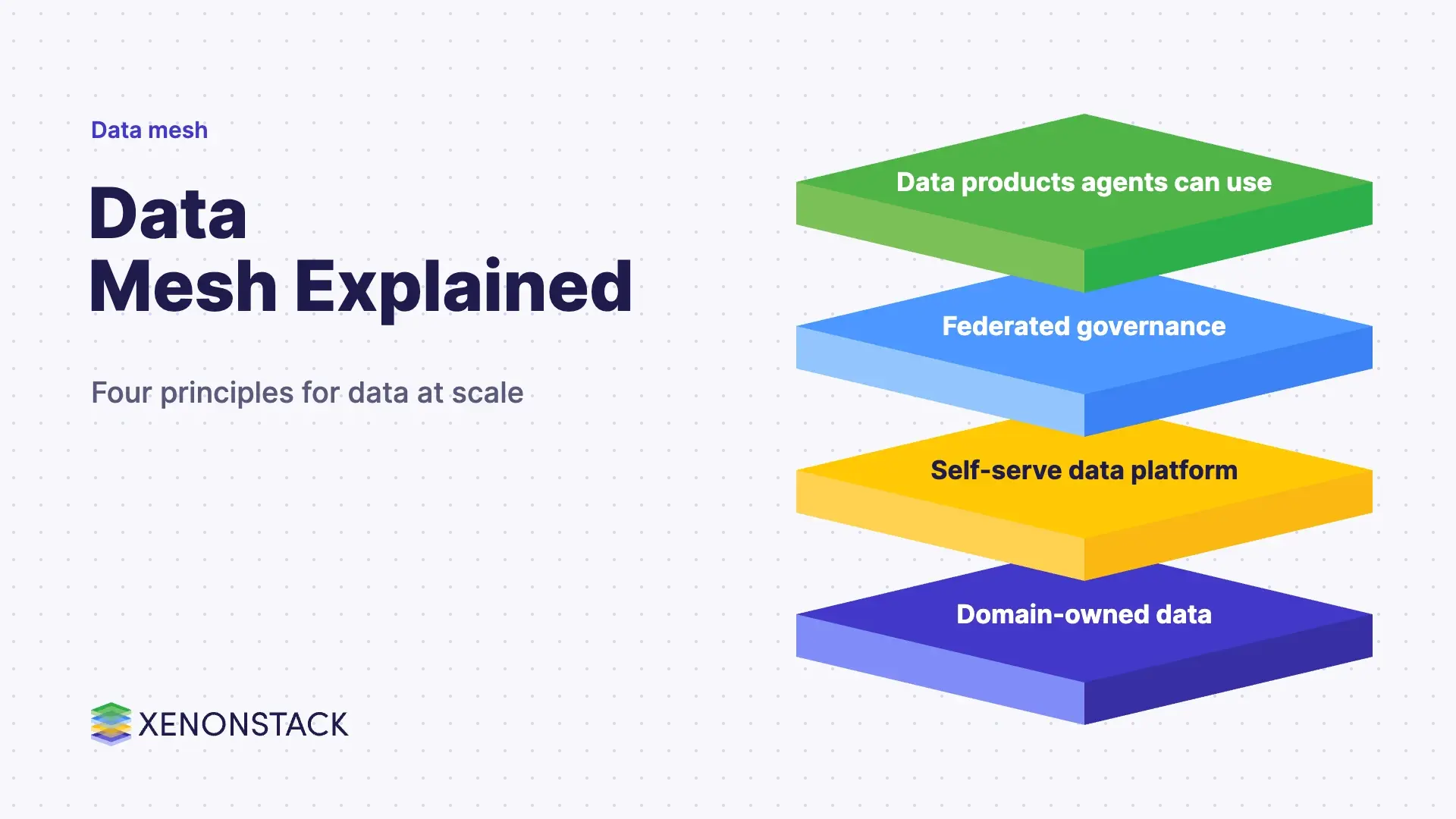
A data mesh is a decentralised data architecture that organises data by business domain, so the teams who know the data best own it and serve it to others as a product. It replaces a single central data team with shared standards and a self-serve platform, so data scales with the organisation.
This page is for data architects, platform owners and business leaders weighing a move away from centralised data teams. It covers the four principles, how a mesh differs from a data fabric, how AI agents use data products and what to do first.
What is a data mesh?
IBM's data mesh overview calls a data mesh "a decentralized data architecture that organizes data by business domain", with domain teams owning and sharing their data as products. Zhamak Dehghani's data mesh principles article on martinfowler.com presents it as an approach to getting value from analytical data at scale, founded in four principles. Its stated objective is "to create a foundation for getting value from analytical data and historical facts at scale".
Data mesh sits within the wider shift to modern data architecture. Our guide to data mesh covers implementation in more depth.
Why does data mesh matter?
A central data team can become a bottleneck as an organisation grows, because every request queues behind it. A data mesh moves ownership to the domains that know the data best, with shared standards so that data can scale with the business. It is as much an organisational change as a technical one: teams must collaborate across functions to get value from data.
What are the four principles of data mesh?
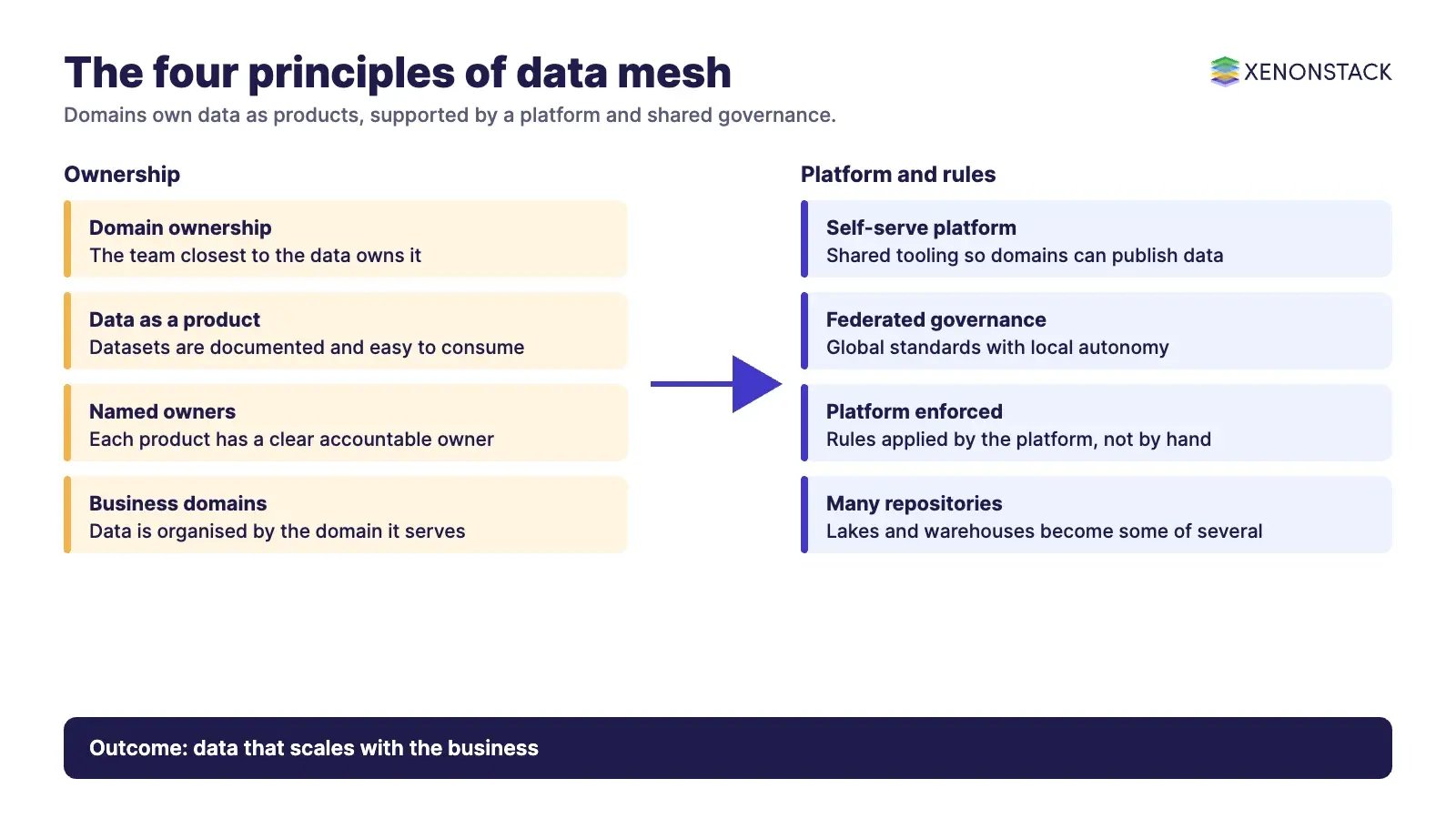
The Dehghani article names four principles. The quoted phrases are from the article.
| Principle | What the article says | What it means in practice |
|---|---|---|
| Domain ownership | "Domain-oriented decentralized data ownership and architecture" | The team closest to the data is accountable for it |
| Data as a product | "Analytical data provided by the domains must be treated as a product" | Datasets are documented, reliable and easy to consume |
| Self-serve data platform | "Self-serve data infrastructure as a platform to enable domain autonomy" | Shared tooling lets domains publish without building infrastructure |
| Federated computational governance | "a governance model that embraces decentralization and domain self-sovereignty" | Global standards are balanced with local autonomy and enforced by the platform |
How is a data mesh different from a data fabric and a data lake?
IBM describes a data fabric as complementary to a data mesh rather than a replacement: it uses intelligent and automated systems to break down silos and can help create and manage data products. IBM adds that data lakes and warehouses are not made obsolete; their role changes from single centralised platforms to supporting multiple decentralised repositories. For a longer comparison, read data fabric vs data mesh.
| Approach | Main idea | Organising unit |
|---|---|---|
| Data mesh | Domain teams own and serve data as products | Business domain |
| Data fabric | Automation and intelligent systems connect data across silos | Connected data landscape |
| Data lake or warehouse | A repository for storing and analysing data | One of many repositories in a mesh |
Governance carries more weight in a mesh because ownership is spread out. See our essential elements of a data strategy for how the pieces fit.
How does data mesh apply to AI agents?
Well-defined data products with named owners are what AI agents need to consume data safely across domains: each product says what the data means, who is accountable and how it may be used. Our piece on agentic AI for data management looks at the agent side. For the governed context agents rely on, see ElixirData, XenonStack's Context OS.
What should you do first?
- Choose one or two business domains that already know their data well.
- Name an owner for each domain and agree what counts as a data product.
- Agree a small set of global standards, such as naming, quality and access.
- Decide which shared platform capabilities domains need to publish data.
- Test the first data product with a real consumer, human or agent, before scaling.
To map one decision your agents make, and the data products and policy it depends on, book a Context Workshop. See what happens in the workshop.
Frequently asked questions
What is a data mesh?
A data mesh is a decentralised data architecture that organises data by business domain, with domain teams owning and sharing their data as products.
What are the four principles of data mesh?
Domain-oriented ownership, data as a product, a self-serve data platform and federated computational governance.
Is a data mesh a technology?
No. It is an organisational and architectural approach, put into practice with platforms, catalogs and governance tools.
What is the difference between a data mesh and a data fabric?
A data mesh decentralises ownership to business domains. IBM describes a data fabric as complementary: it uses intelligent and automated systems to break down silos.
Does a data mesh replace the data warehouse or data lake?
No. According to IBM, warehouses and lakes remain, but they become some of several decentralised repositories rather than the single central platform.
Explore the XenonStack platform family: ElixirData · ElixirClaw · ElixirHub · NexaStack · MetaSecure · Neural AI · AgentGRC · AgentSRE · AgentAnalyst · AgentInstruct · AgentRAI · AgentScrum · AgentSearch · AgentForce · AI Aviator · SAIF Aviator · CohortIQ · XenonStack AI · XenonStack UAE