 Xenonstack Glossary
XenonStack GlossaryDeep Reinforcement Learning: How It Works
Key takeaway
- Deep reinforcement learning trains neural network policies by trial and error. See the core concepts, how it differs from RL and what to do first.
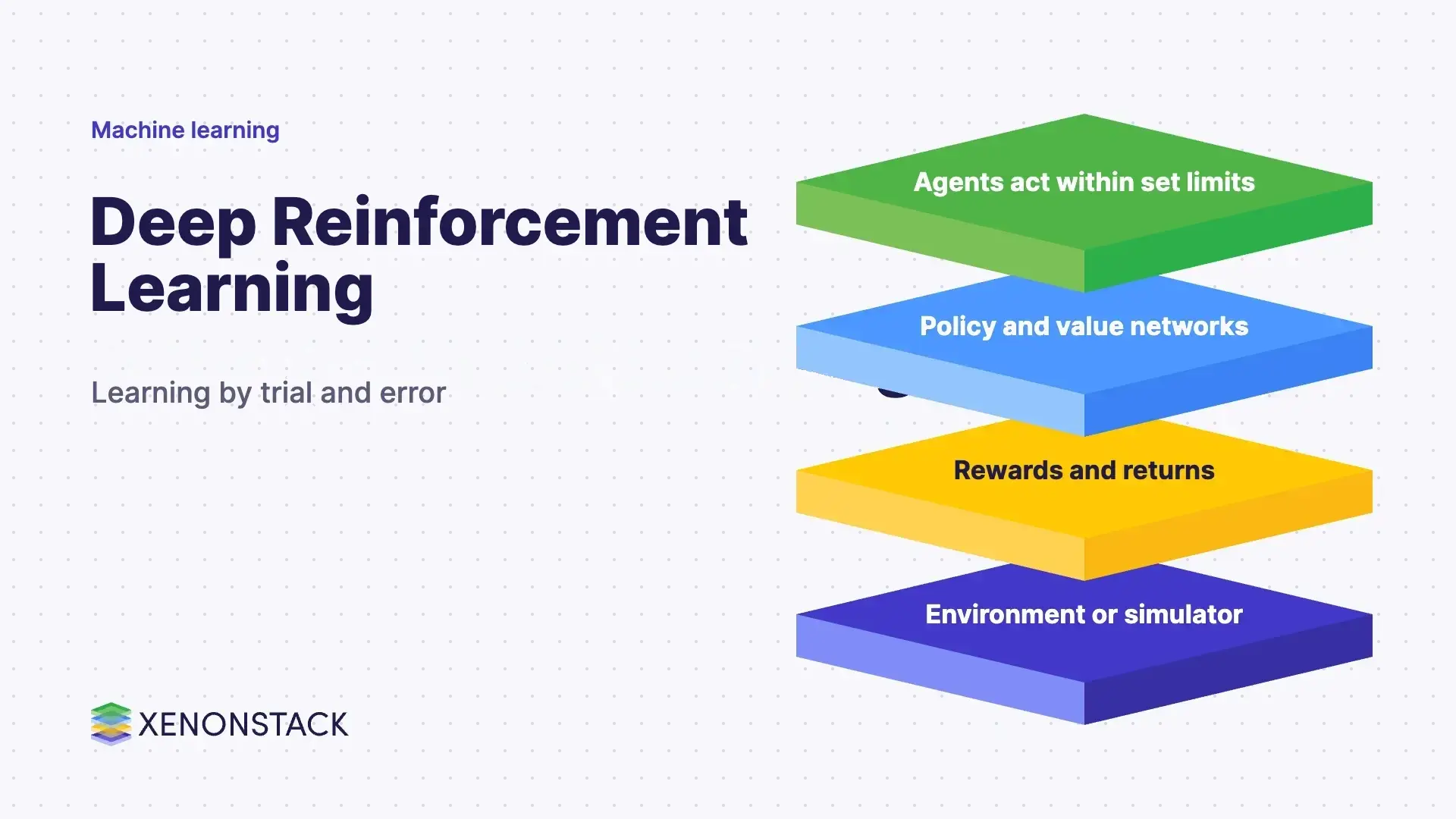
Deep reinforcement learning is reinforcement learning in which neural networks represent the policy or the value function, so an agent can learn from rich inputs such as images. The agent learns by trial and error, taking actions in an environment and adjusting its behaviour according to the rewards it receives.
This page is for leaders and engineers who need to know what the term means, what its parts are, and where it fits beside AI agents. It ends with a short first-steps list.
What is deep reinforcement learning?
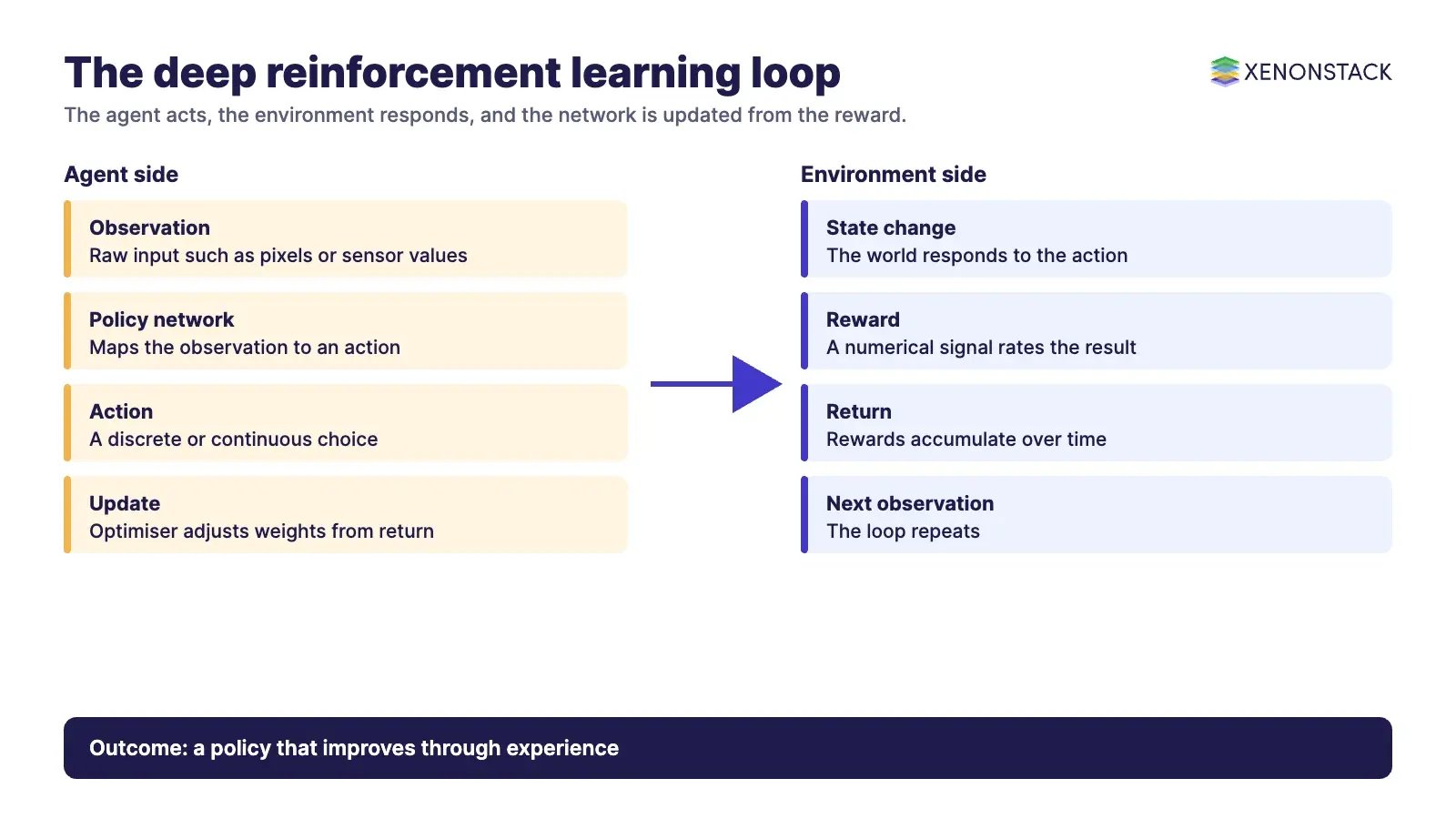
OpenAI's Spinning Up introduction puts reinforcement learning in one line: it is the study of agents and how they learn by trial and error. In deep reinforcement learning, the policy is parameterised by a neural network whose weights and biases an optimiser adjusts to change behaviour. Observations can be fed in as vectors, matrices or tensors, for example an image as a matrix of pixels.
What are the core concepts of reinforcement learning?
| Concept | Meaning in Spinning Up | Role of the neural network |
|---|---|---|
| Agent and environment | The learner, and the world it acts in | The network sits inside the agent |
| State and observation | A full description of the world, or a partial view of it | Takes the observation as input |
| Action | A choice from a discrete or continuous action space | Outputs action scores or probabilities |
| Reward and return | A numerical signal, and the cumulative reward the agent tries to maximise | Training pushes the network towards higher return |
| Policy | The agent's decision rule, deterministic or stochastic | Often the network itself |
| Value function | The expected return from a state or a state and action pair | Can be approximated by a second network |
How did deep reinforcement learning become practical?
The best-known early result is Playing Atari with Deep Reinforcement Learning. The authors trained a convolutional neural network with a modified form of Q-learning. Its input was raw pixels and its output was a value function estimating future rewards. The same architecture and learning algorithm were applied to seven Atari 2600 games, outperformed earlier approaches on six and beat a human expert on three.
The lesson for enterprise teams is the setup, not the games: a reward signal, an environment to practise in, and a model that can read the raw inputs.
How does deep reinforcement learning differ from neighbouring terms?
| Term | What it is | Learning signal |
|---|---|---|
| Reinforcement learning | An agent learning by trial and error in an environment | Reward |
| Deep reinforcement learning | Reinforcement learning with neural network policies or value functions | Reward |
| Deep learning | Neural networks trained on data, a building block for deep RL | Depends on the task |
The Hugging Face Deep RL course describes deep RL as a type of machine learning where an agent learns how to behave in an environment by taking actions and observing the results.
How does deep reinforcement learning relate to AI agents?
An AI agent in the wider sense chooses actions to reach a goal, and a deep reinforcement learning policy is one way to make that choice. Teams building agents on ElixirClaw, XenonStack's AI agents computing platform, can treat a learned policy as one component beside language-model reasoning and tools. Whatever the component, define which actions it may take and who reviews them, because an agent optimising a reward will pursue exactly the reward you wrote.
What should you do first?
- Pick one decision with a clear, measurable reward.
- Build or obtain a safe environment, such as a simulator, where the agent can practise.
- Start with a small open implementation, for example the Hugging Face course project.
- Set limits on the actions the agent may take before any live use.
- Compare the learned policy with a simple rule-based baseline.
To map one decision your agents make, and the data and policy it depends on, book a Context Workshop. See what happens in the workshop.
Frequently asked questions
What is deep reinforcement learning in simple terms?
It is reinforcement learning where neural networks represent the policy or value function, so the agent can learn by trial and error from rich inputs such as images.
How is it different from reinforcement learning?
Reinforcement learning is the general idea of learning by trial and error from rewards. The deep version uses neural networks to produce the policy or estimate values.
What was the Atari result?
A convolutional network trained with a modified Q-learning method learned from raw pixels. It outperformed earlier approaches on six of seven Atari 2600 games and beat a human expert on three.
What is a policy?
A policy is the agent's decision rule. It can be deterministic, mapping each state to one action, or stochastic, sampling actions from a probability distribution.
Explore the XenonStack platform family: ElixirData · ElixirClaw · ElixirHub · NexaStack · MetaSecure · Neural AI · AgentGRC · AgentSRE · AgentAnalyst · AgentInstruct · AgentRAI · AgentScrum · AgentSearch · AgentForce · AI Aviator · SAIF Aviator · CohortIQ · XenonStack AI · XenonStack UAE