 Xenonstack Glossary
What are your key focus areas? *
AI Workflow and Operations
Data Management and Operations
AI Governance
Analytics and Insights
Observability
Security Operations
Risk and Compliance
Procurement and Supply Chain
Private Cloud AI
Vision AI

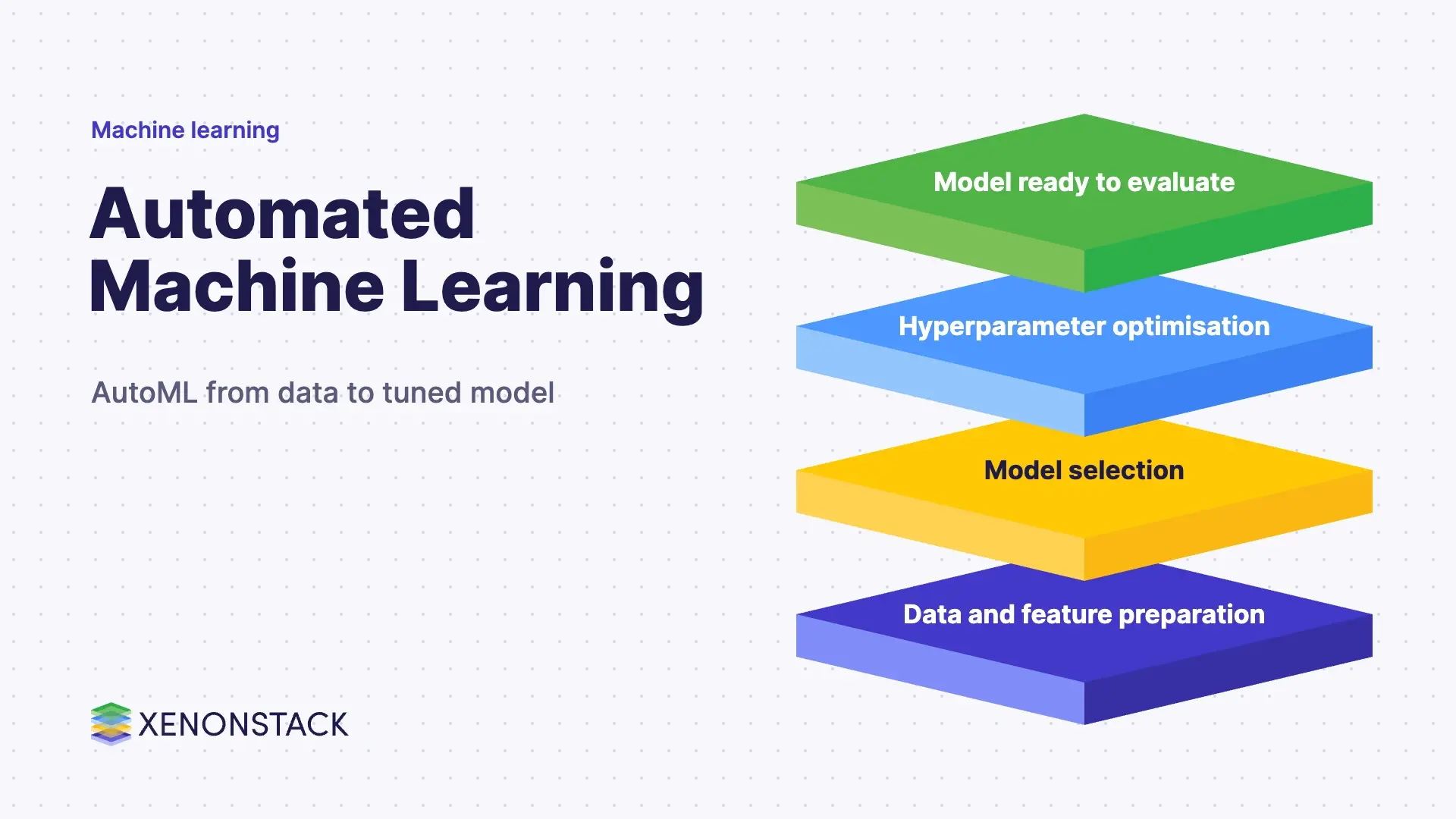
Automated machine learning, or AutoML, is a set of methods and processes that automate parts of the machine learning workflow, such as feature construction, model selection and hyperparameter tuning, so that models can be built with less manual effort. It aims to make machine learning usable by non-experts and more efficient for experts.
This page is for business and technology leaders who want to know what AutoML automates, which tools exist, where human expertise is still needed and how it connects to AI agents.
The AutoML.org overview describes automated machine learning as research that provides methods and processes to make machine learning available to non-experts, improve its efficiency and accelerate research in the field.
In a manual workflow, feature engineering and model choice are handled by hand. AutoML handles that work in an automated way.
The overview lists several tasks that AutoML targets.
| Task | What AutoML does | Why it matters |
|---|---|---|
| Data preparation and features | Helps clean data and select or construct features | Reduces repetitive manual work |
| Model selection | Chooses a model family together with its hyperparameters | Removes guesswork when trying many models |
| Hyperparameter optimisation | Automates a slow, error-prone tuning task | Gives new problems a repeatable method; see hyperparameter tuning |
| Neural architecture search | Looks for well-performing deep network designs | Developers do not evaluate architectures by hand |
AutoML.org names AutoML systems including AutoWEKA, Auto-sklearn, Auto-PyTorch, AutoGluon, H2O AutoML, MLBox, TPOT and TransmogrifAI. For hyperparameter optimisation it names SMAC3 and DEHB.
Choose by the language and framework your team already uses, and test the tool on a problem where you know a good answer.
The overview says AutoML lets people without machine learning expertise build models off the shelf, and reduces the time developers spend on tuning and architecture trials. It also supports fairer research comparisons: tuning all algorithms with the same toolkit shows whether a method is genuinely better or just better tuned.
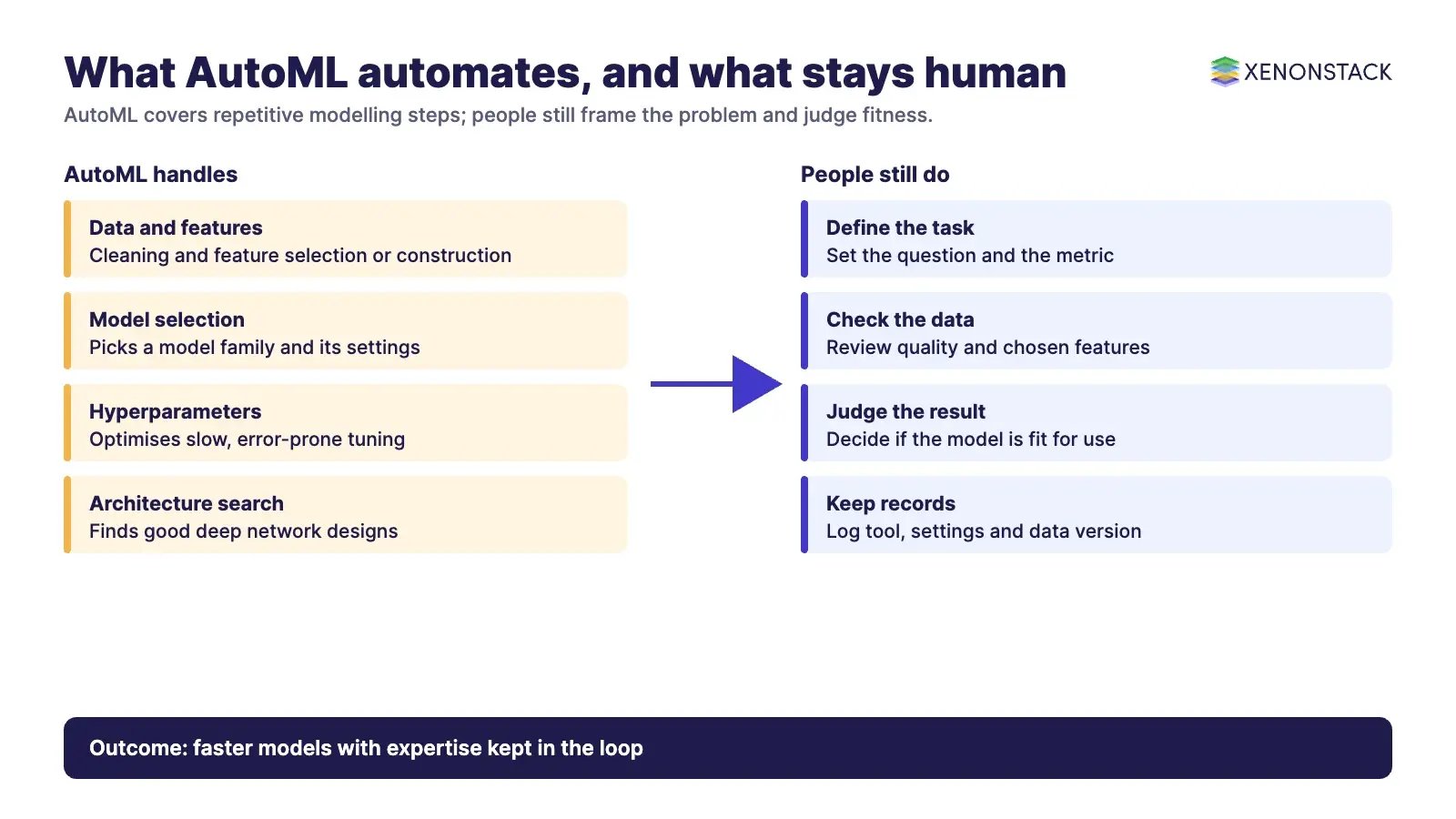
The page frames AutoML as making expert tasks accessible, not as removing the need for expertise. Someone still has to define the problem, check the data and judge whether the result is fit for use.
Agents are built on models, and AutoML shortens the path to a first working model. Teams building agents on ElixirClaw, the AI agents computing platform from XenonStack can use AutoML for the predictive components, while keeping each run, its data and its chosen model on record. Another technique worth knowing in this area is bootstrap aggregation.
To map one decision your agents make, and the data and policy it depends on, book a Context Workshop. See what happens in the workshop.
AutoML provides methods and processes that automate parts of building a machine learning model, such as data preparation, model selection and hyperparameter optimisation, so non-experts can build models more easily.
AutoML.org lists data cleaning and feature work, model selection together with hyperparameters, hyperparameter optimisation and neural architecture search.
No. The overview presents AutoML as making expert tasks accessible and reducing time spent on tuning and trials. Expertise is still needed to frame the problem and judge the result.
AutoML.org names Auto-sklearn, Auto-PyTorch, AutoGluon, H2O AutoML, TPOT, AutoWEKA, MLBox and TransmogrifAI, plus SMAC3 and DEHB for hyperparameter optimisation.
Explore the XenonStack platform family: ElixirData · ElixirClaw · ElixirHub · NexaStack · MetaSecure · Neural AI · AgentGRC · AgentSRE · AgentAnalyst · AgentInstruct · AgentRAI · AgentScrum · AgentSearch · AgentForce · AI Aviator · SAIF Aviator · CohortIQ · XenonStack AI · XenonStack UAE
Tell us about you and your priorities so we can prepare the right conversation. It takes about 2 minutes.
AI continuously monitors systems for risks before they escalate. It correlates signals across logs, metrics, and traces. This ensures faster detection, fewer incidents, and stronger reliability
 Proactive detection of performance and availability issues
 Root-cause analysis across microservices and environments
 Automated remediation playbooks to reduce MTTR

AI converts camera feeds into instant situational awareness. It detects unusual motion and unsafe behavior in real time. Long hours of video become searchable and summarized instantly
 Real-time detection of suspicious motion or intrusion
 Natural language video search and instant playback
 Smart summaries for audits, investigations, and compliance

Your data stack becomes intelligent and conversational. Agents surface insights, detect anomalies, and explain trends. Move from dashboards to autonomous, always-on analytics
 Connects to warehouses, lakes, and streaming sources
 Question-answering in natural language
 Continuous monitoring for anomalies and KPI deviations

Agents identify recurring failures and performance issues. They trigger workflows that resolve common problems automatically. Your infrastructure evolves into a self-healing environment
 Automated diagnostics for recurring errors
 Playbook execution: restart services, scale pods, clear queues
 Feedback loop for improving remediation strategies

AI continuously checks controls and compliance posture. It detects misconfigurations and risks before they escalate. Evidence collection becomes automatic and audit-ready
 Continuous control checks across infrastructure and SaaS
 Automated evidence collection for audits
 Risk scoring and prioritized remediation recommendations

Financial and procurement workflows become proactive and insight-driven. Agents monitor spend, vendors, and contracts in real time. Approvals and sourcing decisions become faster and smarter
 Real-time visibility into spend and commitments
 Anomaly detection on invoices and vendor performance
 Intelligent workflows for approvals and sourcing decisions


