 Xenonstack Glossary
What are your key focus areas? *
AI Workflow and Operations
Data Management and Operations
AI Governance
Analytics and Insights
Observability
Security Operations
Risk and Compliance
Procurement and Supply Chain
Private Cloud AI
Vision AI

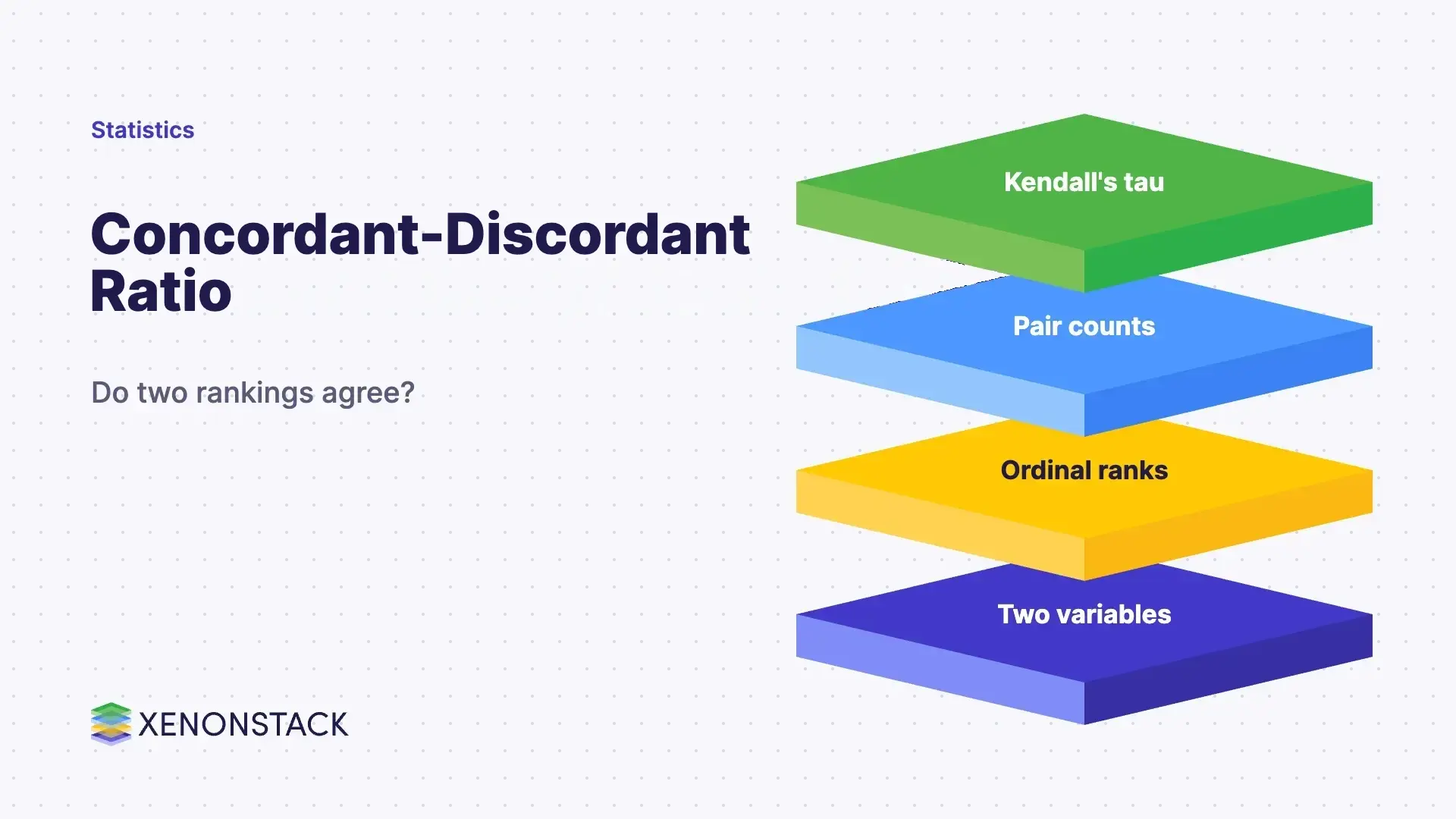
The concordant-discordant ratio compares the number of observation pairs that two variables rank in the same order (concordant) with the number they rank in opposite order (discordant). It treats data as ordinal, so only the order of values matters, not their size. The two counts are the building blocks of Kendall's tau, a measure of association between two ordinal variables.
This page is for analysts, data scientists and decision makers who need to judge whether two rankings agree. It covers what the ratio is, how pairs are counted, how ties are handled, and how it differs from related measures.
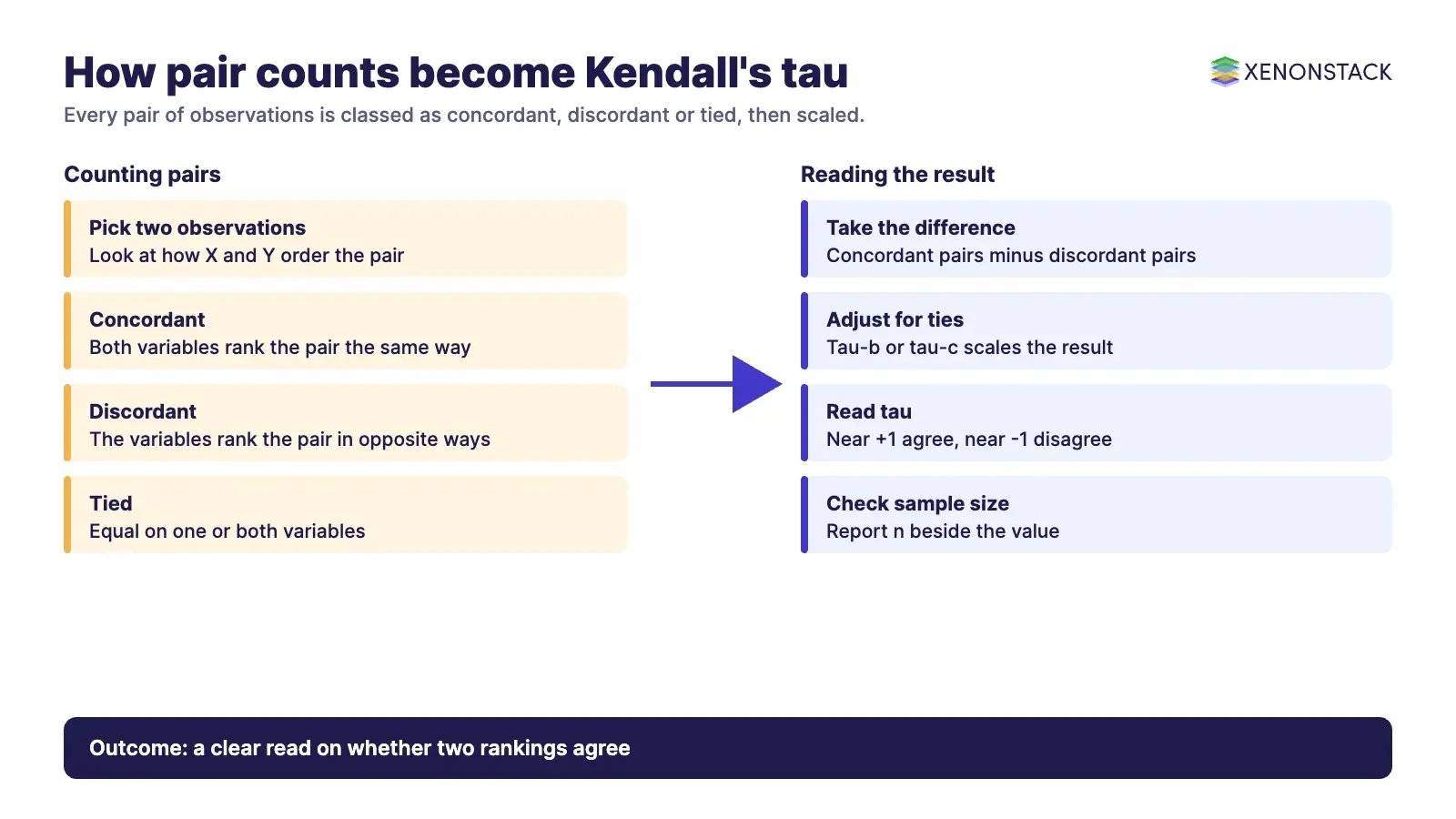
Take any two observations and look at how two variables, X and Y, order them. If both variables put the same observation first, the pair is concordant. If they disagree, the pair is discordant. The ratio is the count of concordant pairs set against the count of discordant pairs: a ratio above one means agreement dominates, and a ratio below one means disagreement dominates. The Wikipedia article on the Kendall rank correlation coefficient describes concordance and discordance in exactly these terms.
Many business measures are rankings, not quantities: customer satisfaction bands, risk grades, model scores against analyst ratings. Pair counts let you test whether two such rankings move together without assuming the gaps between ranks are equal. Because only order is used, a few extreme values cannot distort the result.
With n observations there are n(n-1)/2 pairs. Each pair is concordant, discordant or tied. The SciPy kendalltau documentation gives Kendall's tau-b as (P - Q) divided by the square root of (P + Q + T) times (P + Q + U), where P is the number of concordant pairs, Q the number of discordant pairs, T the pairs tied only in x and U the pairs tied only in y. A pair tied in both x and y is left out of both T and U.
| Count | Meaning | Effect on association |
|---|---|---|
| Concordant pairs (P) | Both variables order the pair the same way | Push tau towards +1 |
| Discordant pairs (Q) | The variables order the pair in opposite ways | Push tau towards -1 |
| Ties | The pair is equal on one or both variables | Handled by the tau variant you choose |
The Wikipedia article on the Kendall rank correlation coefficient explains that values near +1 indicate strong positive association, values near -1 strong negative association, and values near zero little or no association.
| Measure | What it uses | Typical use |
|---|---|---|
| Concordant-discordant ratio | Counts of concordant against discordant pairs | A quick read on whether rankings agree |
| Kendall's tau | The difference between the two counts, scaled to the range -1 to +1 | A formal measure of ordinal association |
| Pearson correlation | The actual values, assuming a linear relationship | Continuous data with linear patterns |
The ratio and tau carry the same information about agreement. Tau scales it to a bounded range, which makes results easier to compare across datasets. Tau-a does not adjust for ties, so it cannot reach plus or minus one when ties exist, as the Wikipedia article notes. Tau-b and tau-c differ in how they scale the result, according to SciPy.
When an AI agent ranks leads, claims or alerts, the question is whether its ranking agrees with the order a human expert would give. Counting concordant and discordant pairs between the two lists is a simple, assumption-light check. Pair counts depend on trustworthy source data and clear policy about what counts as a correct order, which is where a governed decision layer such as ElixirData, XenonStack's Context OS, sits.
To map one decision your agents make, and the data and policy it depends on, book a Context Workshop. See what happens in the workshop.
A concordant pair is two observations that both variables order the same way. If one observation ranks higher on X and also higher on Y, the pair is concordant.
A discordant pair is two observations that the two variables order in opposite ways. One ranks higher on X but lower on Y.
Kendall's tau is built from the same counts. It uses the difference between concordant and discordant pairs, scaled to a range of -1 to +1, with tau-b also adjusting for ties.
Tau-a makes no adjustment for ties. Tau-b and tau-c adjust for them in different ways. In SciPy, a pair tied in both variables is excluded from the tie counts.
Explore the XenonStack platform family: ElixirData · ElixirClaw · ElixirHub · NexaStack · MetaSecure · Neural AI · AgentGRC · AgentSRE · AgentAnalyst · AgentInstruct · AgentRAI · AgentScrum · AgentSearch · AgentForce · AI Aviator · SAIF Aviator · CohortIQ · XenonStack AI · XenonStack UAE
Tell us about you and your priorities so we can prepare the right conversation. It takes about 2 minutes.
AI continuously monitors systems for risks before they escalate. It correlates signals across logs, metrics, and traces. This ensures faster detection, fewer incidents, and stronger reliability
 Proactive detection of performance and availability issues
 Root-cause analysis across microservices and environments
 Automated remediation playbooks to reduce MTTR

AI converts camera feeds into instant situational awareness. It detects unusual motion and unsafe behavior in real time. Long hours of video become searchable and summarized instantly
 Real-time detection of suspicious motion or intrusion
 Natural language video search and instant playback
 Smart summaries for audits, investigations, and compliance

Your data stack becomes intelligent and conversational. Agents surface insights, detect anomalies, and explain trends. Move from dashboards to autonomous, always-on analytics
 Connects to warehouses, lakes, and streaming sources
 Question-answering in natural language
 Continuous monitoring for anomalies and KPI deviations

Agents identify recurring failures and performance issues. They trigger workflows that resolve common problems automatically. Your infrastructure evolves into a self-healing environment
 Automated diagnostics for recurring errors
 Playbook execution: restart services, scale pods, clear queues
 Feedback loop for improving remediation strategies

AI continuously checks controls and compliance posture. It detects misconfigurations and risks before they escalate. Evidence collection becomes automatic and audit-ready
 Continuous control checks across infrastructure and SaaS
 Automated evidence collection for audits
 Risk scoring and prioritized remediation recommendations

Financial and procurement workflows become proactive and insight-driven. Agents monitor spend, vendors, and contracts in real time. Approvals and sourcing decisions become faster and smarter
 Real-time visibility into spend and commitments
 Anomaly detection on invoices and vendor performance
 Intelligent workflows for approvals and sourcing decisions


