 Xenonstack Glossary
XenonStack GlossaryData Governance: Definition, Pillars and AI Agents
Key takeaway
- Data governance sets the roles, rules and processes for how data is owned, protected and used. See the four pillars and where AI agents fit.
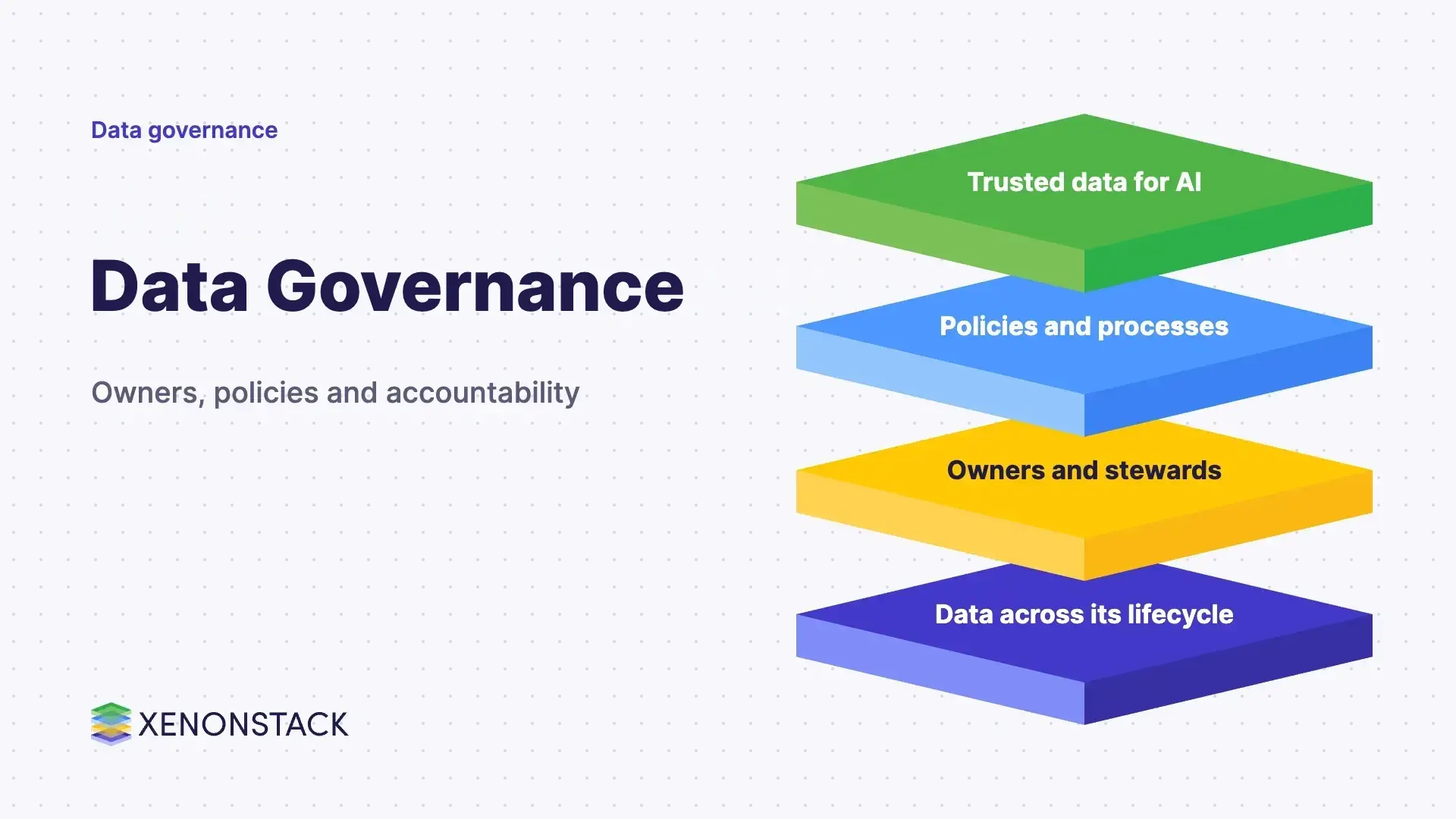
Data governance is the set of roles, policies and processes that decide who is accountable for an organisation's data and how it may be gathered, stored, protected and used. It turns data from a by-product of systems into a managed asset that analytics, compliance teams and AI agents can rely on.
This page is for data, risk and technology leaders who need a clear definition before they build a programme. It covers the pillars, how governance differs from data management, how it extends to AI agents and what to do first.
What is data governance?
The Databricks data governance glossary describes it as "a comprehensive approach that comprises the principles, practices and tools to manage an organization's data assets", aligned with business strategy and covering the data lifecycle. IBM's data governance overview frames it as a data management discipline focused on quality, security and availability: it sets the rules and procedures for how data is gathered, who is accountable for it, where it is kept and how it is used.
In practice that means named owners for each data domain, written policies, agreed quality standards and evidence that regulations are met. Our guide to the essential elements of a data strategy shows where governance sits beside architecture, platforms and skills.
Why does data governance matter?
Without governance, data quality drifts, duplicate datasets multiply and teams stop trusting reports. The Databricks glossary lists the benefits as fewer data silos and duplicates, quicker and better-informed decisions, broader sharing of data across teams, stronger protection of sensitive information and easier adherence to regulatory obligations. It names regulations such as GDPR, CCPA and HIPAA as common drivers.
What are the key parts of a data governance framework?
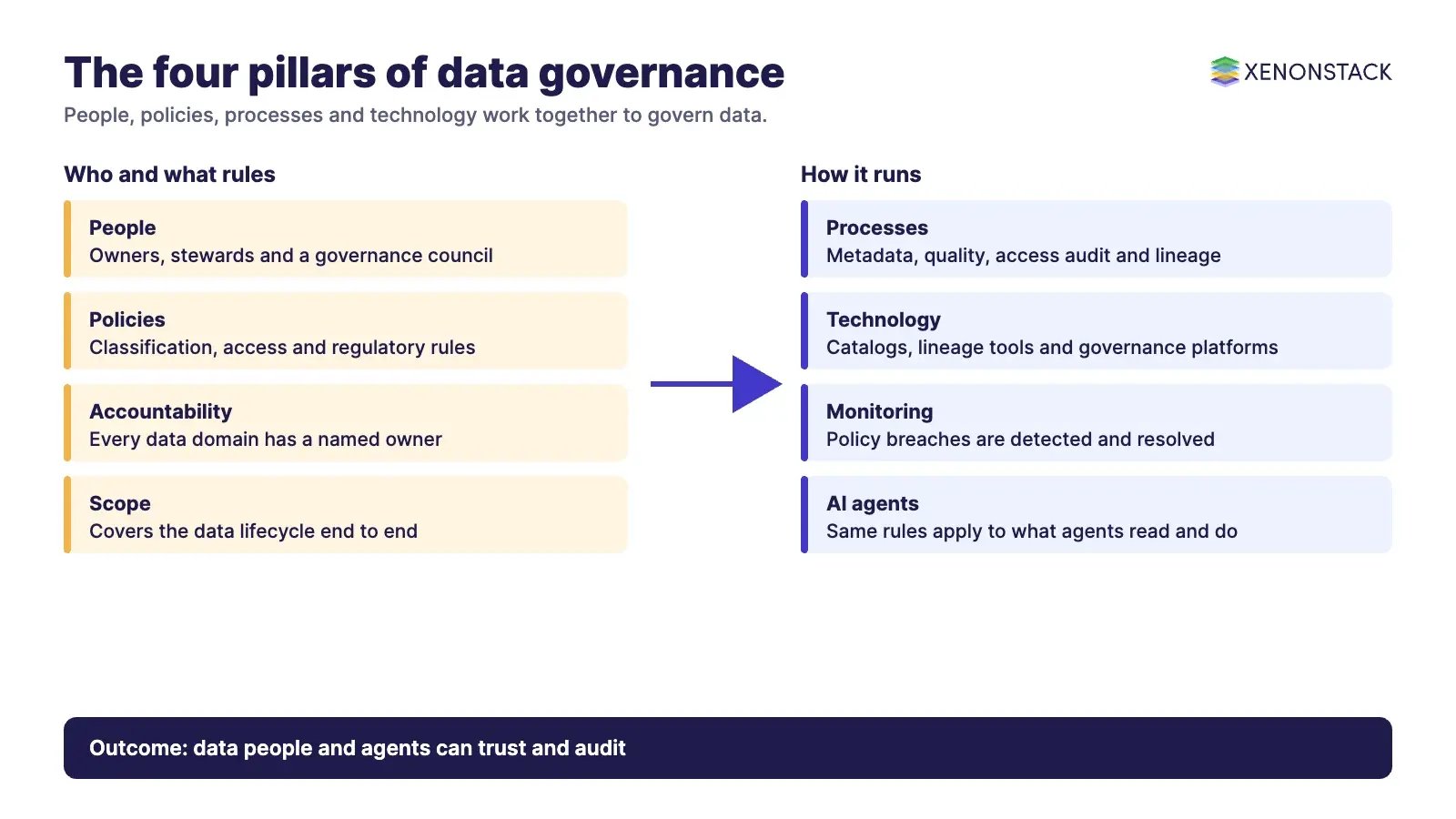
The Databricks glossary organises a framework into four pillars. The table adds our reading of what each one looks like day to day.
| Pillar | What it covers (per Databricks) | In practice |
|---|---|---|
| People | Data owners, data stewards, data architects and a governance council | Someone is accountable for every data domain |
| Policies | Rules for classification, access controls and regulatory requirements | Written, versioned and applied the same way everywhere |
| Processes | Metadata management, data quality work, access auditing and lineage tracking | Repeatable routines, not one-off clean-ups |
| Technology | Data catalogs, lineage tools, master data management and governance platforms | Tools make the rules visible and enforceable |
IBM adds a useful split of roles. Data owners oversee specific data domains across business units, while data stewards handle the daily management of those domains.
How is data governance different from data management?
IBM calls data governance "a subset of data management". Management is the wider practice of processing, storing and securing data. Governance decides the rules and accountability that this work must follow.
| Term | Main question it answers | How it relates to governance |
|---|---|---|
| Data governance | Who owns this data, and what rules apply to it? | Sets policy and accountability |
| Data management | How is data stored, moved and processed? | Carries out the work governance directs |
| Data quality | Does the data meet the standard we set? | A process that governance defines and checks |
| Metadata management | Is the data described and traceable? | A foundation for governance, see metadata management for agentic AI |
How does data governance apply to AI agents?
IBM says that knowing where data comes from, how sensitive it is and how it moves through its lifecycle is "the foundation for any AI governance practice". Once an AI agent reads and acts on enterprise data, governance has to answer new questions: which data the agent may see, which actions it may take and what record each decision leaves. For agent-specific controls, see AgentGRC AI governance. For the context layer these questions depend on, see ElixirData, XenonStack's Context OS.
What should you do first?
- Pick one high-value data domain and name its owner and steward.
- Write down the five or six policies that domain must follow, such as access, retention and quality.
- Record where the data comes from and who uses it, so lineage and impact are visible.
- Agree how breaches of policy are detected and who resolves them.
- Extend the same rules to any AI agent that reads or writes that domain.
To map one decision your agents make, and the data and policy it depends on, book a Context Workshop. See what happens in the workshop.
Frequently asked questions
What is data governance in simple terms?
Data governance is the set of roles, rules and processes that decide who is accountable for data and how it may be gathered, stored and used.
Who is responsible for data governance?
Usually a governance council or chief data officer sets policy, while data owners oversee their domains and data stewards handle daily management. IBM describes owners and stewards in these terms.
What are the four pillars of data governance?
The Databricks glossary names people, policies, processes and technology.
What is the difference between data governance and data management?
Data management is the wider practice of storing, moving and processing data. Data governance is a subset of it that sets the rules and accountability the rest must follow.
Why does data governance matter for AI?
AI systems act on data, so their outputs are only as trustworthy as the data's origin, sensitivity and handling. Governance gives teams that record and the rules to enforce.
Explore the XenonStack platform family: ElixirData · ElixirClaw · ElixirHub · NexaStack · MetaSecure · Neural AI · AgentGRC · AgentSRE · AgentAnalyst · AgentInstruct · AgentRAI · AgentScrum · AgentSearch · AgentForce · AI Aviator · SAIF Aviator · CohortIQ · XenonStack AI · XenonStack UAE