 Xenonstack Glossary
XenonStack GlossaryDecision-Driven Data Analytics: A Practical Guide
Key takeaway
- Decision-driven data analytics starts with the decision to be made, then works back to the data needed. See how it differs from data-driven analytics.
Decision-driven data analytics is an approach that starts from the decision that needs to be made and works backward toward the data needed to make it. It reverses the common habit of starting with the data you already hold and looking for something useful to say about it.
This page is for analytics leaders, data teams and business decision makers. It covers what the approach is, how it differs from data-driven analytics, the steps to follow, and how it applies when AI agents take part in decisions.
What is decision-driven data analytics?
Researchers writing in Knowledge at Wharton describe it as analysis that starts from the decision to be made and works backward toward the data that is needed. The first step is to clarify the decision itself, and the article says existing data should not be a consideration at that stage.
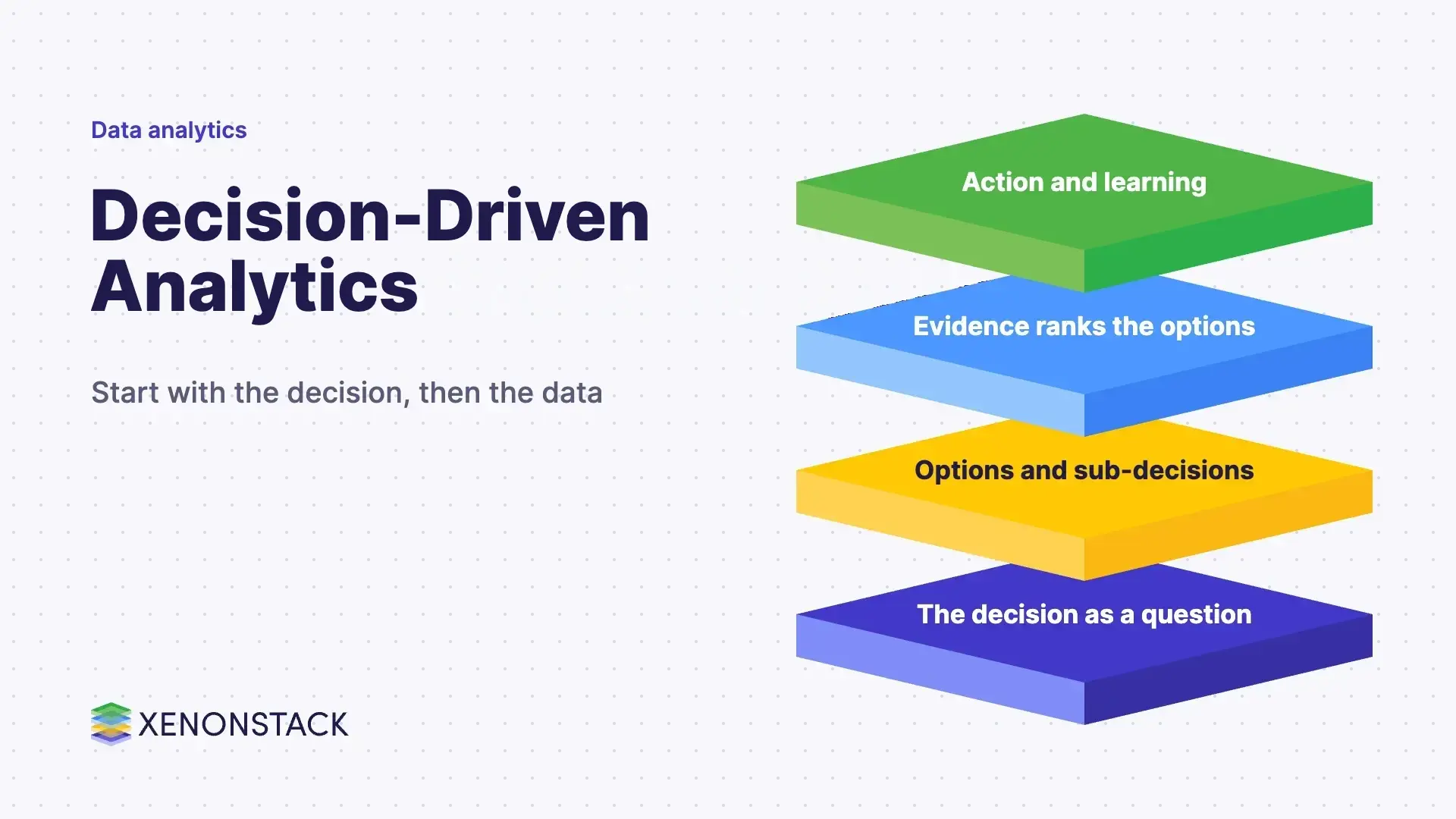
The idea is that analytics should serve a choice someone has to make. A decision is framed as a question, the possible actions are listed, and only then is it clear which data would help rank those actions.
Why does it matter?
When teams start from available data, they tend to answer the questions the data happens to support, which may not be the questions that matter. Starting from the decision ties analytical work to action, so an insight has a defined owner and a defined use.
The same article stresses that crafting the right questions is a foundational step in data analysis. It also notes that exploratory analysis and data mining still have value, but they serve a different goal.
How does decision-driven analytics work?
- Define the decision as a question. State what must be chosen and by whom.
- List the options. Keep to choices you can act on, and widen the set by asking colleagues for other views.
- Break it into sub-decisions. Consider each part independently where possible.
- Identify the data needed. Decide what evidence would rank the alternatives, then collect or analyse it.
- Act and learn. Apply the best option and record what happened.
The question type matters. A factual question predicts outcomes, while a counterfactual question compares outcomes with and without an intervention. The Wharton article gives an example: asking who is most likely to cancel does not show whom an incentive would actually work on, so a counterfactual question and a randomised experiment are needed.
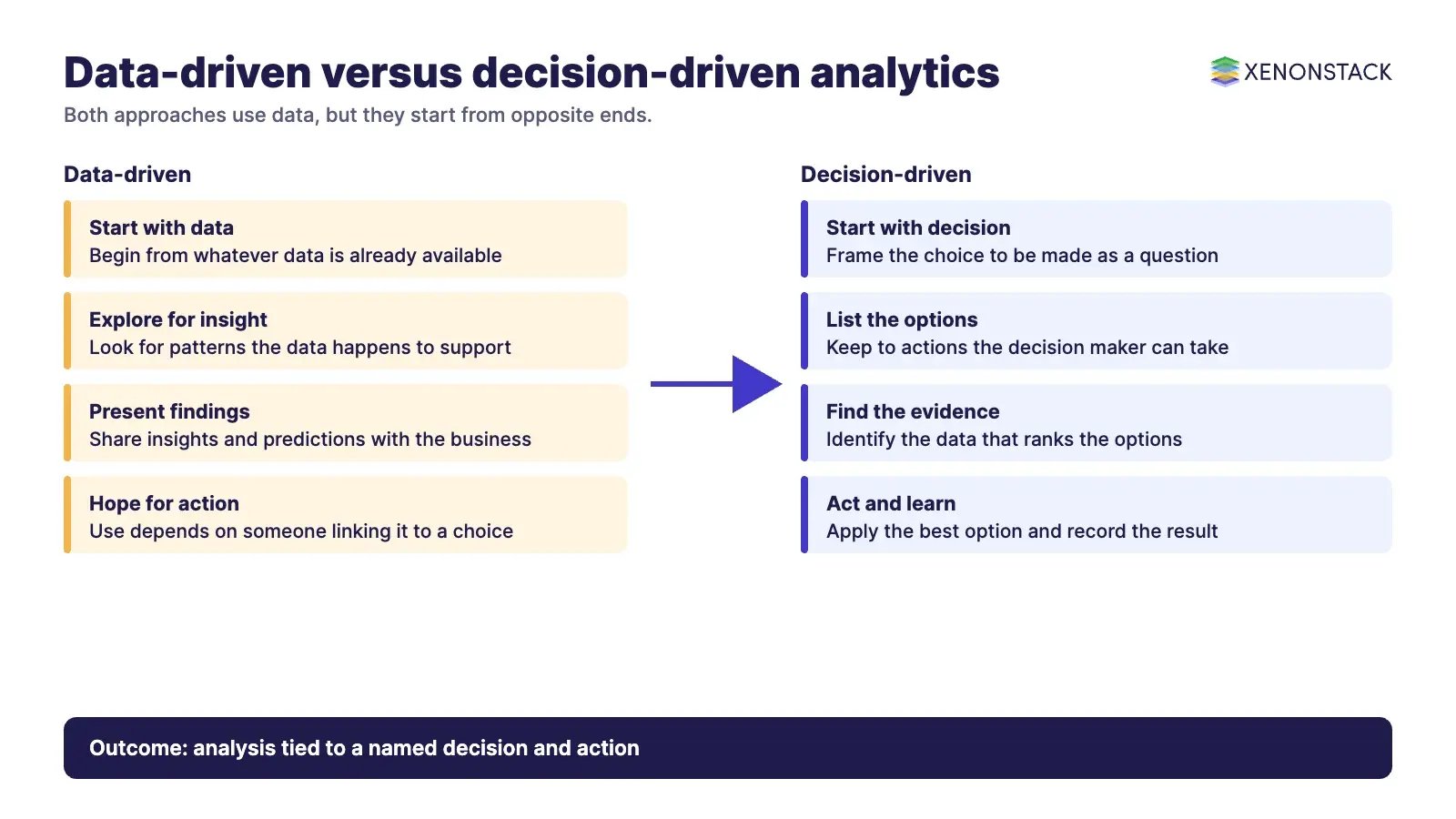
How does it differ from data-driven analytics?
| Aspect | Data-driven analytics | Decision-driven analytics |
|---|---|---|
| Starting point | The data that is available | The decision to be made |
| Typical question | What does this data tell us? | What should we do, and what evidence ranks the options? |
| Main output | Insights and predictions | A recommended action for a named decision |
| Risk | Answering the wrong question well | Missing patterns that exploration would reveal |
The two are complementary. Exploration can surface questions worth asking, and decision-driven analysis then focuses effort on the choices that matter.
How does it relate to AI agents?
AI agents increasingly make or recommend decisions, which makes it more important to know which decision is being made, what evidence it depends on and which policy applies. A decision-first view gives each agent a clear question to answer. ElixirData is XenonStack's Context OS.
What should you do first?
- Pick one recurring decision that matters to the business.
- Write it as a question with a named owner.
- List the options and the evidence that would separate them.
- Check which of that evidence you already hold and what is missing.
To map one decision your agents make, and the data and policy it depends on, book a Context Workshop. See what happens in the workshop.
Frequently asked questions
What is decision-driven data analytics?
It is an approach that starts from the decision that needs to be made and works backward toward the data needed to make it, rather than starting from the data that is available.
How is it different from data-driven analytics?
Data-driven analytics starts with available data and looks for insights. Decision-driven analytics starts with a defined decision and identifies the evidence needed to choose between options.
Why should existing data not shape the first step?
Starting from existing data raises the risk of asking the wrong kind of question. The first step is to clarify the decision, and data comes after that.
What is a counterfactual question?
It compares outcomes with and without an intervention. It helps show whether an action, such as an incentive, actually changes behaviour.
Does decision-driven analytics replace exploratory analysis?
No. Exploratory analysis and data mining still have value, but they serve a different goal from analysis built around a specific decision.
Explore the XenonStack platform family: ElixirData · ElixirClaw · ElixirHub · NexaStack · MetaSecure · Neural AI · AgentGRC · AgentSRE · AgentAnalyst · AgentInstruct · AgentRAI · AgentScrum · AgentSearch · AgentForce · AI Aviator · SAIF Aviator · CohortIQ · XenonStack AI · XenonStack UAE