 Xenonstack Glossary
XenonStack GlossaryWhat Is Digital Asset Management (DAM)?
Key takeaway
- Digital asset management (DAM) stores, organises and governs images, video and documents in one library. See its components, benefits and AI role.
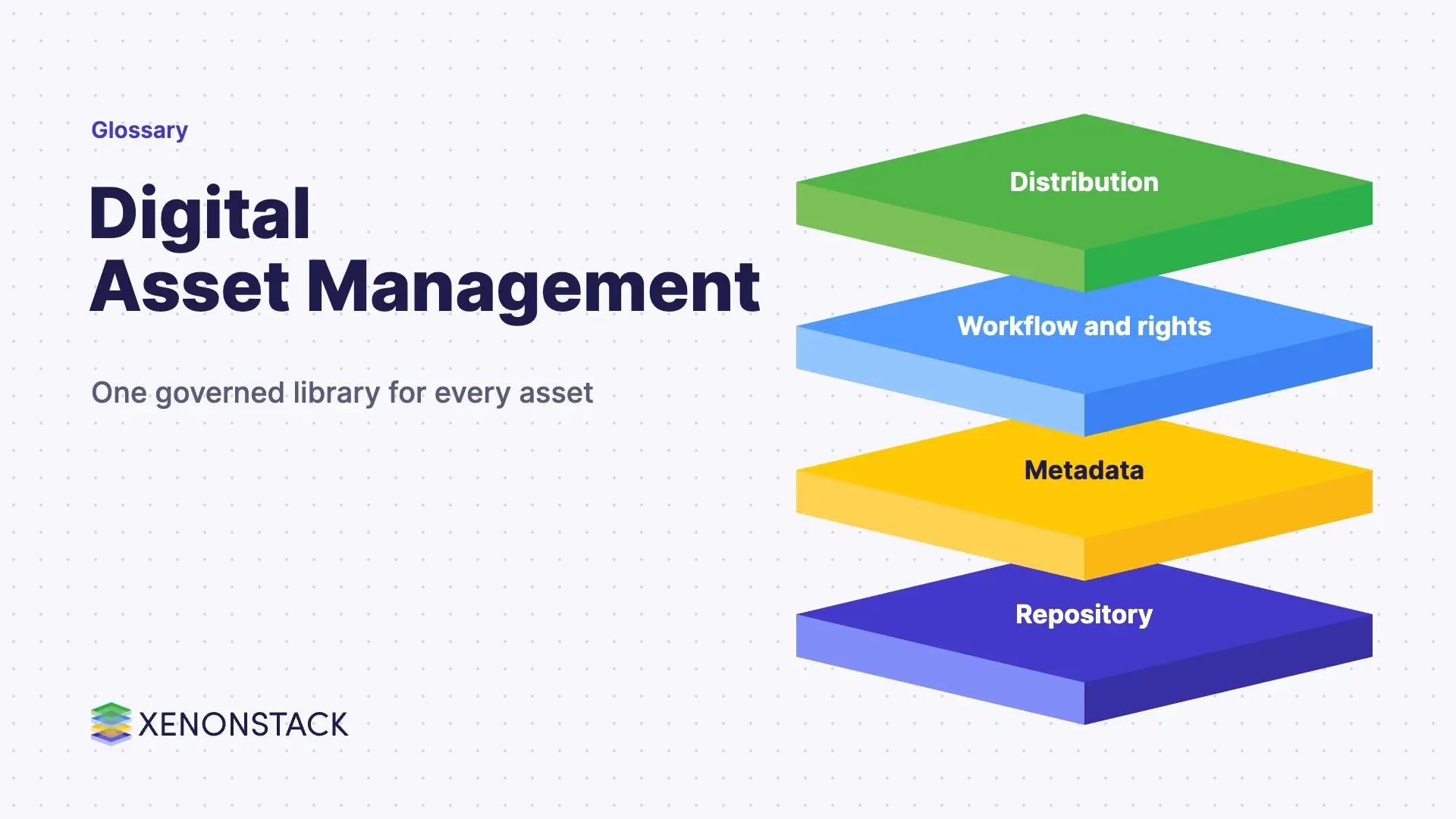
Digital asset management (DAM) is a system and discipline for storing, organising, securing and distributing an organisation's digital assets, such as images, video, audio, documents and presentations, in one governed library. It gives teams a single source of truth so the right, approved file reaches the right channel with its usage rights intact.
What is digital asset management?
DAM combines software, metadata and workflow. Each asset is stored once, tagged with descriptive and rights information, and made searchable. Instead of files scattered across inboxes, shared drives and personal laptops, leaders gain one place where assets can be found, approved, reused and retired.
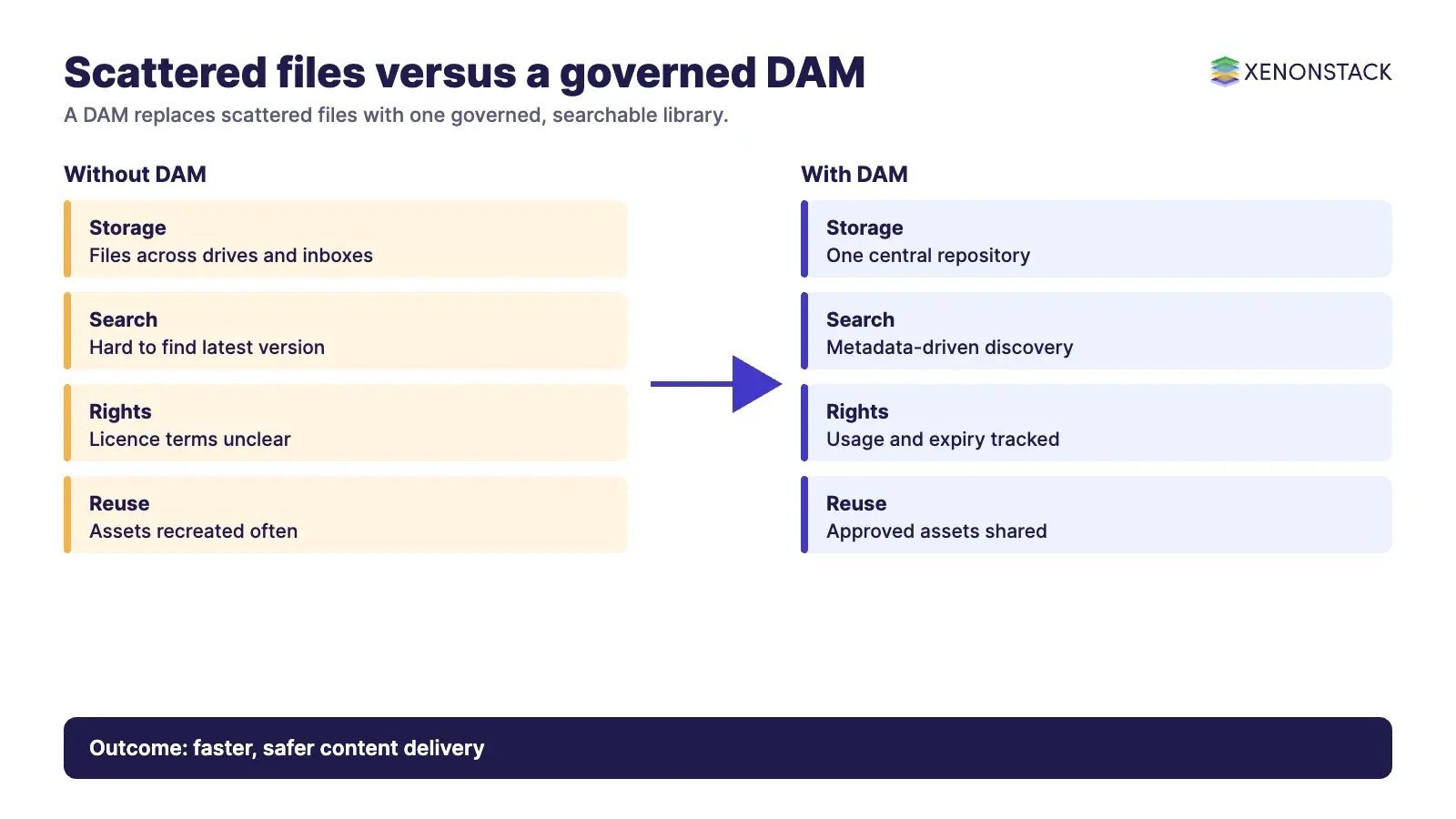
For executives, the value is control and speed: fewer duplicated files, less brand and licensing risk, and faster campaign and product delivery.
What are the core components of a DAM system?
| Component | What it does | Why it matters |
|---|---|---|
| Central repository | Holds every approved asset and its versions | One source of truth |
| Metadata and taxonomy | Describes content, owner, rights and expiry | Fast, reliable search |
| Workflow and approvals | Routes assets through review and sign-off | Consistent quality and compliance |
| Access and rights control | Sets who can view, edit and publish | Reduced licensing and security risk |
| Distribution and integration | Delivers assets to web, social and internal tools | Faster time to market |
How does DAM benefit different industries?
The same principles apply across functions, with different assets at the centre.
- HR and recruitment: employee records, benefit documents, hiring requisitions, leave requests and payroll receipts held under strict access control.
- Retail and procurement: vendor contact details, invoices and product specifications kept current and easy to retrieve.
- Construction and manufacturing: proprietary product designs, development plans and planning materials protected and versioned.
- Sales and marketing: brand assets maintained and reused consistently across the organisation.
When should an organisation invest in DAM?
Invest when teams struggle to find the latest file, when the same asset is recreated repeatedly, when licensing or brand errors appear, or when AI initiatives need trustworthy content. A phased rollout, starting with one asset class and a small metadata model, usually delivers value soonest.
How does DAM connect to metadata and AI agents?
A DAM is only as useful as its metadata. The same discipline behind a data catalog applies here, and our guide to metadata management explains how to keep that context accurate. As enterprises deploy AI agents, they need governed context to choose approved assets and justify the choice. ElixirData provides governed context and metadata for enterprise AI agents, so assets, rights and decisions stay traceable.
To see how this applies to your estate, join a Context Workshop with our team.
FAQ
What is digital asset management in simple terms?
Digital asset management is a system that stores, organises, secures and distributes an organisation's digital files, such as images, video, audio and documents, in one governed library. Teams find the approved version quickly and reuse it with confidence.
What is the difference between DAM and a data catalog?
A DAM governs creative and media files, while a data catalog describes structured datasets and their lineage. Both rely on good metadata, and many enterprises connect them so that people and AI agents see one consistent view of what the business owns.
Which teams benefit most from a DAM?
Marketing, sales, HR, procurement, product design and manufacturing teams benefit most. Any function that creates, approves and reuses files across channels gains from a single source of truth and clear usage rights.
How does DAM support AI and agents?
Rich metadata, rights information and version history give AI agents the context they need to pick an approved asset and explain why. Without that context, agents may reuse outdated or unlicensed material.
How should an organisation start with DAM?
Start with one high-value asset class, define a simple metadata model and ownership rules, then migrate and measure search success and reuse. Expand to further teams once the taxonomy proves itself.
Explore the XenonStack platform family: ElixirData · ElixirClaw · ElixirHub · NexaStack · MetaSecure · Neural AI · AgentGRC · AgentSRE · AgentAnalyst · AgentInstruct · AgentRAI · AgentScrum · AgentSearch · AgentForce · AI Aviator · SAIF Aviator · CohortIQ · XenonStack AI · XenonStack UAE