What are your key focus areas? *
AI Workflow and Operations
Data Management and Operations
AI Governance
Analytics and Insights
Observability
Security Operations
Risk and Compliance
Procurement and Supply Chain
Private Cloud AI
Vision AI

Get Started with your requirements and primary focus, that will help us to make your solution
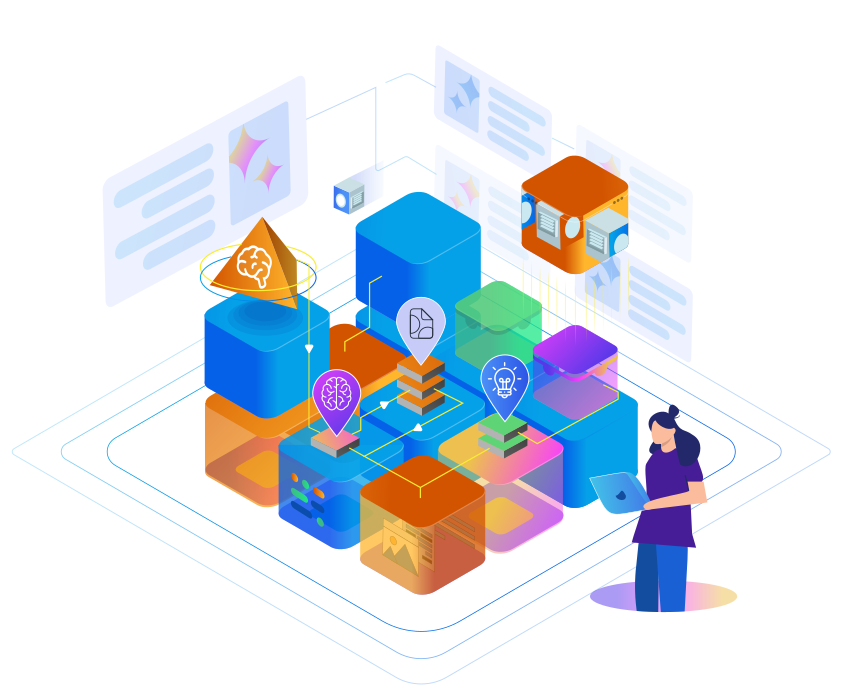
Agentic AI transforms enterprise technology by integrating self-operating, decision-driven AI agents across the infrastructure. These agents interact with business platforms, monitor digital ecosystems, and autonomously adapt systems to ensure efficiency, resilience, and innovation
Self-learning agents proactively identify system anomalies, resolve issues before they escalate, and continuously refine infrastructure performance
AI agents dynamically orchestrate business processes, understand context, and optimize task execution across departments without manual input
AI agents govern data flow across silos, ensure compliance, and automatically resolve inconsistencies for enterprise-wide data reliability
Agents anticipate disruptions and autonomously reconfigure systems to maintain business continuity with minimal downtime
Redefine your enterprise technology stack with XenonStack’s agentic AI-powered digital transformation services designed to increase autonomy and intelligence across business systems

Autonomous agents manage compute, storage, and network resources, ensuring optimal utilization and reducing human dependency in IT operations

Task-specific AI agents streamline cross-functional operations, from HR to Finance, driving consistency and speed through context-aware execution

Security agents automatically detect, respond to, and neutralize threats—building enterprise trust with embedded compliance and governance layers
Collaborative AI agents simulate decision paths across business functions to identify optimal outcomes, accelerate strategic planning, and reduce risk
Enterprise automation networks expand from RPA to agentic orchestration—adapting to business process changes in real time, without reprogramming
AI agents autonomously capture, curate, and redistribute organizational knowledge—fueling innovation and reducing onboarding time
Multi-agent systems collaborate to simulate outcomes, recommend actions, and autonomously execute workflows that drive enterprise-wide efficiency and innovation
Discover More


Build scalable data lakes where agents handle data ingestion, schema evolution, and storage optimization across structured, semi-structured, and unstructured formats
Discover More
AI-driven agents reverse-engineer monolithic applications, identify modular components, and propose microservice-based architectures for performance and scalability
Discover More
Automate infrastructure provisioning using Terraform and GitOps, with agents validating templates, tracking drift, and remediating inconsistencies across cloud services

Accelerate product and feature delivery by enabling agile development, faster experimentation, and quicker go-to-market timelines
Design fault-tolerant and scalable systems that maintain performance and availability under high load or unexpected disruptions
Reduce IT overhead by modernizing infrastructure, automating workflows, and streamlining operations for maximum resource efficiency
Safeguard enterprise systems and customer data through robust security architectures, compliance measures, and proactive threat detection
Build scalable architectures that support emerging technologies, AI integration, and evolving business needs with long-term flexibility
AI agents run enterprise IT and business systems with less manual work. Predictive operations intelligence detects anomalies early, cognitive process automation orchestrates cross-department workflows, data fabric intelligence governs data flow and consistency across silos, and adaptive system resilience anticipates disruptions and reconfigures systems to limit downtime.
Hyper-automation extends from robotic process automation to agentic orchestration, so workflows move from fixed scripts to agents that coordinate work across departments. Enterprise workflow intelligence and multi-agent decision orchestration sit alongside this, supporting operational decisions with agents rather than manual hand-offs between teams.
Autonomous legacy application refactoring moves applications toward microservices, and infrastructure-as-code automation uses Terraform and GitOps. IT infrastructure management services complement this, with agents refining infrastructure performance and detecting anomalies early, helping IT leaders reduce manual effort in maintaining and evolving technology estates.
Agent-enabled data lake architectures and data fabric intelligence help govern data flow and consistency across silos. Enterprise knowledge management is offered as a service, and agentic operational decision support can draw on that data, so teams can find information and make decisions from a more consistent foundation.
Adaptive system resilience has agents anticipate disruptions and reconfigure systems to limit downtime. Predictive operations intelligence supports this by detecting anomalies early and refining infrastructure performance. Data security frameworks form part of the service portfolio, so resilience and security sit within the same agent-led operating model.
Explore how enterprises are automating AI pipelines, workflows, and decision systems using agent-based architecture. Learn how AI agents accelerate system performance, automate repetitive tasks, and provide continuous learning for enterprise-wide optimization
Explore Further

Discover how Agentic Process Automation empowers IT leaders to orchestrate intelligent workflows, integrate system intelligence, and transform operations. Unlock the next level of scalability, governance, and innovation across your enterprise technology stack
Explore Further
AI continuously monitors systems for risks before they escalate. It correlates signals across logs, metrics, and traces. This ensures faster detection, fewer incidents, and stronger reliability
 Proactive detection of performance and availability issues
 Root-cause analysis across microservices and environments
 Automated remediation playbooks to reduce MTTR

AI converts camera feeds into instant situational awareness. It detects unusual motion and unsafe behavior in real time. Long hours of video become searchable and summarized instantly
 Real-time detection of suspicious motion or intrusion
 Natural language video search and instant playback
 Smart summaries for audits, investigations, and compliance

Your data stack becomes intelligent and conversational. Agents surface insights, detect anomalies, and explain trends. Move from dashboards to autonomous, always-on analytics
 Connects to warehouses, lakes, and streaming sources
 Question-answering in natural language
 Continuous monitoring for anomalies and KPI deviations

Agents identify recurring failures and performance issues. They trigger workflows that resolve common problems automatically. Your infrastructure evolves into a self-healing environment
 Automated diagnostics for recurring errors
 Playbook execution: restart services, scale pods, clear queues
 Feedback loop for improving remediation strategies

AI continuously checks controls and compliance posture. It detects misconfigurations and risks before they escalate. Evidence collection becomes automatic and audit-ready
 Continuous control checks across infrastructure and SaaS
 Automated evidence collection for audits
 Risk scoring and prioritized remediation recommendations

Financial and procurement workflows become proactive and insight-driven. Agents monitor spend, vendors, and contracts in real time. Approvals and sourcing decisions become faster and smarter
 Real-time visibility into spend and commitments
 Anomaly detection on invoices and vendor performance
 Intelligent workflows for approvals and sourcing decisions


