 Xenonstack Glossary
What are your key focus areas? *
AI Workflow and Operations
Data Management and Operations
AI Governance
Analytics and Insights
Observability
Security Operations
Risk and Compliance
Procurement and Supply Chain
Private Cloud AI
Vision AI

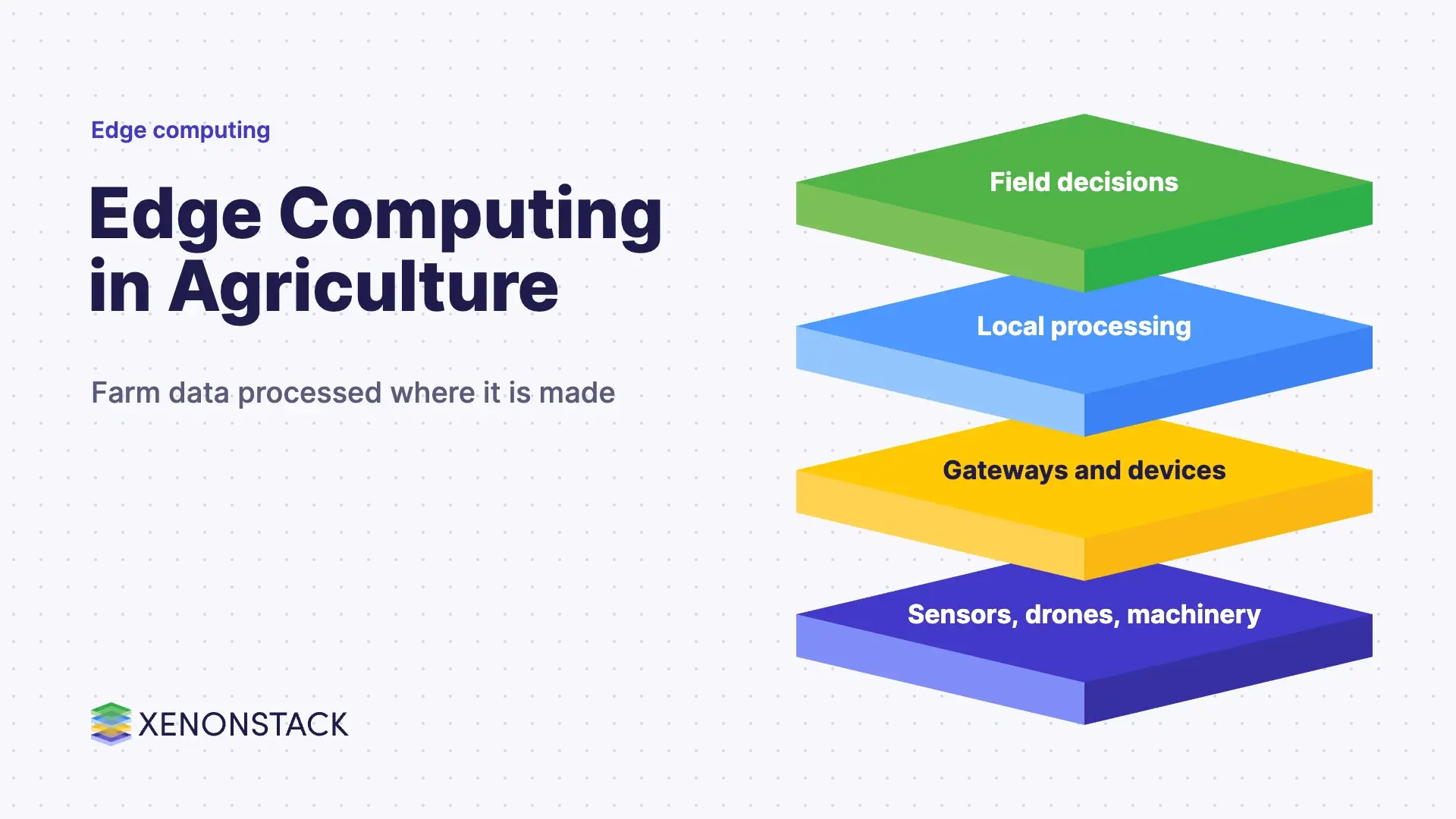
Edge computing in agriculture means processing farm data on or near the field, using devices such as sensors, drones, gateways and machinery, instead of sending everything to a distant data centre first. It lets decisions about soil, crops and livestock continue when the network is slow or absent.
This page is for agribusiness leaders, farm technology teams and architects. It covers why farms suit edge computing, the main use cases, the limits to plan for, and what to settle first.
Farmland is often remote, without high-speed bandwidth, without suitable resources to handle data, and sometimes with limited training in current practice. IBM describes edge computing as a distributed framework that brings applications closer to data sources, and notes that sending all device data to a central site creates bandwidth and latency issues. It also says edge AI devices can function offline, which matters on remote sites. The FCC precision agriculture report calls connectivity the enabling fabric of precision agriculture, says access to that infrastructure is not readily available in rural America, and recommends that edge compute infrastructure and private 5G systems be eligible for federal broadband funding.
Each use case below pairs a farm input with a decision that benefits from local processing. For the wider method, see our guide to Edge Analytics and to AI Solutions on Edge.
| Use case | What happens at the edge | Example input |
|---|---|---|
| Soil quality | Check moisture and condition on a mobile device at the farm location | Soil colour and moisture readings |
| Livestock health | Track temperature, heart rate and other signals to flag health conditions | Sensor tags on animals |
| Crop and leaf health | Spot signs of insects, pests or rodents from leaf colour and pores | Drone images |
| Disaster protection | Make informed decisions about environmental hazards or natural disasters | Agriculture IoT sensors |
| Satellite imagery | Analyse geo-spatial data for crop distribution patterns and weather impact | Satellite images |
| Predictive analytics | Support seasonal analysis, market scenarios and cost optimisation | Historical and live farm data |
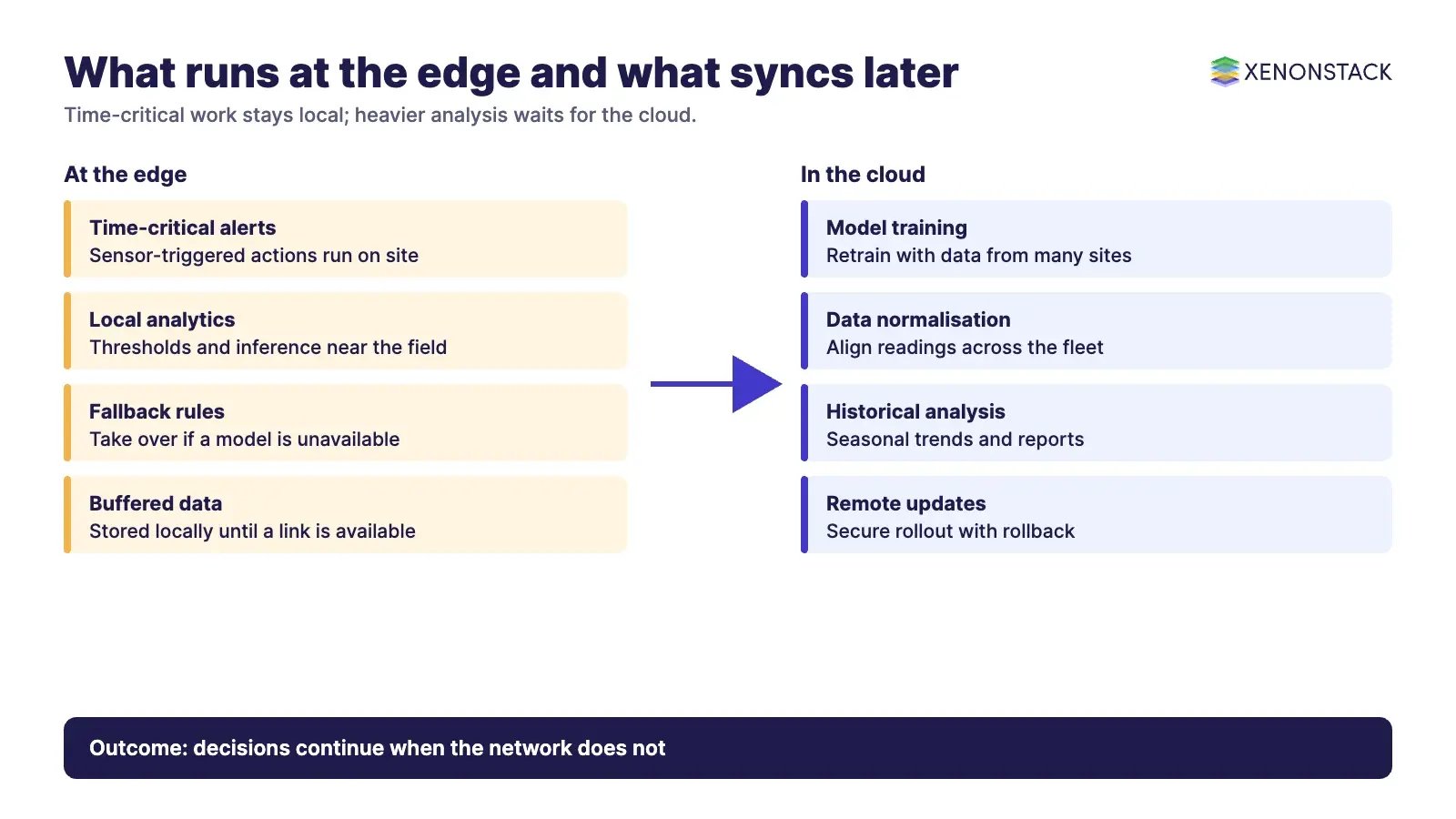
Spyrosoft argues that the edge should own time-critical execution, such as alerts and sensor-triggered actions, and gives a frost alarm that should not wait for a cloud round trip. Fallback rules should take over if a model is unavailable, and the node should synchronise when it can. Model training, fleet-wide data normalisation and historical analysis suit the cloud. Send summaries and events, not raw streams, where you can.
| Limit | What to plan |
|---|---|
| Power | Sending less data preserves battery life |
| Hardware | Agricultural hardware has thermal, power and memory constraints, so size models for the production device |
| Updates | Plan secure remote updates and rollback |
| Sync conflicts | Define precedence rules and audit trails before offline edits collide |
| Testing | Test under weak connectivity and long offline windows, not only on stable office Wi-Fi |
Agents on a farm act on readings from many devices. Each action depends on which data was current, which was delayed and which rule applied. ElixirData is XenonStack's Context OS.
To map one farm decision your agents make, and the data and policy it depends on, book a Context Workshop. See what happens in the workshop.
Edge computing in agriculture means processing data from sensors, drones and machinery on or near the farm instead of sending all of it to a distant data centre first.
Farms are often remote with limited bandwidth, and edge devices can process data locally and keep working offline, so decisions do not wait for a network round trip.
Examples include checking soil moisture on a mobile device, tracking livestock health with sensor tags, and analysing drone images of crop leaves for signs of pests.
Agricultural hardware has thermal, power and memory constraints, and teams must plan for secure remote updates, sync conflicts and testing under weak connectivity.
Explore the XenonStack platform family: ElixirData · ElixirClaw · ElixirHub · NexaStack · MetaSecure · Neural AI · AgentGRC · AgentSRE · AgentAnalyst · AgentInstruct · AgentRAI · AgentScrum · AgentSearch · AgentForce · AI Aviator · SAIF Aviator · CohortIQ · XenonStack AI · XenonStack UAE
Tell us about you and your priorities so we can prepare the right conversation. It takes about 2 minutes.
AI continuously monitors systems for risks before they escalate. It correlates signals across logs, metrics, and traces. This ensures faster detection, fewer incidents, and stronger reliability
 Proactive detection of performance and availability issues
 Root-cause analysis across microservices and environments
 Automated remediation playbooks to reduce MTTR

AI converts camera feeds into instant situational awareness. It detects unusual motion and unsafe behavior in real time. Long hours of video become searchable and summarized instantly
 Real-time detection of suspicious motion or intrusion
 Natural language video search and instant playback
 Smart summaries for audits, investigations, and compliance

Your data stack becomes intelligent and conversational. Agents surface insights, detect anomalies, and explain trends. Move from dashboards to autonomous, always-on analytics
 Connects to warehouses, lakes, and streaming sources
 Question-answering in natural language
 Continuous monitoring for anomalies and KPI deviations

Agents identify recurring failures and performance issues. They trigger workflows that resolve common problems automatically. Your infrastructure evolves into a self-healing environment
 Automated diagnostics for recurring errors
 Playbook execution: restart services, scale pods, clear queues
 Feedback loop for improving remediation strategies

AI continuously checks controls and compliance posture. It detects misconfigurations and risks before they escalate. Evidence collection becomes automatic and audit-ready
 Continuous control checks across infrastructure and SaaS
 Automated evidence collection for audits
 Risk scoring and prioritized remediation recommendations

Financial and procurement workflows become proactive and insight-driven. Agents monitor spend, vendors, and contracts in real time. Approvals and sourcing decisions become faster and smarter
 Real-time visibility into spend and commitments
 Anomaly detection on invoices and vendor performance
 Intelligent workflows for approvals and sourcing decisions


