 Xenonstack Glossary
XenonStack GlossaryApache Spark: Architecture, Components and Uses
Key takeaway
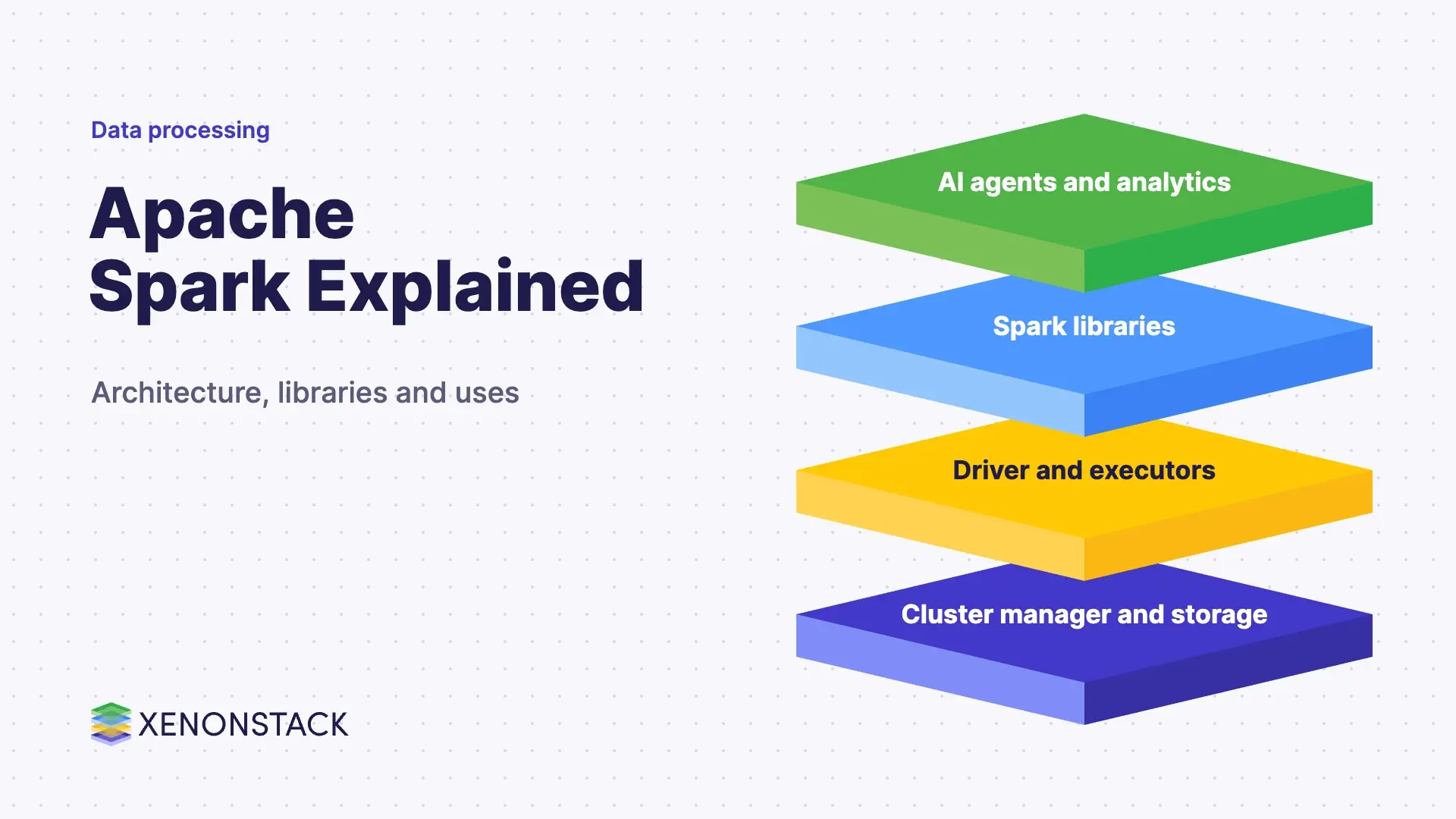
- Apache Spark is a multi-language engine for large-scale data processing. See how its driver, executors and libraries work, and how it feeds AI agents.
Apache Spark is an open-source, multi-language engine for executing data engineering, data science and machine learning on single machines or clusters. The Apache Spark website describes it as a unified engine for large-scale data analytics, with one API surface for batch and streaming work.
This page is for data engineers, architects and analytics leaders who need a clear picture of how Spark runs a job and where it fits in a data platform. It covers the architecture, the core libraries, how Spark differs from neighbouring terms, and how it relates to AI agents.
What is Apache Spark used for?
According to the Apache Spark website, Spark lets you unify the processing of data in batches and in real-time streaming, using Python, SQL, Scala, Java or R. The same page lists four typical uses: batch and streaming pipelines, distributed SQL analytics for dashboards and ad-hoc reporting, exploratory data analysis on very large datasets, and training machine learning algorithms that scale from a laptop to a cluster using the same code.
How does Spark run a job?
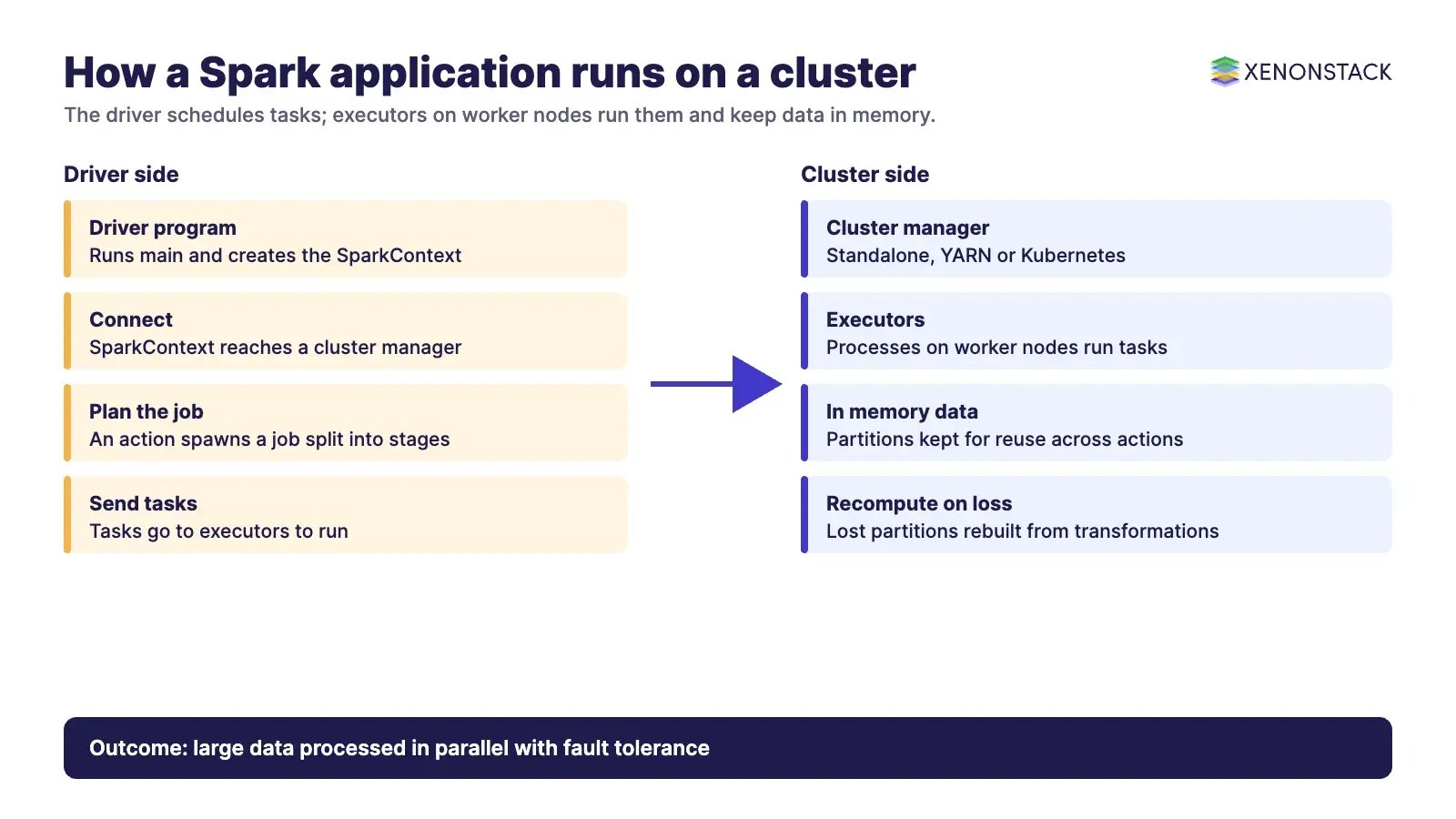
The Spark cluster mode overview explains that a Spark application is coordinated by the SparkContext object in the main program, called the driver program. The driver connects to a cluster manager, acquires executors on worker nodes, sends the application code and then sends tasks to those executors to run.
| Part | What it does |
|---|---|
| Driver program | Runs the main function of the application and creates the SparkContext; schedules tasks on the cluster |
| Cluster manager | An external service for acquiring resources; Spark supports Standalone, Hadoop YARN and Kubernetes |
| Executor | A process on a worker node that runs tasks and keeps data in memory or disk storage; each application has its own executors |
| Task | The unit of work sent to one executor |
| Job and stage | A job is a parallel computation spawned by a Spark action; each job is divided into stages of tasks that depend on each other |
The same page notes that data cannot be shared across different Spark applications without writing it to an external storage system.
What are the core Spark libraries?
The Apache Spark website lists SQL and DataFrames, Spark Connect, Spark Streaming, pandas on Spark and MLlib for machine learning. It marks GraphX as deprecated.
Underneath, the RDD programming guide describes a resilient distributed dataset (RDD) as a fault-tolerant collection of elements partitioned across the nodes of a cluster and operated on in parallel. Transformations are lazy: they are only computed when an action needs a result. Persisting a dataset keeps its partitions in memory for reuse, and a lost partition is recomputed from the transformations that created it.
How is Spark different from related terms?
| Term | What it is | How it relates to Spark |
|---|---|---|
| Spark | A distributed processing engine | Executes the computation: SQL, streaming, machine learning |
| Cluster manager | Allocates machines and resources | Spark runs on it and is agnostic to which one is used |
| Storage system | Holds data between applications | Spark reads and writes it; data shared between applications must be written to it |
| Data platform | The governed estate around the engine | Decides which data Spark may use and who may see the output |
Spark answers how to compute. It does not decide which data is trusted, who owns it or which policy applies. Those questions belong to the data platform around it.
How does Apache Spark relate to AI agents?
Agents act on data that pipelines have already shaped. A Spark job that cleans, joins and aggregates events decides what an agent will later see, so the lineage, ownership and policy attached to that output become part of every decision the agent makes. ElixirData is XenonStack's Context OS, the product to read about when you map the data and policy behind an agent decision.
What should you do first when adopting Spark?
- Name the workloads: batch, streaming, SQL analytics or machine learning, and pick the library for each.
- Choose a cluster manager your platform team already runs: Standalone, YARN or Kubernetes.
- Decide where prepared data is written so other applications can reuse it.
- Record ownership and quality rules for each output dataset before agents or dashboards consume it.
To map one decision your agents make, and the data and policy it depends on, book a Context Workshop. See what happens in the workshop.
Frequently asked questions
What is Apache Spark in simple terms?
Apache Spark is an open-source engine that processes large amounts of data in parallel across many machines. It supports batch jobs, streaming, SQL queries and machine learning from one platform.
Which languages does Spark support?
According to the Apache Spark website, Spark supports Python, SQL, Scala, Java and R.
What are the main parts of a Spark application?
A driver program creates the SparkContext and schedules tasks. A cluster manager provides resources, and executors on worker nodes run the tasks and keep data in memory or on disk.
Does Spark replace a data warehouse?
Not by definition. Spark is a processing engine, while a warehouse is a storage and query system. Many platforms use both, and the choice depends on workloads, cost and governance needs.
How does Spark fit with AI agents?
Spark prepares and transforms the data that agents consume. The quality, lineage and policy attached to that data shape what an agent can do, so they should be settled before agents rely on it.
Explore the XenonStack platform family: ElixirData · ElixirClaw · ElixirHub · NexaStack · MetaSecure · Neural AI · AgentGRC · AgentSRE · AgentAnalyst · AgentInstruct · AgentRAI · AgentScrum · AgentSearch · AgentForce · AI Aviator · SAIF Aviator · CohortIQ · XenonStack AI · XenonStack UAE