 Xenonstack Glossary
What are your key focus areas? *
AI Workflow and Operations
Data Management and Operations
AI Governance
Analytics and Insights
Observability
Security Operations
Risk and Compliance
Procurement and Supply Chain
Private Cloud AI
Vision AI

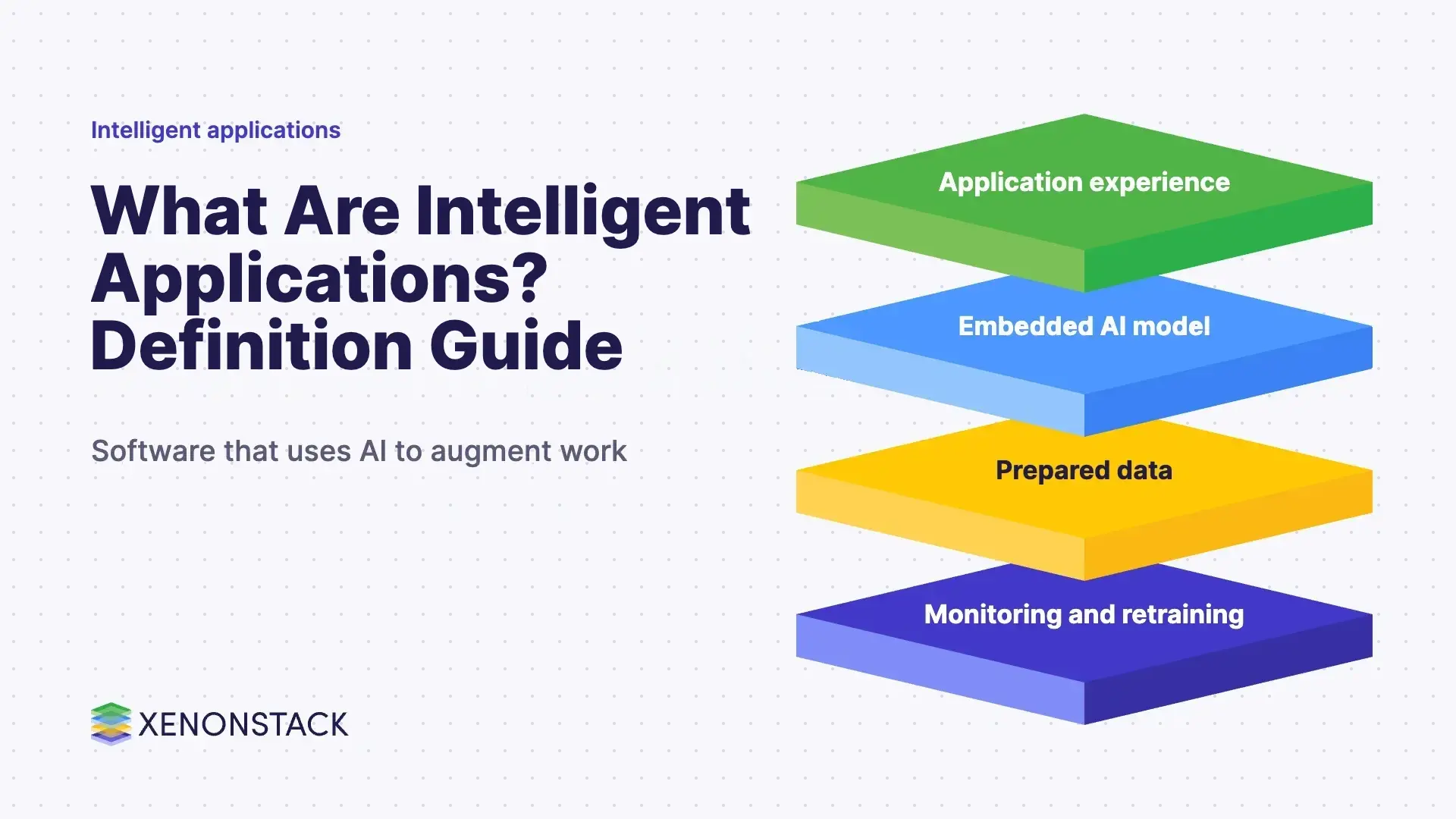
Intelligent applications are software applications that incorporate artificial intelligence to augment a human workflow, using data and models to solve a specific business problem. They are also known as AI-powered or smart applications, and they can answer questions that their developers did not explicitly program.
This page is for product, data and engineering leaders. It covers what intelligent applications are, how they differ from traditional software, how they are built and how they relate to AI agents.
Red Hat describes intelligent applications as "software applications that incorporate artificial intelligence (AI) to augment a human workflow." They apply AI to a specific business problem and use data to solve it.
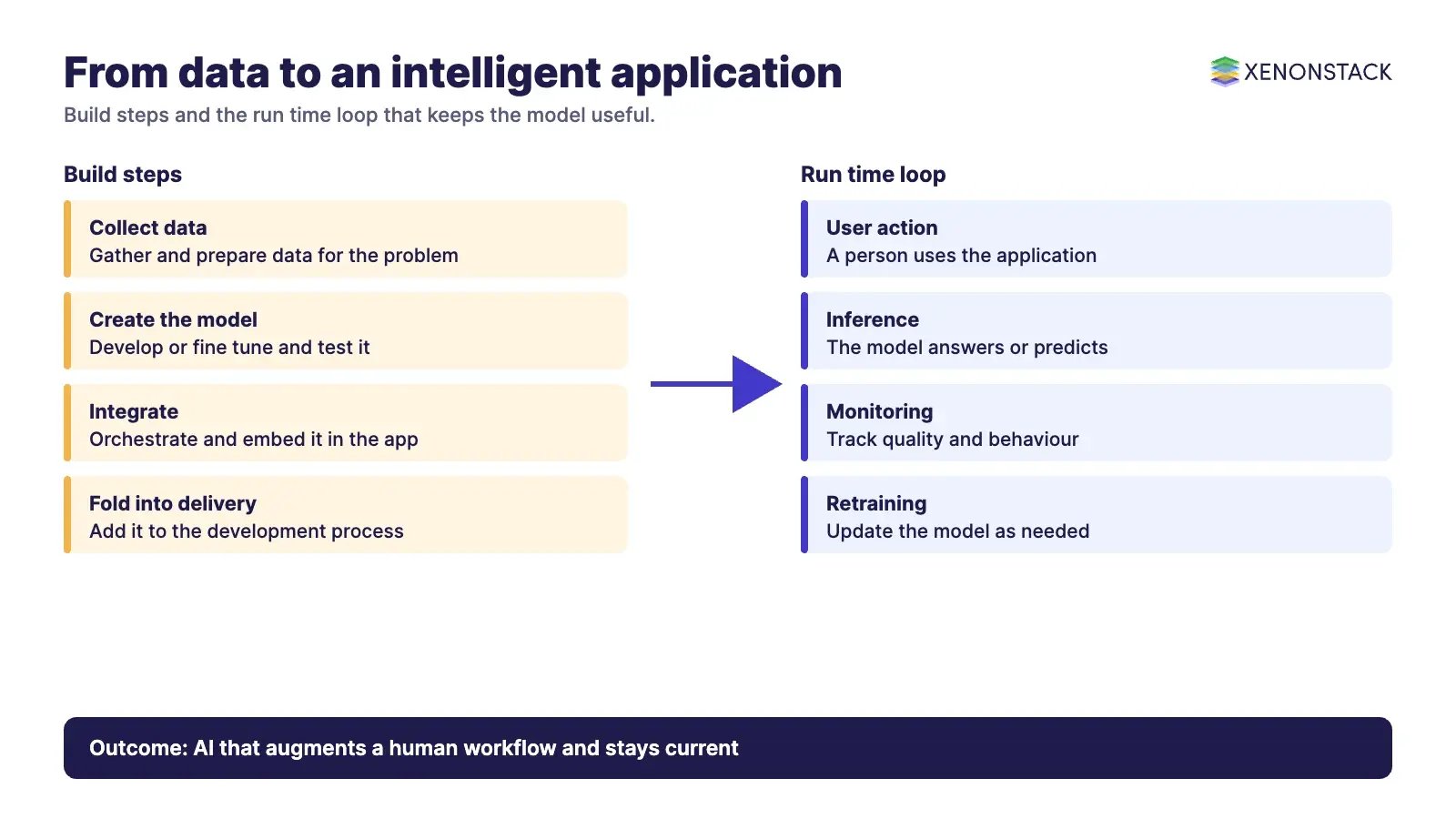
They are also called AI-powered or smart applications. The AI techniques inside, such as machine learning, natural language processing and computer vision, supply the capabilities that a user sees as recommendations, predictions, chat or automation.
According to Red Hat, traditional applications rely on rule-based logic, while intelligent applications can answer questions they were not specifically programmed for, which it calls AI inference. They can also learn from new information and user interactions, improving accuracy over time and adapting to changing conditions.
| Question | Traditional application | Intelligent application |
|---|---|---|
| How does it decide? | Fixed, rule-based logic | Model inference, often combined with rules |
| Can it handle unplanned questions? | Only those the code anticipates | Yes, within what the model has learned |
| Does it improve with use? | Only when developers change the code | It can learn from new data and interactions |
| What does it need to run? | Code and a database | Code, data, a trained model and monitoring |
Red Hat lists five steps, and each one is a place where projects stall.
Red Hat also names the main challenges: data quality, testing for responsible behaviour, MLOps practices that keep data scientists, engineers and IT teams aligned, and the complexity of AI environments. It notes that cloud-native methods such as microservices, serverless architecture and DevOps can help bring these applications to users.
Common domains include healthcare diagnosis support, logistics and demand prediction, smart city infrastructure and personalised education. The pattern is the same in each: data feeds a model, the model supports a decision, and the application puts that decision in front of a person at the right moment. Treat any claim of measured gains in these fields with care unless it names its source and method.
An intelligent application usually helps a person act. An AI agent goes a step further and takes actions in a workflow, calling tools and other systems towards a goal. The two share the same needs: reliable data, tested models, monitoring and clear ownership of decisions. ElixirClaw, the AI agents computing platform from XenonStack, is the related product page for teams moving from AI features to agents.
To map one decision your agents make, and the data and policy it depends on, book a Context Workshop. See what happens in the workshop.
Intelligent applications are software applications that incorporate AI to augment a human workflow, using data to solve a specific business problem.
A traditional application relies on rule-based logic. An intelligent application can answer questions it was not specifically programmed for and can learn from new data and interactions.
Machine learning, natural language processing and computer vision are common choices, delivered through models that are integrated into the application.
Data quality, testing for responsible behaviour, aligning data science, engineering and IT teams through MLOps, and the complexity of AI environments.
No. An intelligent application augments a human workflow, while an AI agent takes actions in a workflow towards a goal. Many agents are built on the same models and data practices.
Explore the XenonStack platform family: ElixirData · ElixirClaw · ElixirHub · NexaStack · MetaSecure · Neural AI · AgentGRC · AgentSRE · AgentAnalyst · AgentInstruct · AgentRAI · AgentScrum · AgentSearch · AgentForce · AI Aviator · SAIF Aviator · CohortIQ · XenonStack AI · XenonStack UAE
Tell us about you and your priorities so we can prepare the right conversation. It takes about 2 minutes.
AI continuously monitors systems for risks before they escalate. It correlates signals across logs, metrics, and traces. This ensures faster detection, fewer incidents, and stronger reliability
 Proactive detection of performance and availability issues
 Root-cause analysis across microservices and environments
 Automated remediation playbooks to reduce MTTR

AI converts camera feeds into instant situational awareness. It detects unusual motion and unsafe behavior in real time. Long hours of video become searchable and summarized instantly
 Real-time detection of suspicious motion or intrusion
 Natural language video search and instant playback
 Smart summaries for audits, investigations, and compliance

Your data stack becomes intelligent and conversational. Agents surface insights, detect anomalies, and explain trends. Move from dashboards to autonomous, always-on analytics
 Connects to warehouses, lakes, and streaming sources
 Question-answering in natural language
 Continuous monitoring for anomalies and KPI deviations

Agents identify recurring failures and performance issues. They trigger workflows that resolve common problems automatically. Your infrastructure evolves into a self-healing environment
 Automated diagnostics for recurring errors
 Playbook execution: restart services, scale pods, clear queues
 Feedback loop for improving remediation strategies

AI continuously checks controls and compliance posture. It detects misconfigurations and risks before they escalate. Evidence collection becomes automatic and audit-ready
 Continuous control checks across infrastructure and SaaS
 Automated evidence collection for audits
 Risk scoring and prioritized remediation recommendations

Financial and procurement workflows become proactive and insight-driven. Agents monitor spend, vendors, and contracts in real time. Approvals and sourcing decisions become faster and smarter
 Real-time visibility into spend and commitments
 Anomaly detection on invoices and vendor performance
 Intelligent workflows for approvals and sourcing decisions


