 Xenonstack Glossary
XenonStack GlossaryEnd-to-End Machine Learning: Meaning and Examples
Key takeaway
- End-to-end machine learning uses one model to map raw input to the final output. See examples such as self-driving, pros and cons, and when to use it.
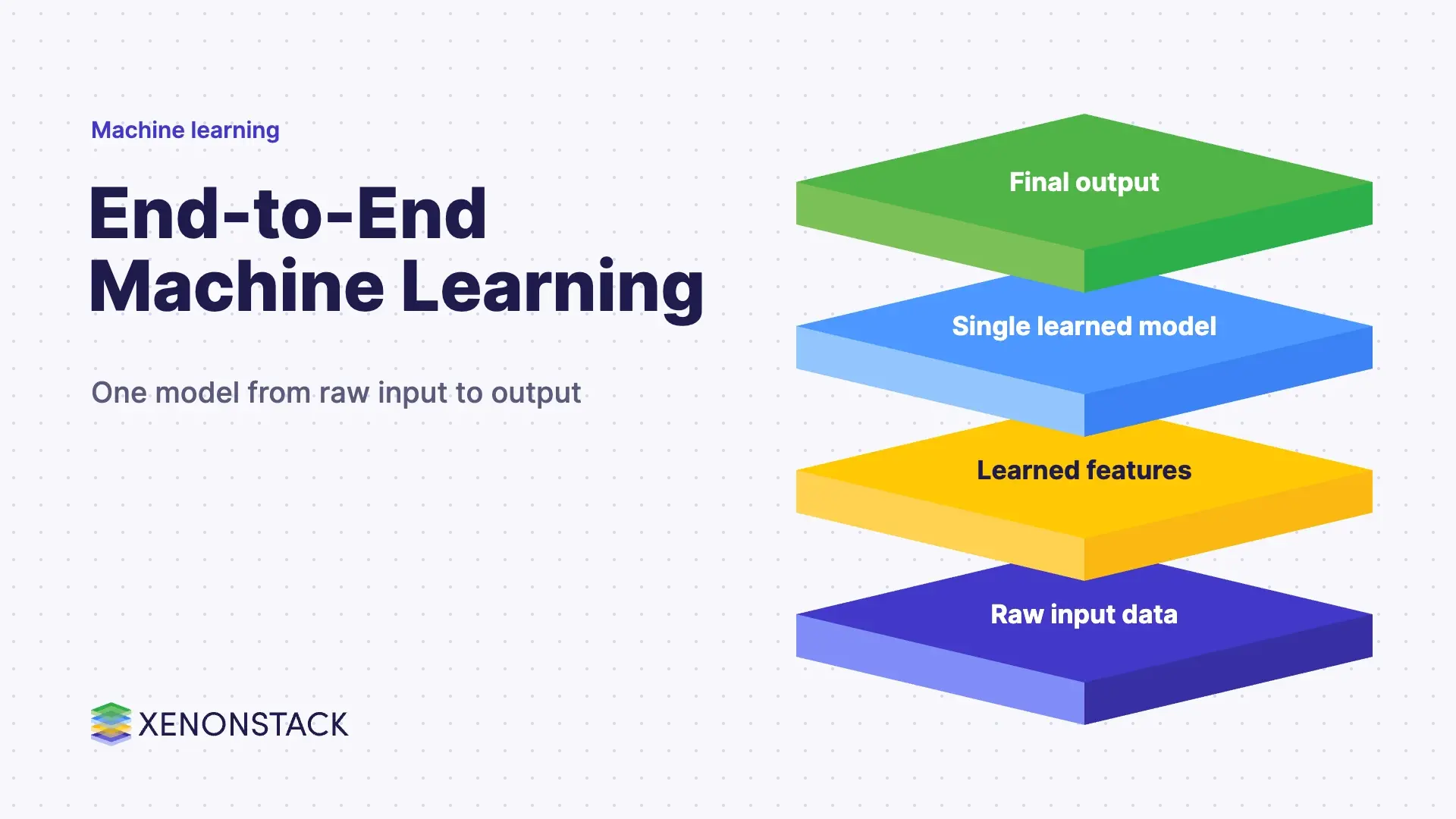
End-to-end machine learning is an approach in which a single model learns the whole task, from raw input to final output, instead of passing the data through a chain of separately built stages. The model works out for itself which intermediate features matter.
This page is for data scientists and technical leaders deciding whether to replace a staged pipeline with one learned model. It covers what end-to-end learning is, a driving example, the trade-offs, and what to check first.
What is end-to-end machine learning?
An algorithm can solve the whole function on its own, without extra human steps such as swapping models between stages or marking new data for each stage. The AltexSoft glossary puts it as a single model that learns to go from raw input to final output in one unified pipeline. Speech recognition is its example: a model maps raw audio straight to text, skipping the separate acoustic and language modules older systems needed.
What is an example of end-to-end learning?
End-to-end driving is the classic case. In the NVIDIA self-driving paper, a convolutional neural network maps raw pixels from a single front-facing camera directly to steering commands, with only the human steering angle as the training signal. The authors say they never explicitly trained it to detect, for example, the outline of roads, and they argue that optimising all processing steps together should eventually give better performance and smaller systems. The abstract presents that as an argument, not a proven result.
How does it differ from a modular pipeline?
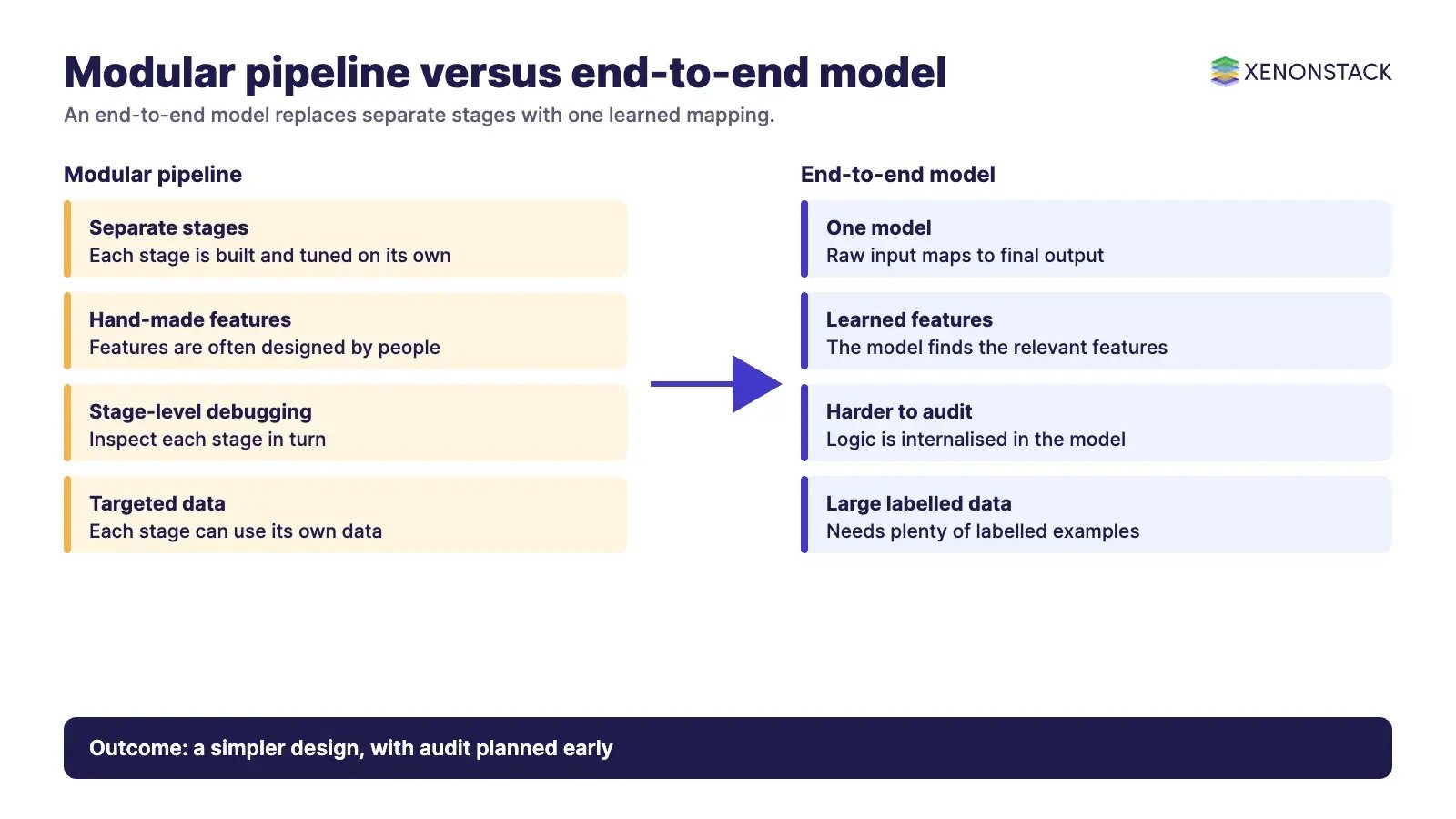
| Question | Modular pipeline | End-to-end model |
|---|---|---|
| Structure | Separate stages, each built and tuned on its own | One model from input to output |
| Features | Often designed by hand | Learned from the data |
| Data need | Each stage can use targeted data | Demands large amounts of labelled data, per AltexSoft |
| Debugging | Inspect each stage in turn | Harder to interpret, debug and audit, per AltexSoft |
| Fit | When stages need review or reuse | When the full mapping is learnable from data |
What are the benefits and risks?
The AltexSoft glossary lists two benefits: simpler design, because fewer hand-engineered components mean less design complexity, and learned features, because the model can learn the most relevant features directly from data. Its listed drawbacks are the need for large amounts of labelled data and the difficulty of interpreting, debugging and auditing a model whose logic is internalised. For regulated or high-stakes uses, that last point deserves early attention.
Does the phrase mean something else?
Teams also use end-to-end machine learning to mean the whole lifecycle, from data collection through training to deployment and monitoring. This page covers the learning approach. Even a single end-to-end model still sits inside that wider lifecycle and needs the same care with data and review.
How does end-to-end learning relate to AI agents?
An agent can call an end-to-end model as one tool, for example to read an image or transcribe audio. The agent still needs to know which data the model saw and which policy applies to its output. ElixirClaw is XenonStack's AI agents computing platform.
What should you do first?
- Write down the input and the final output you want the model to map between.
- Check that you have enough labelled data for a single model to learn the whole task.
- Keep the modular pipeline as a baseline to compare against.
- Decide how you will inspect and audit the model before it goes live.
To map one decision your agents make using a learned model, and the data and policy it depends on, book a Context Workshop. See what happens in the workshop.
Frequently asked questions
What is end-to-end machine learning?
End-to-end machine learning is an approach in which a single model learns the whole task, from raw input to final output, instead of using a chain of separately built stages.
What is an example of end-to-end learning?
End-to-end driving, where one neural network maps camera pixels directly to steering commands, is a well-known example. Speech recognition that maps raw audio straight to text is another.
What are the advantages of end-to-end learning?
It can simplify the design, because fewer components are engineered by hand, and the model can learn the most relevant features directly from the data.
What are the disadvantages of end-to-end learning?
It typically needs large amounts of labelled data, and it can be harder to interpret, debug and audit when something goes wrong.
Explore the XenonStack platform family: ElixirData · ElixirClaw · ElixirHub · NexaStack · MetaSecure · Neural AI · AgentGRC · AgentSRE · AgentAnalyst · AgentInstruct · AgentRAI · AgentScrum · AgentSearch · AgentForce · AI Aviator · SAIF Aviator · CohortIQ · XenonStack AI · XenonStack UAE