 Xenonstack Glossary
What are your key focus areas? *
AI Workflow and Operations
Data Management and Operations
AI Governance
Analytics and Insights
Observability
Security Operations
Risk and Compliance
Procurement and Supply Chain
Private Cloud AI
Vision AI

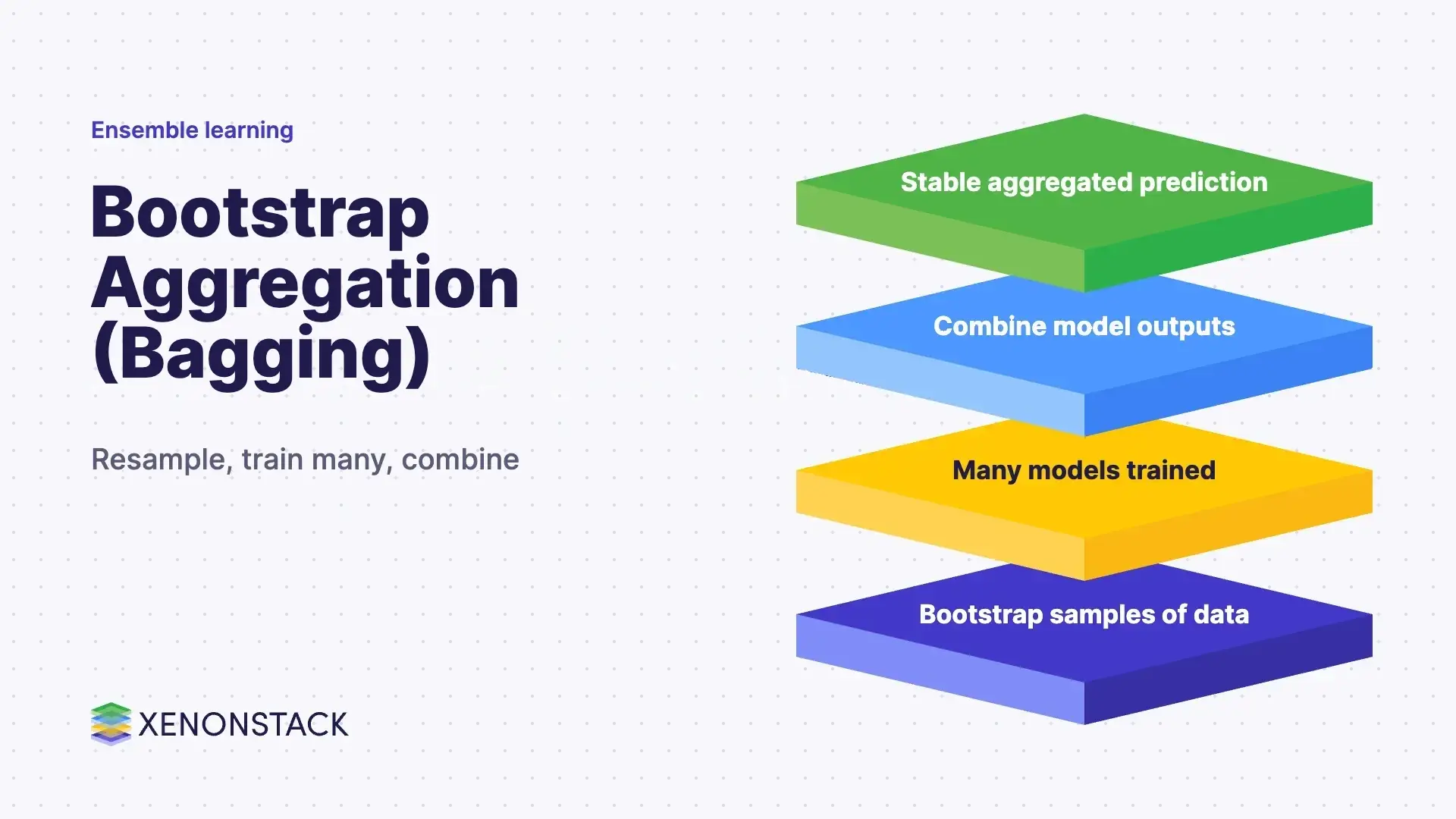
Bootstrap aggregation, or bagging, is an ensemble method that trains several copies of a model on random samples of the training data, drawn with replacement, and aggregates their predictions to reduce variance. It works best on flexible models such as fully grown decision trees.
This page is for data scientists and technology leaders who want to know what bagging does, how it relates to random forests and boosting, and what to settle before using it in models that feed AI agents.
The scikit-learn ensemble guide defines bagging methods as a class of algorithms that build several instances of a black-box estimator on random subsets of the original training set and then aggregate their individual predictions into a final prediction. When samples are drawn with replacement, the method is known as bagging.
The word bootstrap refers to that sampling with replacement: each model sees a slightly different version of the data, so its mistakes differ from those of the others.
According to the guide, these methods reduce the variance of a base estimator, for example a decision tree, by introducing randomisation into its construction and then making an ensemble out of it. Because they reduce overfitting, bagging methods work best with strong and complex models such as fully developed decision trees.
A model with high variance changes a lot when the training data changes slightly. Combining many such models smooths out those swings, which is the stability gain that gives the method its value.
The same guide describes the main controls: the size of the sample and feature subsets, and whether samples and features are drawn with or without replacement. When only part of the data is used for each model, the samples left out can estimate generalisation accuracy through out-of-bag scoring.
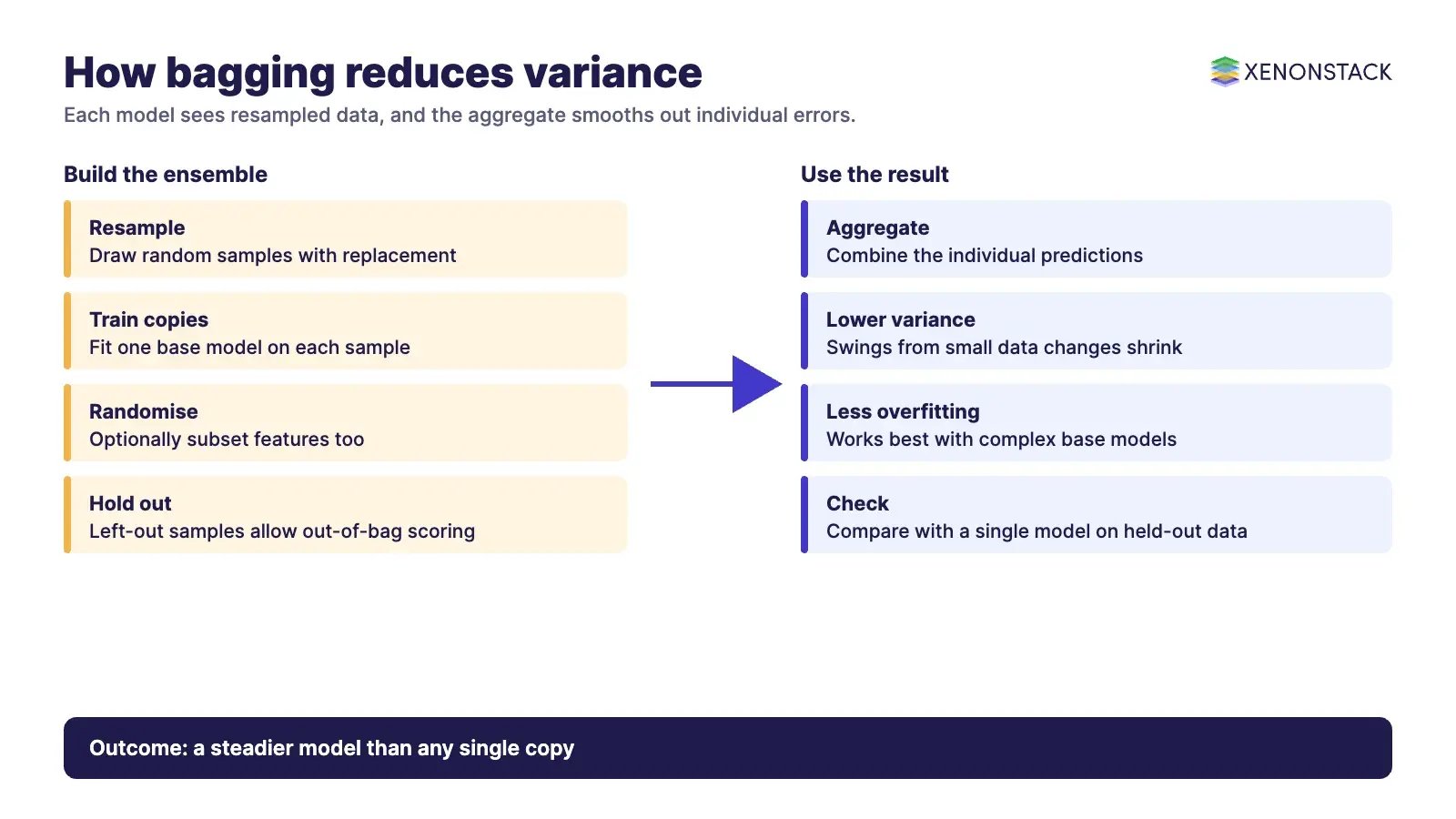
In practice you choose a base model, the number of copies, how much data each copy sees and how to evaluate the result. Related tuning topics are covered in our entries on hyperparameter tuning and automated machine learning.
The scikit-learn guide lists several close relatives that differ in how they draw their subsets.
| Method | How it builds the ensemble | Note from the guide |
|---|---|---|
| Bagging | Random subsets of samples, drawn with replacement | Best with strong, complex models |
| Pasting | Random subsets of samples, drawn without replacement | A related variant |
| Random subspaces and patches | Random subsets of features, or of samples and features | Other ways to randomise the base models |
| Random forest | Each tree uses a bootstrap sample, with features also randomised at each split | Its stated purpose is to decrease variance |
| Boosting | A different ensemble family that the guide contrasts with bagging | Usually works best with weak models such as shallow trees |
Agents often depend on predictive models for scoring, routing or forecasting, and those models need to be stable when data shifts. Teams running agents on ElixirClaw, the AI agents computing platform from XenonStack can use bagging as one way to make such models steadier, while keeping the training data and settings recorded for review.
To map one decision your agents make, and the data and policy it depends on, book a Context Workshop. See what happens in the workshop.
Bagging builds several instances of a base estimator on random subsets of the training set, drawn with replacement, and aggregates their predictions into one. Its aim is to reduce the variance of the base estimator.
The bootstrap is sampling with replacement. Each model in the ensemble is trained on its own resampled version of the data, so the models make different errors that the aggregate can smooth out.
Not exactly. A random forest builds each tree from a bootstrap sample, as bagging does, but it also randomises the features considered at each split. Its stated purpose is to decrease variance.
The scikit-learn guide says bagging works best with strong and complex models, such as fully developed decision trees, whereas boosting usually works best with weak models such as shallow trees.
Explore the XenonStack platform family: ElixirData · ElixirClaw · ElixirHub · NexaStack · MetaSecure · Neural AI · AgentGRC · AgentSRE · AgentAnalyst · AgentInstruct · AgentRAI · AgentScrum · AgentSearch · AgentForce · AI Aviator · SAIF Aviator · CohortIQ · XenonStack AI · XenonStack UAE
Tell us about you and your priorities so we can prepare the right conversation. It takes about 2 minutes.
AI continuously monitors systems for risks before they escalate. It correlates signals across logs, metrics, and traces. This ensures faster detection, fewer incidents, and stronger reliability
 Proactive detection of performance and availability issues
 Root-cause analysis across microservices and environments
 Automated remediation playbooks to reduce MTTR

AI converts camera feeds into instant situational awareness. It detects unusual motion and unsafe behavior in real time. Long hours of video become searchable and summarized instantly
 Real-time detection of suspicious motion or intrusion
 Natural language video search and instant playback
 Smart summaries for audits, investigations, and compliance

Your data stack becomes intelligent and conversational. Agents surface insights, detect anomalies, and explain trends. Move from dashboards to autonomous, always-on analytics
 Connects to warehouses, lakes, and streaming sources
 Question-answering in natural language
 Continuous monitoring for anomalies and KPI deviations

Agents identify recurring failures and performance issues. They trigger workflows that resolve common problems automatically. Your infrastructure evolves into a self-healing environment
 Automated diagnostics for recurring errors
 Playbook execution: restart services, scale pods, clear queues
 Feedback loop for improving remediation strategies

AI continuously checks controls and compliance posture. It detects misconfigurations and risks before they escalate. Evidence collection becomes automatic and audit-ready
 Continuous control checks across infrastructure and SaaS
 Automated evidence collection for audits
 Risk scoring and prioritized remediation recommendations

Financial and procurement workflows become proactive and insight-driven. Agents monitor spend, vendors, and contracts in real time. Approvals and sourcing decisions become faster and smarter
 Real-time visibility into spend and commitments
 Anomaly detection on invoices and vendor performance
 Intelligent workflows for approvals and sourcing decisions


