 Xenonstack Glossary
XenonStack GlossaryEnterprise Metadata Management (EMM) Explained
Key takeaway
- Enterprise metadata management governs technical, business and operational metadata across systems. Learn its parts, lineage and what AI agents need.
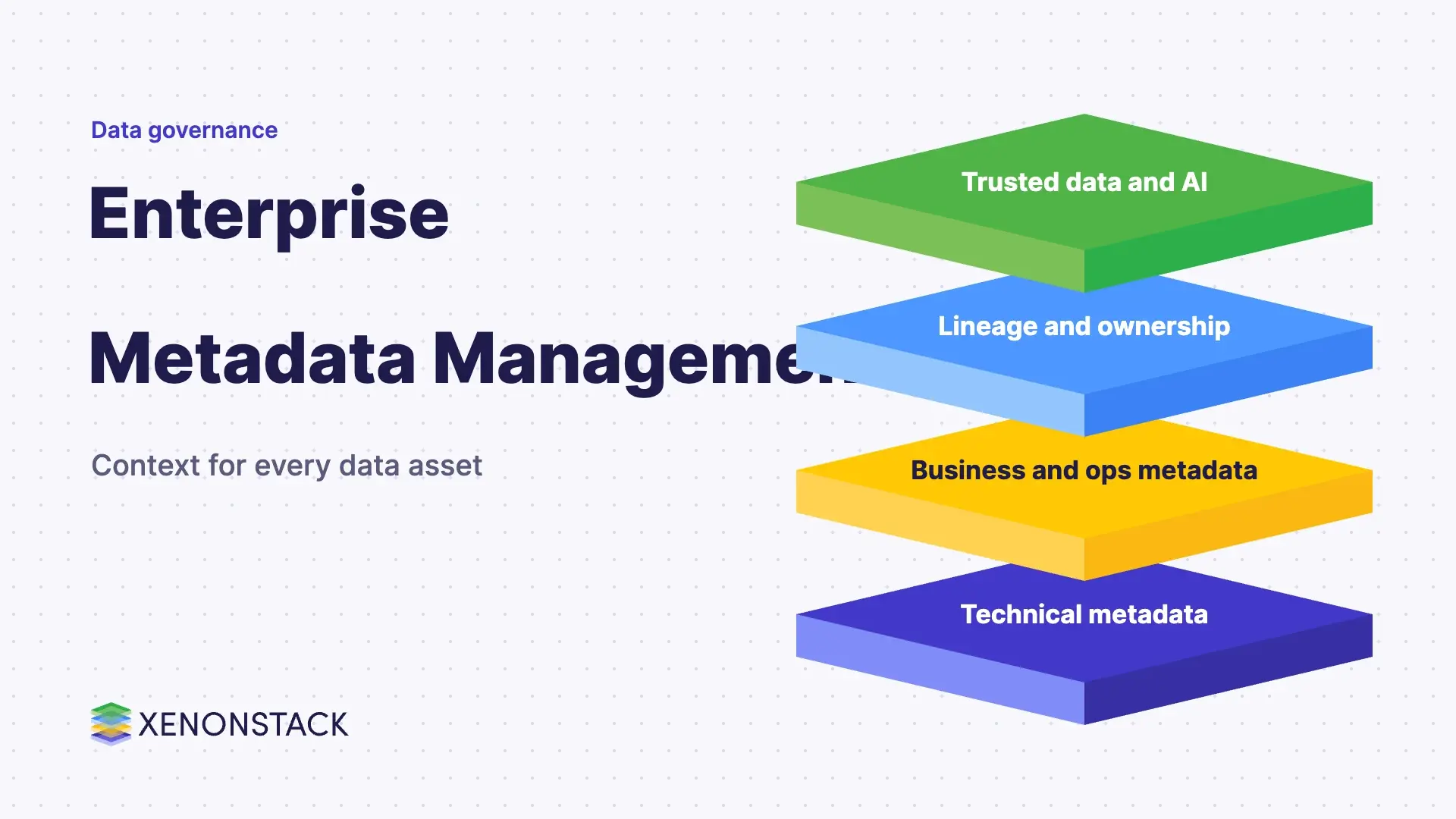
Enterprise metadata management (EMM) is the practice of creating, governing and connecting metadata, the data that describes other data, across every system in an organisation. It gives people and software a shared understanding of what data exists, what it means, where it came from and who is responsible for it.
This page is for data leaders, stewards and architects who need a clear definition and a practical starting point. It covers the types of metadata, why EMM underpins governance, how it differs from a data catalog, and what AI agents need from it.
What is enterprise metadata management?
Actian's guide to metadata management puts it simply: "Knowing the who, what, when, where, and why of your data means knowing your metadata." Metadata is created whenever data is created, changed, deleted or acquired, so it exists in every system you run. The word enterprise means managing it as one connected asset, instead of leaving each tool with its own private version. Our article on metadata management for agentic AI looks at the same subject from the agent side.
What types of metadata does it cover?
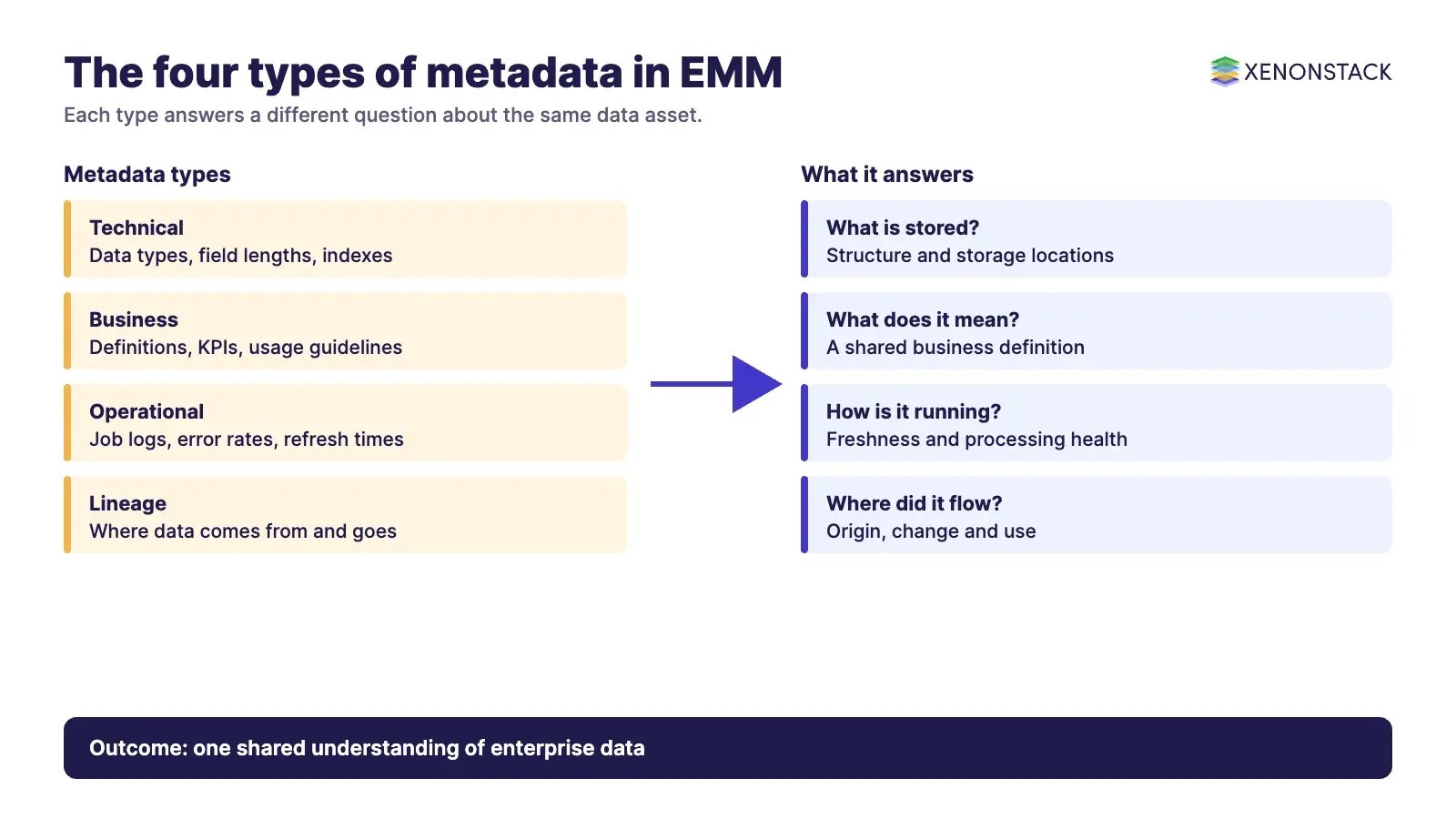
The Actian guide separates metadata into technical, business and operational types, and describes lineage as tracking where data comes from, how it changes and where it is used.
| Type | What it describes | Examples |
|---|---|---|
| Technical | The technical traits of data | Data types, field lengths, indexes, storage locations |
| Business | The business context of data | Definitions, KPIs, calculations, usage guidelines |
| Operational | What happens during processing and use | Job logs, processing times, error rates, refresh schedules |
| Lineage | Origin, change and use of data | The path from a source system to a report |
Not every author draws the lines the same way. EW Solutions treats operational metadata as a type of technical metadata, so agree one model inside your organisation before you build on it.
Why does enterprise metadata management matter?
The Actian guide says metadata management improves discovery, governance, compliance and decision-making, gives teams a shared understanding of data assets and provides audit trails. EW Solutions calls it "a cornerstone of effective data governance" and says it supports the policies and procedures that governance depends on. It also notes that data stewards spend most of their time working with metadata, which is a good reason to give them proper tools and clear ownership.
How is it different from a data catalog or a metadata repository?
These terms overlap, and teams often use them loosely.
| Term | What it is | Relationship to EMM |
|---|---|---|
| Enterprise metadata management | The discipline: standards, ownership and processes for metadata | The whole practice |
| Metadata repository | In EW Solutions' words, the industry's first widespread term for the metadata management system | Where metadata and its model are stored |
| Data catalog | The system that indexes data assets and their metadata, per the Actian data discovery glossary | How people find what EMM governs |
For the architecture behind a catalog, read data catalog architecture. For an open source option, see the OpenMetadata platform guide.
How does enterprise metadata management relate to AI agents?
An AI agent that chooses data to act on needs to know what a field means, who owns it and where it came from. Metadata is where those facts are recorded, so an agent can only rely on what someone has captured and kept current. ElixirData is XenonStack's Context OS, the decision infrastructure layer for AI agents.
What should you do first?
- List the systems whose data your most important decisions depend on.
- Agree one metadata model: technical, business, operational and lineage.
- Name an owner for the definitions of your most used data.
- Capture lineage for one critical report or agent workflow.
- Check how users and agents find that metadata, and fix the gaps.
To map one decision your agents make, and the data and policy it depends on, book a Context Workshop. See what happens in the workshop.
Frequently asked questions
What is enterprise metadata management?
It is the practice of creating, governing and connecting metadata across every system in an organisation, so people and software share an understanding of what data exists, what it means and who owns it.
What are the main types of metadata?
Technical, business and operational metadata, plus lineage, which tracks where data comes from, how it changes and where it is used.
Is metadata management the same as data governance?
No. Metadata management supplies the definitions, ownership and lineage that governance policies depend on, while governance sets the policies and accountability.
How is a data catalog different from metadata management?
A data catalog is the system that indexes data assets and their metadata. Metadata management is the wider discipline of deciding what to record, who owns it and how it stays current.
Why do AI agents need metadata?
An agent can only use data safely if it knows what a field means, who owns it and where it came from, and metadata records those facts.
Explore the XenonStack platform family: ElixirData · ElixirClaw · ElixirHub · NexaStack · MetaSecure · Neural AI · AgentGRC · AgentSRE · AgentAnalyst · AgentInstruct · AgentRAI · AgentScrum · AgentSearch · AgentForce · AI Aviator · SAIF Aviator · CohortIQ · XenonStack AI · XenonStack UAE