 Xenonstack Glossary
What are your key focus areas? *
AI Workflow and Operations
Data Management and Operations
AI Governance
Analytics and Insights
Observability
Security Operations
Risk and Compliance
Procurement and Supply Chain
Private Cloud AI
Vision AI

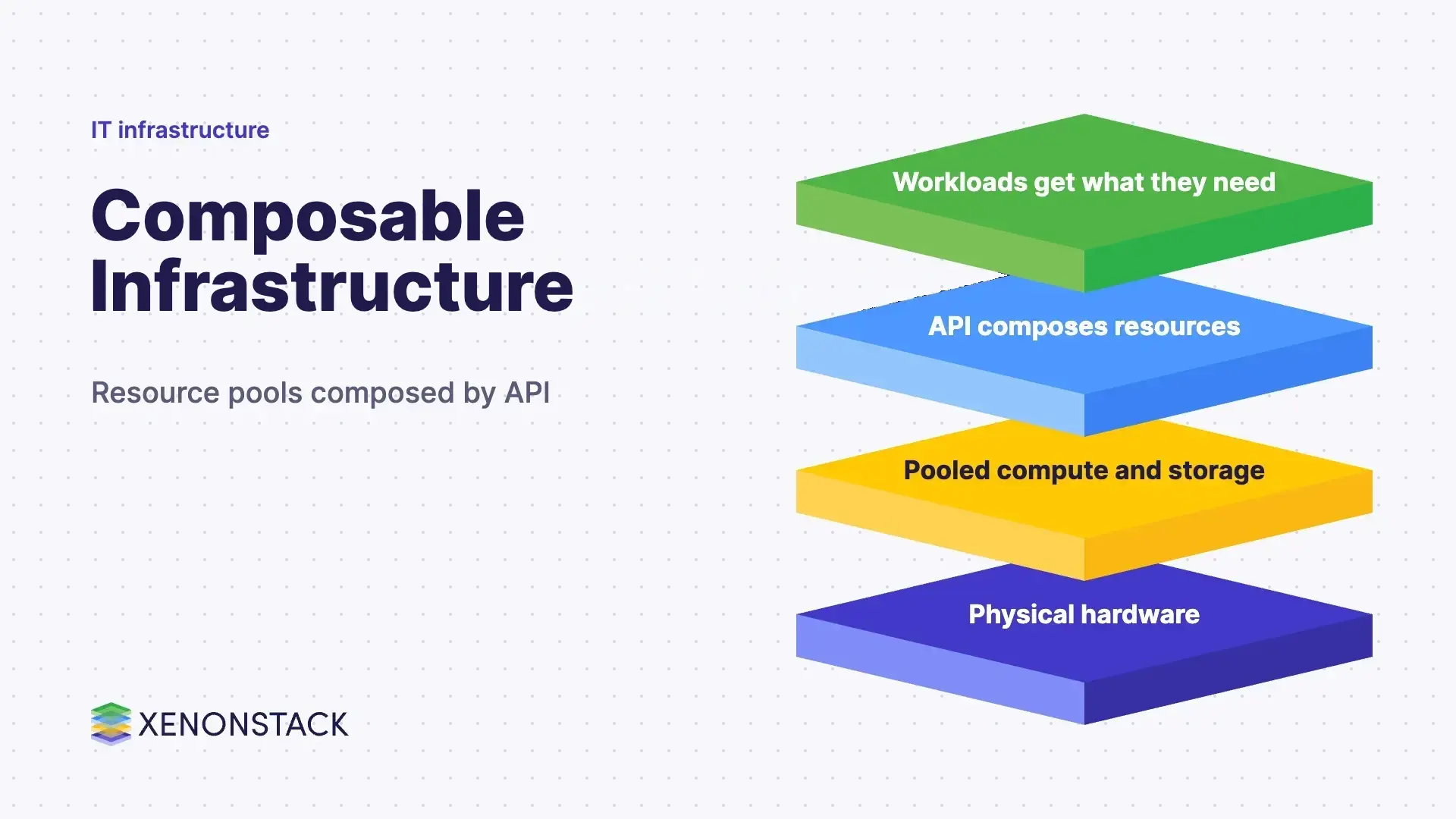
Composable infrastructure is an approach that abstracts compute, storage and networking into shared pools so software can assemble what a workload needs through an API and return it when done. It lets IT provision resources on demand instead of building fixed stacks per application.
This page is for infrastructure and platform leaders. It covers how composable infrastructure works, how it differs from converged and hyperconverged systems, the key parts, and where to begin.
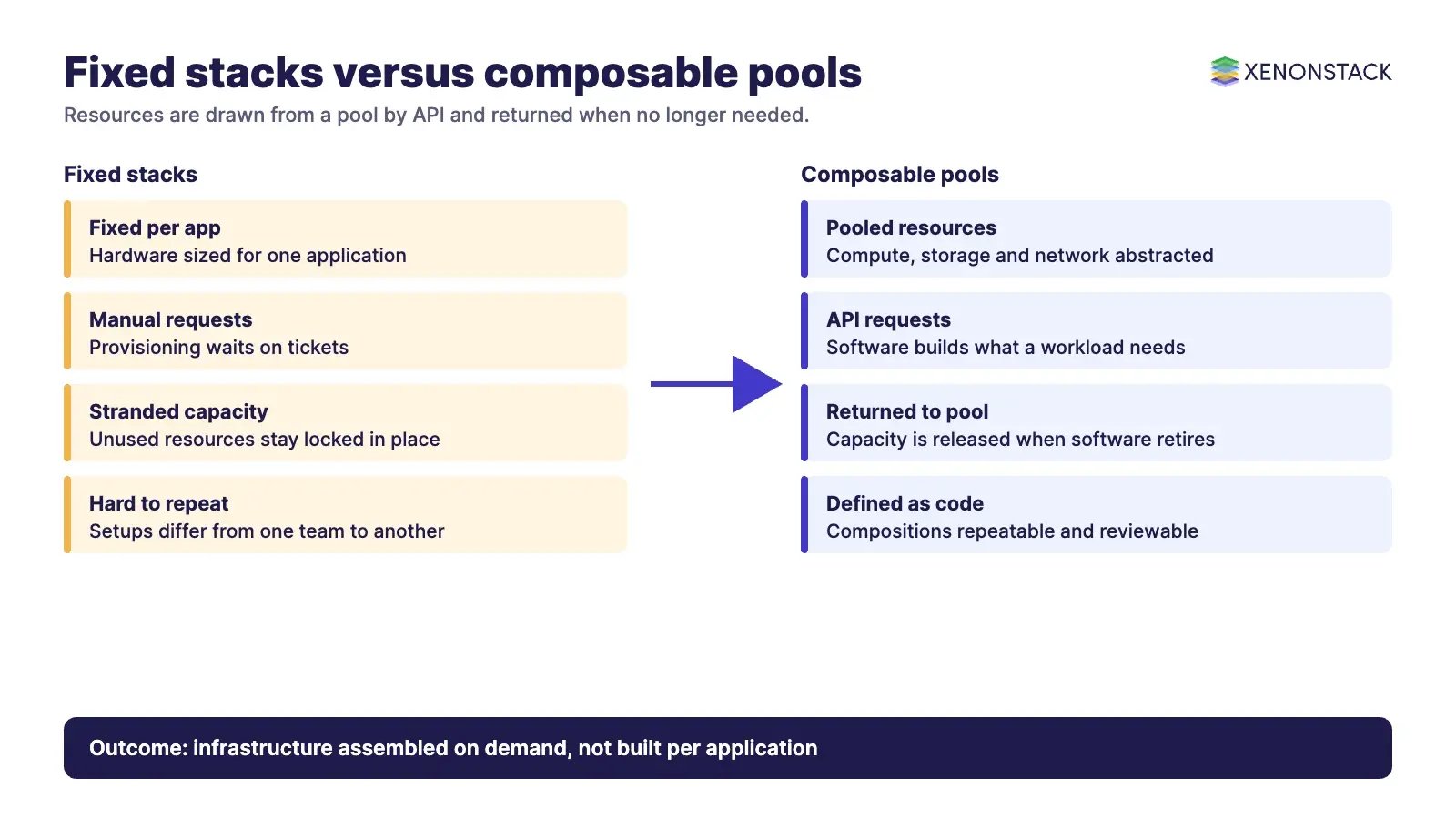
HPE explains that composable infrastructure works by abstracting enterprise resources and pooling them so they can be managed by an API. Compute, storage and networking are drawn from the pool when an application needs them, and returned to it when the software is no longer needed.
Resources are abstracted from their physical locations and presented as pools. A request through the API builds the infrastructure an application needs from those pools. Because the request is code, the same definition can be repeated, reviewed and versioned, which is why composable infrastructure is closely tied to infrastructure as code.
Standards help here. DMTF describes Redfish as simple and secure management for converged, hybrid IT built on common web services standards, and the DMTF site lists a Redfish composability white paper. SNIA describes Swordfish as an extension to Redfish that manages storage equipment and storage services.
| Question | Converged and hyperconverged | Composable |
|---|---|---|
| Resource model | Simplified, packaged infrastructure solutions | Pools of abstracted resources |
| Framing | Grouped by HPE with other simplified infrastructure solutions | By API request that builds from the pool |
| Workload mix | Per HPE, composable lets IT keep physical workloads alongside virtual and container ones | Physical, virtual and container together |
HPE groups converged and hyperconverged systems with other simplified infrastructure solutions and contrasts composable infrastructure with them on that last point.
Agents that provision or resize infrastructure through an API act on real systems and real cost. Each request needs limits, an owner and a record of why it was made. That turns infrastructure access into a governed decision. ElixirClaw, XenonStack's AI agents computing platform, is where teams build and run such agents.
To map one decision your agents make about infrastructure, and the data and policy it depends on, book a Context Workshop. See what happens in the workshop.
It is infrastructure whose compute, storage and networking are pooled so software can assemble what a workload needs through an API.
No. HPE contrasts the two: composable infrastructure lets IT keep physical workloads in the same environment as virtual and container workloads.
HPE explains that pooled resources are managed by an API, which builds infrastructure from the pool and returns it when the software is retired.
Because compositions are requests made through an API, they can be written as code, versioned and reviewed like any other code.
DMTF describes Redfish as management for converged, hybrid IT. SNIA describes Swordfish as an extension to Redfish for storage.
Explore the XenonStack platform family: ElixirData · ElixirClaw · ElixirHub · NexaStack · MetaSecure · Neural AI · AgentGRC · AgentSRE · AgentAnalyst · AgentInstruct · AgentRAI · AgentScrum · AgentSearch · AgentForce · AI Aviator · SAIF Aviator · CohortIQ · XenonStack AI · XenonStack UAE
Tell us about you and your priorities so we can prepare the right conversation. It takes about 2 minutes.
AI continuously monitors systems for risks before they escalate. It correlates signals across logs, metrics, and traces. This ensures faster detection, fewer incidents, and stronger reliability
 Proactive detection of performance and availability issues
 Root-cause analysis across microservices and environments
 Automated remediation playbooks to reduce MTTR

AI converts camera feeds into instant situational awareness. It detects unusual motion and unsafe behavior in real time. Long hours of video become searchable and summarized instantly
 Real-time detection of suspicious motion or intrusion
 Natural language video search and instant playback
 Smart summaries for audits, investigations, and compliance

Your data stack becomes intelligent and conversational. Agents surface insights, detect anomalies, and explain trends. Move from dashboards to autonomous, always-on analytics
 Connects to warehouses, lakes, and streaming sources
 Question-answering in natural language
 Continuous monitoring for anomalies and KPI deviations

Agents identify recurring failures and performance issues. They trigger workflows that resolve common problems automatically. Your infrastructure evolves into a self-healing environment
 Automated diagnostics for recurring errors
 Playbook execution: restart services, scale pods, clear queues
 Feedback loop for improving remediation strategies

AI continuously checks controls and compliance posture. It detects misconfigurations and risks before they escalate. Evidence collection becomes automatic and audit-ready
 Continuous control checks across infrastructure and SaaS
 Automated evidence collection for audits
 Risk scoring and prioritized remediation recommendations

Financial and procurement workflows become proactive and insight-driven. Agents monitor spend, vendors, and contracts in real time. Approvals and sourcing decisions become faster and smarter
 Real-time visibility into spend and commitments
 Anomaly detection on invoices and vendor performance
 Intelligent workflows for approvals and sourcing decisions


