 Xenonstack Glossary
XenonStack GlossaryWhat Is Composite AI? Definition and Examples
Key takeaway
- Composite AI combines different AI techniques, such as machine learning, rules and language processing, in one system. See how it works and where it fits.
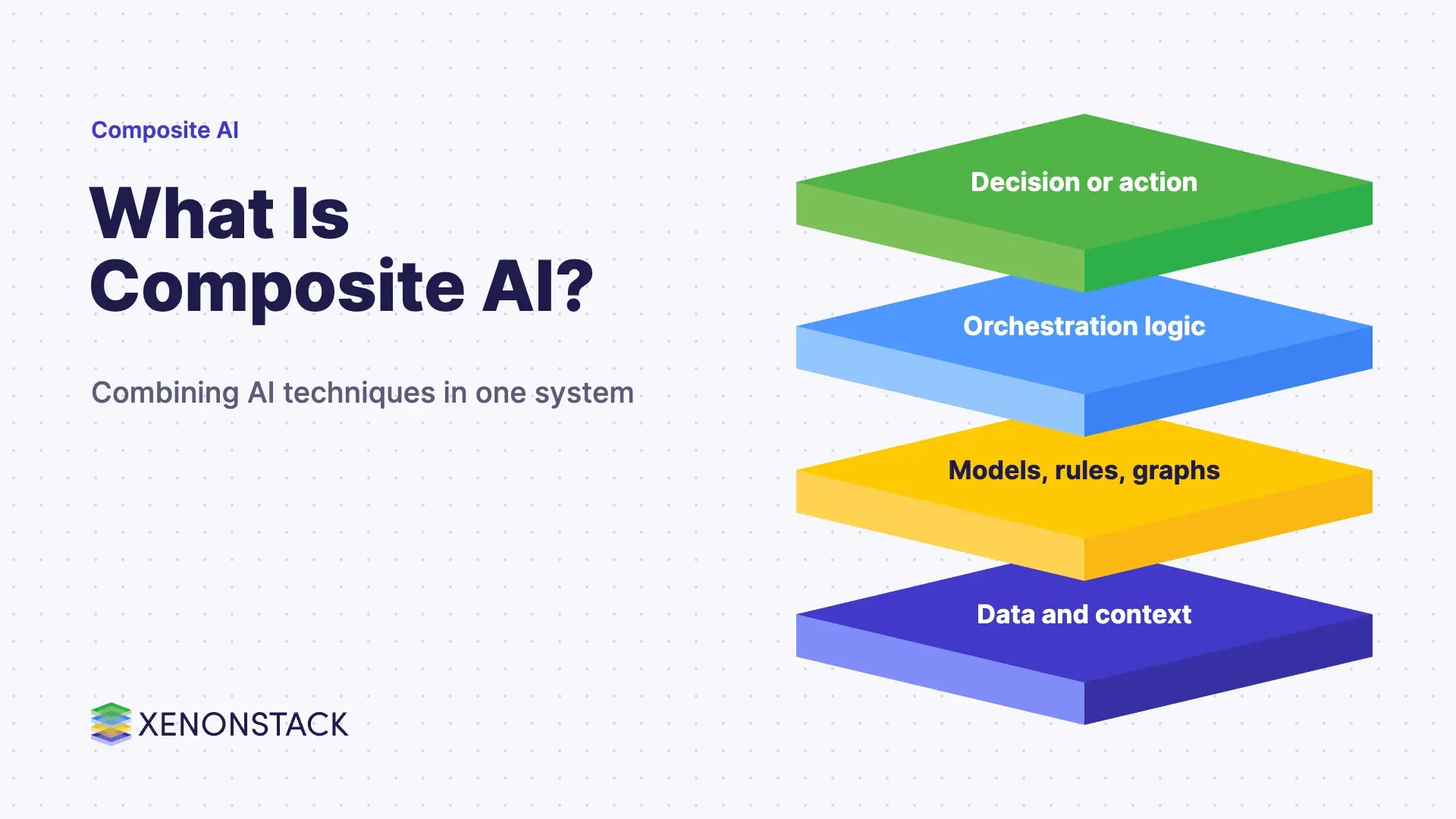
Composite AI is the combination of different AI techniques, such as machine learning, rules, natural language processing and optimisation, in one system to solve a problem that no single technique handles well. Instead of relying on one model, a composite system routes each part of the problem to the method that suits it.
This page is for technology and data leaders who want a clear definition. It covers what composite AI is, why it matters, how it differs from related terms and how it connects to AI agents.
What is composite AI?
BigDATAwire reports that Gartner describes composite AI as the "combination of different AI techniques to achieve the best result." The same article lists techniques that can sit beside machine learning and deep learning: traditional rules-based systems, natural language processing, optimisation techniques and graph techniques.
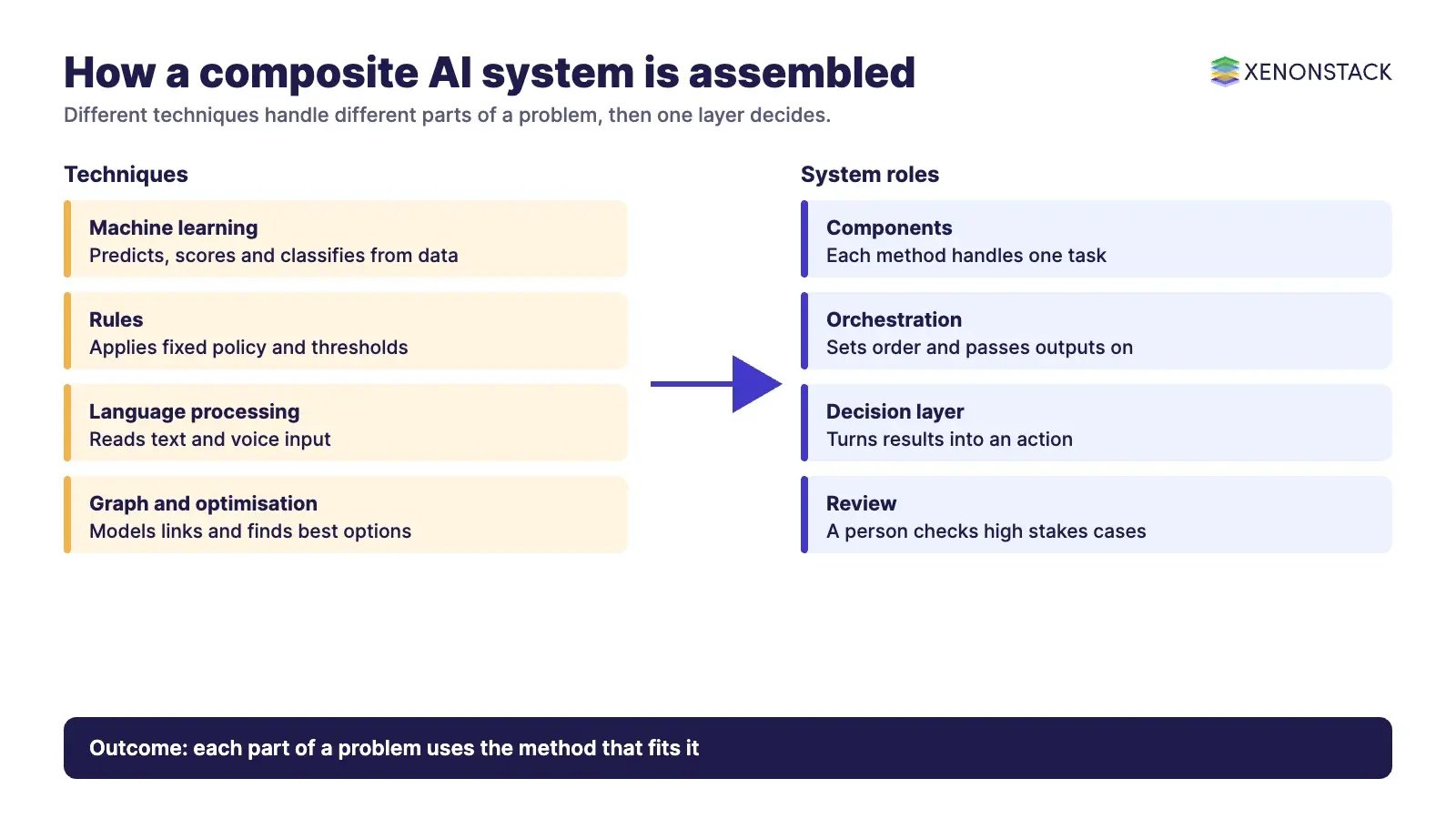
The idea is simple. No single technique solves every part of a business problem, so a composite system assigns each part to the method that suits it and joins the results into one outcome.
Why does composite AI matter?
InformationWeek says that combining techniques is meant to improve learning efficiency, the level of common sense in a system and the range of business problems it can solve. It adds that each technique addresses a different aspect of a problem, so using several together can have a multiplier effect compared with relying on one.
BigDATAwire gives a retail example. A retailer setting prices and promotions might use machine learning for price elasticity and promotional lift, plus rules and demand forecasting, and it must still decide whether to optimise for revenue, margin or market share. The article also notes that the data shapes the choice: text or voice points towards natural language processing, while structured data points towards statistics, machine learning and forecasting.
How does a composite AI system work?
A composite system has three working parts, whichever techniques it uses.
- Components: models and methods, each suited to one task, such as a forecast, a classification, a rule check or a text extraction.
- Orchestration: logic that decides which component runs, in what order, and how outputs pass from one to the next.
- Decision layer: the point where the combined result becomes an action, a recommendation or a hand-off to a person.
Because the parts are separate, you can replace one model without rebuilding the rest, and you can keep rules in place where an organisation needs a predictable answer.
How is composite AI different from a single model or an ensemble?
| Approach | What it combines | Typical use |
|---|---|---|
| Single model | One technique, such as one neural network | A well-defined task with plenty of suitable data |
| Ensemble | Several models of the same kind whose outputs are averaged or voted on | Improving accuracy on one prediction task |
| Composite AI | Different techniques, such as machine learning, rules, language processing, optimisation and graph methods | A business problem with several distinct parts |
| Composite architecture | Packaged business capabilities on a flexible data fabric, as BigDATAwire reports Gartner naming it | Building flexible, adaptable systems |
The terms overlap in practice, but the test is whether the techniques differ in kind, not only in number.
How does composite AI relate to AI agents?
An AI agent is a natural place to apply the composite pattern. A language model may read a request, a rules step may check policy, a forecasting model may supply a number, and the agent then chooses the next action. The agent is the orchestrator, and the quality of its decisions depends on how well each component is governed. ElixirClaw, the AI agents computing platform from XenonStack, is the related product page.
What should you do first?
- Pick one business decision that has more than one kind of input, such as text, numbers and policy.
- List the techniques each part needs, and use a rule where a rule is enough.
- Decide which component owns the final decision and who reviews it.
- Record which components produced each output so you can trace results later.
- Start with two techniques, measure the result, then add more only if the gain justifies the complexity.
To map one decision your agents make, and the data and policy it depends on, book a Context Workshop. See what happens in the workshop.
Frequently asked questions
What is composite AI in simple terms?
Composite AI is the combination of different AI techniques, such as machine learning, rules and natural language processing, in one system so that each part of a problem is handled by the method that suits it.
Who defined composite AI?
Gartner describes it as the combination of different AI techniques to achieve the best result, as reported by BigDATAwire and InformationWeek.
Is composite AI the same as an ensemble model?
No. An ensemble usually combines several models of the same kind to improve one prediction, while composite AI combines techniques that differ in kind.
Why not use one large model for everything?
A single model may not suit every part of a problem. Rules can give predictable answers, forecasting models suit structured data, and language models suit text, so combining them can cover more of the problem.
How do AI agents use composite AI?
An agent can act as the orchestrator, calling a language model, a rules check and a forecasting model in turn, then choosing an action from the combined result.
Explore the XenonStack platform family: ElixirData · ElixirClaw · ElixirHub · NexaStack · MetaSecure · Neural AI · AgentGRC · AgentSRE · AgentAnalyst · AgentInstruct · AgentRAI · AgentScrum · AgentSearch · AgentForce · AI Aviator · SAIF Aviator · CohortIQ · XenonStack AI · XenonStack UAE