 Xenonstack Glossary
XenonStack GlossaryWhat Is Business Intelligence? Definition and Parts
Key takeaway
- Business intelligence (BI) is the processes and tools that collect, manage and analyse data for decisions. See its parts and how BI differs from analytics.
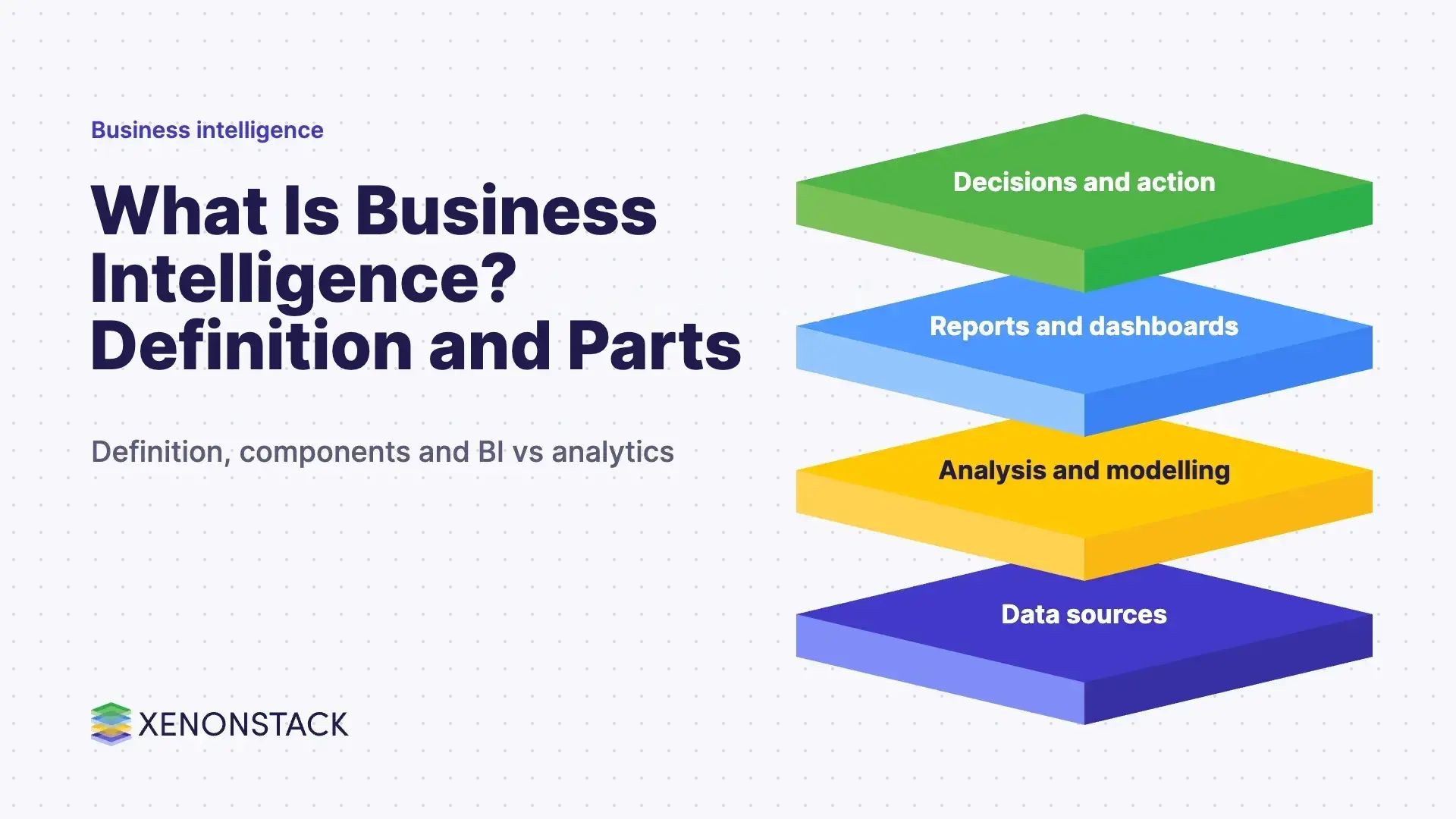
Business intelligence (BI) is the set of processes and technologies an organisation uses to collect, manage and analyse its data so that it can produce insights for strategy and daily operations. BI tools turn raw data into reports, summaries, dashboards, maps, graphs and charts that describe the state of the business.
This page is the definition of BI, for managers and data teams who need a clear starting point. It covers the components, how BI differs from business analytics, and where AI agents fit.
What is business intelligence?
IBM defines BI as a set of technological processes for collecting, managing and analysing organisational data, with the aim of yielding insights that inform business strategies and operations. Google Cloud frames it as using people and technologies to collect and analyse data for strategic and daily decision-making.
Put simply, BI turns data into actionable knowledge about the nature of the business. To see how a BI programme runs in practice, with its architecture, process and roles, read our business intelligence overview.
What are the components of business intelligence?
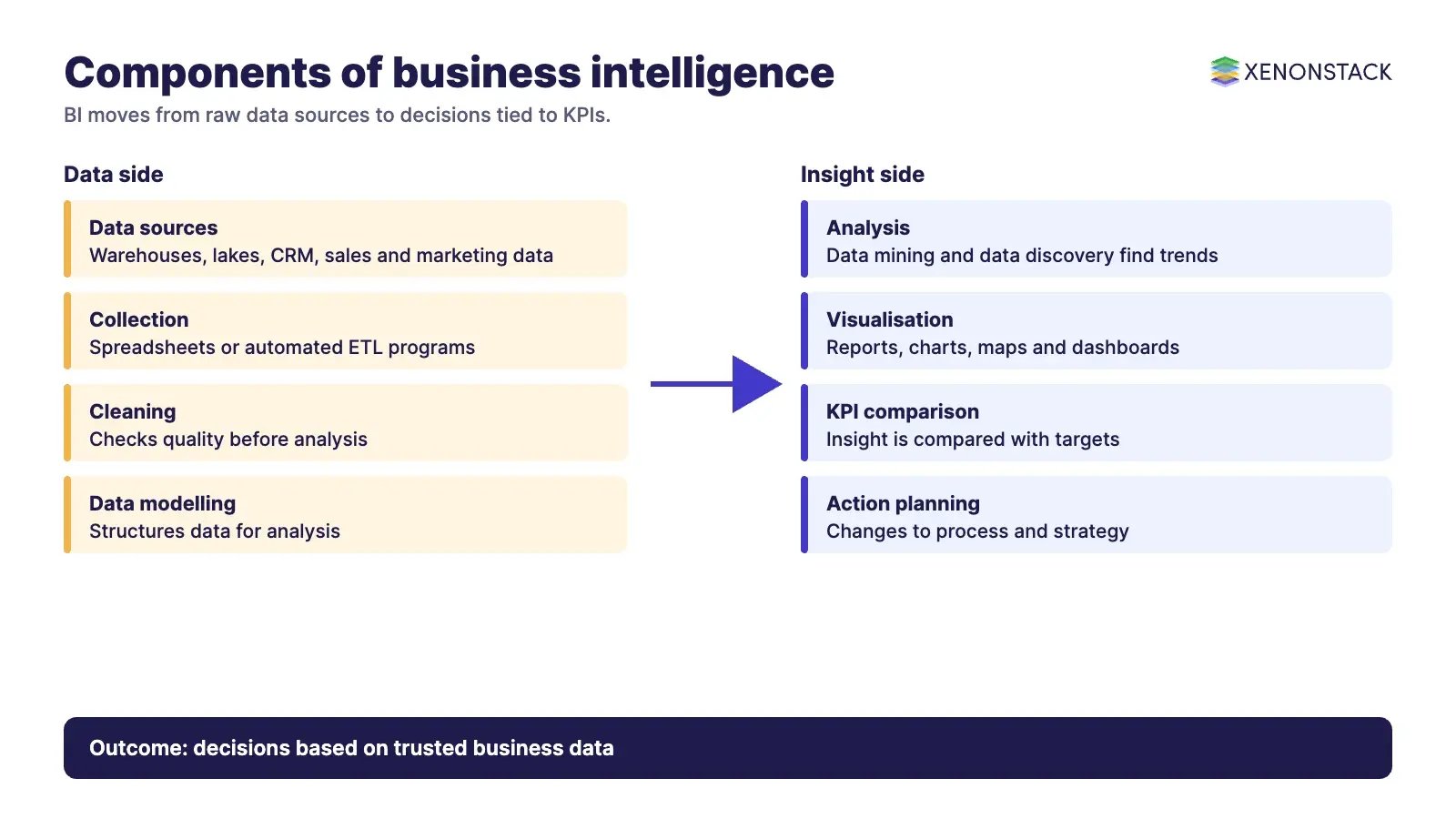
According to IBM, BI draws on data sources such as warehouses, data lakes, cloud platforms, CRM, inventory, sales and marketing systems. Data is collected by hand in spreadsheets or by automated ETL programs, then examined with data mining, data discovery and data modelling tools. Results are visualised, and insights are compared against KPIs to guide changes. Our page on ETL explains the collection step.
| Component | What it does | Examples named by IBM |
|---|---|---|
| Data sources | Hold the raw business data | Warehouses, data lakes, CRM, sales, social media |
| Collection | Gathers and cleans the data | Spreadsheets, automated ETL programs |
| Analysis | Finds trends and anomalies | Data mining, data discovery, data modelling |
| Visualisation | Presents results to users | Tableau, IBM Cognos Analytics, Microsoft Excel, SAP |
| Action planning | Compares insight with targets | KPIs for process, marketing and supply chain changes |
What is the difference between business intelligence and business analytics?
Sources describe the boundary slightly differently, so check which definition a team is using. IBM says BI is descriptive, showing what current business data reveals, and that business analytics is a subset of BI that adds forward-looking, prescriptive analysis. The business analytics page from IBM also calls business analytics a subset of BI, with BI as the broader umbrella that includes the infrastructure for identifying and storing data.
| Question | Business intelligence | Business analytics |
|---|---|---|
| Main focus | What the data shows now and in the past | What might happen and what to do about it |
| Typical output | Reports, dashboards, charts | Forecasts and recommendations |
| Example from IBM | How many customers were acquired last month | What happens if advertising spend rises |
Our page on business analytics covers the second column in detail.
Why does business intelligence matter?
Google Cloud notes that the quality and location of data are critical, and that bad data results in bad business intelligence. BI therefore matters most where data sits in many systems and leaders need one trusted view. Without that view, each team reports its own numbers.
How does business intelligence relate to AI agents?
AI agents increasingly read the same reports and metrics people do, so the definitions behind a KPI shape what an agent concludes. Keeping those definitions consistent is a governance task. ElixirData is XenonStack's Context OS, built for this decision layer above the data.
What should you do first?
- List the decisions your reports and dashboards are meant to support.
- Name the data sources behind each key metric and check their quality.
- Write one agreed definition for each KPI.
- Separate descriptive reporting from forward-looking analysis in your plans.
To map one decision your agents make, and the metrics and policy it depends on, book a Context Workshop. See what happens in the workshop.
Frequently asked questions
What is business intelligence in simple terms?
Business intelligence is the use of processes and technology to collect, manage and analyse organisational data so that it informs strategy and daily operations.
What are the main components of BI?
Data sources, data collection, analysis, visualisation and action planning against KPIs.
Is business analytics part of business intelligence?
IBM describes business analytics as a subset of business intelligence that adds forward-looking analysis, though other sources draw the boundary differently.
What does a BI tool produce?
BI tools produce reports, summaries, dashboards, maps, graphs and charts that describe the nature of the business.
Why does data quality matter for BI?
Because bad data results in bad business intelligence, so insights are only as trustworthy as the data behind them.
Explore the XenonStack platform family: ElixirData · ElixirClaw · ElixirHub · NexaStack · MetaSecure · Neural AI · AgentGRC · AgentSRE · AgentAnalyst · AgentInstruct · AgentRAI · AgentScrum · AgentSearch · AgentForce · AI Aviator · SAIF Aviator · CohortIQ · XenonStack AI · XenonStack UAE