 Xenonstack Glossary
What are your key focus areas? *
AI Workflow and Operations
Data Management and Operations
AI Governance
Analytics and Insights
Observability
Security Operations
Risk and Compliance
Procurement and Supply Chain
Private Cloud AI
Vision AI

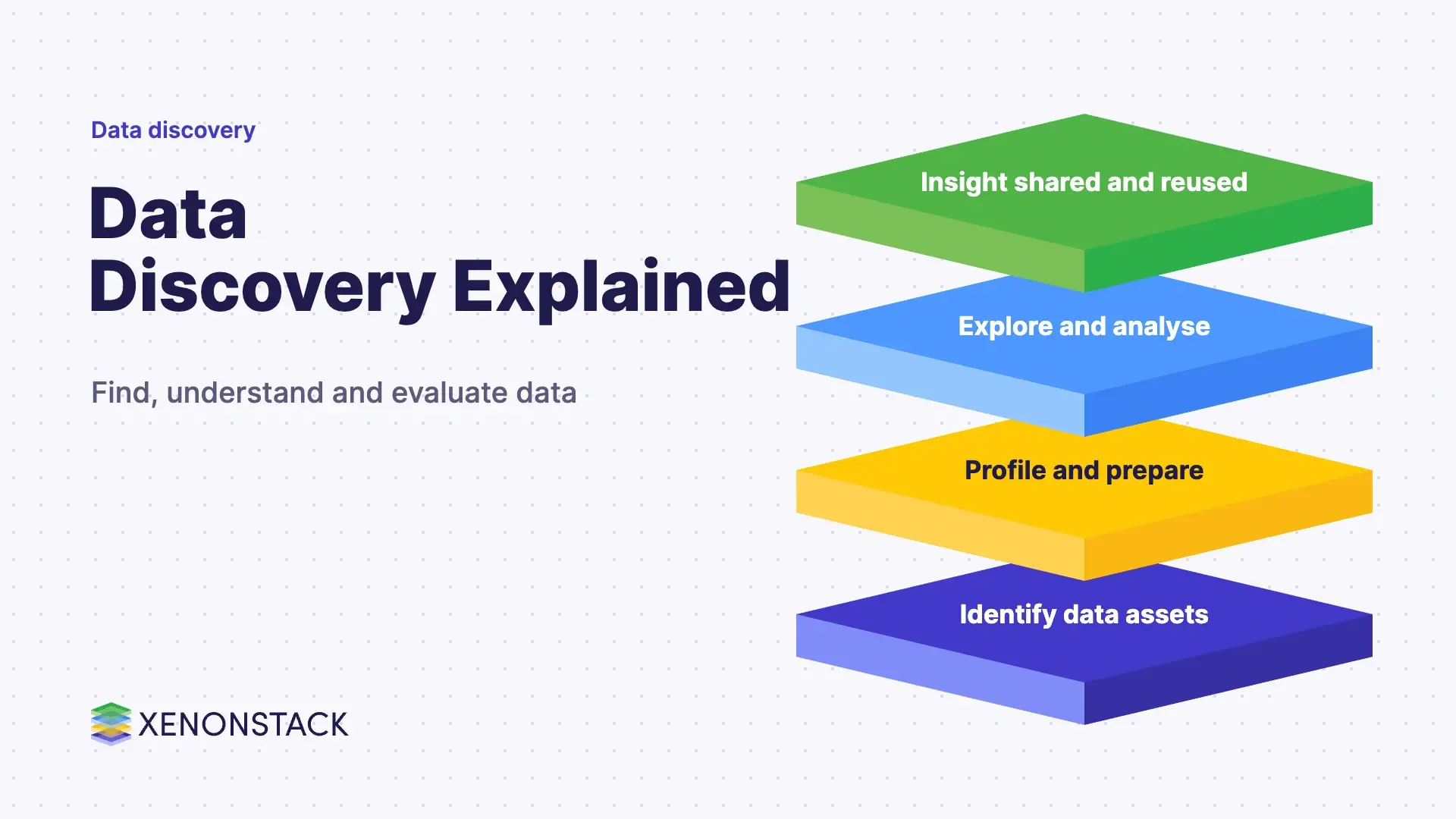
Data discovery is the process of finding, understanding and evaluating data assets across an organisation, so people can decide whether a dataset fits a use such as analytics, reporting or machine learning. It is an ongoing practice rather than a one-off project.
This page is for analytics leads, data owners and business users who need to know where trusted data lives. It covers the stages of discovery, how it differs from a data catalog and from analytics, and where AI agents now fit.
The Actian data discovery glossary describes it as "the process of finding, understanding, and evaluating data assets" and frames the core challenge as a trust problem rather than a search problem. Domo's glossary calls it "the discipline of finding, understanding, evaluating, and preparing data for analysis" and places it at the intersection of data management, analytics and business intelligence. Our guide to data discovery tools covers the tooling side.
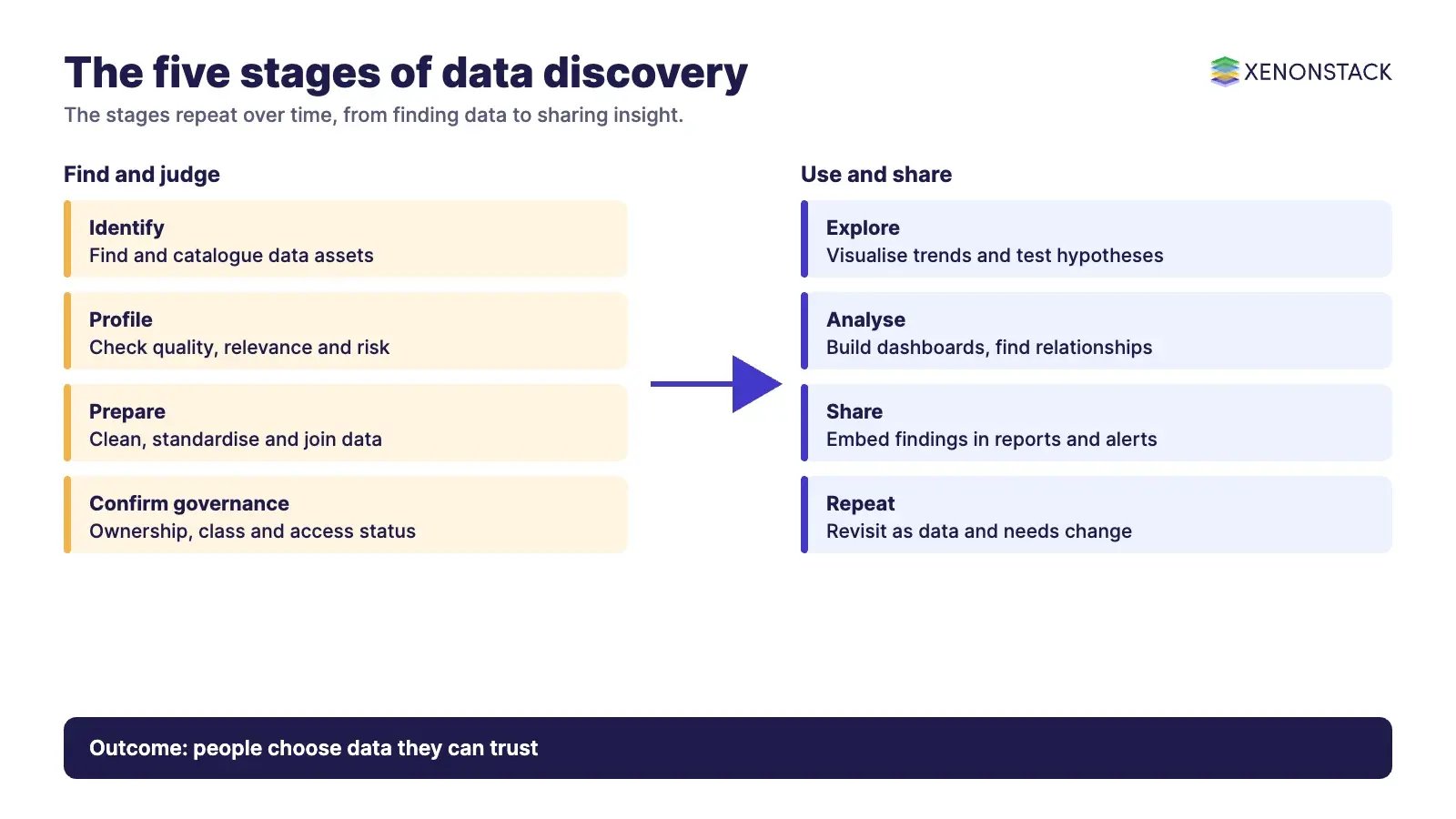
Domo describes five stages that repeat over time.
| Stage | What happens |
|---|---|
| Data identification | Find and catalogue data assets, including structured, semi-structured, unstructured and external sources |
| Profiling and assessment | Evaluate quality, structure, relevance and compliance risk, and flag gaps and duplicates |
| Preparation and integration | Clean, standardise, define consistently and join data across systems |
| Exploration and analysis | Visualise trends, test hypotheses and find relationships |
| Insight sharing | Embed findings in dashboards, reports, alerts and planning |
Actian adds a useful check on the way: before use, confirm governance context such as ownership, classification and access status.
According to Domo, effective discovery supports better decisions based on complete, accurate and timely information, makes existing data assets more useful, improves collaboration through shared definitions and reduces compliance exposure by clarifying where sensitive data lives. Actian says users can find and assess data without opening a request, which lowers the load on central data teams.
| Term | Role | Source wording |
|---|---|---|
| Data discovery | The capability to find and judge data | "Laying the groundwork" (Domo) |
| Data catalog | The system that indexes assets and metadata | "The catalog is the system. Discovery is the capability that the system enables." (Actian) |
| Analytics | Interprets prepared data | "Turning data into insight" (Domo) |
| Data mining | Uses statistics and machine learning to find complex patterns | "Digging deeper" (Domo) |
Actian also notes that a catalog can exist with poor discovery if its metadata is thin or stale. See data catalog architecture for how catalogs are built.
Each stage above is something an AI agent can be asked to do under human review: find candidate data, profile it and explain what looks wrong. The result is only as good as the metadata and governance context the agent can read. ElixirData is XenonStack's Context OS, the decision infrastructure layer for AI agents. For the analytics side, see our agentic analytics platform page and the article on agentic analytics.
To map one decision your agents make, and the data and policy it depends on, book a Context Workshop. See what happens in the workshop.
It is the process of finding, understanding and evaluating data assets so people can decide whether a dataset fits a use such as analytics, reporting or machine learning.
Data identification, profiling and assessment, preparation and integration, exploration and analysis, and insight sharing.
A data catalog is the system that indexes data assets and metadata. Data discovery is the capability that the system enables.
Not strictly, but a catalog gives users one place to search, and discovery is only as good as the metadata behind it. A catalog with thin or stale metadata still gives poor discovery.
They can take on steps such as finding candidate data and profiling it, with a person reviewing the conclusion, provided they can read reliable metadata and governance context.
Explore the XenonStack platform family: ElixirData · ElixirClaw · ElixirHub · NexaStack · MetaSecure · Neural AI · AgentGRC · AgentSRE · AgentAnalyst · AgentInstruct · AgentRAI · AgentScrum · AgentSearch · AgentForce · AI Aviator · SAIF Aviator · CohortIQ · XenonStack AI · XenonStack UAE
Tell us about you and your priorities so we can prepare the right conversation. It takes about 2 minutes.
AI continuously monitors systems for risks before they escalate. It correlates signals across logs, metrics, and traces. This ensures faster detection, fewer incidents, and stronger reliability
 Proactive detection of performance and availability issues
 Root-cause analysis across microservices and environments
 Automated remediation playbooks to reduce MTTR

AI converts camera feeds into instant situational awareness. It detects unusual motion and unsafe behavior in real time. Long hours of video become searchable and summarized instantly
 Real-time detection of suspicious motion or intrusion
 Natural language video search and instant playback
 Smart summaries for audits, investigations, and compliance

Your data stack becomes intelligent and conversational. Agents surface insights, detect anomalies, and explain trends. Move from dashboards to autonomous, always-on analytics
 Connects to warehouses, lakes, and streaming sources
 Question-answering in natural language
 Continuous monitoring for anomalies and KPI deviations

Agents identify recurring failures and performance issues. They trigger workflows that resolve common problems automatically. Your infrastructure evolves into a self-healing environment
 Automated diagnostics for recurring errors
 Playbook execution: restart services, scale pods, clear queues
 Feedback loop for improving remediation strategies

AI continuously checks controls and compliance posture. It detects misconfigurations and risks before they escalate. Evidence collection becomes automatic and audit-ready
 Continuous control checks across infrastructure and SaaS
 Automated evidence collection for audits
 Risk scoring and prioritized remediation recommendations

Financial and procurement workflows become proactive and insight-driven. Agents monitor spend, vendors, and contracts in real time. Approvals and sourcing decisions become faster and smarter
 Real-time visibility into spend and commitments
 Anomaly detection on invoices and vendor performance
 Intelligent workflows for approvals and sourcing decisions


