Key takeaway
- Adaptive security architecture explained: the predict, prevent, detect and respond cycle, CARTA vs zero trust, a reference architecture and AI agents.
Adaptive security architecture is a security model that treats protection as a continuous cycle of predicting, preventing, detecting and responding to threats, rather than a perimeter that is configured once and left alone. Gartner introduced the term in 2014 and later presented continuous adaptive risk and trust assessment (CARTA) as the approach to evolve towards.
This guide is for security and technology leaders. It explains the concept (not the security-awareness vendor that shares the name), how it relates to CARTA and zero trust, a vendor-neutral reference architecture, how AI agents help and add risk, and what to do first.
What is adaptive security architecture?
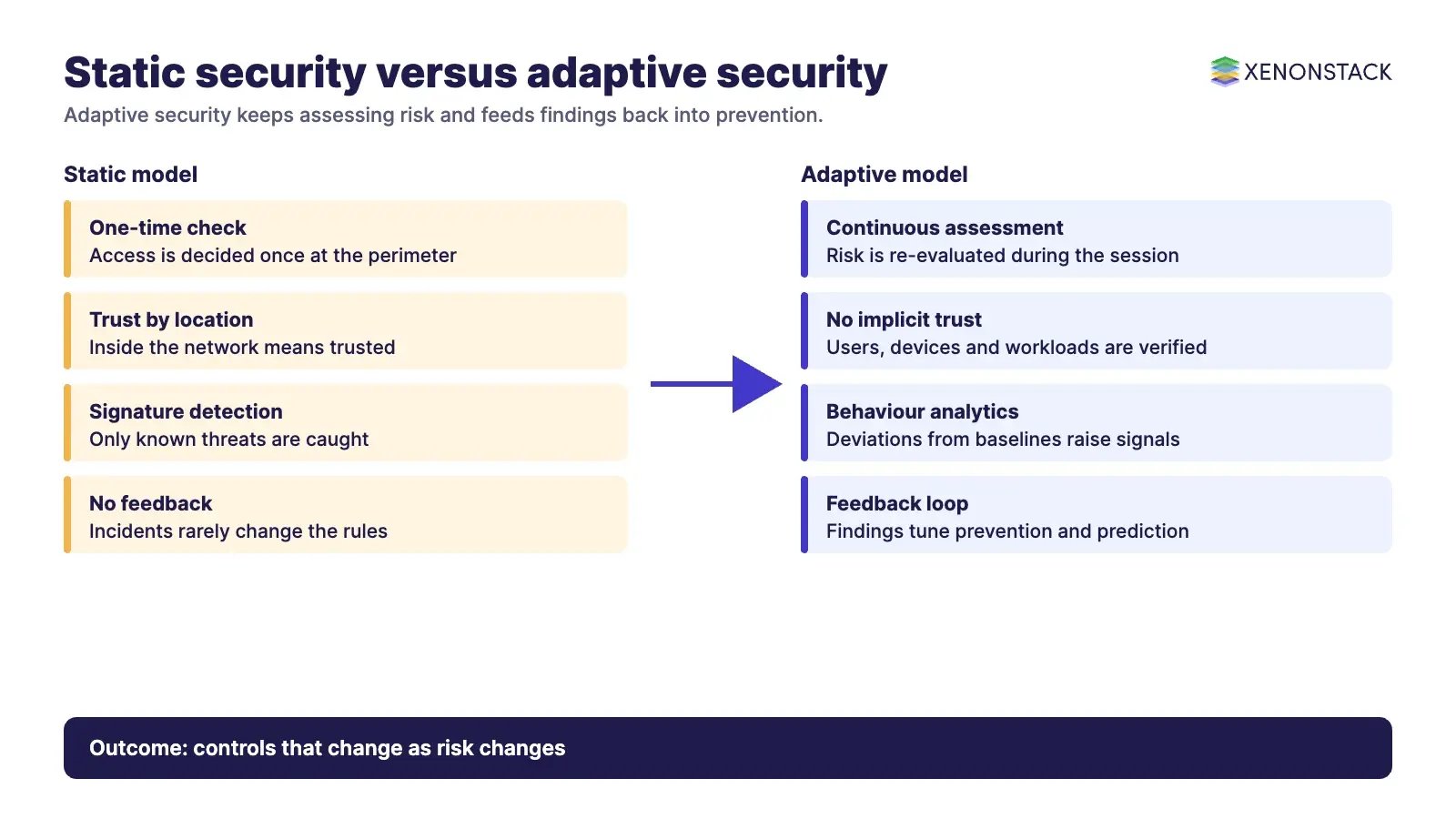
It is a design approach in which security controls adjust to observed behaviour, context and risk instead of relying on static rules. A traditional model asks one question at the door: is this user or packet allowed? An adaptive model keeps asking, using signals from identities, devices, workloads, networks and data, and changes its decision when the risk changes.
A June 2017 Gartner article says that "in 2014, Gartner introduced Adaptive Security Architecture but organizations now need to evolve past that", and presents CARTA as the new approach, applied across the business from DevOps to external partners. The 2014 framing is therefore a foundation, not the current state of the art.
What are the four capabilities of adaptive security?
The model is commonly described as a cycle of four capabilities: predict, prevent, detect and respond. Each feeds the next, and the cycle repeats.
| Capability | What it does | Typical tooling | Question for leaders |
|---|---|---|---|
| Predict | Anticipates likely attacks and hardens the most exposed assets first | Threat intelligence, exposure management, risk scoring | Which assets and identities would attackers target first? |
| Prevent | Reduces the attack surface and blocks known threats | Identity and access management, MFA, endpoint protection, segmentation | Are preventive controls tuned by risk or applied uniformly? |
| Detect | Finds activity that got past prevention using behaviour and anomaly analysis | SIEM, XDR, behaviour analytics | How long does an intruder stay unnoticed? |
| Respond | Contains, investigates and remediates, then feeds findings back | SOAR, playbooks, forensics, recovery | Can we contain and report an incident within regulatory deadlines? |
The point is the feedback loop. A detection that leads to a new preventive rule, or a response that updates a risk score, is what makes the architecture adaptive rather than simply layered.
How does adaptive security differ from CARTA and zero trust?
NIST SP 800-207 (August 2020) describes zero trust as approaches that "move defenses from static, network-based perimeters to focus on users, assets, and resources", with no implicit trust granted based on network location or asset ownership.
| Aspect | Adaptive security architecture | CARTA | Zero trust |
|---|---|---|---|
| Origin | Gartner, 2014 | Gartner, presented in 2017 as the next step | NIST SP 800-207, August 2020 |
| Core idea | Predict, prevent, detect and respond as a continuous cycle | Continuous assessment of risk and trust | No implicit trust; verify before access to each resource |
| Main focus | Threat lifecycle and security operations | Business risk and trust across users, partners and DevOps | Access to resources by users, devices and workloads |
Zero trust tells you how to make access decisions, and adaptive security tells you how to keep improving them from what you detect. Our guide to zero trust security architecture covers the access side in depth.
What does a vendor-neutral reference architecture look like?
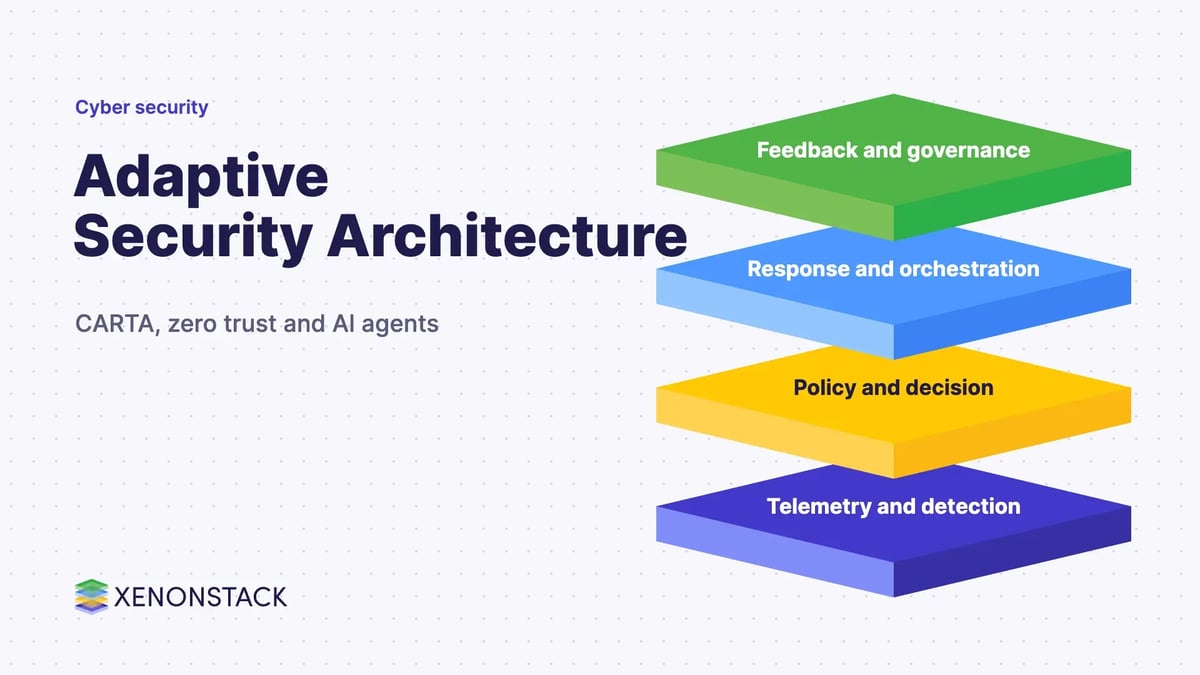
Most enterprise implementations settle into five layers. Product names vary; the responsibilities do not.
- Telemetry: logs, traces and events from identity, endpoints, cloud, networks and SaaS. Open standards such as OpenTelemetry reduce lock-in.
- Analytics and detection: correlates current activity with baselines. AI-driven threat hunting sits here, and machine learning in cybersecurity supports anomaly detection.
- Policy and decision: turns risk signals into step-up authentication, reduced privileges, session termination or device quarantine.
- Response and orchestration: runs playbooks and coordinates the security operations centre. Disruptive actions should need explicit approval rules.
- Feedback and governance: records what happened, why each decision was made and what changed afterwards, and produces the evidence boards and regulators expect.
How do AI agents change adaptive security?
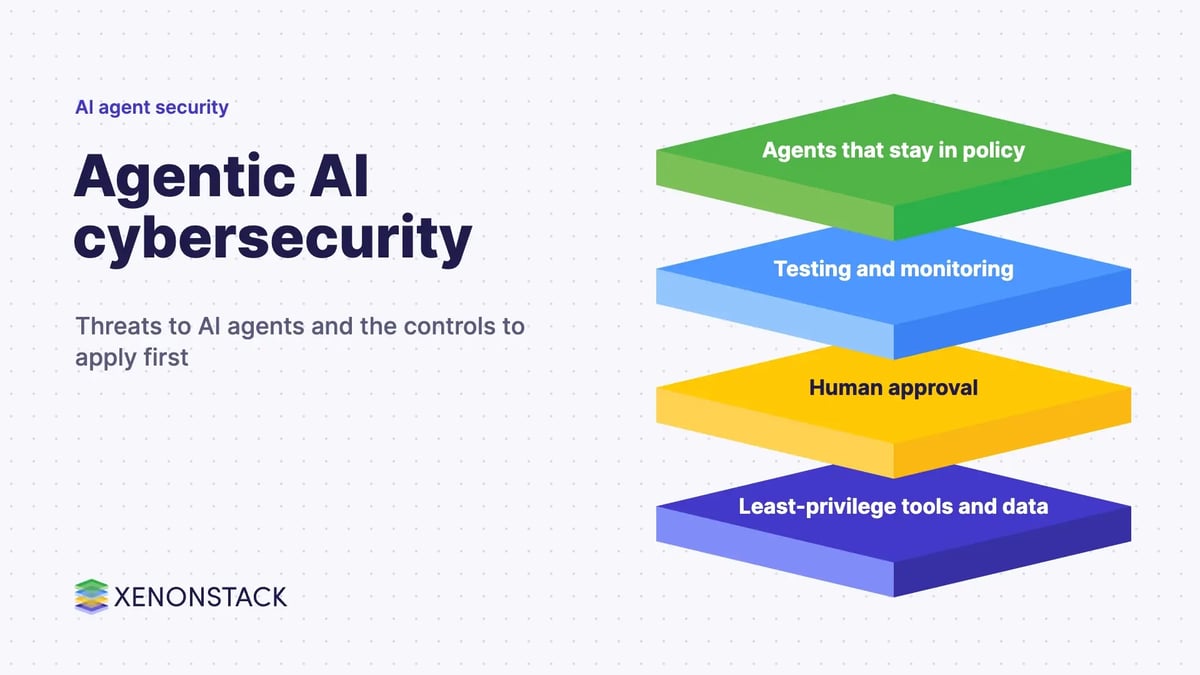
The newer shift is agentic AI in security operations: agents that gather context on an alert, draft an investigation summary, propose a containment step and, within defined limits, carry it out. Used well, this shortens the time between detection and response. AI also becomes part of the attack surface. An agent that reads attacker-controlled content, such as a phishing email, and can also change firewall rules is where prompt injection and excessive permissions meet; see overcoming cybersecurity challenges in agentic AI.
- Give security agents the least privilege needed for each task, and separate read actions from change actions.
- Require human approval for disruptive or irreversible steps such as disabling accounts or isolating production systems.
- Log every agent decision, input and action so it can be audited and replayed.
- Treat agents as identities monitored by the same adaptive controls.
The ElixirClaw platform is XenonStack's AI agents computing platform, for building and running agents like these under governance.
Which metrics show that adaptive security is working?
| Metric | What it tells you |
|---|---|
| Mean time to detect | How long attackers operate before discovery |
| Mean time to contain | How quickly response limits damage |
| Time to classify an incident | How fast you can decide whether reporting is required under rules such as NIS2 or DORA (check each official text for duties and deadlines) |
| Telemetry coverage | Share of critical assets, identities and third parties sending usable signals |
| Standing privileged access | Accounts, human or machine, with permanent high privilege |
| Controls changed after incidents | Whether lessons flow back into prevention |
What should you do first?
- Govern and baseline: agree risk appetite, crown-jewel assets and reporting obligations.
- Identity first: consolidate identity providers, enforce strong authentication and remove standing privileged access.
- Complete the telemetry across cloud, SaaS, endpoints and third parties before buying more detection tools.
- Detect and respond as one loop, and measure the time from alert to containment.
- Automate with guardrails: start with low-risk, high-volume steps and keep approval gates on disruptive actions.
- Validate continuously with penetration testing and resilience testing, and build security into delivery pipelines (see DevSecOps framework and tools).
Watch the trade-offs: tool sprawl creates more alerts rather than more security, behaviour-based detection needs tuning to avoid analyst fatigue, and automated containment can take down legitimate services. For foundational controls, use our cybersecurity checklist.
To map one security response decision your agents should make, and the context and policy it depends on, book a Context Workshop. See what happens in the workshop.
Frequently asked questions
What is adaptive security in simple terms?
It is a security approach that keeps assessing risk and adjusts controls as conditions change, using a continuous cycle of predict, prevent, detect and respond instead of fixed, one-time rules.
What does CARTA stand for?
CARTA stands for continuous adaptive risk and trust assessment. Gartner presented it in 2017 as the approach organisations should move to after the 2014 Adaptive Security Architecture.
Is adaptive security the same as zero trust?
No, but they overlap. Zero trust, defined in NIST SP 800-207, removes implicit trust based on network location and focuses on users, assets and resources. Adaptive security adds the loop that uses detection and response findings to improve those access decisions.
Where does AI fit in adaptive security?
AI supports anomaly detection and triage, and agents can propose or carry out response steps within limits. They need least privilege, approval gates for disruptive actions and full logging.
Is this the same as the company called Adaptive Security?
No. Adaptive Security is also a vendor name. This article covers the architecture concept, which is independent of any vendor.
Follow XenonStack on LinkedIn: XenonStack on LinkedIn for new guides on agentic AI, data and platform engineering.
Ready to put AI agents to work? Explore ElixirClaw, the agentic OS platform to build, orchestrate and govern AI agents.
Explore the XenonStack platform family: ElixirData · ElixirClaw · ElixirHub · NexaStack · MetaSecure · Neural AI · AgentGRC · AgentSRE · AgentAnalyst · AgentInstruct · AgentRAI · AgentScrum · AgentSearch · AgentForce · AI Aviator · SAIF Aviator · CohortIQ · XenonStack AI · XenonStack UAE