

Key takeaway
- Continuous intelligence turns live data into governed action. See the decision loop, what to automate first, controls, tooling changes and adoption steps.
Continuous intelligence is a design pattern in which real-time analytics are built into business operations, processing current and historical data to prescribe actions in response to business moments and other events (Gartner's definition, as quoted by SAP). The practical test for a CTO or CDO is simple: when something changes in the business, does a governed action follow while it still matters, or does a report arrive later for someone to read?
This guide treats continuous intelligence as an operating loop and a decision-rights question. For the technical layers underneath, read our real-time analytics architecture guide; for the vendor shortlist for platforms that govern decisions, see decision intelligence platforms. Here we cover what the loop contains, which decisions to hand to it first, how to govern it and when to leave it alone.
What is continuous intelligence, and how does it differ from BI and streaming analytics?
Business intelligence reports on what happened. Streaming analytics computes on events as they arrive. Continuous intelligence sits above both: it connects the result to a decision and an action. SAP describes the contrast as periodic checks of pre-defined KPIs versus machines monitoring data in the background to surface trends and correlations nobody defined in advance.
| Approach | Main question | Output | Who acts |
|---|---|---|---|
| Business intelligence | What happened? | Reports and dashboards | A person, later |
| Streaming analytics | What is happening in this stream? | Live metrics, alerts | A person, or a simple trigger |
| Continuous intelligence | What should we do now, and was it right? | A prescribed or automated action with a record | A system within limits, with a person where needed |
How does the continuous intelligence loop work?
Every working implementation repeats the same five steps. Weak spots are almost always in steps three to five, not in the data pipeline.
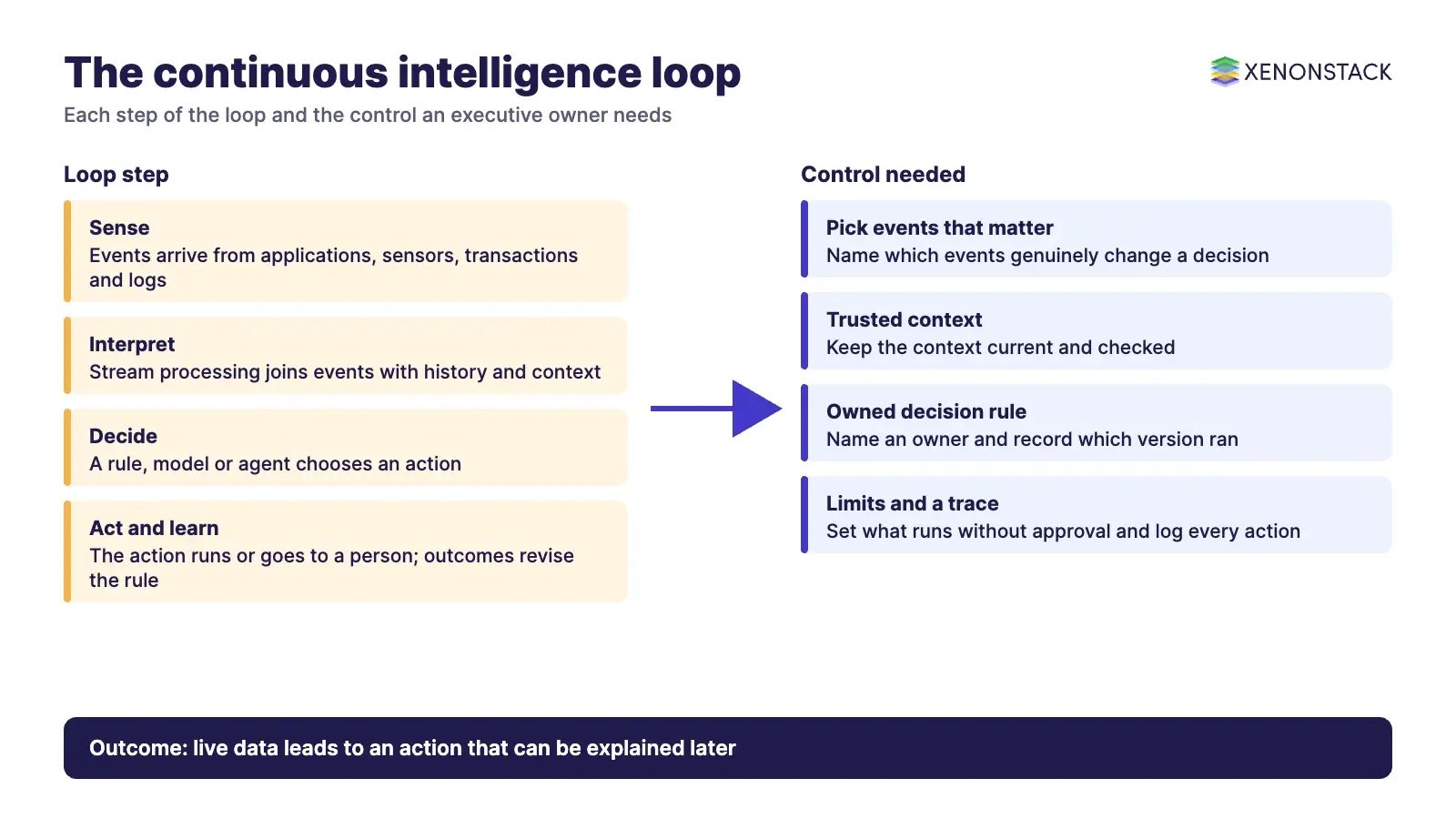
| Step | What happens | Question for the executive owner |
|---|---|---|
| 1. Sense | Events arrive from applications, sensors, transactions and logs | Which events genuinely change a decision? |
| 2. Interpret | Stream processing joins events with history and context, using state and rules or models | Is the context trusted and current? |
| 3. Decide | A rule, model or agent chooses an action | Who owns the decision rule, and which version ran? |
| 4. Act | The action executes in an operational system, or goes to a person for approval | What may run without approval? |
| 5. Learn | Outcomes are compared with expectations and the rule or model is revised | How quickly does feedback change the rule? |
Apache Flink's own documentation names event-driven applications, data analytics applications and data pipelines as its three main use case groups, and lists fraud detection and anomaly detection among the typical event-driven examples (Apache Flink use cases). That is the "interpret" step. The loop only becomes continuous intelligence when the output is wired to an action. Our streaming data platform and real-time analytics pages describe how we build the sensing and interpreting layers.
Which decisions should you automate first?
Pick decisions that are frequent, measurable and reversible. The table separates decisions by how much human control they should keep. The examples are drawn from the use cases in Flink's documentation and SAP's article, plus predictive maintenance as a common sensor-driven pattern.
| Decision type | Example | Suggested control | When it fits |
|---|---|---|---|
| Alert only | Anomaly in transaction patterns, unusual spike in open service tickets | Notify an owner with context | Early pilots, unclear rules |
| Recommend | Suggested response to a demand surge in retail, suggested part replacement from sensor drift | Person approves in one step | Rules are stable, cost of error moderate |
| Automate within limits | Routing a ticket, throttling a service, pausing a suspicious payment for review | Hard limits, full decision trace, easy rollback | High volume, low regret, proven accuracy |
| Keep human | Decisions with legal, safety or major financial effect | Human decides; system prepares evidence | Regulated or irreversible actions |
The same loop can feed AI agents as well as dashboards. For the question-answering end of the loop, AgentAnalyst lets teams ask questions of enterprise data in plain language and get real-time insights.
How do you govern decisions that systems take on their own?
Speed without a record is a risk. Each automated decision needs a trace: the event, the context and policy version used, the rule or model version, the action and the approver if there was one. Without it, you cannot explain or reverse an action later. ElixirData Context OS keeps governed context, versioned policy and decision traces in one decision layer above AI agents, which is the layer this loop needs once agents start to act. Where you build and run the agents themselves, ElixirClaw is an agentic OS platform to build, orchestrate and govern AI agents and automation workflows while keeping humans in control.
Three controls matter most: limits on what may run without approval, a named owner for every decision rule, and a review cycle for models whose inputs drift. Continuous monitoring of controls is one place where this already works in practice; the video below shows always-on compliance checks run by agents inside defined policy.
Video: continuous control monitoring, an example of an always-on loop that checks, acts within policy and keeps a record.
What has changed in the tooling?
| Change | What it means for you | Source |
|---|---|---|
| Amazon Kinesis Data Analytics for SQL has been discontinued, with Managed Service for Apache Flink as the successor | Plan migration of SQL-based streaming jobs to Flink | AWS documentation |
| Spark DStreams is legacy; Structured Streaming is the model to use | Avoid new builds on DStreams | Apache Spark docs |
| Consumers of real-time results now include AI agents, not only dashboards | Decision traces and policy limits move from nice to have to required | See governance section above |
For engine and managed-service choices, our streaming analytics tools guide compares the options.
What is a sensible adoption sequence?
- Name one decision. Write down the decision, its owner, the event that triggers it and the action that follows.
- Measure the current delay. Record how long the decision takes today and what that delay costs.
- Start with alert or recommend. Run the loop with a person approving, and compare outcomes with the old process.
- Add the decision trace. Log inputs, versions and outcomes before any automation.
- Automate within limits. Move proven, low-regret decisions to automatic action with a rollback path.
- Feed the DataOps cycle. Use outcomes to improve models and rules. Our AI agents for DevOps and progressive delivery guide covers the delivery side of that cycle.
When is continuous intelligence not the right fit?
- The decision is made monthly or quarterly. A scheduled report is cheaper and clearer.
- Nobody owns the action. A live signal without an owner becomes alert noise.
- The source data is not trusted. Automating on poor data scales the error.
- The decision is irreversible or heavily regulated. Keep a person in control and use the system to prepare evidence.
To see where continuous intelligence applies in your own operations, our use cases for continuous intelligence article walks through examples such as IT alert triage, fraud and predictive maintenance.
To map one real-time decision your agents should make, and the context and policy it depends on, book a Context Workshop. See what happens in the workshop.
Frequently asked questions
What is continuous intelligence in simple terms?
It is a design pattern in which real-time analytics are built into business operations, processing current and historical data to prescribe actions in response to business moments and other events. The point is that the result drives an action, not only a dashboard.
How is continuous intelligence different from real-time analytics?
Real-time analytics answers a question about fresh data. Continuous intelligence adds the rest of the loop: a decision rule or model, an action in an operational system, a record of why it was taken, and feedback that improves the next decision.
Do we need Apache Flink or Kafka to do continuous intelligence?
Not necessarily. You need stream processing that can hold state and react to events, and Apache Flink is one engine built for event-driven applications such as fraud and anomaly detection. Which engine fits depends on your latency target, skills and cloud, so choose after you have named the decision.
Which decisions should be automated first?
Start with frequent, low-regret decisions where the cost of a wrong action is small and reversible, such as routing a ticket or raising an alert. Keep a human approval step for decisions that move money, affect customers directly or fall under regulation.
How do you govern decisions that systems take on their own?
Version the policy each decision uses, log the inputs, the rule or model version and the action taken, and set clear limits on what may run without approval. That decision trace is what lets risk and audit teams review an automated action later.
Explore the XenonStack platform family: ElixirData · ElixirClaw · ElixirHub · NexaStack · MetaSecure · Neural AI · AgentGRC · AgentSRE · AgentAnalyst · AgentInstruct · AgentRAI · AgentScrum · AgentSearch · AgentForce · AI Aviator · SAIF Aviator · CohortIQ · XenonStack AI · XenonStack UAE


