Key takeaway
- Cloud native security protects containers, clusters and pipelines across their lifecycle. See the 3 Rs, four layers, tools, controls and first steps.
Cloud native security is the practice of protecting applications built from microservices, containers and automated pipelines at every stage of their lifecycle, from design and build through deployment and runtime.
This guide is for platform, DevOps and security leaders running cloud native workloads on providers such as Amazon Web Services or Google Cloud. It covers the architecture, the three Rs, the layered model, open-source tools, control types and the first steps to take, and it fits alongside our wider overview of cloud security.
What is cloud native security and why is it different?
Applications on Kubernetes change constantly, as CI/CD pipelines rebuild images and replace pods. A model that assumes a fixed perimeter does not fit that pace.
The Kubernetes documentation on cloud native security says Kubernetes draws on CNCF advice about good practice and organises controls by lifecycle phase: develop, distribute, deploy and runtime. Its distribute phase, for example, asks you to scan container images for known vulnerabilities and to keep images in a private registry that only authorised clients can pull from.
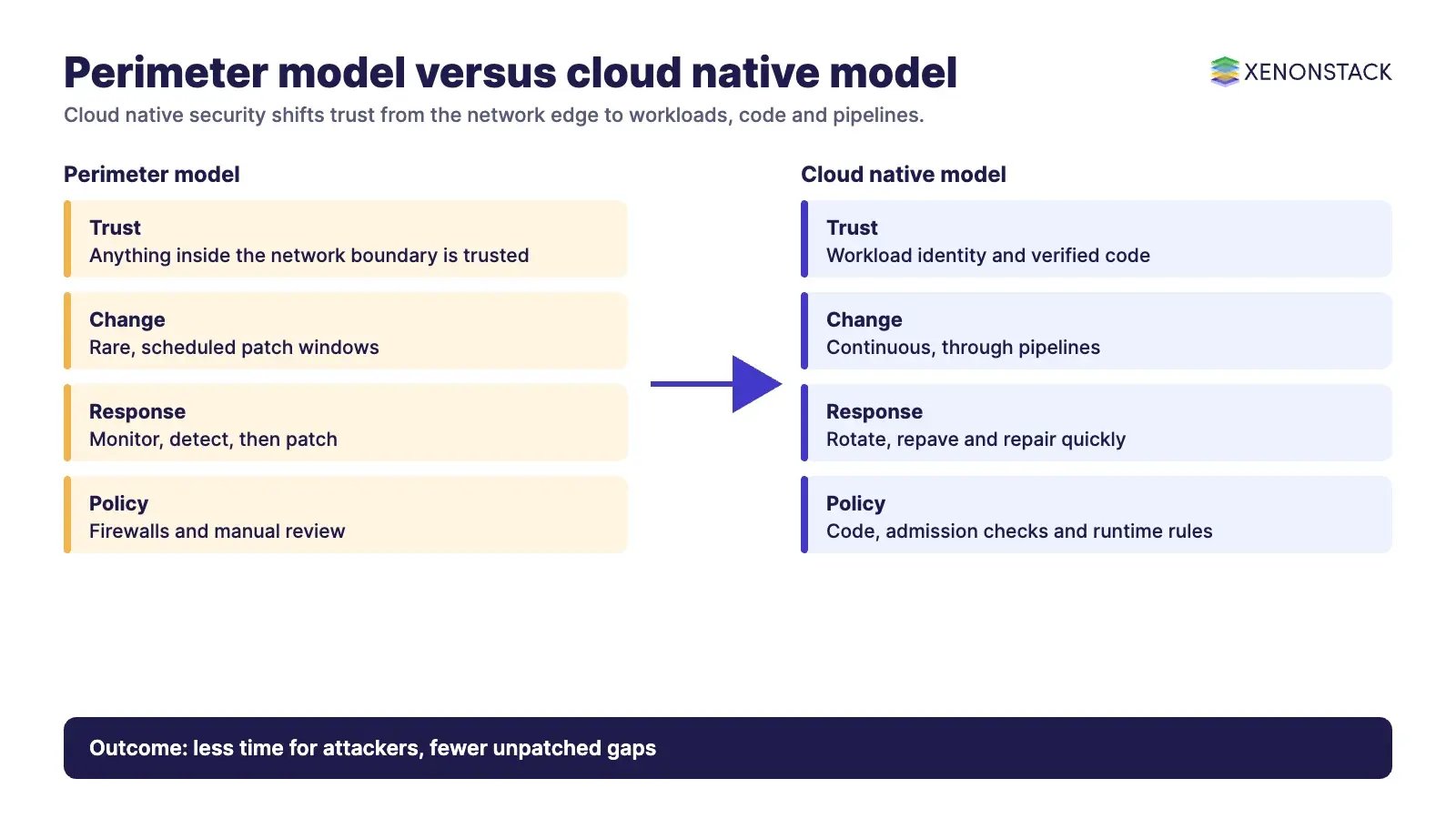
Google describes the same shift in its BeyondProd architecture. The document says it "doesn't rely on traditional network perimeter protections such as firewalls" and that service trust depends on code provenance, trusted hardware and service identity rather than network location.
| Question | Perimeter model | Cloud native model |
|---|---|---|
| Where is trust placed? | Inside the network boundary | In workload identity and verified code |
| How often does the estate change? | Rarely, through scheduled patches | Continuously, through pipelines |
| What is the main response to risk? | Monitor and detect, then patch | Rebuild from a known state and enforce policy early |
| Where does policy live? | Firewalls and manual review | Code, admission checks and runtime rules |
What are the 3 Rs of cloud native security?
The three Rs come from a January 2017 VMware Tanzu post, whose author argues that attacks need time, leaked credentials and unpatched or misconfigured software. The post says to rotate datacenter credentials every few minutes or hours, repave every server and application every few hours from a known good state, and repair vulnerable operating systems and application stacks within hours of a patch becoming available. Its summary is that faster is safer.
The model works best with immutable infrastructure, so it pairs naturally with Kubernetes security automation and with adaptive security practices that watch behaviour and respond as it changes.
What are the four layers of cloud native security?
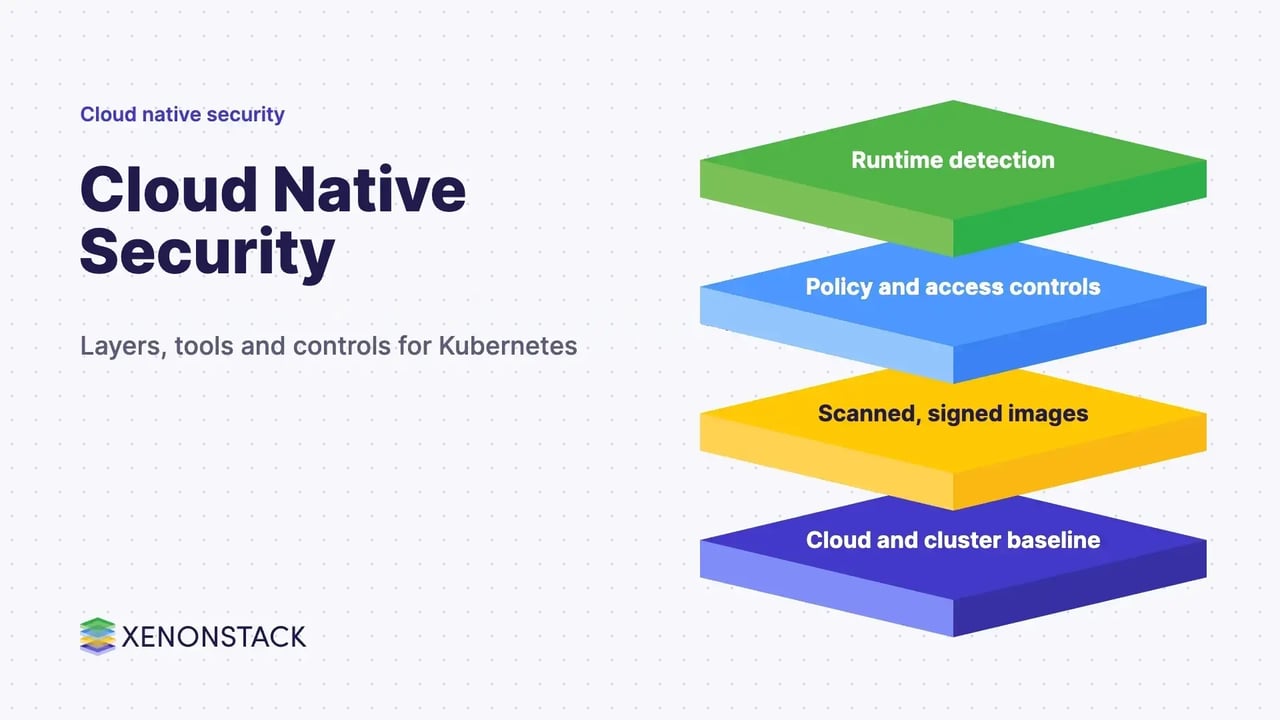
A common way to sort controls is into four layers: cloud, cluster, container and code. Each layer rests on the one below it, so a weakness in an outer layer can undermine the inner ones.
Code
Focus on securing the code throughout its lifecycle. This includes implementing secure coding practices, conducting regular code reviews, and utilizing tools for static and dynamic analysis to identify vulnerabilities early in the development process
Container
Ensure that containers are secured by using trusted images, scanning for vulnerabilities, and applying security best practices. This involves managing container runtimes and implementing security policies that govern how containers interact
Cluster
Secure the orchestration and management of container clusters (like Kubernetes). This includes configuring access controls, securing the API server, and regularly auditing cluster configurations to prevent unauthorized access and misconfigurations
Cloud
Protect the underlying cloud infrastructure. This involves managing cloud security settings, monitoring for suspicious activity, and ensuring that data is encrypted both at rest and in transit. It also includes compliance with regulations and standards relevant to your organization
Which tools support cloud native security?
Open-source tools cover different parts of the lifecycle. The table lists the ones whose own project pages we read.
| Tool | What its project page says it does | Lifecycle fit |
|---|---|---|
| Clair | Static analysis of vulnerabilities in application containers; clients index images through its API and match them against known vulnerabilities | Distribute: image scanning |
| kube-bench | Checks whether Kubernetes is deployed securely by running the checks in the CIS Kubernetes Benchmark | Deploy: cluster configuration audit |
| Open Policy Agent | A general-purpose policy engine; policies are written in Rego, a declarative language, and decisions can be more than allow or deny | Deploy and runtime: policy decisions |
| Falco | Runtime security that reads Linux system calls and alerts when a rule is violated; a graduated CNCF project | Runtime: threat detection |
Other open-source projects in this space include Curiefense, CloudSploit and Pacu: check each project's own repository for current maintenance status before adopting one.
What threats and control types should you plan for?
Common causes include unsecured APIs and exposed legacy features that allow unauthorised access, accounts without multi-factor authentication, and default settings or credentials left in place. Cloud providers can also hold administrative access, so sensitive data needs Zero Trust policies, audit logs and tightly restricted access. Advanced persistent threats stay hidden for long periods, so threat intelligence and security analytics help teams spot them sooner.
| Control type | Purpose | Cloud native example |
|---|---|---|
| Deterrent | Warn users that actions are logged | Login banners and visible audit logging |
| Preventive | Stop the action before it happens | Admission policies, network segmentation, least privilege |
| Detective | Spot unusual activity | Runtime rules, intrusion detection, log review |
| Corrective | Contain and fix after a breach | Blocking a compromised port or address, stopping a malicious process |
| Workload | Control images, packages and libraries | Approved base images and a private registry |
| Identity and access | Prevent privilege escalation | Role-based access, service accounts, MFA |
How does cloud native security fit into DevOps?
Moving checks to the start of the software development life cycle means vulnerabilities are found when they are cheapest to fix. This is the idea behind DevSecOps: image scans, policy checks and penetration testing run in the pipeline, with patch management and access control handled as code. See also cloud native DevOps.
How do AI agents change cloud native security?
Agents that operate in clusters, pipelines and cloud accounts act with credentials, so each one needs its own identity, narrowly scoped permissions, policy checks before it acts and an audit trail afterwards. The three Rs apply directly: agent credentials should be short-lived and rotated, and agent runtimes should be rebuilt from known images. XenonStack's ElixirClaw is the AI agents computing platform for building and running such automation.
What should you do first?
- Inventory images, clusters and pipelines, and note who owns each.
- Scan images in the pipeline and move them to a private registry.
- Run a CIS benchmark audit on each cluster and fix the findings.
- Automate credential rotation and rebuild workloads from known images on a schedule.
- Add admission and runtime policy, then route alerts to a named owner.
To map one decision your agents make, and the data and policy it depends on, book a Context Workshop. See what happens in the workshop.
Frequently asked questions
What is cloud native security?
It is the practice of securing applications built from containers, microservices and automated pipelines across their whole lifecycle, using identity, policy and verification for each workload instead of relying on a single network perimeter.
What are the 3 Rs of cloud native security?
Rotate credentials every few minutes or hours, repave servers and applications from a known good state every few hours, and repair vulnerable software within hours of a patch becoming available, as described in a January 2017 VMware Tanzu post.
What are the 4 Cs of cloud native security?
They are four layers: cloud, cluster, container and code. A weakness in an outer layer can undermine the layers inside it, so controls are needed at each one.
Which open-source tools help secure Kubernetes workloads?
Clair scans container images for known vulnerabilities, kube-bench checks a cluster against the CIS Kubernetes Benchmark, Open Policy Agent makes policy decisions, and Falco detects rule violations at runtime.
How does DevSecOps relate to cloud native security?
DevSecOps moves security checks such as image scanning, policy checks and penetration testing into the delivery pipeline, so problems are found early and fixed before release.
Ready to put AI agents to work? See an ElixirClaw demo: the agentic OS to build, orchestrate and govern AI agents across your enterprise systems.
Explore the XenonStack platform family: ElixirData · ElixirClaw · ElixirHub · NexaStack · MetaSecure · Neural AI · AgentGRC · AgentSRE · AgentAnalyst · AgentInstruct · AgentRAI · AgentScrum · AgentSearch · AgentForce · AI Aviator · SAIF Aviator · CohortIQ · XenonStack AI · XenonStack UAE