Key takeaway
- How agentic AI works in banking, healthcare, manufacturing, retail, telecom, logistics and government: use cases, controls, regulation and first steps.
Agentic AI by industry means AI agents that plan and carry out multi-step work inside one sector's systems, rules and risk limits: claims and credit decisions in banking and insurance, documentation and administration in healthcare, maintenance and procurement in manufacturing, and network operations in telecom. The agents are much the same across sectors. What changes is the context they need, the decisions they may take alone, and the regulation that applies. This guide sets out where agents deliver value in each industry, which controls each sector needs, and how to start.
What changes when AI agents move into a specific industry?
A general-purpose agent can draft, search and summarise. An industry agent has to act inside a regulated process, so three things matter more than the model:
- Industry context. Entities, definitions and policies that the agent reads before acting: a claim and its policy terms, a patient record and its consent, a work order and its safety permit.
- Decision rights. Which actions the agent may take alone, which need a human approval, and which it may never take.
- Evidence. A decision record for every action, showing the inputs, the policy applied and who approved it, so the decision can be explained to an auditor or regulator.
These three layers sit outside the agent. That is why we describe the foundation as decision infrastructure: the same governed context and decision records serve every agent in the enterprise, whatever the sector.
Which industries use agentic AI, and for what?
| Industry | Where agents help first | Control that matters most |
|---|---|---|
| Banking and insurance | Claims triage, credit and KYC case work, finance operations | Human approval on credit and claim outcomes; full decision trail |
| Healthcare and life sciences | Clinical documentation, administration, knowledge retrieval | Consent-aware data access; clinician sign-off |
| Manufacturing and energy | Root-cause analysis, maintenance planning, procurement | Safety permits and change control before any physical action |
| Retail and consumer goods | Recommendations, pricing support, loss and fraud prevention | Limits on autonomous price and refund actions |
| Telecom | Network operations, incident handling, service assurance | Staged rollout of network changes with automatic rollback |
| Supply chain and logistics | Exception handling, carrier and inventory decisions | Spend and commitment limits per agent |
| Government and public sector | Case handling, citizen services, inspections | Explainable decisions and public accountability records |
| Travel and hospitality | Guest service, bookings, disruption handling | Clear hand-off to staff; refund and compensation limits |
| Education | Learner support, administration, content preparation | Age-appropriate safeguards and data protection |
How does an industry agent architecture fit together?
How is agentic AI used in banking, financial services and insurance?
Banks and insurers start with case work that is high in volume and rich in rules: claims intake and triage, KYC refresh, credit memo preparation, reconciliation and close. Agents gather the evidence and prepare the decision; a human approves the outcome where it affects a customer's money or credit. Regulators in the GCC, India and the EU increasingly expect that trail.
- Agentic AI in Banking: Use Cases, Controls and Rules
- Agentic AI in Banking 2026: What GCC, India and EU Regulators Expect from AI Agents
- Agentic AI in Insurance Claims: 2027 Guide
- Agentic AI in Finance Operations: A Guide for CFOs
- AI in Wealth Management: Agentic AI Guide
How is agentic AI used in healthcare and life sciences?
The first wins are administrative: clinical documentation, prior authorisation packs, scheduling and knowledge retrieval for staff. In life sciences, agents support literature review and content preparation. Every use needs consent-aware access to patient data and a clinician who signs off anything that reaches a patient record.
- Agentic AI in Healthcare: Applications, Risks and Rules
- Decision Infrastructure for Healthcare Administration: AI Agents with Governed Context
- Healthcare Knowledge Management with Agentic AI
- Agentic AI for Clinical Documentation in Healthcare
- Agentic AI in Pharma: Drug Discovery and Content
How is agentic AI used in manufacturing, energy and industrial operations?
Plants use agents to shorten the path from an alarm to a decision: root-cause analysis across sensor, maintenance and quality data, maintenance planning, and procurement of spares. Agents recommend; any action on physical equipment passes through the existing safety permit and change-control process.
- Agentic AI in Manufacturing: Use Cases and Governance
- Industrial Procurement with Agentic AI: A Practical Guide
- Agentic AI in Energy Sector: Use Cases and Controls
- Agentic AI in Oil and Gas: Where Agents Fit Safely
How is agentic AI used in retail and consumer goods?
Retailers apply agents to recommendations, assortment and pricing support, and loss and fraud prevention. The control question is how far an agent may change a price, issue a refund or block a transaction without a person.
- AI Agents for Retail: Decisions, Controls, Rollout
- Retail Loss and Fraud Prevention with Agentic AI
- Agentic Process Automation for Retail and CPG
How is agentic AI used in telecom?
Operators use agents for incident handling, service assurance and steps towards autonomous networks. Changes to the network are staged, checked and reversible, so an agent's action can be rolled back automatically.
- Agentic AI in Telecom: Use Cases and Autonomous Networks
- AI in Telecom: Use Cases, Standards and AI Agents
- AIOps for Telecom: Use Cases, Tools and AI Agents
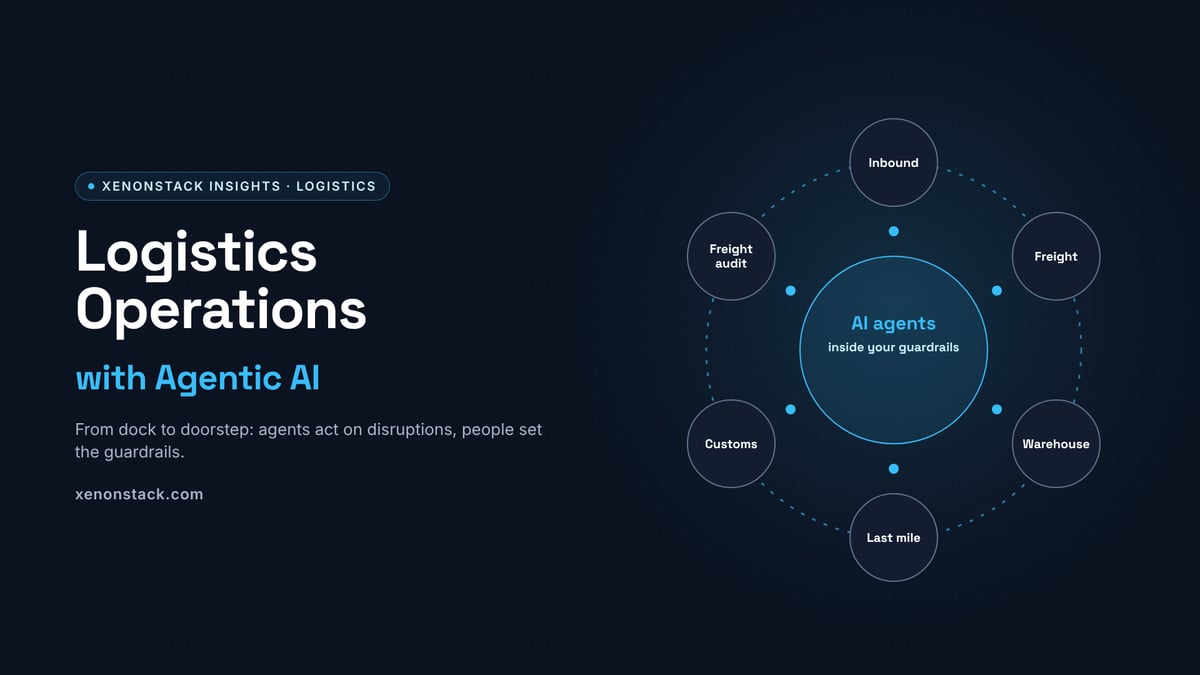
How is agentic AI used in supply chain and logistics?
Agents handle exceptions: a late shipment, a stock-out risk, a carrier that misses a slot. They compare options and either act within an agreed spend limit or escalate with a recommendation.
- Agentic AI in Logistics Operations: A Practical Guide
- Agentic AI in Supply Chain Management: Use Cases
- Agentic Process Automation in Logistics and Supply Chain
How is agentic AI used in government, hospitality and education?
Public bodies need decisions they can explain to citizens, so a decision record matters as much as the agent itself. Hospitality uses agents for guest service and disruption handling with a clear hand-off to staff. Education uses agents for learner support and administration, with strong data protection.
- Decision-Record Layer for Government AI Accountability
- Voice AI Agents in Hospitality: Beyond the AI Receptionist
- Agentic AI in Travel and Hospitality: Use Cases and Risks
- AI Agents in Education: Roles, Controls and Skills
How does regulation differ by industry?
Regulation follows the use, not the technology. Under the EU AI Act, uses such as creditworthiness assessment and risk pricing for life and health insurance are listed as high-risk, so agents in those processes carry obligations for risk management, human oversight and record keeping. Sector regulators in banking, healthcare and the public sector add their own expectations on top. Our guide to AI regulation for AI agents covers the EU AI Act, NIST AI RMF and ISO/IEC 42001 in detail.
Where should an enterprise start with industry agents?
- Pick one decision, not one department. Choose a frequent decision with clear rules and a measurable delay, such as claim triage or maintenance planning.
- Map the context the decision needs. List the systems, definitions and policies a person uses today.
- Set decision rights. Agree what the agent may do alone, what needs approval and what is out of bounds.
- Record every decision. Keep inputs, policy, approver and outcome from day one.
- Reuse the foundation. Add the next decision on the same context and controls instead of starting again.
For the cross-industry foundations, see our guides to agentic AI, AI agents and agentic AI governance and compliance.
Plan your first industry agent in a Context Workshop
In one working session, we map one decision in your sector, the context it needs and the controls it must meet. Book a Context Workshop or see a Context OS demo.
Frequently Asked Questions
What is agentic AI by industry?
It is the use of AI agents that plan and act within one sector's processes, data and rules, such as claims in insurance or maintenance in manufacturing, with controls set for that sector's risks and regulation.
Which industries are adopting agentic AI first?
Banking and insurance, healthcare administration, manufacturing, telecom and logistics lead, because they combine high case volumes, clear rules and costly delays.
Do industry agents need different models?
Usually not. The difference lies in the context the agent reads, the skills it uses, its decision rights and the evidence it records. These are set per industry on a shared platform.
How does regulation affect agentic AI in each industry?
It depends on the use. Credit and insurance risk decisions are high-risk under the EU AI Act, healthcare uses fall under patient-data and clinical rules, and public bodies must be able to explain decisions. Human oversight and decision records help in every case.
How does XenonStack support industry agents?
ElixirData provides the governed context and decision records, and ElixirClaw runs the agents with sector skills, policy checks and approval gates on one platform.
Follow XenonStack on LinkedIn: XenonStack on LinkedIn for new guides on agentic AI, data and platform engineering.
Ready to put AI agents to work? Explore ElixirClaw, the agentic OS platform to build, orchestrate and govern AI agents.
Explore the XenonStack platform family: ElixirData · ElixirClaw · ElixirHub · NexaStack · MetaSecure · Neural AI · AgentGRC · AgentSRE · AgentAnalyst · AgentInstruct · AgentRAI · AgentScrum · AgentSearch · AgentForce · AI Aviator · SAIF Aviator · CohortIQ · XenonStack AI · XenonStack UAE