Key takeaway
- How agentic AI drafts clinical notes, supports coding and keeps every EHR write governed. Decision table, risks and an adoption sequence for CIOs.
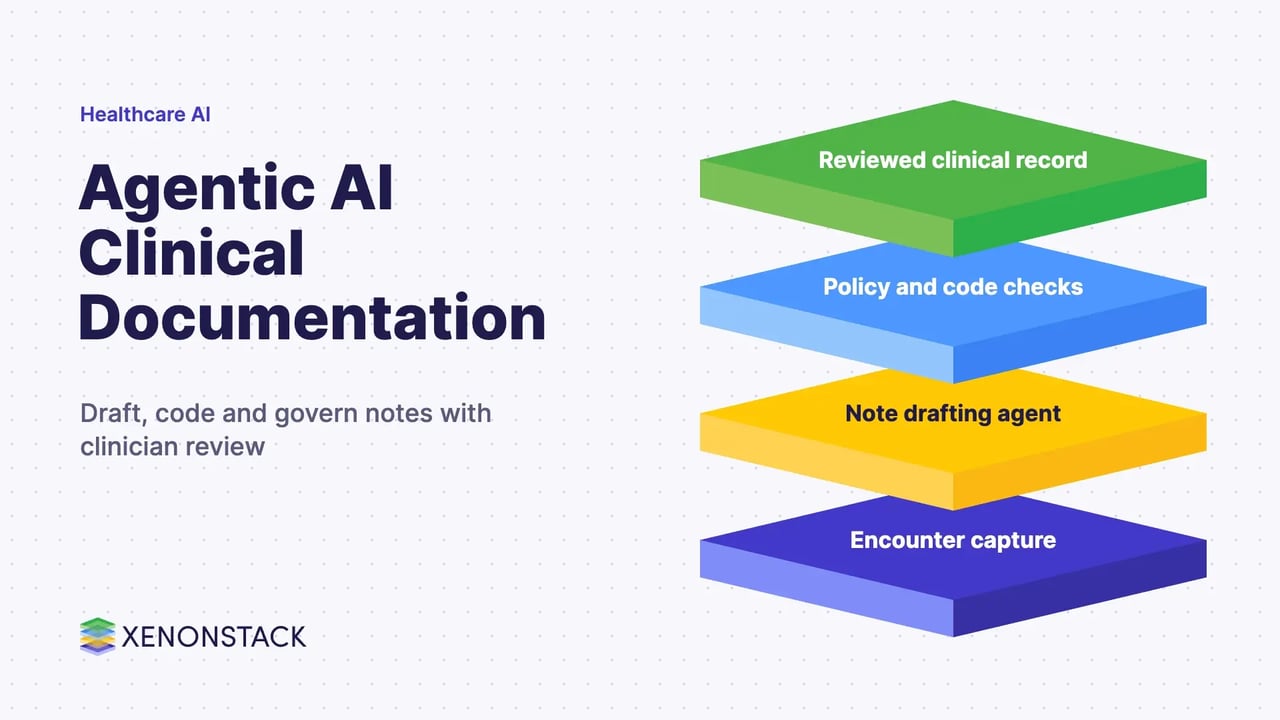
Agentic AI for clinical documentation is software that listens to or reads a patient encounter, drafts the note and the billing codes, checks them against policy, and hands the result to a clinician to review before anything is written to the record. For a CIO or Chief Medical Information Officer, the value is not only faster notes. It is a documentation workflow where every draft, edit and approval can be traced.
This guide is for enterprise decision makers who need to know where agents fit, what has changed on the AWS side, how to govern them and when not to use them. For the language-model techniques behind note generation, read our companion post on healthcare documentation with natural language processing. This post focuses on the agent layer and the controls around it.
What is agentic AI clinical documentation, and how is it different from speech-to-text?
Speech-to-text turns audio into words. An agent goes further: it plans a sequence of steps, calls tools, and checks its own output. In a documentation workflow those steps are usually transcription, extraction of symptoms, medications and diagnoses, drafting of the note, suggestion of codes, and a check against the organisation's rules before a human sees the draft. XenonStack describes its broader approach on the Agentic AI for healthcare page and its sector work on digital healthcare transformation.
Where does manual documentation break down?
Clinical notes, histories, prescriptions, discharge summaries and compliance reports all depend on people typing into rigid electronic health record (EHR) screens. The failure points are consistent:
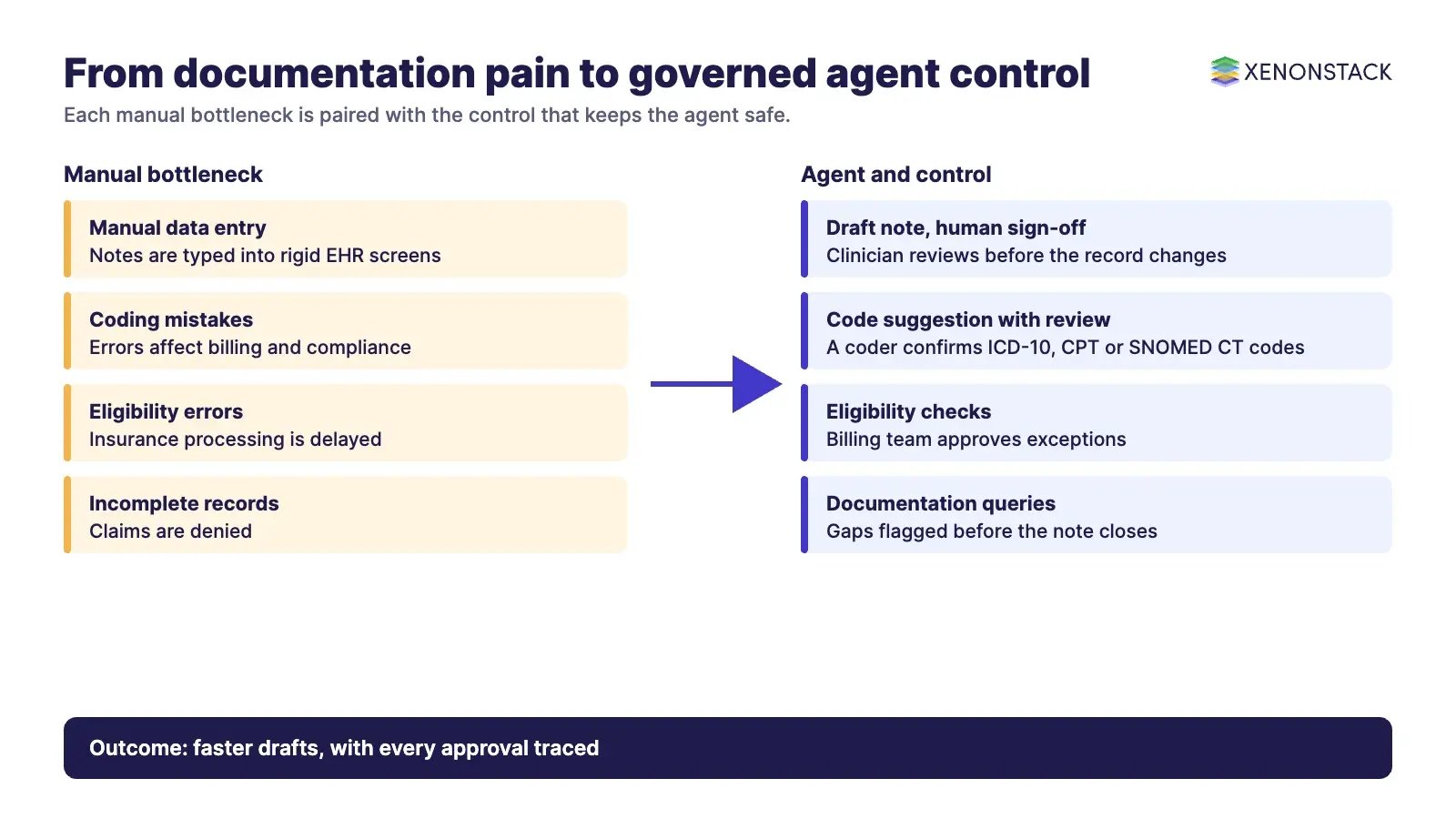
- Manual data entry that delays notes and introduces inaccuracies.
- Medical coding mistakes that affect billing and compliance.
- Eligibility verification errors that hold up insurance processing.
- Repetitive administrative work that falls on clinical staff.
- Claim denials caused by incomplete or inconsistent records.
These problems turn into operating cost, clinician fatigue and revenue leakage. The case for an agent rests on removing the repeatable parts of this work while keeping clinical judgement with the clinician.
Which documentation tasks can an agent take on?
| Task | What the agent does | Human checkpoint | Fits when |
|---|---|---|---|
| Clinical note drafting | Turns a patient and clinician conversation into a structured draft note | Clinician reviews and signs | Encounters are conversational and notes follow a known template |
| Code suggestion | Maps documented findings to code sets such as ICD-10, CPT and SNOMED CT | Coder or clinician confirms | You have a stable coding policy and a denial history to learn from |
| Clinical documentation improvement | Flags missing or inconsistent detail in a note before it is closed | Clinician answers the query | Incomplete records are a visible cause of denials |
| Eligibility and claim checks | Prepares eligibility checks and flags claims likely to be rejected | Billing team approves exceptions | Payer rules are documented and machine-readable |
| Research and trial records | Collects structured data from encounters and lab results | Study lead validates | Data use is covered by consent and a protocol |
Code mapping and eligibility checks are where agents add the most review burden if the rules are vague. Start with note drafting, where the output is easy for a clinician to judge.
What has changed on the AWS side?
Many teams build on AWS services, and the product landscape has moved. We checked AWS's own pages on 12 November 2026.
| Item | What AWS says | What it means for you |
|---|---|---|
| Amazon Transcribe Medical | Presented as a current service available through public APIs, with AWS HealthScribe noted as an option that combines it with generative AI | Still an option for speech-to-text only |
| AWS HealthScribe | Creates clinical notes from patient and clinician conversations using generative AI, with transcripts that link each note sentence back to the source; described as a HIPAA-eligible service | Evaluate it as the note-drafting component before building your own |
| Amazon Connect Health | The HealthScribe page recommends exploring it for the latest clinical documentation experience | Check it before committing to a long build |
HIPAA eligibility means a service can be used within a HIPAA-compliant design. It does not make your workflow compliant. That depends on how you configure and operate it.
How do you govern an agent that writes to the clinical record?
The HHS HIPAA Security Rule calls for appropriate administrative, physical and technical safeguards to protect the confidentiality, integrity and availability of electronic health information. For an agent, that translates into practical controls:
- Draft status by default. Agent output stays a draft until a named clinician approves it.
- Least privilege. The agent reads only the records the encounter needs and writes only to draft fields.
- Source linking. Each statement in a note can be traced to the transcript or record it came from.
- Decision trace. Keep a log of what the agent saw, what it proposed, what the human changed and which policy version applied.
- Standards-based exchange. HL7 describes FHIR as a standard for exchanging healthcare information electronically, so use it for integration rather than custom interfaces where your EHR supports it.
ElixirData's Context OS keeps governed context, versioned policy and decision traces in one decision layer above AI agents, and AgentGRC keeps autonomous agent actions inside policy, with the audit trail risk teams need. ElixirClaw is an agentic OS platform to build, orchestrate and govern AI agents and automation workflows while keeping humans in control.
What does a sensible adoption sequence look like?
- Pick one specialty and one note type. Choose a high-volume, low-risk setting.
- Run in shadow mode. The agent drafts, clinicians write as usual, and you compare.
- Add clinician review. Measure edit rates and the kinds of corrections made.
- Introduce code suggestions. Keep a coder in the loop and track denial reasons.
- Extend to claims and compliance reports. Only after the controls above are working.
What are the cost and trade-off considerations, and when is it the wrong choice?
The main cost drivers are the speech and language services, integration work with your EHR, clinician review time and governance tooling. Savings depend on how much review time the drafts remove, which you should measure in your own pilot rather than assume.
An agent is the wrong choice where encounters are highly sensitive and consent for recording is not settled, where your EHR offers no safe integration path, where coding rules are unclear, or where no clinician has time to review drafts. In those cases, fix the process first.
The direction of travel is toward documentation that is captured during the visit, linked to its sources and reviewed by exception. Whether that reaches decision support or predictive insight depends on evidence from your own pilots, so treat those as options to test rather than promises.
To map one documentation decision your agents should make, and the context and policy it depends on, book a Context Workshop. See what happens in the workshop.
Frequently asked questions
What is agentic AI for clinical documentation?
It is a set of AI agents that capture an encounter, draft the note, suggest codes and check the draft against policy, then pass it to a clinician for review before it enters the record.
Does the agent replace clinician review?
No. Agent output should stay a draft until a named clinician approves it, and the approval should be logged.
Is AWS HealthScribe HIPAA eligible?
AWS describes AWS HealthScribe as a HIPAA-eligible service. Eligibility is not the same as compliance, so your configuration and operating controls still need review.
Which standards matter most for integration?
The HIPAA Security Rule sets the safeguards for electronic health information, and HL7 FHIR is a standard for exchanging healthcare information electronically. Code sets such as ICD-10, CPT and SNOMED CT matter for coding.
Where should we start?
Start with one specialty and one note type, run the agent in shadow mode, then add clinician review before extending to coding and claims.
Explore the XenonStack platform family: ElixirData · ElixirClaw · ElixirHub · NexaStack · MetaSecure · Neural AI · AgentGRC · AgentSRE · AgentAnalyst · AgentInstruct · AgentRAI · AgentScrum · AgentSearch · AgentForce · AI Aviator · SAIF Aviator · CohortIQ · XenonStack AI · XenonStack UAE