Key takeaway
- How retailers use agentic AI to prevent loss and fraud: what NRF 2026 data shows, which patterns agents can act on, governance and a rollout order.
Agentic AI helps retailers cut loss and fraud by watching point-of-sale, video, inventory and returns data together, scoring each event against policy, and routing the few that matter to a person with the evidence attached. It does not replace loss prevention teams. It replaces the manual audit and the after-the-fact review as the first line of detection.
This guide is written for CIOs, CISOs, heads of loss prevention and the architects who must integrate the stack. It covers where the 2026 loss picture is shifting, which loss patterns agents can act on, how to govern automated actions on staff and customers, and a sensible order of adoption. For the wider foundations, see our guide to the agentic AI risk management approach and the fraud prediction with AutoAI use case.

Retail AI Spending Growth
Retail industry AI spending is forecast to reach $10.8 billion in 2025 and surge to $91 billion by 2033.

Agentic AI Adoption and Budget
7% of retailers use Agentic AI for personalization and automation, while 86% have an AI budget, over half for Agentic AI.
What does agentic AI change in retail loss and fraud prevention?
Classic loss prevention tools raise an alert and wait. An agentic system perceives data from several sources, reasons about whether an event is suspicious in context, and takes a bounded action such as holding a refund, opening an incident record or asking a manager to confirm. Each step is logged so the decision can be reviewed later.
| Area | Rule-based and manual approach | Agentic approach | Trade-off |
|---|---|---|---|
| Detection | Fixed thresholds and exception reports reviewed after the shift | Pattern and context checks across POS, video, inventory and staff data as events arrive | More integration work and a need to tune false positives |
| Response | Analyst reads a report, then raises a ticket | Agent opens the incident, attaches evidence and routes it to the right approver | Actions need clear limits and an audit trail |
| Coverage | Sampled audits of stores and transactions | Every transaction and flagged clip is checked against the same policy | Data quality becomes the limiting factor |
| Staff and customers | Judgement of whoever is on shift | Consistent rules, with a human decision where the outcome affects a person | Fairness, privacy and appeal routes must be designed in |
What does the 2026 NRF data say about where losses are moving?
The National Retail Federation (NRF) and the Loss Prevention Research Council published "Impact of Theft & Violence 2026" in summer 2026. The survey ran online from February to April 2026 among senior loss prevention and security executives at 66 retail companies representing 143 brands. Read the results as one survey of large retailers, not as the whole market. Sources: SecurityInfoWatch and Retail Dive, as reported.
| Finding (2025 versus 2024, as reported) | Figure | What it means for the architecture |
|---|---|---|
| Shoplifting incidents | Down 12.4% | Physical theft is easing in this sample, so budget cannot assume it is the only problem |
| Retail merchandise theft | Down 8.1% | Inventory and video signals remain useful but are not the whole picture |
| Retailers reporting more phone scams | 69% | Contact centre and payment channels need the same monitoring as the store |
| Retailers reporting more loyalty fraud | 51% | Account-level signals belong in the same decision layer as store signals |
| Retailers reporting more repeat offenders | 50% | Case history and cross-store matching matter |
| Retailers reporting more gift card theft or fraud | 42% | Tender-type rules and velocity checks at POS and online |
| Retailers reporting more organised retail crime incidents | 40% | Link incidents across stores and over time |
| Retailers reporting more walkout or pushout theft | 37% | Real-time alerts to staff with safe response guidance |
NRF also reports that 63% of retailers say they report fewer than half of store-related theft incidents, mainly because losses are low-dollar or below felony thresholds, or because of concerns about law enforcement follow-through. The article does not quantify return fraud or give loss estimates, so we do not either. Treat any vendor claim of a loss percentage with the same caution and ask for the method.
Which loss patterns can agents act on, and what do they need?
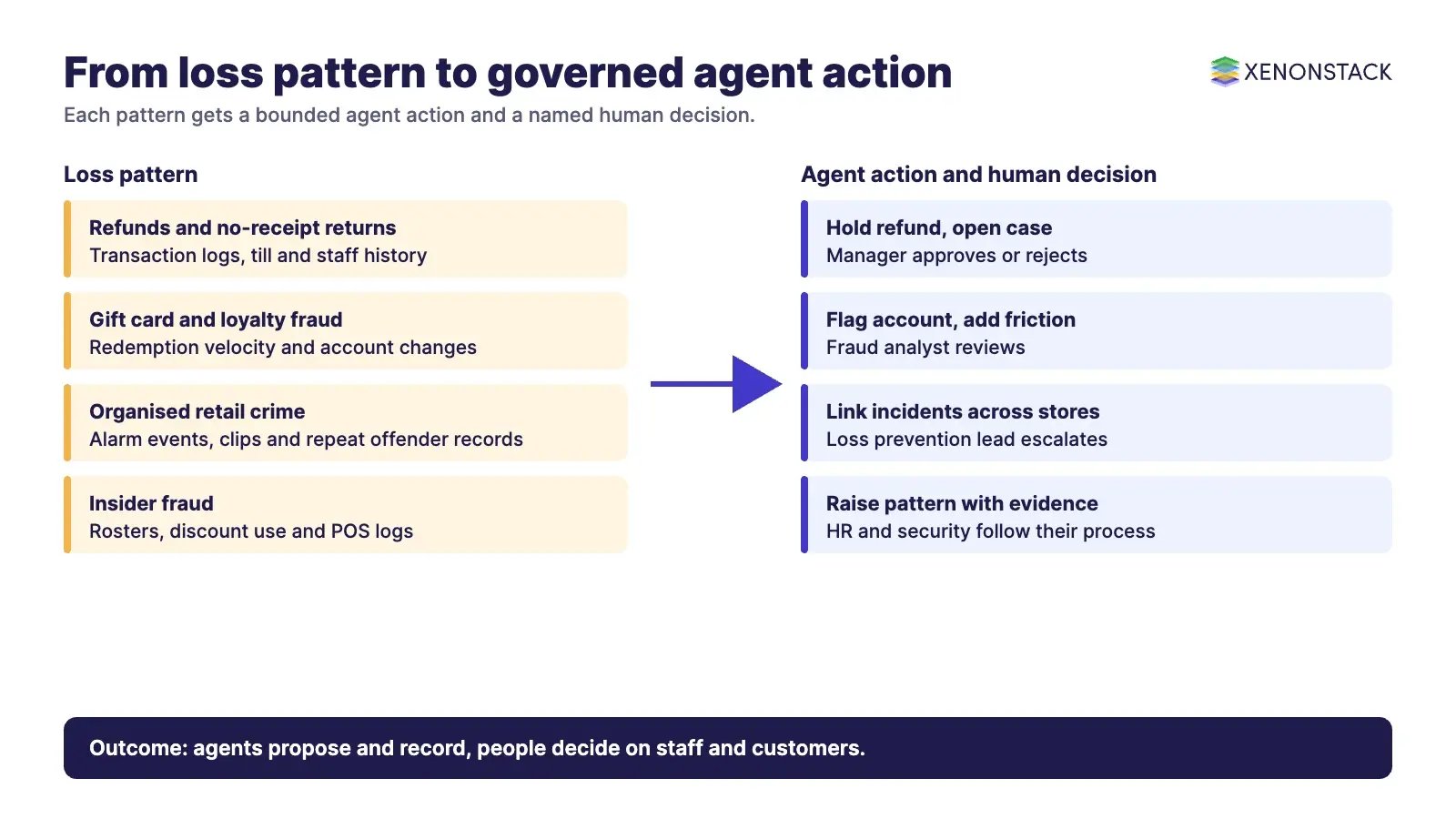
The table below pairs each pattern with the data an agent needs and the action it should be allowed to take. The last column is the point where a person decides.
| Loss pattern | Signals needed | Bounded agent action | Human decision |
|---|---|---|---|
| POS voids, refunds and no-receipt returns | Transaction logs, till and staff history, tender type | Hold a refund above a policy limit and open a case | Manager approves or rejects |
| Gift card and loyalty fraud | Redemption velocity, account changes, tender mix | Flag the account and add friction to the next redemption | Fraud analyst reviews the case |
| Walkout and organised retail crime | Alarm events, video clips, repeat offender records | Link incidents across stores and send a summary to the regional team | Loss prevention lead decides on escalation |
| Insider fraud | Rosters, discount use, after-hours access, POS logs | Raise a pattern, not an accusation, with the evidence attached | HR and security follow their own process |
| Phone scams on staff or contact centre | Call records, refund requests, account verification steps | Block the action and prompt the verification script | Supervisor confirms |
| Inventory discrepancy | Stock counts, receiving and transfer data | Open an investigation and correlate with POS and video | Store or supply chain owner resolves |
Streaming the data is usually the first engineering task. Our post on real-time analytics with AWS Kinesis and agents covers one way to build it. The point of the table is that the agent proposes and records, and a named role decides wherever the outcome affects a person.
Video: ElixirClaw agents stop a payment fraud case in finance operations. The same hold, evidence and approve pattern applies to retail refunds and voids.
How does the perception, decision and action loop work across a store estate?
Agentic systems for loss prevention follow a loop. Build it in this order:
- Perceive: ingest POS, video events, inventory, roster and account data into one governed layer, with identifiers that let events be joined.
- Decide: score each event against written policy and history, and decide whether it is routine, suspicious or needs a person.
- Act within limits: hold a transaction, open an incident, notify staff or request approval. Each action is allowed, changed, escalated or blocked by policy.
- Record and learn: store the evidence, the decision and the outcome so reviewers can audit it and thresholds can be tuned.
Latency decides where each step runs. Checks that must happen at the till can run on store-level servers, while cross-store pattern matching can run in the cloud. NexaStack describes itself as an agentic operating platform for physical AI that runs across on-premises, cloud and hybrid environments, which is the deployment shape this split needs. Confirm the fit for your store estate in a pilot.
Where do ElixirClaw, NexaStack and the ElixirData agents fit?
| Product | Role in a loss and fraud programme | Source of description |
|---|---|---|
| ElixirClaw | An agentic OS platform to build, orchestrate and govern AI agents and automation workflows while keeping humans in control. See also its post on omnichannel fraud prevention. | elixirclaw.ai |
| NexaStack | An agentic operating platform for physical AI that runs across on-premises, cloud and hybrid environments, relevant to store-level processing. | nexastack.io |
| AgentGRC | Keeps autonomous agent actions inside policy, with the audit trail risk teams need. Actions can be allowed, modified, escalated or blocked, and teams can begin in shadow mode. | elixirdata.co |
| Exception Handling Agent | Catches workflow exceptions that need human judgement, gathers context and routes them to an approver with an audit trail. Useful for refund and discount exceptions. | elixirdata.co |
Product pages describe what each product is built to do. They are vendor statements, so validate fit against your own data and policies before committing.
What should governance, privacy and cost controls look like?
Keep a person in the loop where an outcome affects someone
Article 22 of the GDPR gives individuals the right not to be subject to a decision based solely on automated processing, including profiling, where it has legal effects or similarly significantly affects them. There are exceptions, such as contract necessity or explicit consent, and where they apply the controller must provide at least the right to obtain human intervention, to state a view and to contest the decision (Article 22 text). For customers and staff in scope, design the agent to recommend and a person to decide. Take advice from counsel for each jurisdiction and use case.
Govern the agent like a new employee with limits
Define which actions an agent may take, the value limits, and who approves above them. Record each action with its context and outcome. Start in shadow mode, where the agent runs alongside people, and widen its autonomy only when the records show it performs reliably. This is the pattern the AgentGRC page describes.
Count the cost of false positives
Every wrongly held refund or flagged customer costs goodwill and staff time. Track precision by pattern, set review queues the team can actually clear, and retire rules that generate noise. We do not quote a savings figure here because none from a primary source applies to every retailer.
In what order should a retailer adopt it?
- Choose one pattern. Returns and refunds are a common start because the data is in the POS and the approver is clear.
- Unify the data. Join POS, roster and account identifiers and fix data quality before adding video.
- Write the playbook. Policy, limits, approvers and escalation paths in plain language. Our post on security monitoring and incident response shows how to structure one.
- Run in shadow mode for a defined period and compare agent proposals with human decisions.
- Grant limited autonomy for low-value, reversible actions, with every action logged.
- Add patterns and channels such as gift cards, loyalty, contact centre and online, using the same decision layer.
When is agentic AI the wrong choice?
Do not start with agents if your POS, roster and inventory data cannot be joined, if no one owns the response to an alert, or if a simple rule already catches most of the problem. Do not give an agent authority to act against an employee or customer without a human decision and an appeal route. Fix the process first, then automate it. A tuned rule or a staffing change is sometimes the better answer.
To map one loss or fraud decision your agents should make, and the context and policy it depends on, book a Context Workshop. See what happens in the workshop.
FAQs on agentic AI for retail loss and fraud prevention
What is agentic AI in retail loss prevention?
It is a system of AI agents that reads POS, video, inventory and account data together, judges events against policy, and takes bounded actions such as holding a refund or opening an incident, with a person deciding where outcomes affect staff or customers.
Is shoplifting rising or falling in 2026?
The NRF survey of 66 retail companies reports shoplifting incidents down 12.4% and merchandise theft down 8.1% in 2025 versus 2024, while many retailers report more phone scams (69%), loyalty fraud (51%) and gift card fraud (42%). Another source cited by Retail Dive, the Council on Criminal Justice, found reported shoplifting in three dozen major US cities up 4% in the first half of 2026 versus the first half of 2025.
Can an AI agent decide on its own to accuse an employee or refuse a customer?
It should not. GDPR Article 22 gives individuals the right not to be subject to decisions based solely on automated processing that significantly affect them, subject to exceptions and safeguards that include human intervention. Design the agent to recommend and a person to decide.
Where should the first pilot start?
Pick one pattern with clear data and an owner, such as refunds and returns. Run the agent in shadow mode alongside staff, compare its proposals with human decisions, and widen its authority only when the record supports it.
Does the agent need to run in the store?
Checks that must complete at the till benefit from store-level processing, while cross-store pattern matching can run centrally. Test latency in a pilot rather than assuming either location.
Explore the XenonStack platform family: ElixirData · ElixirClaw · ElixirHub · NexaStack · MetaSecure · Neural AI · AgentGRC · AgentSRE · AgentAnalyst · AgentInstruct · AgentScrum · AgentSearch · AgentForce · AI Aviator · SAIF Aviator · CohortIQ · XenonStack AI · XenonStack UAE
Follow XenonStack on LinkedIn: XenonStack on LinkedIn for new guides on agentic AI, data and platform engineering.