AI-powered video analytics for content moderation is a pipeline that scores every video, live stream and clip against your policy before it reaches an audience, sends only the uncertain or high-impact cases to people, and records why each decision was made. The value is not the classifier alone. It is the routing, the appeal path and the evidence trail around it.
This guide takes the platform-governance view: how a moderation pipeline is built, where humans stay in the loop, what the EU rules now expect and what to plan for by 2030. For camera-based monitoring, read edge AI video surveillance; for sector use cases, see vision analytics use cases.
Key takeaways
- Moderation needs several signals (frames, audio, speech, on-screen text and metadata), not one model.
- Route by confidence and impact: automate clear, reversible cases and queue the rest for trained reviewers.
- In the EU, platforms must explain removals and offer appeals, and AI-generated content labelling rules apply from August 2026.
- Log every decision with its policy version so it can be explained, appealed and audited.
Why does video moderation need AI?
Video arrives faster than any review team can watch it, and a harmful clip does most of its damage in the first minutes. Automated screening gives three things that manual review cannot: coverage of every upload, a consistent first pass against the same written policy, and a response time short enough to act during a live stream. It does not remove the need for people. It decides where their time goes.
| Question | Manual-only review | AI first pass with human review |
|---|---|---|
| Coverage | Sampled or reported items | Every upload and stream segment is scored |
| Consistency | Varies by reviewer, shift and fatigue | Same policy rules applied each time, with human calibration |
| Speed | Minutes to days after posting | Seconds for clear cases; queue for the rest |
| Weak point | Volume and reviewer wellbeing | Context, satire and new harm patterns |
How does a real-time moderation pipeline work?
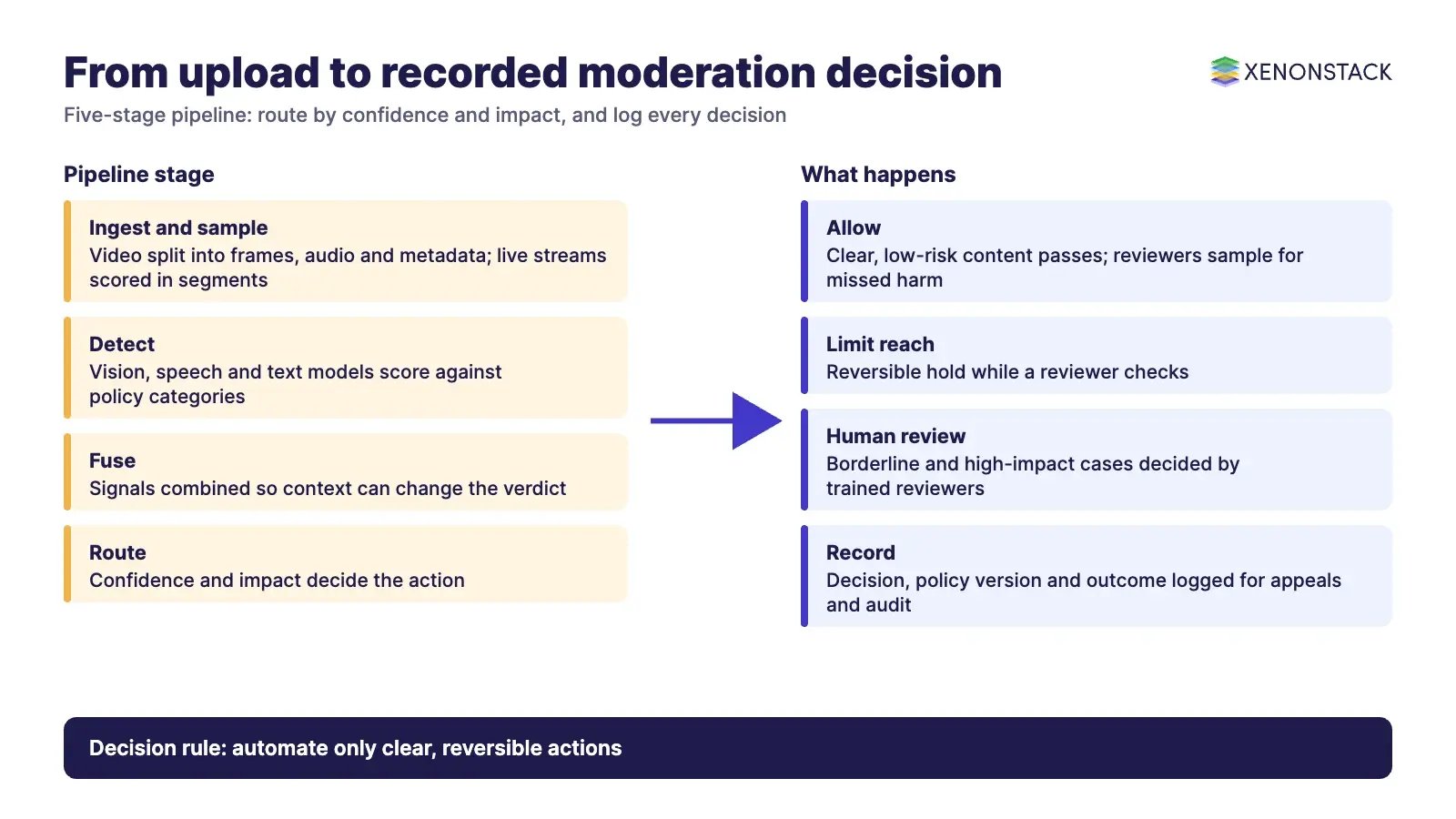
A practical pipeline has five stages. Each stage should be able to fail safely: if a model is unavailable, content is held for review or limited in reach, not silently approved.
| Stage | What happens | Typical signals |
|---|---|---|
| 1. Ingest and sample | Video is split into frames, audio and metadata; live streams are scored in short segments | Frames, audio track, title, description, upload history |
| 2. Detect | Vision, speech and text models score each segment against policy categories | Objects and scenes, transcribed speech, on-screen text, tone |
| 3. Fuse | Signals are combined so context can change the verdict | Visual plus audio plus text agreement or conflict |
| 4. Route | Confidence and impact decide: allow, limit reach, hold or send to a reviewer | Score, category severity, reach, account history |
| 5. Record and learn | Decision, policy version and reviewer outcome are stored and fed back into evaluation | Reviewer overturns, appeals, new patterns |
Which technologies sit behind the detect and fuse stages?
Computer vision models read frames for scenes, objects and symbols. Speech recognition turns audio into text that language models can check against hate, harassment and misinformation rules. Audio analysis adds tone, and multimodal models combine the signals so that, for example, a violent scene in a news report is judged differently from the same scene in a clip that celebrates it. Our guide to ethical considerations and bias in computer vision covers the fairness side of these models.
Where should the processing run?
Run first-pass screening where the video already is. Platforms with central uploads usually screen in the cloud; deployments with privacy or latency limits screen at the edge and send only decisions and short clips onwards. Our edge AI video surveillance guide explains the hybrid split. For teams that need local, policy-bound visual analytics, NexaStack is an agentic operating platform for physical AI that runs across on-premises, cloud and hybrid environments.
Which approach fits which moderation need?
| Need | Approach that fits | Watch for |
|---|---|---|
| Screen uploaded video before publishing | Asynchronous scoring with hold-and-review for uncertain items | Upload delay if thresholds are set too cautiously |
| Moderate live streams | Segment-level scoring with fast limit-reach or pause actions | False positives interrupting legitimate broadcasts |
| Detect manipulated or AI-generated video | Provenance checks (such as Content Credentials) plus classifier signals | Missing provenance does not prove manipulation |
| Brand-safety or ad adjacency | Category scoring with customer-specific policy rules | Policies that differ by market and advertiser |
| Regulated reporting | Decision log with reasons, policy version and appeal outcome | Missing or incomplete reasons |
What do the EU rules expect of AI moderation?
Two EU frameworks shape the design. Under the Digital Services Act, according to the European Commission, users can report illegal content through an easy mechanism on the platform, platforms must respond to reports and offer appeals, and they must explain why content was removed or suspended. Platforms with more than 45 million monthly EU users must identify and analyse wide-spread risks, including the spread of illegal content and risks to minors, and put measures in place to reduce them (Digital Services Act package).
The EU AI Act adds transparency duties. The Commission says providers of generative AI must make AI-generated content identifiable, and certain content, including deepfakes, must be clearly labelled. The Act became applicable on 2 August 2026 with exceptions, and Commission guidelines on transparency obligations were published on 20 July 2026 (AI Act policy page). This is general information, not legal advice; confirm obligations for your service with counsel.
The DSA Transparency Database shows the scale of automated moderation. When we read it on 12 November 2026, it listed more than 4.4 billion statements of reasons from 387 active platforms over the previous 180 days, and reported that 42% of statements were for fully automated decisions (DSA Transparency Database). The figures change daily, so check the live page.
How do you handle deepfakes and AI-generated video?
Treat this as two checks. First, provenance: C2PA is an open standard whose Content Credentials act, in its own words, like a nutrition label for digital content, recording the origin and edits of a file (C2PA). A valid credential is a useful positive signal. Second, classification: detectors can flag likely manipulation, but they give probabilities, not proof, so high-impact decisions need a reviewer. Our guide to generative video models explains how the content is produced in the first place.
Where do humans stay in the loop?
AI should flag; people should decide where the impact is high or the context is unclear. Set the split by decision type, not by a single accuracy figure.
| Decision | Who decides | Why |
|---|---|---|
| Clearly allowed content | AI, sampled by reviewers | Low risk; sampling checks for missed harm |
| Limit reach pending review | AI, reversible | Fast, low-impact and easy to undo |
| Removal of borderline content | Trained reviewer | Context, satire, news value and local rules |
| Account suspension | Reviewer with senior approval | High impact on the user and a likely appeal |
| Policy changes | Trust and safety lead with legal | Affects every later decision |
Autonomy limits and approvals need an owner and a record. Our guide to agentic AI risk management covers agent inventories, risk tiers and matching controls. AgentGRC keeps autonomous agent actions inside policy, with the audit trail risk teams need, and the Audit Agent assembles decision lineage, policies and approvals for compliance traceability, according to its site.
What are the main risks and trade-offs?
| Risk | What goes wrong | Control |
|---|---|---|
| Context errors | Satire, education or news is removed; harmful content in disguise passes | Multimodal fusion, reviewer queues for borderline scores, regular error audits |
| Bias | Some languages, accents or communities are over-flagged | Balanced evaluation sets per market and language; track overturn rates by group |
| Privacy | Central pooling of user video | Edge screening, minimal retention, access controls |
| Fast-moving threats | New symbols, slang and edits evade old models | Frequent retraining from reviewer outcomes and a rapid rule-update path |
| Reviewer harm | Repeated exposure to disturbing content | Blur and audio-off defaults, rotation and support, as set by your trust and safety policy |
| Vendor change | Cloud moderation APIs change or retire | Abstract the model layer and keep your own evaluation set |
When not to automate: do not let a model alone remove content that affects livelihood, news reporting or political speech, and do not rely on a single signal for any permanent action.
How should you adopt AI video moderation?
- Write the policy first. Define categories, severity and what each action means, per market.
- Build an evaluation set. Collect reviewed examples across languages and content types before choosing models.
- Start in shadow mode. Score content without acting and compare with reviewer decisions.
- Automate reversible steps. Begin with limit-reach and queue-priority actions; widen only when overturn rates are low.
- Log and review. Store the decision, policy version and outcome; review overturns and appeals every month.
Cloud vendors document their own services. For example, according to its Microsoft Learn page, Azure AI Content Safety offers text and image analysis across four harm categories (sexual content, violence, hate and self harm) with multi-severity levels, and the page does not describe video moderation (Azure AI Content Safety overview). Read each vendor's page for the media types and limits it supports before you design around it.
What will change in AI video moderation over the next 3 to 5 years?
The dated items below come from official pages we read on 12 November 2026. The rest is XenonStack's view and is marked as such.
| Change | Evidence | Timing | What to do now |
|---|---|---|---|
| AI-generated content must be identifiable and deepfakes labelled in the EU | European Commission AI Act page: transparency rules from August 2026; guidelines published 20 July 2026 | 2026 onward | Add provenance and label checks to the upload pipeline |
| New prohibition on non-consensual intimate content and CSAM generation | European Commission AI Act page: Prohibition 9 from December 2026 | From December 2026 | Review detection and takedown paths for this category |
| Cloud video APIs give way to multimodal models | Google documents the Video Intelligence API as deprecated from 14 September 2026 with shutdown on 14 September 2027 and recommends the Gemini family; Microsoft lists its Analyze Multimodal preview as retiring on 30 April 2027 | 2026 to 2027 | Keep the model layer swappable and re-test on your own evaluation set |
| Automated decisions are logged and public at scale | DSA Transparency Database: 42% of submitted statements were fully automated decisions on 12 November 2026 | Ongoing | Make reasons, policy version and appeal outcome part of every decision record |
| Provenance becomes a routine moderation signal | C2PA Content Credentials record origin and edits; adoption pace is XenonStack's view | 2027 to 2030 (our view) | Read credentials where present; never treat their absence as proof of manipulation |
What would change this outlook: delays or changes to EU guidance, wider detector failures against new generators, or a platform-level move to credentials that proves slower than expected. Re-check the dated items against the official pages each quarter.
To map one moderation decision your agents make, and the context and policy it depends on, book a Context Workshop. See what happens in the workshop. ElixirClaw is an agentic OS platform to build, orchestrate and govern AI agents and automation workflows while keeping humans in control. For agent-based camera workflows, read what is agentic video intelligence.
Frequently asked questions
What is AI-powered video moderation?
It is automated screening of video, audio and text against a written content policy, with confidence-based routing to human reviewers and a record of each decision.
Can AI replace human moderators?
No. AI handles clear and reversible cases at scale, while trained reviewers decide borderline, high-impact and appealed cases where context matters.
What must EU platforms explain when they remove content?
According to the European Commission, platforms must explain why content was removed or suspended, respond to reports and offer options to appeal.
Does the EU AI Act cover deepfakes?
The Commission says certain AI-generated content, including deepfakes, must be clearly labelled and that generative AI providers must make content identifiable. Confirm your obligations with counsel.
How should moderation handle AI-generated video?
Combine provenance checks such as C2PA Content Credentials with classifier signals, and send high-impact cases to a reviewer, because a missing credential is not proof of manipulation.
What will change in AI video moderation by 2030?
Expect EU labelling rules for AI-generated content, multimodal models replacing older cloud video APIs, and decision records and provenance becoming routine parts of moderation. The timing of provenance adoption is our view.
Follow XenonStack on LinkedIn: XenonStack on LinkedIn for new guides on agentic AI, data and platform engineering.
Explore the XenonStack platform family: ElixirData · ElixirClaw · ElixirHub · NexaStack · MetaSecure · Neural AI · AgentGRC · AgentSRE · AgentAnalyst · AgentInstruct · AgentRAI · AgentScrum · AgentSearch · AgentForce · AI Aviator · SAIF Aviator · CohortIQ · XenonStack AI · XenonStack UAE