Key takeaway
- Deploy AI vision models on Intel hardware: choose Xeon AMX, GPU, NPU or Gaudi 3 by workload, convert with OpenVINO, and add the controls enterprises need.
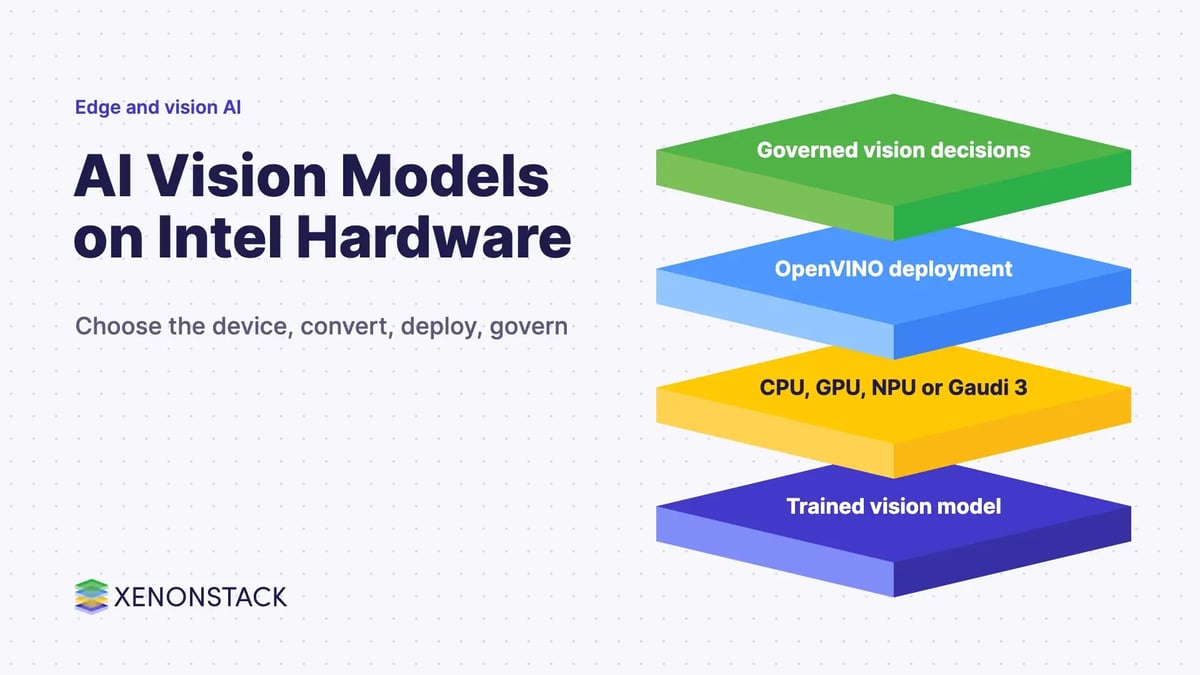
To run AI vision models on Intel hardware, train in the framework you already use, convert the model with the OpenVINO toolkit, and choose the device by workload: a Xeon CPU with Intel AMX, an Intel GPU, the NPU in Intel Core Ultra processors, or a Gaudi 3 accelerator for large-scale training and inference. OpenVINO is open source, so the same converted model can be tested across these devices before any hardware is bought. The decision for a CTO is less "which chip" and more "which device meets the latency, power and governance limits of this camera or line".
This guide gives enterprise architects a decision table by workload, the deployment workflow, the controls to put around a vision system, and a sourced 3 to 5 year outlook. It builds on our guides to computer vision on edge and to GPU versus CPU for computer vision inference. Intel claims below come from Intel's own pages and are worded "according to its site".
Which Intel hardware fits which AI vision workload?
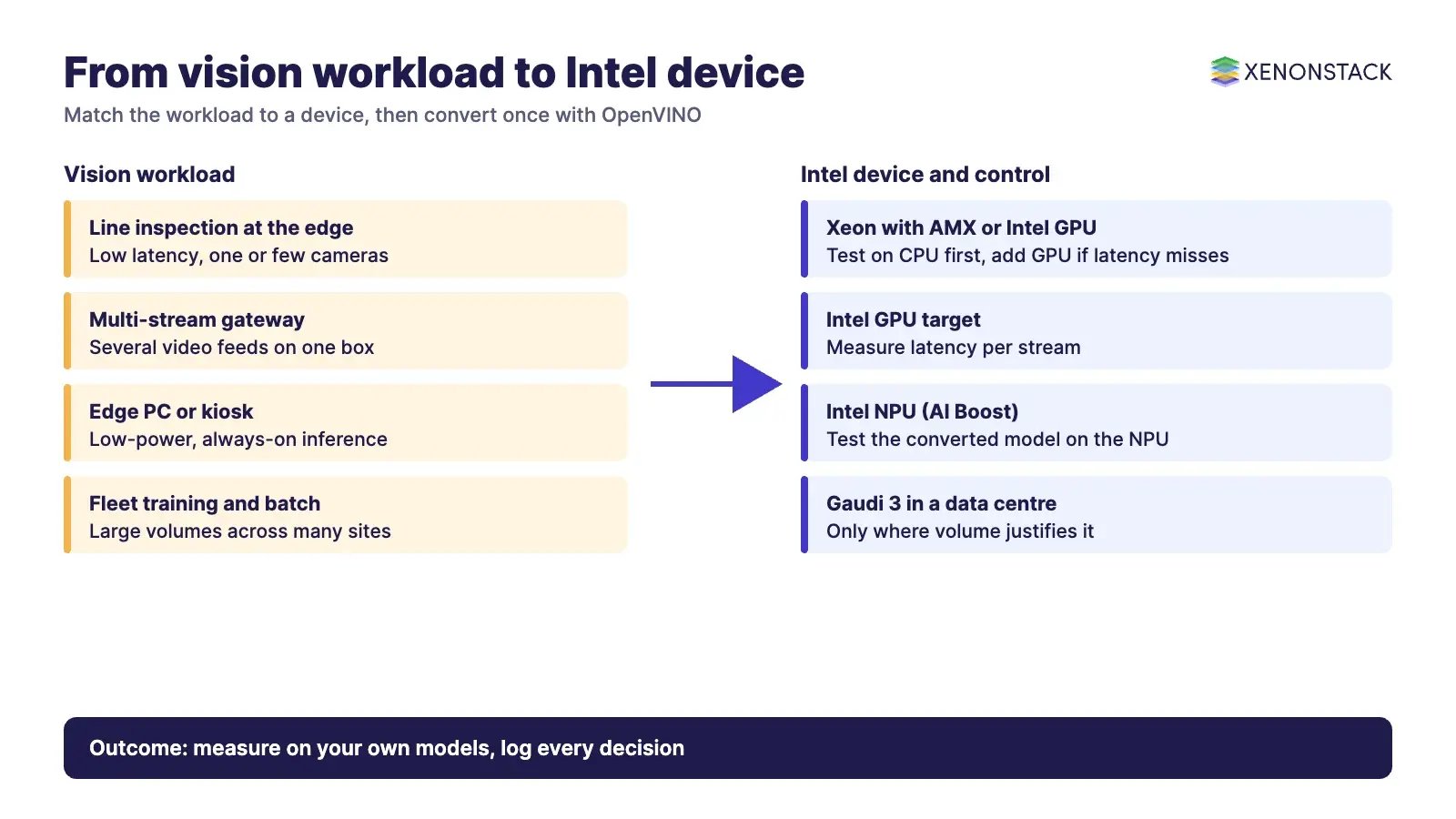
AI accelerators are hardware or software that speed up the matrix-heavy work of training and inference. For vision, the practical choice is between processors you may already own and a purpose-built data centre accelerator. Intel's OpenVINO README lists CPU (x86 and ARM), Intel integrated and discrete GPU, and the Intel NPU as supported targets.
| Device | When it fits | What Intel says on its site |
|---|---|---|
| Intel Xeon Scalable with Intel AMX | Inference beside existing servers, mixed workloads, no separate accelerator card | Intel AMX is "a new built-in accelerator that improves the performance of deep-learning training and inference on the CPU", and Intel says it suits image recognition. Availability varies by SKU. |
| Intel integrated or discrete GPU | Camera gateways and workstations running several video streams | Listed as a supported OpenVINO target. |
| Intel NPU (Intel AI Boost in Core Ultra) | Low-power, always-on inference on edge PCs and kiosks | Intel brands the NPU in Core Ultra processors "Intel AI Boost"; OpenVINO lists the Intel NPU as a target. |
| Intel Gaudi 3 | Large-scale training and inference in a data centre or cloud | 5 nm process, 64 Tensor Processor Cores, 8 Matrix Multiplication Engines, 128 GB memory, 24 integrated 200 Gb Ethernet ports (Intel launch announcement). |
| Movidius VPU (Neural Compute Stick era) | Existing prototypes only; check support before any new design | Intel's support article says MYRIAD devices were not supported in OpenVINO 2022.3.0 and points to release 2022.2.2 for them. |
Intel's Gaudi 3 launch figures are framed around language models (Llama and Falcon), and Intel labels them projected. We found no Intel vision-specific benchmark for Gaudi 3 on its pages, so treat any vision throughput figure as something to measure on your own models. Gaudi 3 is also priced and operated as data centre infrastructure, which is rarely the right answer for a camera on a production line.
How does OpenVINO connect trained models to Intel devices?
Intel describes OpenVINO as an "open-source software toolkit for optimizing and deploying deep learning models", licensed under Apache 2.0. It accepts models trained in PyTorch, TensorFlow, ONNX, Keras, PaddlePaddle and JAX/Flax, and its documentation covers conversion with openvino.convert_model, compression through NNCF (weight compression, post-training quantization and quantization-aware training), automatic device selection and heterogeneous execution across CPU, GPU and NPU. A Model Server is documented for serving models over a network.
For a vision team this means one conversion step and one inference API across the device options above. It is also the lever for cost: quantization usually decides whether a detector fits on a small edge device, but the accuracy loss on your own images must be measured, not assumed. Our assembly line inspection guide shows where that accuracy threshold matters in practice.
What does the deployment workflow look like from training to production?
| Stage | What happens | Control to put in place |
|---|---|---|
| Train | Build the detector, classifier or segmentation model in a supported framework | Version the dataset and record its labelling rules |
| Convert | Convert to OpenVINO format and save it | Store the converted model with its source commit |
| Optimise | Apply NNCF compression where latency or memory demands it | Re-test accuracy on a held-out set from the real site |
| Select device | Test CPU, GPU and NPU targets, or let automatic selection choose | Record latency per stream and power draw per device |
| Deploy | Package for edge or serve from a data centre | Staged roll-out with a rollback path |
| Monitor | Watch for lighting, camera and product drift | Retrain on a schedule and keep a decision log |
Edge or data centre?
Edge deployment keeps video local and cuts round-trip delay, which suits inspection and safety checks. Data centre deployment suits batch analytics, retraining and fleets of sites. Most enterprises need both: edge inference with central training. Our guides to edge AI in smart factories and edge computing cover that split, and NexaStack describes itself as an agentic operating platform for physical AI that runs across on-premises, cloud and hybrid environments.
What governance, security and cost controls does a vision system need?
Vision systems turn images of people, products and sites into decisions, so the model is only one part of the risk. Hardware security features differ by processor and SKU, so check Intel's product specifications for the exact part you buy rather than assuming a feature. Beyond that, record which model version made which decision, who approved the threshold, and what a human can override.
- Decision record: log model version, input reference, output and any human override.
- Change control: treat a new converted model or a new quantization setting as a release.
- Cost: compare the cost per stream of CPU, GPU and NPU options from measured latency, not from vendor projections.
- People data: where video shows people, agree retention, access and purpose before go-live.
ElixirData keeps governed context, versioned policy and decision traces in one decision layer above AI agents, and its Decision Review Agent examines past decisions to find inconsistencies and patterns. For how vision outputs feed automated actions, see agentic workflows and computer vision applications with agentic AI.
Which industrial vision use cases suit this approach?
| Use case | Typical placement | Main design question |
|---|---|---|
| Quality control and defect detection | Edge, beside the line | What false-reject rate can the line tolerate? |
| Safety and equipment monitoring | Edge, with central alerting | Who acts on an alert, and how quickly? |
| Warehouse and robotics vision | Edge on the vehicle or gateway | How is the model updated across a fleet? |
| Fleet analytics and retraining | Data centre or cloud | Which sites share data, and under what rules? |
What should an adoption sequence look like?
- Pick one inspection or monitoring task with a measurable outcome.
- Convert the existing model with OpenVINO and measure latency and accuracy on CPU first.
- Add GPU or NPU targets only where the CPU result misses the latency target.
- Pilot on one line or site with human review of every flagged item.
- Write the decision-log and change-control rules, then scale site by site.
- Consider Gaudi 3 only when training or batch inference volume justifies data centre hardware.
When is this approach not the right fit?
A single camera with a modest model rarely needs a data centre accelerator, and a fleet already standardised on another vendor's toolchain may gain little from moving. If the main problem is poor labels or inconsistent lighting, new hardware will not fix it. Intel's own Gaudi page lists Dell, HPE and Supermicro among OEM options, so procurement and support should be confirmed with them rather than assumed.
What will change in AI vision on Intel hardware over the next 3 to 5 years?
| Trend | What the source says | What it means for planning |
|---|---|---|
| Intel data centre accelerator roadmap | As reported by TechCrunch, on its 30 January 2025 earnings call Intel said it would use Falcon Shores as an internal test chip without bringing it to market, and focus on Jaguar Shores as a rack-scale solution. | Plan around Gaudi 3 and confirm the roadmap with Intel before long-term commitments. |
| NPUs in edge PCs | Intel brands the NPU in Core Ultra processors "Intel AI Boost", and OpenVINO lists the Intel NPU as a target. | Edge PCs can run vision inference at low power; test your models on them. |
| Open toolchain | OpenVINO is Apache 2.0 licensed and supports several frameworks and device types. | Model portability across devices should reduce lock-in. |
| Regulation | The European Commission states that high-risk AI rules for sensitive areas such as biometrics now apply from 2 December 2027, and for systems in regulated products from 2 August 2028, after the AI Omnibus. | Vision systems that identify people need documentation and human oversight in the design from the start. This is not legal advice; check with counsel. |
| Agentic operations | Vision outputs increasingly trigger automated actions. | Put policy and decision records between detection and action. |
To map one vision decision your agents should make, and the context and policy it depends on, book a Context Workshop. See what happens in the workshop.
What should you plan for in 2027?
The dated items for 2027 that affect vision deployments are regulatory, so settle your designs with them in mind.
- 2 December 2027: the European Commission states that AI Act rules for high risk systems in sensitive areas such as biometrics, education and employment apply from this date. Vision systems that identify people need documentation and human oversight designed in before then (European Commission AI Act page).
- 2 August 2028: the same page gives this date for AI embedded in regulated products, so product makers can use 2027 to scope the work (European Commission).
- Throughout 2027: measure latency, power and accuracy on your own cameras across CPU, GPU and NPU, and keep the decision log described above. This is not legal advice; check with counsel.
Frequently asked questions
Do I need Gaudi 3 to run vision models?
No. OpenVINO targets CPUs, Intel GPUs and the Intel NPU, and many inspection tasks run on those. Gaudi 3 is aimed at large-scale training and inference.
Which frameworks does OpenVINO accept?
According to its README, models from PyTorch, TensorFlow, ONNX, Keras, PaddlePaddle and JAX/Flax.
Is OpenVINO free to use?
It is licensed under Apache License 2.0, according to its repository.
Are Movidius VPUs still the low-power option?
Check first. Intel's support article says MYRIAD devices were not supported in OpenVINO 2022.3.0 and points to 2022.2.2. For new edge designs, test the Intel NPU or GPU targets.
What will change in AI vision on Intel hardware over the next 3 to 5 years?
As reported by TechCrunch, Intel is focusing on Jaguar Shores for rack-scale AI, and the EU's high-risk AI rules now apply from December 2027 and August 2028. Plan for governance and device portability.
Where should vision inference run, edge or data centre?
Edge for low-latency checks on a line; data centre for retraining and fleet analytics. Most enterprises use both.
Sources
Follow XenonStack on LinkedIn: XenonStack on LinkedIn for new guides on agentic AI, data and platform engineering.
Ready to put AI agents to work? Explore ElixirClaw, the agentic OS platform to build, orchestrate and govern AI agents.
Explore the XenonStack platform family: ElixirData · ElixirClaw · ElixirHub · NexaStack · MetaSecure · Neural AI · AgentGRC · AgentSRE · AgentAnalyst · AgentInstruct · AgentRAI · AgentScrum · AgentSearch · AgentForce · AI Aviator · SAIF Aviator · CohortIQ · XenonStack AI · XenonStack UAE