Key takeaway
- Plan smart city computer vision on Databricks: architecture, governance, privacy and AI Act dates, a 3 to 5 year outlook and an adoption sequence for CIOs.
How should a city use Databricks for computer vision projects?
A city can use Databricks as the shared data and model layer behind its camera, sensor and IoT programmes, with video and images landing in governed storage, models trained and tracked in one place, and results served to traffic, safety and planning teams. According to the Databricks lakehouse documentation, a lakehouse "combines the benefits of data lakes and data warehouses", with Delta Lake as the storage layer and Unity Catalog as the governance layer for data and AI. The platform does not decide what a city should watch, keep or act on. Those are policy decisions, and they need to be made before the first camera feed is connected.
This guide takes the platform and operating view for CIOs, CDOs and enterprise architects. For the model and edge side, read computer vision on edge; for the traffic use case, see AI traffic management; for fused video, audio and sensor streams, see multi-modal surveillance agents on Databricks.
What does the Databricks platform provide for city vision workloads?
The table maps each platform component to the job it does in a city vision pipeline. Capabilities are taken from Databricks documentation; confirm current product names and regional availability on the Databricks pages before you commit to a design.
| Component | What the docs say | Role in a city vision pipeline |
|---|---|---|
| Delta Lake | An optimised storage layer that supports ACID transactions and schema enforcement (Databricks lakehouse documentation). | Holds detection events, metadata and labels so that dashboards and models read consistent tables. |
| Unity Catalog | The unified governance layer for data and AI; it covers volumes, models, lineage and an audit log (Unity Catalog docs). | Controls who can see raw footage, derived counts and models; records who accessed what. |
| Auto Loader | Incrementally processes new files as they arrive in cloud storage, including the binary file format (Auto Loader docs). | Picks up clips and image batches from camera gateways without custom bookkeeping. |
| Structured Streaming | Streaming with the same Spark APIs as batch, in micro-batch mode by default (Structured Streaming docs). | Turns detection events and sensor readings into near real-time metrics. |
| MLflow | Experiment tracking, model evaluation and a model registry integrated with Unity Catalog (MLflow on Databricks docs). | Records which model version produced which result, which a city needs for audit. |
| Model Serving | Deploys custom MLflow-format Python models behind REST endpoints for real-time and batch inference (Model Serving docs). | Exposes a detection or classification model to city applications. |
| GPU compute | GPU-accelerated instance types are supported, with Databricks Runtime ML for GPU (GPU compute docs). | Training and heavy batch inference on image and video data. |
The same documentation page for GPU compute states that Databricks is deprecating P3 instances and that Photon is not supported on GPU instance types, so check the instance family before sizing a training cluster.
What are the main challenges in city-scale computer vision?
Most city programmes struggle with four things before model accuracy becomes the issue.
- Volume and variety. Video, still images, sensor readings and event logs arrive at different rates and formats, and need a clear retention rule for each.
- Privacy and lawful use. Cameras in public places raise data protection and, in the EU, AI Act questions that must be answered at design time.
- Integration. Detections only matter when they reach signal control, dispatch, maintenance or planning systems that already exist.
- Ownership. Several departments often share one camera estate, so access, cost and accountability need explicit owners.
How does the reference architecture work from camera to decision?
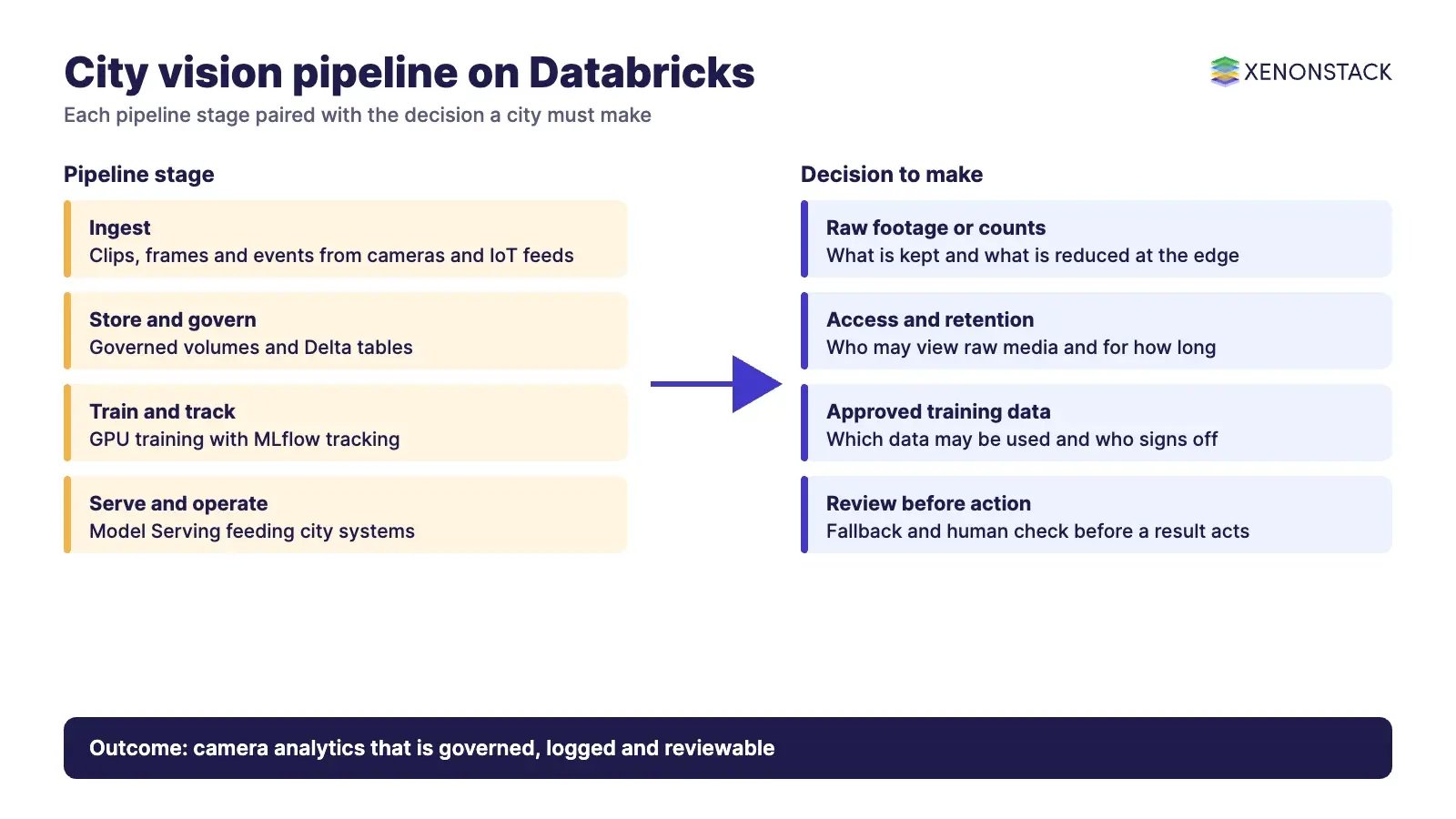
A practical sequence has five stages. Each stage has a platform feature and a governance decision attached to it.
| Stage | What happens | Platform feature | Decision to make |
|---|---|---|---|
| 1. Ingest | Clips, frames and events arrive from cameras, gateways and IoT feeds. | Auto Loader, Structured Streaming | What is kept as raw footage, and what is reduced to counts at the edge? |
| 2. Store and govern | Files sit in governed volumes; events sit in Delta tables. | Delta Lake, Unity Catalog | Who may view raw media, and for how long is it retained? |
| 3. Prepare and train | Frames are labelled, sampled and used to train models. | Spark, GPU compute, MLflow | Which data may be used for training, and who approves it? |
| 4. Serve | A registered model is exposed for real-time or batch scoring. | Model Serving | What is the fallback when the endpoint or the camera is down? |
| 5. Operate | Outputs feed dashboards and city systems; results are monitored. | Delta tables, MLflow tracking | What is the review point before a result triggers an action? |
Unity Catalog volumes follow the same namespace and permission model as tables, which means the controls that protect a detection table can also protect the footage behind it. Auto Loader also notes that it does not guarantee the order in which files are discovered or processed, so design event handling to tolerate late or out-of-order arrivals. Cost control for this architecture is covered in FinOps for Databricks, and platform controls in governance and security in SAP Databricks.
Where do edge and cloud processing each fit?
Time-critical detections, such as an incident alert at a junction, usually run close to the camera, while training, fleet-wide analytics and reporting run centrally. The edge side is explained in computer vision on edge, and the platform view in the XenonStack Databricks page. Databricks Model Serving documentation cites low overhead latency for its endpoints, but a city should measure end-to-end latency from camera to action in its own network rather than rely on a platform figure.
| Workload | Where it usually runs | Why |
|---|---|---|
| Event detection at a junction | Edge device or gateway | Keeps response local and reduces the video that leaves the site. |
| Model training and retraining | Central, on GPU compute | Needs labelled data from many sites and large compute. |
| City-wide analytics and reports | Central lakehouse | Combines events with traffic, asset and planning data. |
| Batch review of stored footage | Central, scheduled | Does not need real-time response. |
Which smart city use cases fit this approach?
| Use case | What the pipeline produces | What to watch |
|---|---|---|
| Traffic and congestion | Counts, speeds and queue estimates per approach; see our guide to AI traffic management. | Prefer counts over identification; keep a manual fallback for signals. |
| Incident detection | Alerts for events such as stopped vehicles or obstructions. | A human reviews alerts before any enforcement action. |
| Environmental monitoring | Sensor and vision readings combined into sustainability indicators. | Calibrate and validate against reference instruments. |
| Parking and kerbside | Occupancy estimates for spaces and zones. | Publish only aggregates where possible. |
| Pedestrian flow | Aggregated movement counts for planning. | Avoid collecting identifiers; test for coverage bias. |
These are patterns, not claims of results. Any improvement a city reports should be measured against a baseline taken before deployment.
How should privacy and AI Act obligations be handled?
Treat privacy as a design input. The GDPR has applied since 25 May 2018 according to the European Commission, and the European Data Protection Board publishes Guidelines 3/2019 on processing of personal data through video devices (final version, 30 January 2020). Under the EU AI Act, the Commission page on the regulatory framework for AI lists prohibited practices, including real-time remote biometric identification for law enforcement in publicly accessible spaces, applying from 2 February 2025. This is not legal advice; ask counsel which rules apply in your jurisdiction.
Practical controls follow from this. Reduce footage to counts or event records as early as the use case allows, blur or exclude faces and number plates where identification is not the purpose, set retention periods per data class, and log every access to raw media through Unity Catalog audit records. Publish a plain-language notice of what the cameras do and who to contact, because public trust is a delivery risk as much as a legal one.
What will change in smart city computer vision over the next 3 to 5 years?
The signals below come from official pages. They indicate direction; they are not forecasts of market size or accuracy.
| Signal | Source | What it means for a city programme |
|---|---|---|
| AI Act transparency rules and general application from 2 August 2026; Annex III high-risk obligations moved to 2 December 2027 under the AI Omnibus; Annex I products 2 August 2028. | European Commission | Plan compliance evidence now: system inventory, risk classification and documented human oversight for any camera analytics. |
| NIST AI RMF 1.0 (26 January 2023) and the Generative AI profile (NIST-AI-600-1, 26 July 2024); NIST notes that AI RMF 1.0 is being revised. | NIST | Use Govern, Map, Measure and Manage as a review checklist, and expect the framework text to be updated. |
| Databricks documents a real-time mode alongside micro-batch mode in Structured Streaming for low-latency operational use cases. | Databricks docs | Lower-latency pipelines become easier to build centrally, but edge processing still matters for local response. |
| Auto Loader documents Beta support for ingesting documents and images as file references. | Databricks docs | Image and document ingestion may get simpler; confirm the feature status before relying on it. |
Our reading: over the next few years the work shifts from proving that a model can detect something to proving that the system is governed, explainable and worth its running cost. Fusing vision with audio and sensor data, covered in our post on multi-modal agents on Databricks, will add value where one signal is ambiguous. Expect procurement to ask for evidence of oversight and logging as routinely as it asks for accuracy.
What is a sensible adoption sequence, and when should a city not proceed?
- Pick one decision. For example, adjusting signal timing at five junctions, with a baseline measured first.
- Set the data rules. Define what is collected, reduced, retained and who can access it.
- Build the thin pipeline. Ingest, store, govern, train and serve for that one decision.
- Run in shadow mode. Compare model output with human judgement before any automated action.
- Review and extend. Add sites or use cases only when results are explained and costs are understood.
Pause if the purpose of the cameras is unclear, if no owner can approve access to footage, if the legal basis for processing has not been confirmed, or if there is no fallback when the system fails. A lakehouse will not fix a missing policy.
The same pattern applies beyond cities: governed data, traced decisions and human review. NexaStack is described on its site as an agentic operating platform for physical AI, and AgentGRC on its site automates compliance checks, risk assessments and audit evidence, which is relevant when camera analytics needs a defensible audit trail.
To map one city decision your cameras should inform, and the data, policy and oversight it depends on, book a Context Workshop. See what happens in the workshop.
Frequently asked questions
What is Databricks used for in smart city computer vision?
According to its documentation, Databricks provides a lakehouse with Delta Lake storage, Unity Catalog governance, MLflow tracking and Model Serving. Cities use these to store, govern, train on and serve results from camera and sensor data.
Does Databricks process video directly?
Auto Loader supports a binary file format for ingestion from cloud storage, so clips and images can be picked up as files. The model that interprets them is your own or a third-party model, tracked in MLflow and served through Model Serving.
Should detection run at the edge or in the cloud?
Time-critical detection usually runs near the camera, while training, analytics and reporting run centrally. Measure end-to-end latency in your own network.
How do we handle privacy for city cameras?
Reduce footage to counts early, restrict access to raw media, set retention periods and log access. In the EU, review the GDPR, EDPB Guidelines 3/2019 and the AI Act, and take legal advice.
What will change over the next 3 to 5 years?
Regulatory dates under the EU AI Act, revisions to the NIST AI RMF and lower-latency streaming options point towards stronger governance evidence and simpler central pipelines.
How do we start?
Choose one decision, measure a baseline, define data rules, build a thin pipeline and run in shadow mode before automating any action.
Ready to put AI agents to work? Explore ElixirClaw, the agentic OS platform to build, orchestrate and govern AI agents.
Explore the XenonStack platform family: ElixirData · ElixirClaw · ElixirHub · NexaStack · MetaSecure · Neural AI · AgentGRC · AgentSRE · AgentAnalyst · AgentInstruct · AgentRAI · AgentScrum · AgentSearch · AgentForce · AI Aviator · SAIF Aviator · CohortIQ · XenonStack AI · XenonStack UAE