Key takeaway
- Multimodal AI surveillance fuses video, audio and sensor data for real-time alerts. See how fusion, Databricks streaming and governance fit together.
Multimodal AI surveillance combines video, audio, text logs and sensor streams in one system, so that an AI agent can judge what is happening from several signals at once instead of from camera footage alone. On a platform such as Databricks, those streams are ingested, processed and governed in one place, and alerts go to people for review.
This guide is for security, data and platform leads who are building real-time video streaming applications and video analytics that need more than one camera feed. It covers how fusion works, how the pipeline fits together on Databricks, how to handle privacy, and how AI agents change the work.
What is multimodal AI surveillance?
Conventional systems usually depend on a single input, most often video. That limits context, produces false alarms and makes it hard to combine audio, text or thermal data. A multimodal system adds those inputs, so a low-light camera can be checked against sound or sensor readings before anyone is alerted. Typical uses are crowd monitoring, perimeter security and traffic analytics, plus real-time store monitoring, retail analytics dashboards and real-time drought prediction monitoring, where many sensors must be read together. The perception side is computer vision; the multimodal part is what joins it to the other signals.
How does multimodal fusion work?
A multimodal pipeline has four stages. Input modules ingest each stream. Feature extraction turns raw data into structured features, for example with convolutional neural networks for images and transformers for audio or text, with a time-series database holding continuous sensor data. A fusion module combines the features. A decision model then flags anomalies or ranks alerts. Timestamps must be synchronised across streams, or the fusion step compares moments that did not happen together.
| Fusion approach | How it works | Trade-off |
|---|---|---|
| Early fusion | Merges features from each modality into one joint representation before the decision model | Captures links between signals, but needs well-aligned inputs |
| Late fusion | Runs a separate detector per modality and combines their outputs or confidence scores | Easier to build and to swap parts, but sees fewer cross-signal links |
| Attention-based fusion | A transformer weights each modality dynamically for each case | Adapts to noisy or missing inputs, but is harder to explain |
How do you build multimodal surveillance on Databricks?
The Databricks documentation describes the building blocks. Auto Loader processes new data files as they arrive in cloud storage and supports schema inference and evolution. Structured Streaming is Apache Spark's streaming engine, with a default micro-batch mode whose latency is measured in seconds or minutes, and a real-time mode designed for sub-second operational workloads. Delta Lake tables can act as streaming sources and sinks with exactly-once processing guarantees. This is why a write-up that promises instant detection should be read with care: choose the mode by the latency your alerts need. The platform pattern is the lakehouse, which keeps structured and raw data together, and good data ingestion practice applies to every stream.
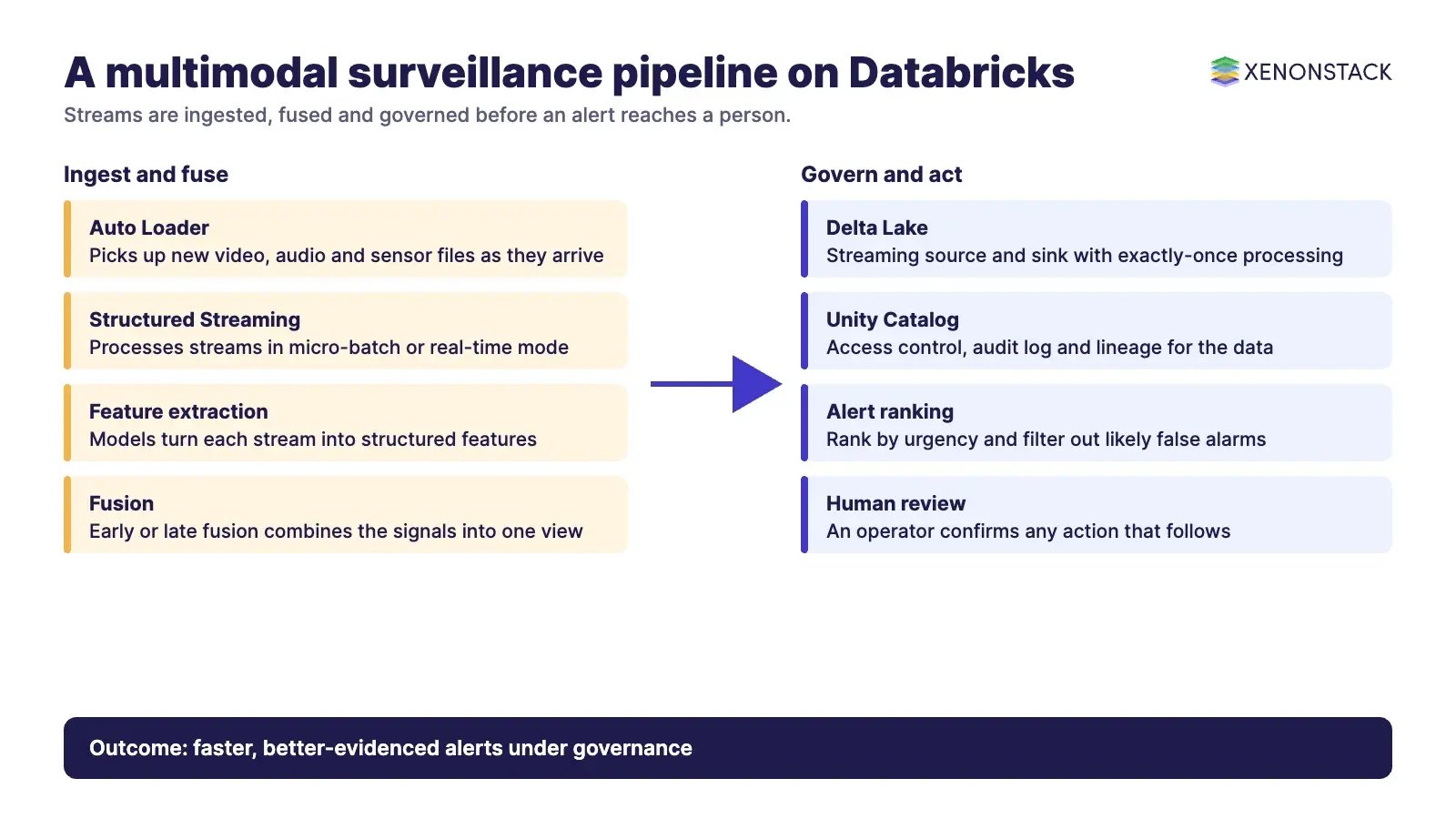
| Need | Databricks capability | Role in the pipeline |
|---|---|---|
| Ingest new files | Auto Loader | Picks up video, audio and sensor files as they land |
| Process streams | Structured Streaming, micro-batch or real-time mode | Runs feature extraction, fusion and scoring |
| Store and replay | Delta Lake | Keeps results and history with exactly-once processing |
| Govern | Unity Catalog | Access control, audit log and lineage |
How do you handle privacy and governance?
Video and audio of people are sensitive data. The Unity Catalog documentation calls it the unified governance layer for data and AI, and lists access control, an audit log of data access and system activity, and automatic lineage. Use those controls to limit who can view footage and to record who did. Collect only what the purpose needs, blur faces and remove personal details from transcripts where you can, and take legal advice on rules such as GDPR. Publish how the data is used and invite independent review, so the system is not pushed towards unchecked facial recognition. For the same problem on another cloud, see smart surveillance with Azure Computer Vision, and for media content see video and text analysis with multi-modal agents.
How do AI agents change surveillance?
A classifier raises an alert. An agent can carry on from there: pull the related clips, query logs and sensors, summarise the video and assemble a case with evidence for an operator. Because the agent calls tools, give it narrow permissions, keep a trace of every step, and require a person to approve any action with consequences. Read more on AI agents in our guide. For running vision models close to the cameras, XenonStack offers NexaStack, inference infrastructure.
What should you do first?
- Choose one site or scenario and list the signals that matter, with the latency each alert needs.
- Check that timestamps line up across cameras, microphones and sensors.
- Start with late fusion across existing detectors, then test early fusion where it helps.
- Set Unity Catalog access, audit and retention rules before footage is stored.
- Measure false alarms and review time, and keep a person on every action.
To map one decision your agents make, and the data and policy it depends on, book a Context Workshop. See what happens in the workshop.
Frequently asked questions
What is multimodal AI surveillance?
It is a system that combines video, audio, text logs and sensor data so that an AI agent can judge events from several signals, not from camera footage alone.
What is the difference between early and late fusion?
Early fusion merges features from each modality before the decision model. Late fusion runs a separate detector per modality and combines their outputs.
Can Databricks process surveillance streams in real time?
Databricks documents a real-time mode of Structured Streaming designed for sub-second workloads, and a default micro-batch mode with latency in seconds or minutes. Choose by the latency you need.
How is privacy protected in AI surveillance?
Combine access control, audit logs and lineage, such as those in Unity Catalog, with data minimisation, face blurring and legal review.
Do AI agents replace security operators?
No. Agents can gather evidence and draft a case, but a person should approve any action with consequences.
Follow XenonStack on LinkedIn: XenonStack on LinkedIn for new guides on agentic AI, data and platform engineering.
Ready to put AI agents to work? Explore ElixirClaw, the agentic OS platform to build, orchestrate and govern AI agents.
Explore the XenonStack platform family: ElixirData · ElixirClaw · ElixirHub · NexaStack · MetaSecure · Neural AI · AgentGRC · AgentSRE · AgentAnalyst · AgentInstruct · AgentRAI · AgentScrum · AgentSearch · AgentForce · AI Aviator · SAIF Aviator · CohortIQ · XenonStack AI · XenonStack UAE