Key takeaway
- See how real-time drought prediction ingests weather-station data, scores it with SPEI and forecasts with Holt-Winters, and what to check before adopting.
Real-time drought prediction is the use of streaming weather-station data, a drought index and forecasting models to detect when a drought begins, measure how severe it is and forecast how it will develop. The XenonStack use case ingests data from 280 weather stations, scores it with the Standardised Precipitation Evapotranspiration Index (SPEI), and forecasts with the Holt-Winters method.
This page is for water authorities, agricultural planners, insurers and data teams building weather analytics. It covers the problem, how the pipeline works, where AI agents fit, and what to check before you adopt it.
What is real-time drought prediction and monitoring?
Drought monitoring turns weather observations into a measure of dryness over time. Prediction adds a forecast of when dry conditions will start, how long they will last and how far they will spread. Machine learning and deep learning are often used in this field for local weather forecasting and for linking historical weather with outcomes such as retail sales and demand planning, with GIS-based analytics for the map view.
Big data technologies make this possible by integrating and processing large datasets with high computing power. See our guide to real-time analytics tools and benefits for the wider toolset.
What problem does it solve?
Weather stations report at set intervals and in set message formats. Collecting that data in real time, from many stations, cleaning it and scoring it is an engineering challenge before any forecast can be made. Late or inconsistent data means a drought is noticed after the damage has begun.

The XenonStack system identifies the onset and end of droughts and measures their extent using statistical data points. Water managers and farmers can then plan irrigation, storage and planting with a clearer picture of what is coming.
How does the pipeline work, step by step?
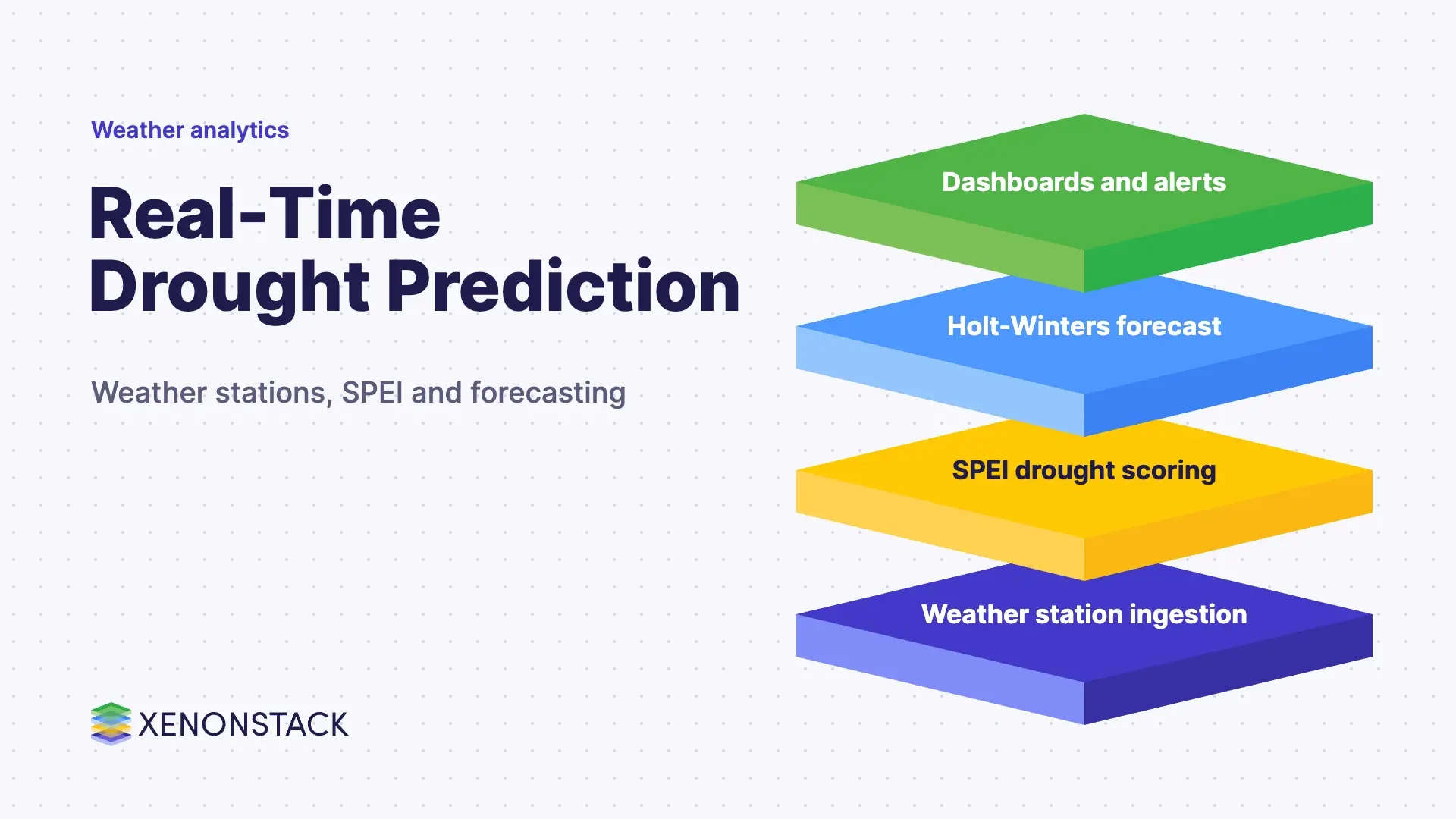
- Ingest. Receive readings from the weather stations at their reporting intervals and message lengths.
- Clean and convert. Convert the raw, messy messages into a compact, consistent format that analysis can use.
- Score with SPEI. The SPEI uses the basis of the Standardised Precipitation Index but includes a temperature component. It needs monthly precipitation and temperature data with no missing months, and negative values indicate drier conditions.
- Forecast. Apply the Holt-Winters method, a triple exponential smoothing approach with level, trend and seasonal components, to forecast future occurrence and extent of drought.
- Publish. Serve the index and forecast to dashboards, maps and alerts for decision makers.
Where do AI agents fit in drought monitoring?
Agents can watch data feeds for gaps, flag a station that stops reporting, explain a change in the index in plain language, and prepare a regular briefing for water and agriculture teams. Decisions such as water restrictions stay with the responsible authority. For governed data and decision infrastructure behind such agents, see ElixirData, XenonStack's Context OS.
How do the forecasting approaches compare?
| Approach | What it does | Strength | Limit to know |
|---|---|---|---|
| SPEI scoring | Standardises the water balance of rainfall and temperature | Accounts for temperature as well as rain | Monthly index, so fast-developing droughts may be detected late; needs complete monthly records |
| Holt-Winters | Forecasts from level, trend and seasonal pattern | Simple to run and works with limited history, per the Nixtla documentation | Assumes seasonality stays constant |
| Deep learning | Learns patterns across many stations and variables | Can capture non-linear behaviour | Needs more data and careful testing |
What should you check before adopting it?
- Data completeness. SPEI needs a serially complete record, so plan for gap filling and station outages.
- Timescale. Choose index timescales that match the decision, from short agricultural periods to long water supply periods.
- Model fit. Test whether a constant seasonal pattern holds for your region before trusting Holt-Winters.
- Validation. Compare forecasts with observed drought declarations from your own authority.
- Response plan. Decide in advance who acts on each alert level.
To map one decision your forecasting agents make, and the data and policy it depends on, book a Context Workshop. See what happens in the workshop.
Frequently asked questions
What is SPEI?
The Standardised Precipitation Evapotranspiration Index is a drought index that uses the basis of the Standardised Precipitation Index but adds a temperature component. Negative values indicate drier conditions.
Why use Holt-Winters for drought forecasting?
It is a triple exponential smoothing method that models level, trend and seasonality, is simple to implement and does not need a large history. It assumes seasonality stays constant.
What data does a drought prediction system need?
Monthly precipitation and temperature records with no missing months for SPEI, plus a reliable feed from the weather stations.
Can drought be predicted in real time?
Streaming data can update the index and forecast as new readings arrive, though SPEI is a monthly index, so rapidly developing droughts may be detected late.
How do AI agents help?
Agents can monitor data feeds, flag silent stations, explain index changes and prepare briefings, while responsible authorities make the response decisions.
Ready to put AI agents to work? See an ElixirClaw demo: the agentic OS to build, orchestrate and govern AI agents across your enterprise systems.
Explore the XenonStack platform family: ElixirData · ElixirClaw · ElixirHub · NexaStack · MetaSecure · Neural AI · AgentGRC · AgentSRE · AgentAnalyst · AgentInstruct · AgentRAI · AgentScrum · AgentSearch · AgentForce · AI Aviator · SAIF Aviator · CohortIQ · XenonStack AI · XenonStack UAE