Key takeaway
- In-memory analytics keeps working data in RAM so queries return fast. See how Apache Ignite and Spark support real-time analytics and what to check first.
In-memory analytics runs queries and computations on data held in a cluster's main memory instead of reading it from disk for every request. Apache Ignite, a distributed database that works in memory first, and Apache Spark, which can cache datasets in memory across operations, are two common ways to build it.
This page is for data and platform teams who need faster analytical queries on transactional databases, Hadoop-based warehouses or streaming sources. It covers the problem, two Ignite-based solution patterns, where AI agents fit and what to check before you adopt it.
What is in-memory analytics?
In-memory analytics keeps the data an analysis needs in RAM, spread across the nodes of a cluster, so that queries, joins and iterative algorithms avoid repeated disk reads. Industries such as retail, telecoms and security need insight from fast-growing data in near real time, and often across several stores at once: relational databases such as MySQL, and big data platforms built on Spark and Hadoop.
The Apache Ignite project describes Ignite as "a distributed database for mission-critical high-velocity applications that require in-memory performance". Ignite also integrates with existing technologies such as Cassandra, Hadoop and Spark.
What problem does it solve?
Teams usually arrive at in-memory analytics with one of these needs:
- A healthcare application built on .NET and SQL Server whose query performance has to improve.
- Fast analytical queries on a community data warehouse based on Apache Spark and Hadoop.
- Both transactional (OLTP) and analytical (OLAP) work across workloads spread over RDBMS, NoSQL and Hadoop stores.
- A real-time query platform that stays consistent as data changes.
How does an in-memory analytics solution work?
Two patterns cover most of these needs.
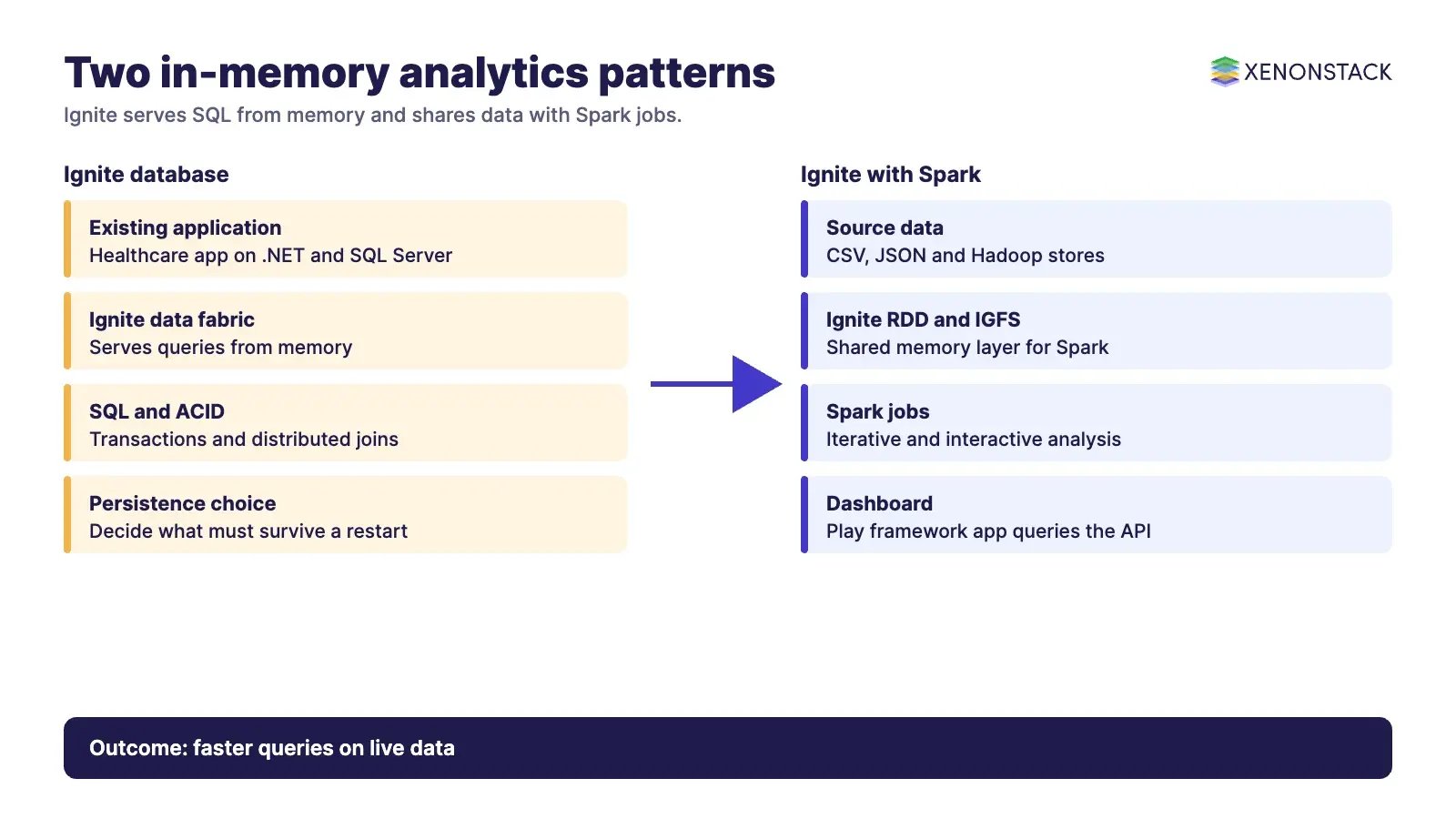
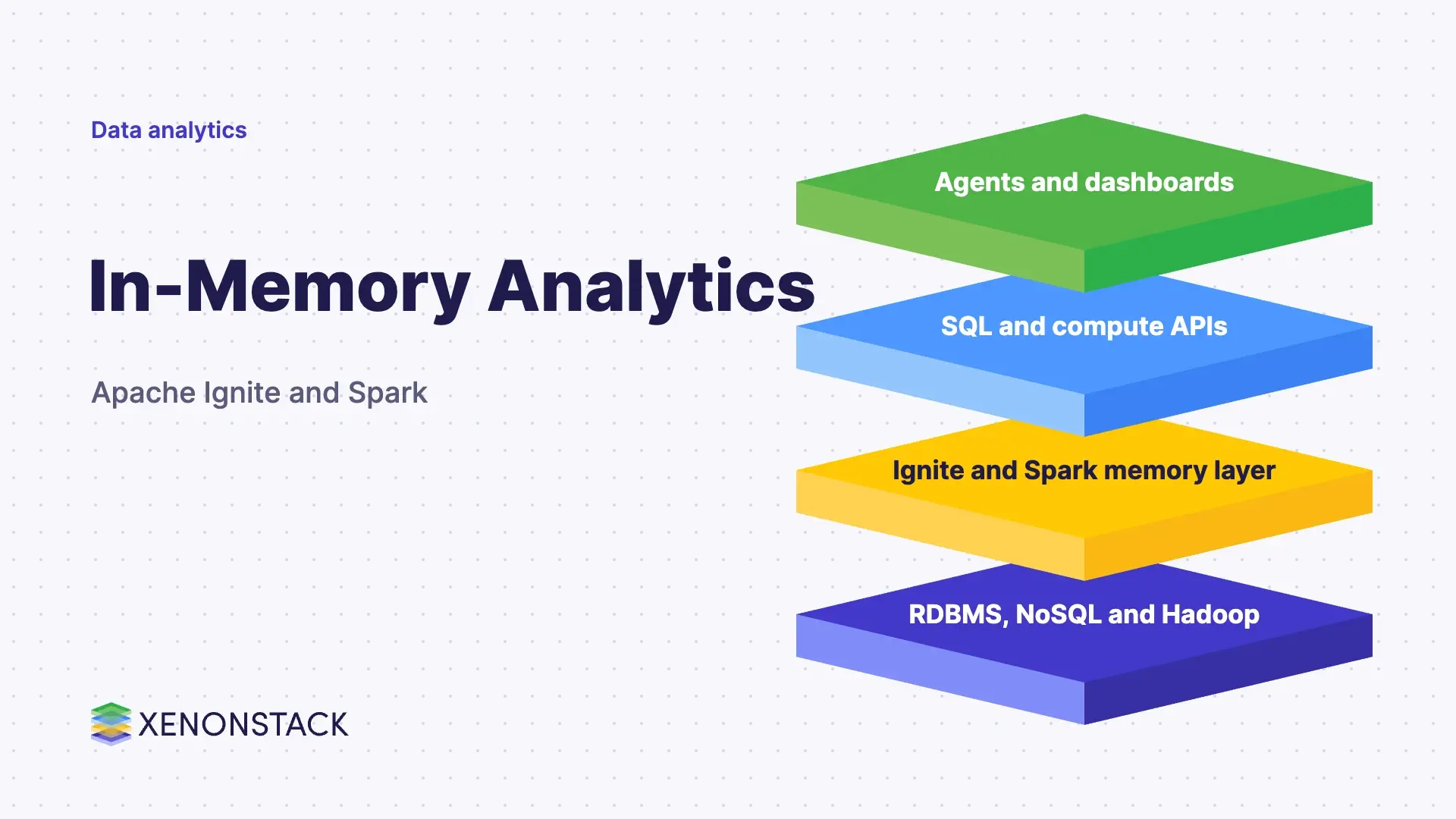
Pattern one: Ignite as an in-memory database for .NET. Ignite sits in front of or beside the existing database and serves SQL queries, ACID transactions and distributed SQL joins from memory, with a data fabric available for .NET applications.
Pattern two: Ignite as a shared memory layer for Spark. Ignite RDDs and the Ignite file system (IGFS) give Spark jobs a shared in-memory layer. An analytics dashboard built with the Play framework talks to Ignite through its API. Users upload semi-structured files such as CSV or JSON and run analytical queries on them.
Memory is not the same as durability. The Ignite documentation says that with native persistence, "Ignite always stores all the data on disk, and loads as much data as it can into RAM for processing", and that without persistence or external storage "Ignite behaves as a pure in-memory store". See the native persistence documentation before you decide how much of your data can be lost on a restart.
How do Apache Ignite and Apache Spark compare?
They overlap but are built for different jobs. According to the Spark RDD programming guide, persisting a dataset in memory lets each node reuse its partitions in later actions, which is a key tool for iterative algorithms and fast interactive use.
| Question | Apache Ignite | Apache Spark |
|---|---|---|
| Main role | Distributed database with SQL, key-value and compute APIs | Distributed processing engine for batch, streaming and iterative work |
| How memory is used | Memory-first storage, with optional native persistence on disk | Datasets cached in memory across operations; lost partitions are recomputed |
| Natural fit | Low-latency SQL, transactions and shared state | Large-scale transformations, iterative algorithms and interactive analysis |
| Used together | Ignite RDDs and IGFS share data between Spark jobs | Reads from and writes to the shared Ignite layer |
| Sources | ignite.apache.org | spark.apache.org |
Where do AI agents fit in in-memory analytics?
Agents need current data to act on, and an in-memory layer gives them quick answers to the questions they ask repeatedly, such as the latest state of an account, a device or an order. An agent can call the query API, summarise the result and trigger a follow-up task, while the analytics layer stays the single place where the numbers are computed.
The data these agents read still needs context and policy around it: who may see which table, how fresh the numbers must be and which decision the answer feeds. ElixirData, XenonStack's Context OS, is the product page for that data and governance layer.
What should you check before adopting it?
- Decide what must survive a restart, and whether to enable persistence or keep an external store as the system of record.
- Estimate the working set and the memory it needs per node, and how the cluster will grow.
- List the queries that must be fast, and test joins and data placement (affinity collocation) on them first.
- Confirm consistency needs for the transactional workload before moving it off the existing database.
- Define access rules and freshness targets for any agent or dashboard that reads the data.
To map one decision your agents make, and the data and policy it depends on, book a Context Workshop. See what happens in the workshop.
Frequently asked questions
Is in-memory analytics the same as an in-memory database?
No. An in-memory database stores data in RAM. In-memory analytics is the practice of running analysis on memory-resident data, and it can use an in-memory database, a cache such as a Spark RDD cache, or both.
Does Apache Ignite replace Apache Spark?
No. Ignite is a distributed database, while Spark is a processing engine. They can be combined, for example by using Ignite RDDs as a shared memory layer for Spark jobs.
Does in-memory data disappear when a node restarts?
It can. Ignite behaves as a pure in-memory store when native persistence is turned off and no external storage is used. With native persistence enabled, all data is kept on disk and RAM holds as much as fits.
Can it handle both transactions and analytics?
Ignite supports SQL, distributed joins and ACID transactions, so one cluster can serve both kinds of work. Test your own mix of queries before consolidating workloads.
How does this help AI agents?
Agents get fast answers from current data without waiting on slow queries. Governance of what each agent may read still has to be defined separately.
Ready to put AI agents to work? See an ElixirClaw demo: the agentic OS to build, orchestrate and govern AI agents across your enterprise systems.
Explore the XenonStack platform family: ElixirData · ElixirClaw · ElixirHub · NexaStack · MetaSecure · Neural AI · AgentGRC · AgentSRE · AgentAnalyst · AgentInstruct · AgentRAI · AgentScrum · AgentSearch · AgentForce · AI Aviator · SAIF Aviator · CohortIQ · XenonStack AI · XenonStack UAE