Key takeaway
- Agentic AI in the energy sector: where agents fit across grid, trading, storage and maintenance, what the IEA and EU rules say, and how to adopt safely.
What is agentic AI in the energy sector?
Agentic AI in the energy sector is software that perceives grid, market, weather and asset data, decides on an action inside defined limits, and carries it out through operational systems. Unlike a forecasting model that only produces a number, an agent closes the loop: it can rebalance a battery schedule, raise a maintenance work order or flag an anomaly to the control room. The practical question for a CEO, CTO or grid architect is not whether agents can act, but which decisions they may take alone and which need a human.
This guide covers where agents fit across grid operations, trading, renewables, storage, maintenance and security, what the IEA and EU regulators say, and how to adopt them in a controlled sequence. For deeper detail on two single topics, see our posts on AI to optimise renewable energy production and predictive maintenance for energy grid management. For the wider concept, read agentic AI frameworks, tools and use cases.
Where does agentic AI fit in energy operations?
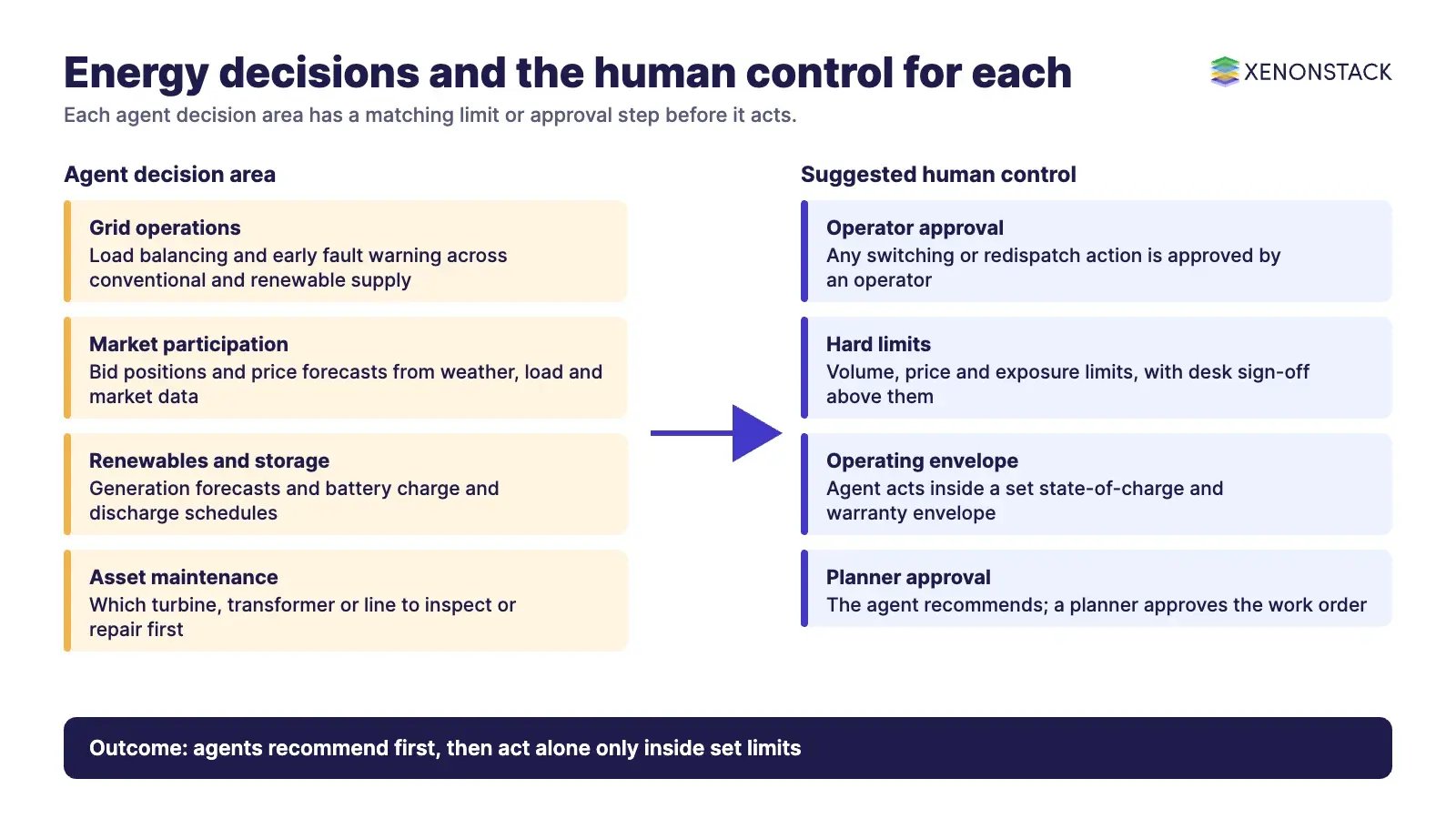
The table sets out five areas, what the agent decides, and where a human should stay in the loop. It is our view of a sensible starting position for most operators, not a regulatory requirement.
| Area | What the agent decides | When it fits | Suggested human control |
|---|---|---|---|
| Grid operations | Load balancing between conventional and renewable supply; early warning of faults | Networks with good sensor and SCADA data and clear switching procedures | Operator approves any switching or redispatch action |
| Market participation | Bid and offer positions, and price forecasts from weather, load and market data | Organisations with existing trading desks and risk limits | Hard limits on volume, price and exposure; desk sign-off above them |
| Renewables and storage | Generation forecasts; when a battery charges or discharges | Sites with solar, wind or battery assets and reliable forecast inputs | Agent acts inside a set state-of-charge and warranty envelope |
| Asset maintenance | Which asset to inspect or repair first, from sensor and condition data | Fleets of turbines, transformers or lines with condition monitoring | Planner approves work orders; the agent recommends |
| Cybersecurity | Anomaly detection and containment steps on operational and IT networks | Operators with a security operations team and tested playbooks | Containment that affects supply requires human approval |
Autonomous grid management and self-healing networks
Distribution and transmission networks now carry decentralised generation, flexible loads and tighter regulatory constraints. An agent can monitor grid health, anticipate faults and propose rerouting or load balancing between conventional and renewable sources using live environmental data. Our energy and utilities solutions page describes the work we do here. In practice, switching actions on live networks should stay behind operator approval until the agent has a proven record in recommendation mode. Keeping governed context, versioned policy and decision traces in one decision layer above the agents is what ElixirData Context OS is built to do.
Video: Smart Grid Monitoring AI, transformer hotspots found early (XenonStack AI).
Market participation and decentralised trading
As consumers and producers trade closer to real time, agents can forecast prices from weather, grid load and market data and propose or place bids. Households and businesses with solar and storage can in principle trade surplus energy, with smart contracts recording the transaction. Treat trading agents as the highest-control case: set limits on volume, price and exposure, and log every order and the data behind it.
Renewable integration and storage
Wind, solar and hydropower output varies with weather. Agents can combine satellite, atmospheric and historical data to forecast production and then schedule battery charging and discharging against expected supply and demand. They can also support demand response by shifting flexible load to off-peak hours through pricing signals. Battery schedules should respect the manufacturer's operating limits, so the agent works inside a defined envelope rather than optimising without bounds.
Predictive maintenance and asset health
Failures in turbines, transformers and lines are costly, and periodic inspection can miss early signs. Agents can read sensor data continuously, rank assets by condition and propose which repair to schedule first, so work follows actual risk rather than a fixed calendar. This is usually the safest first deployment, because the output is a recommendation a planner can check. The same pattern is described in our energy grid maintenance guide.
Cybersecurity for energy infrastructure
Digital energy systems widen the attack surface. Agents can flag unauthorised access and unusual power behaviour, and propose isolating an affected segment. Because containment can itself interrupt supply, it needs approval rules written in advance. Insider misuse is part of the same picture; see our overview of insider threats in cyber security.
What has changed in energy and AI?
The International Energy Agency (IEA) published a dedicated Energy and AI report that covers both AI as a new electricity load and AI as a tool inside the energy system. The figures below are taken from the IEA pages we read on 12 November 2026.
| Finding | Figure | Source and caveat |
|---|---|---|
| Data centre electricity use, 2024 | About 415 TWh, roughly 1.5% of global electricity | IEA Energy and AI, Base Case history |
| Data centre electricity use, 2030 | About 945 TWh, just under 3% of global electricity | IEA Base Case projection |
| Extra transmission capacity from AI | Up to 175 GW could be unlocked in existing lines | IEA estimate; a scenario, not a forecast for any single network |
| Cost savings in power plant operations and maintenance | Up to USD 110 billion a year by 2035 | IEA Widespread Adoption Case; assumes many adoption barriers are overcome |
The IEA also lists the barriers that limit current adoption: unfavourable regulation, lack of data access, interoperability concerns, critical skills gaps, limited digital infrastructure and resistance to change. Source: IEA, Energy and AI.
What governance, security and cost controls does it need?
Energy is regulated critical infrastructure, so controls come before scale. Three points matter for most operators.
EU AI Act. Annex III, point 2 lists AI systems intended as safety components in the management and operation of critical digital infrastructure, road traffic, or in the supply of water, gas, heating or electricity (AI Act Annex III). As reported by Lewis Silkin, the Digital Omnibus on AI entered into force on 27 July 2026 and moved Annex III application from 2 August 2026 to 2 December 2027.
NIS2. The European Commission lists energy among the critical sectors in scope of the NIS2 Directive, whose medium-sized and large entities must take risk-management measures and notify significant incidents. Member States had until 17 October 2024 to transpose it (European Commission).
Decision traces. Whatever the jurisdiction, record what each agent saw, which policy applied and who approved. The Audit Agent gathers decision histories, the policies in force at the time, approvals and authority records so compliance teams can answer auditor questions without manual reconstruction.
On cost, integrating agents with existing grid, market and maintenance systems is the main effort, and the IEA notes interoperability and data access as barriers. Budget for data integration and operator training before model work. For building, orchestrating and governing agents with humans in control, ElixirClaw is an agentic OS platform for that purpose.
How should an energy company adopt agentic AI?
Pick one decision. Choose a bounded decision such as maintenance prioritisation or battery scheduling, and write down who decides today.
Fix the data. Confirm sensor, SCADA and market data are accessible and interoperable before building.
Run in recommendation mode. Let the agent propose actions while operators decide, and measure how often they agree.
Set limits and approvals. Define what the agent may do alone, what needs approval and what is never automated.
Add decision traces and security review. Log every input, policy and approval, and test containment playbooks.
Widen scope gradually. Move to the next decision only when the first has a clear record.
When is agentic AI not the right answer?
Agents add little where the decision is rare, the data is poor or the action is irreversible with no safe test environment. Direct control of protection systems and safety-critical switching is better left to deterministic, certified systems, with agents advising. If the barriers the IEA lists, such as data access and skills gaps, are unresolved, fix those first. Public trust also matters: stakeholders need a clear account of what the agent can and cannot do alone.
Which trends should energy leaders watch?
Three directions are worth tracking. Decentralisation is moving control toward local microgrids. Hybrid AI and IoT sensing is improving real-time monitoring of assets. Computer vision on drones and cameras is adding inspection data; see agentic AI in computer vision. These are directions, not forecasts, and each depends on the data and governance points above.
To map one energy decision your agents should make, and the context and policy it depends on, book a Context Workshop. See what happens in the workshop.
FAQ: Agentic AI in the energy sector
What is agentic AI in the energy sector?
Agentic AI in the energy sector means software agents that read grid, market, weather and asset data, choose an action within set limits, and carry it out through operational systems. Higher-impact actions go to a human for approval.
Which energy use cases are ready for agentic AI first?
Forecasting, asset health monitoring and maintenance planning are the usual starting points, because the agent recommends and a human approves. Direct control of grid switching or trading is better added later, under tight limits.
How much transmission capacity can AI unlock?
The IEA estimates that up to 175 GW of additional transmission capacity could be unlocked in existing lines with the use of AI. This is a scenario estimate, not a guaranteed outcome for any one network.
Is an energy AI agent a high-risk system under the EU AI Act?
It can be. Annex III lists AI systems used as safety components in the management and operation of critical digital infrastructure, or in the supply of water, gas, heating or electricity. Under the Digital Omnibus on AI, as reported by Lewis Silkin, Annex III obligations now apply from 2 December 2027.
What are the main barriers to adopting AI in energy?
The IEA lists unfavourable regulation, lack of data access, interoperability concerns, critical skills gaps, limited digital infrastructure and resistance to change.
Should AI agents act on grid or trading systems without human approval?
Not at the start. Begin with recommendation mode, set explicit limits on what an agent may do alone, and keep a decision trace for every action so operators and auditors can review it.
Follow XenonStack on LinkedIn: XenonStack on LinkedIn for new guides on agentic AI, data and platform engineering.
Explore the XenonStack platform family: ElixirData · ElixirClaw · ElixirHub · NexaStack · MetaSecure · Neural AI · AgentGRC · AgentSRE · AgentAnalyst · AgentInstruct · AgentRAI · AgentScrum · AgentSearch · AgentForce · AI Aviator · SAIF Aviator · CohortIQ · XenonStack AI · XenonStack UAE