Key takeaway
- Industrial procurement with agentic AI: how agents run RFQs, should-cost, contracts and invoice exceptions, with governance, use cases and where to start.
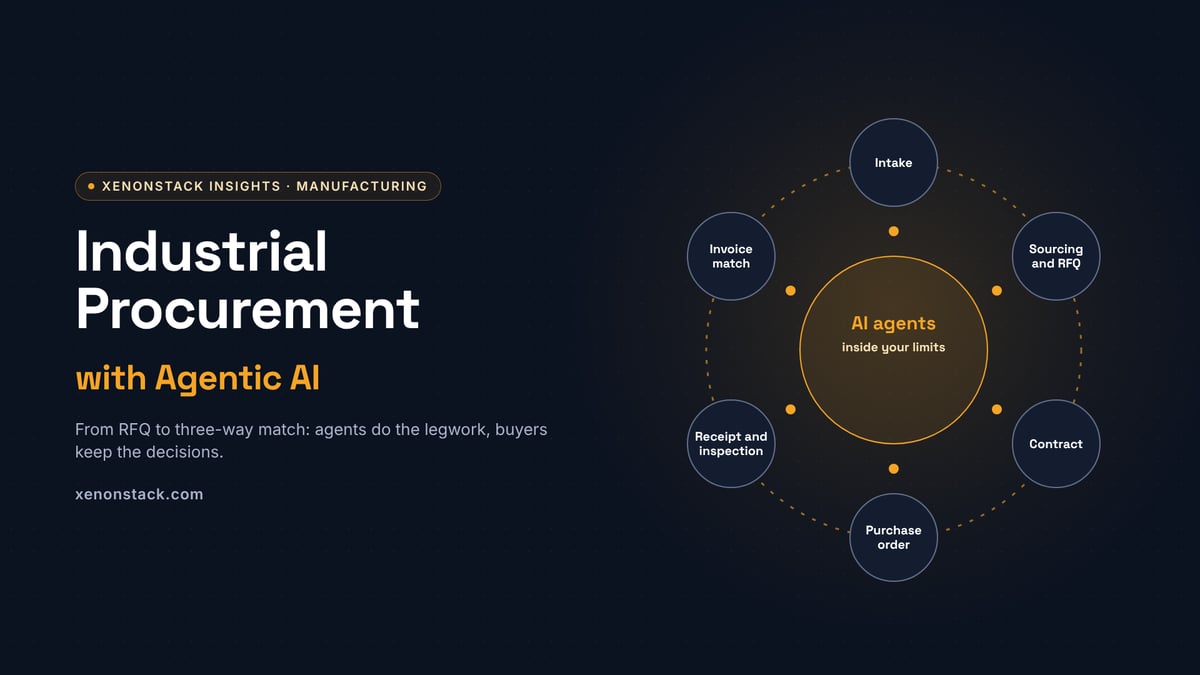
Industrial procurement is the strategic sourcing and buying of raw materials, components, heavy machinery, MRO supplies and technical or EPC services that keep plants and projects running. Agentic AI changes how that work gets done: software agents take on intake, RFQs, bid comparison, contract checks and invoice exceptions, while buyers keep the supplier relationships and the decisions that carry real risk. Every agent action runs inside spend limits, approval rules and an audit trail.
This guide is for chief procurement officers, plant and operations leaders, and CFOs. It covers how the industrial buying process works, where it breaks, how agentic AI differs from RPA and generative AI, which use cases to start with, and how to govern agents so they earn more autonomy safely. PwC expects agentic AI to transform at least three quarters of procurement activities, with productivity gains of 30% or more.
What is industrial procurement?
It is the buying that feeds production, maintenance and capital projects. Unlike indirect buying, it is driven by engineering specifications, production schedules and quality standards, and a single late or non-conforming item can stop a line.
| Category | Typical examples | What makes it hard to buy |
|---|---|---|
| Raw materials | Steel, chemicals, polymers, cement inputs | Volatile prices, quality grades and supply concentration |
| Components and parts | Castings, bearings, electronics, fasteners | Drawings, tolerances and long lead times |
| Heavy machinery and capital equipment | Compressors, kilns, CNC machines, fans | High value, long evaluation, installation and warranty terms |
| MRO supplies | Spares, lubricants, safety gear, tools | Thousands of low-value lines and urgent breakdown buys |
| Technical and EPC services | Engineering, installation, shutdown and maintenance contracts | Scope definition, safety compliance and milestone payments |
How does the industrial procurement process work?
- Identify the need and specification. A work order, MRP run or bill of materials sets what is needed, to what specification and by when.
- Source and qualify suppliers. Buyers check approved suppliers and contracts, issue RFQs and evaluate bids on price, quality, lead time and risk.
- Negotiate and contract. Terms, warranties, delivery schedules and penalties are agreed, often under framework agreements.
- Order and expedite. A purchase order is raised in the ERP and delivery is tracked against the production plan.
- Receive, inspect and pay. Goods are inspected with their certificates, the invoice is matched against the order and receipt, and supplier performance is recorded.
What are the biggest challenges in industrial procurement?
| Challenge | What it costs | Best practice |
|---|---|---|
| Lead-time and supply risk | Line stoppages, expediting fees and excess safety stock | Dual sourcing for critical items and continuous supplier risk monitoring |
| Maverick and tail spend | Buying off contract, lost discounts and weak audit trails | Guided intake that routes every request to catalogues and contracts first |
| Quality and compliance | Rework, recalls, safety incidents and failed audits | Certificate checks at receipt and supplier scorecards tied to sourcing |
| Poor visibility | Decisions made on partial data spread across ERP, email and spreadsheets | One connected view of suppliers, contracts, specifications and spend |
How is agentic AI different from RPA and generative AI in procurement?
| RPA | Generative AI | Agentic AI | |
|---|---|---|---|
| What it does | Repeats fixed, rule-based steps | Drafts, summarises and answers questions | Plans and completes multi-step tasks towards a goal |
| Handles variation | Breaks when formats or screens change | Handles language well, but does not act | Adapts to new documents and exceptions |
| Acts in systems | Yes, along scripted paths | No, a person has to act | Yes, through governed connectors |
| Procurement example | Copies PO data between screens | Drafts an RFQ or summarises a contract | Runs the RFQ, compares bids, flags risk and prepares the award |
| Control needed | Script maintenance | Human review of outputs | Spend limits, permissions, approvals and an audit trail |
The step from generative to agentic AI is the step from advice to action. That is where the value is, and also where governance becomes essential.
How does an industrial purchase run with AI agents?
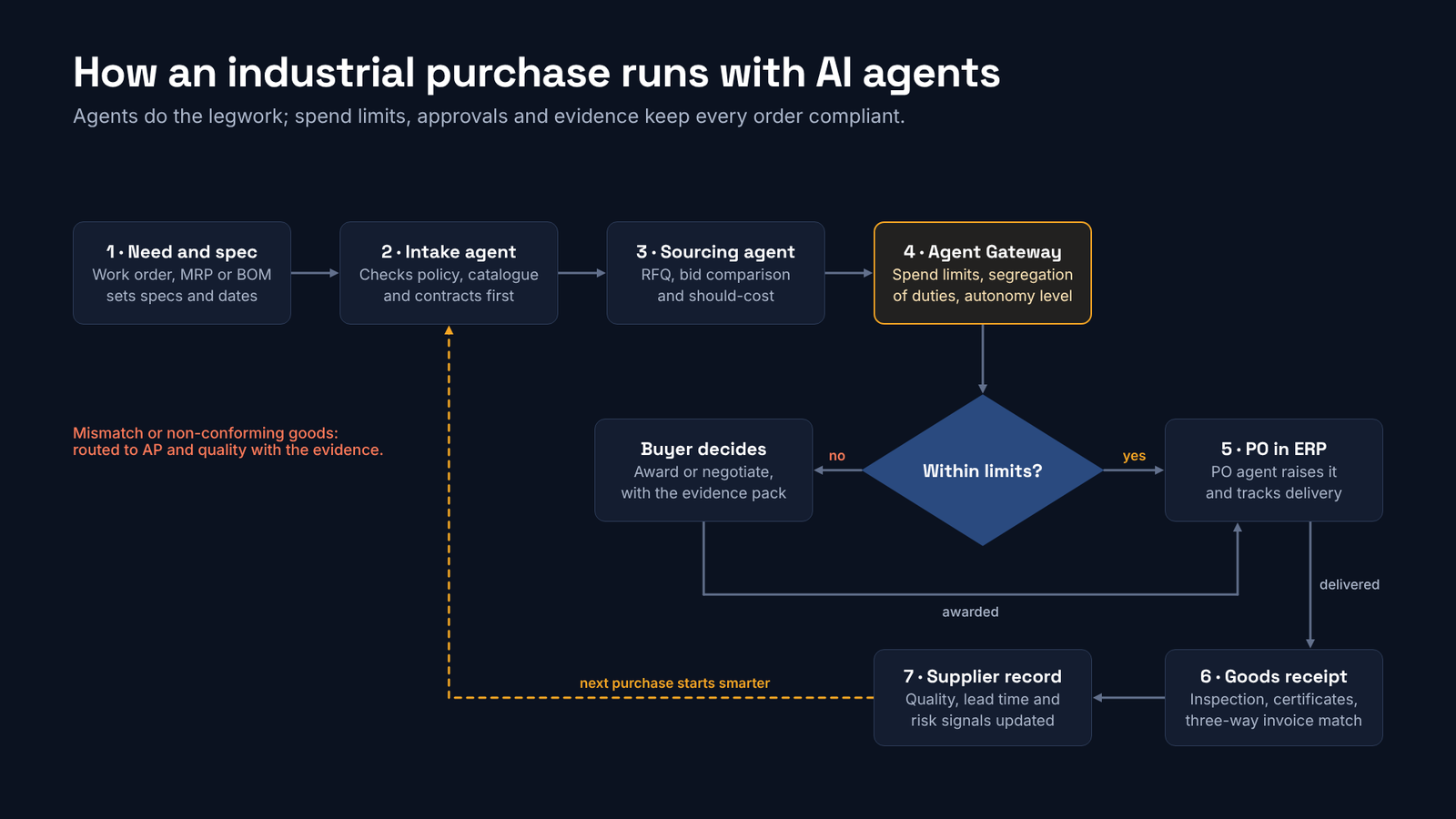
- Need and spec. A work order, MRP run or bill of materials creates the need.
- Intake agent. Checks policy, catalogues and existing contracts before anything is bought new.
- Sourcing agent. Issues RFQs, compares bids against a should-cost model and checks supplier risk.
- Agent Gateway. Checks the proposed award against spend limits, segregation of duties and the process's autonomy level.
- Order. Within limits, the PO agent raises the order in the ERP and tracks delivery. Outside them, the buyer decides with the full evidence pack.
- Goods receipt. Inspection results and certificates are checked and the invoice is matched three ways. Mismatches and non-conforming goods go to accounts payable and quality with the evidence.
- Supplier record. Quality, lead time and risk signals update the supplier record, so the next purchase starts smarter.
Where do AI agents add value first in industrial procurement?
Autonomous sourcing and RFQs
Agents turn a specification into an RFQ, invite qualified suppliers, normalise bids that arrive in different formats and present a ranked comparison with risks flagged. Buyers spend their time negotiating, not chasing quotes.
Should-cost and tail spend
Agents build should-cost estimates from material indices and past prices, and handle low-value spot buys inside agreed limits, bringing tail spend back under contract without adding headcount.
Contract lifecycle and renewals
Agents read contracts, flag non-standard clauses against your playbook, track renewal dates and price-adjustment terms, and prepare renewal options before the deadline passes.
Order and invoice exceptions
When a three-way match fails, agents find the cause, whether a price variance, a short delivery or a missing receipt, resolve what is within tolerance and send the rest to the right person with the evidence.
Supplier risk and ESG monitoring
Agents watch delivery performance, quality records, financial signals and ESG disclosures, and alert category managers before a weak supplier becomes a line stoppage.
What results can procurement teams expect?
PwC's April 2026 analysis gives a useful benchmark. It expects a productivity improvement of at least 30%, rising to as much as 70% for tasks led by agents. It estimates that around 80% of intake and orchestration work can be partly automated, that sourcing agents could lead up to a quarter of current sourcing activities and assist with most of the rest, and that sourcing cycle times could fall by half or more.
Those gains depend on clean supplier and contract data, clear limits and people who trust the agents. Gartner has predicted that over 40% of agentic AI projects will be cancelled by the end of 2027, citing costs, unclear value and weak risk controls. Procurement teams avoid that by measuring each process on its own numbers and governing every agent action.
What does a governed architecture for procurement agents look like?
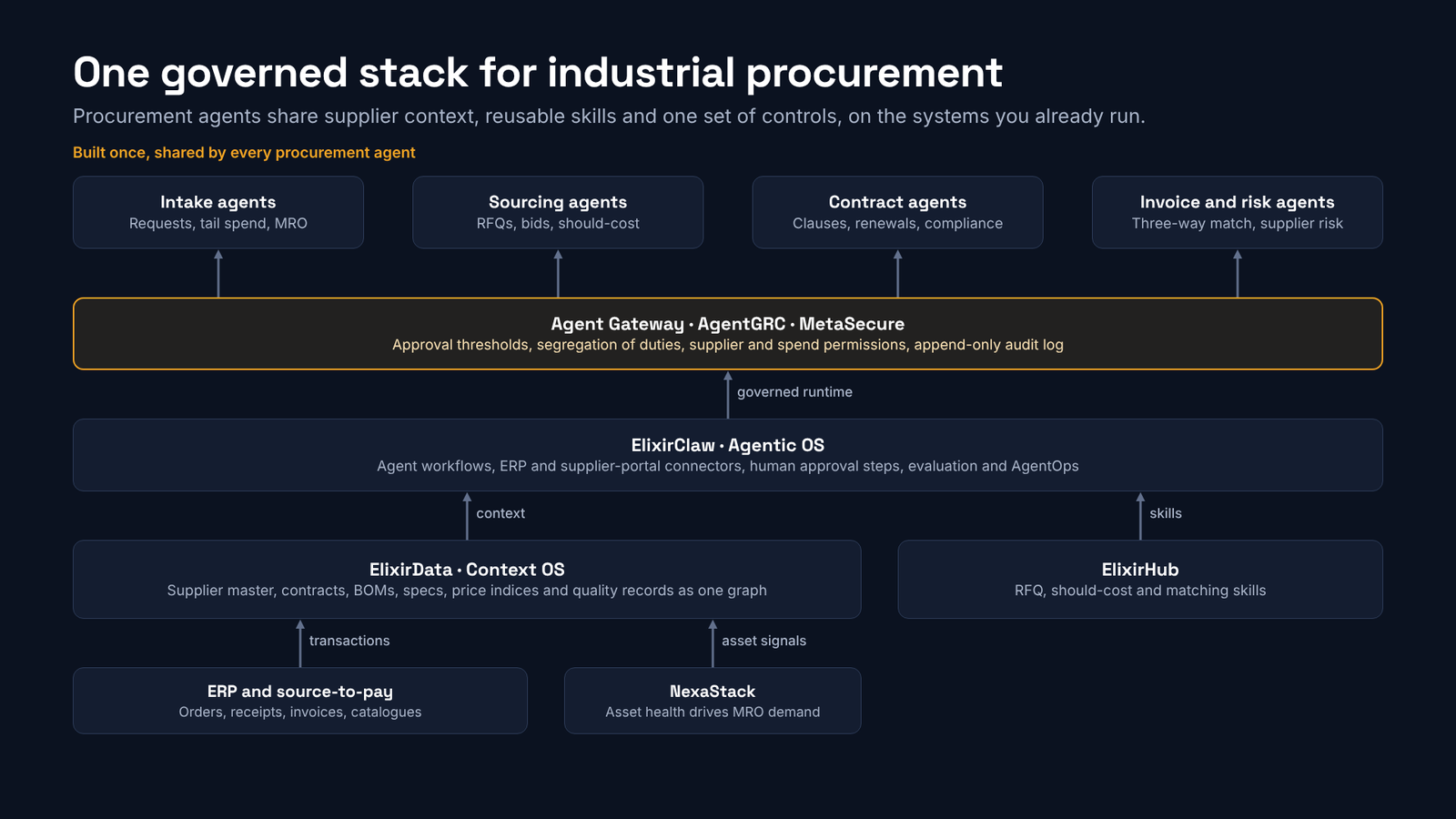
Procurement agents should share one supplier context, one set of reusable skills and one set of controls, rather than each tool bringing its own. That is the idea behind a governed AI stack.
| Layer | What it does for procurement | XenonStack component |
|---|---|---|
| Context | Joins supplier master, contracts, BOMs, specifications, price indices and quality records into one graph | ElixirData Context OS |
| Agents and workflows | Runs intake, sourcing, contract and invoice agents with ERP and supplier-portal connectors and human approval steps | ElixirClaw Agentic OS |
| Skills | Reusable RFQ, should-cost and matching skills shared by every agent | ElixirHub |
| Governance | Approval thresholds, segregation of duties, supplier and spend permissions and an append-only audit log | Agent Gateway, AgentGRC and MetaSecure |
| Assets | Equipment health signals that predict MRO demand before a breakdown | NexaStack |
See how this comes together for buying teams on our agentic procurement page.
How much autonomy should procurement agents have?
Autonomy is set per process and earned on evidence. A process moves up a level only when its record shows accuracy and a low override rate, and any breach moves it down.
| Process | Suggested starting level | Why |
|---|---|---|
| Catalogue and MRO reorders under a set value | Autonomous | High volume, clear rules, low risk per order |
| Invoice exceptions within tolerance | Autonomous | Tolerance rules are explicit and every action is logged |
| Tail-spend spot buys | Act on approval | Moves to autonomous once overrides stay low |
| Supplier onboarding and data changes | Act on approval | Fraud and segregation-of-duties risk |
| Strategic sourcing awards and contract changes | Recommend | Commercial judgement and long-term commitments |
| Capital equipment and safety-critical parts | Recommend | High value or safety impact; people decide |
How should you start?
- Pick one process with high volume and clear rules, such as MRO requests or invoice exceptions.
- Connect read-only to the ERP, contracts and supplier data, and let agents answer and recommend on live work.
- Measure touchless rate, cycle time, override rate and savings against today's baseline.
- Run a 90-day pilot with a target for every measure, then promote, hold or stop on the numbers.
What should you ask before choosing a procurement AI platform?
- Does it work with our ERP and supplier portals without migration?
- Can every agent action be traced to its evidence and reversed?
- Can we set spend limits and autonomy per process and change them on results?
- Do sourcing, contract and invoice agents share one supplier context and one set of controls?
- Does it run in our environment, and do we own what the agents learn?
To map which of your procurement processes agents should run first, and the limits each must work within, book a Context Workshop or see what happens in the workshop. Want to scope agentic procurement for your plants? Book a strategy call.
Frequently asked questions
What is industrial procurement?
Industrial procurement is the strategic sourcing and buying of what keeps plants and projects running: raw materials, components, heavy machinery, maintenance, repair and operations (MRO) supplies, and technical or EPC services. It is driven by engineering specifications, production schedules and quality standards rather than by catalogue prices alone.
How is industrial procurement different from indirect procurement?
Industrial purchases feed production directly, so a late or non-conforming part can stop a line. Specifications, certificates, lead times and supplier qualification matter far more than in indirect buying such as office supplies or marketing services.
What is agentic AI in procurement?
Agentic AI uses software agents that plan and carry out multi-step procurement work, such as preparing an RFQ, comparing bids or resolving an invoice exception, inside the limits a business sets. Unlike RPA, agents handle variation; unlike a chat assistant, they act in your systems.
Will AI agents replace buyers?
No. Agents take on the repetitive legwork: intake, data gathering, bid comparison and exception checks. Buyers keep supplier relationships, negotiations, capital and safety-critical decisions, and they approve anything outside agreed limits.
Which procurement process should we automate with agents first?
Start where volume is high and rules are clear: catalogue and MRO requests, tail spend, and invoice exceptions within tolerance. These prove value quickly and build the evidence needed before agents touch sourcing awards or contracts.
Do procurement agents need a new ERP?
No. Agents work through governed connectors to the ERP, source-to-pay suite and supplier portals you already run, so there is no migration. The work is in connecting supplier, contract and quality data so agents reason with full context.
Follow XenonStack on LinkedIn: XenonStack on LinkedIn for new guides on agentic AI, data and platform engineering.
Explore the XenonStack platform family: ElixirData · ElixirClaw · ElixirHub · NexaStack · MetaSecure · Neural AI · AgentGRC · AgentSRE · AgentAnalyst · AgentInstruct · AgentRAI · AgentScrum · AgentSearch · AgentForce · AI Aviator · SAIF Aviator · CohortIQ · XenonStack AI · XenonStack UAE