Key takeaway
- A governed AI stack lets enterprises run agents at scale: shared context, agents, skills and governance on every layer, with autonomy earned per process.
A governed AI stack is the shared set of layers every AI agent in an enterprise runs on: one context layer, one agent runtime, one skills registry, and governance built into each layer. Every agent action is permitted, logged and reversible. It is what lets an organisation move from a handful of pilots to AI running as an operation, with autonomy earned process by process rather than granted up front.
This guide is for CIOs, COOs, CFOs and risk leaders, and for the architects who have to make agents work across ERP, CRM, IT service and data platforms. It explains what the stack contains, how one governed action runs end to end, how agents earn autonomy, and how to run many agents as an operation. Gartner has predicted that over 40% of agentic AI projects will be cancelled by the end of 2027, citing escalating costs, unclear business value or inadequate risk controls. A governed stack addresses the last two directly.
What is a governed AI stack?
It is an architecture in which context, agents, skills and governance are built once and shared by every agent, instead of rebuilt in each project. Governance is not a policy document beside the stack; it is enforced inside each layer at the moment an agent reads data or takes an action.
| Layer | What it does | XenonStack component |
|---|---|---|
| Context | Joins policies, approval rules, master data, vocabulary and decision history into one graph that every agent reasons over | ElixirData Context OS |
| Agents and workflows | Runs specialist agents and multi-step workflows, with connectors to the systems you already run and your own models exposed as governed tools | ElixirClaw Agentic OS |
| Skills | Stores reusable, versioned agent skills so new agents are assembled from proven parts | ElixirHub |
| Governance | Applies permissions, policy, autonomy levels, defence against manipulated inputs and an append-only decision log to every action | Agent Gateway, AgentGRC and MetaSecure |
| Edge and assets | Extends the same rules to plants, devices and physical AI | NexaStack |
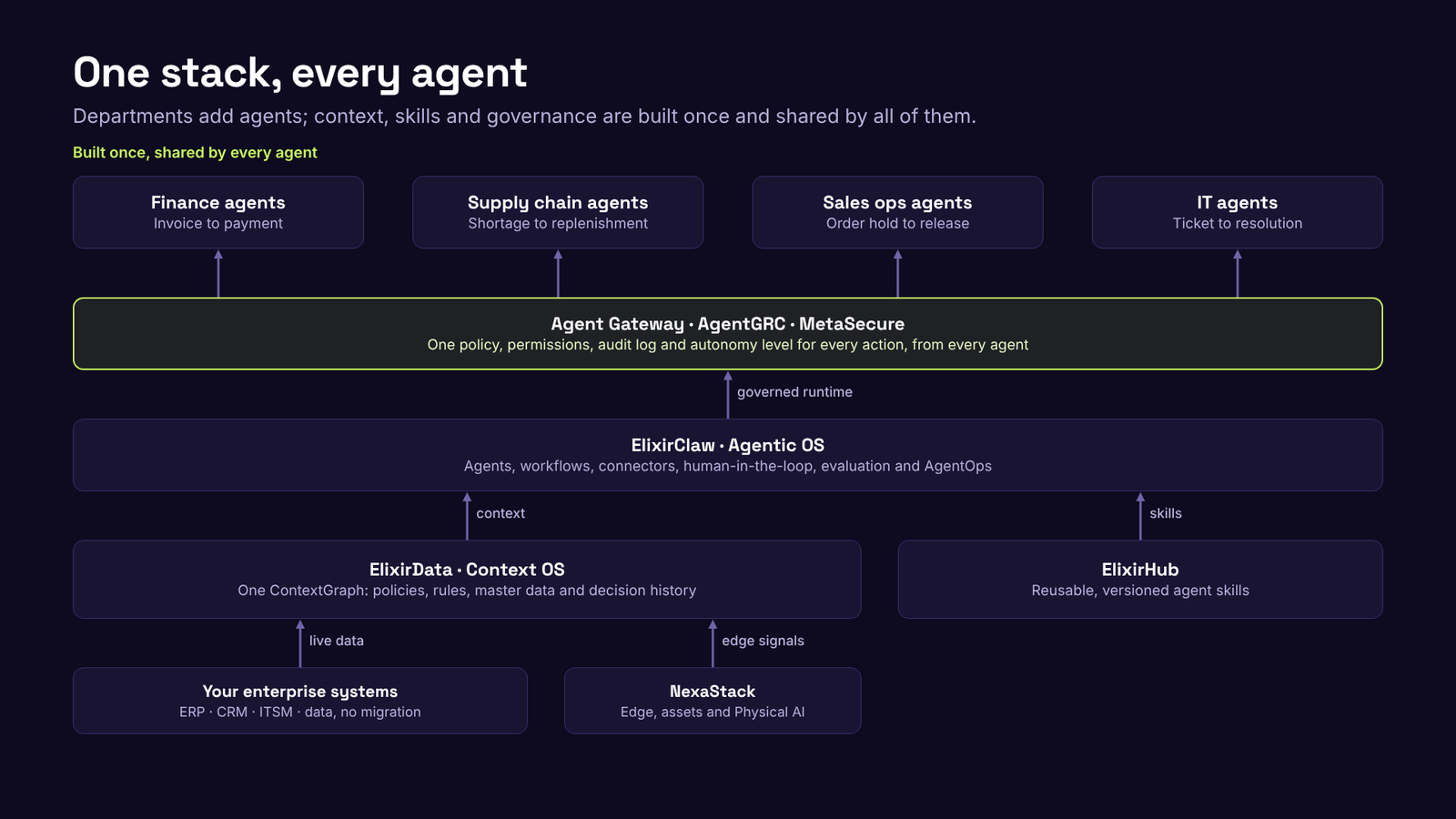
The test for any architecture is simple: when you add the next agent, what do you not have to build again? If the answer is nothing, you have a collection of pilots, not a stack.
Why do AI agents stall between pilot and production?
- Agents see data, not the business. An agent can read a purchase order but not your price tolerance, which suppliers are on watch or who may approve what. Without that context, every answer needs a human check and the business case disappears.
- No one can trace or reverse what an agent did. Auditors will not sign off automation they cannot follow, and risk teams will not approve an action they cannot undo.
- Every tool brings its own agents and rules. ERP, CRM and cloud agents each come with their own permissions and logs, so sprawl grows faster than governance.
Adding more pilots, models or tools makes all three worse. Shared context, one gateway and one decision log fix them once for every agent.
How does one governed agent action run, end to end?
Scale is built from thousands of single actions, so each must run the same governed way. Take an invoice that fails its three-way match:
- Trigger. The exception lands in the accounts payable queue.
- Context. The agent pulls the variance tolerance, the supplier's history and the approval rules from the context layer.
- Reason. It identifies the likely cause, calling your own models as governed tools.
- Gateway. The proposed action is checked against the agent's permissions, the policy and the process's autonomy level.
- Act or ask. Inside policy, the agent releases the invoice through a governed connector. Outside it, the process owner receives the case with its evidence and approves in one click.
- Log. What the agent read, which model decided and what changed are recorded in an append-only decision log.
- Learn. Overrides and outcomes flow back to improve your models, inside your own environment.
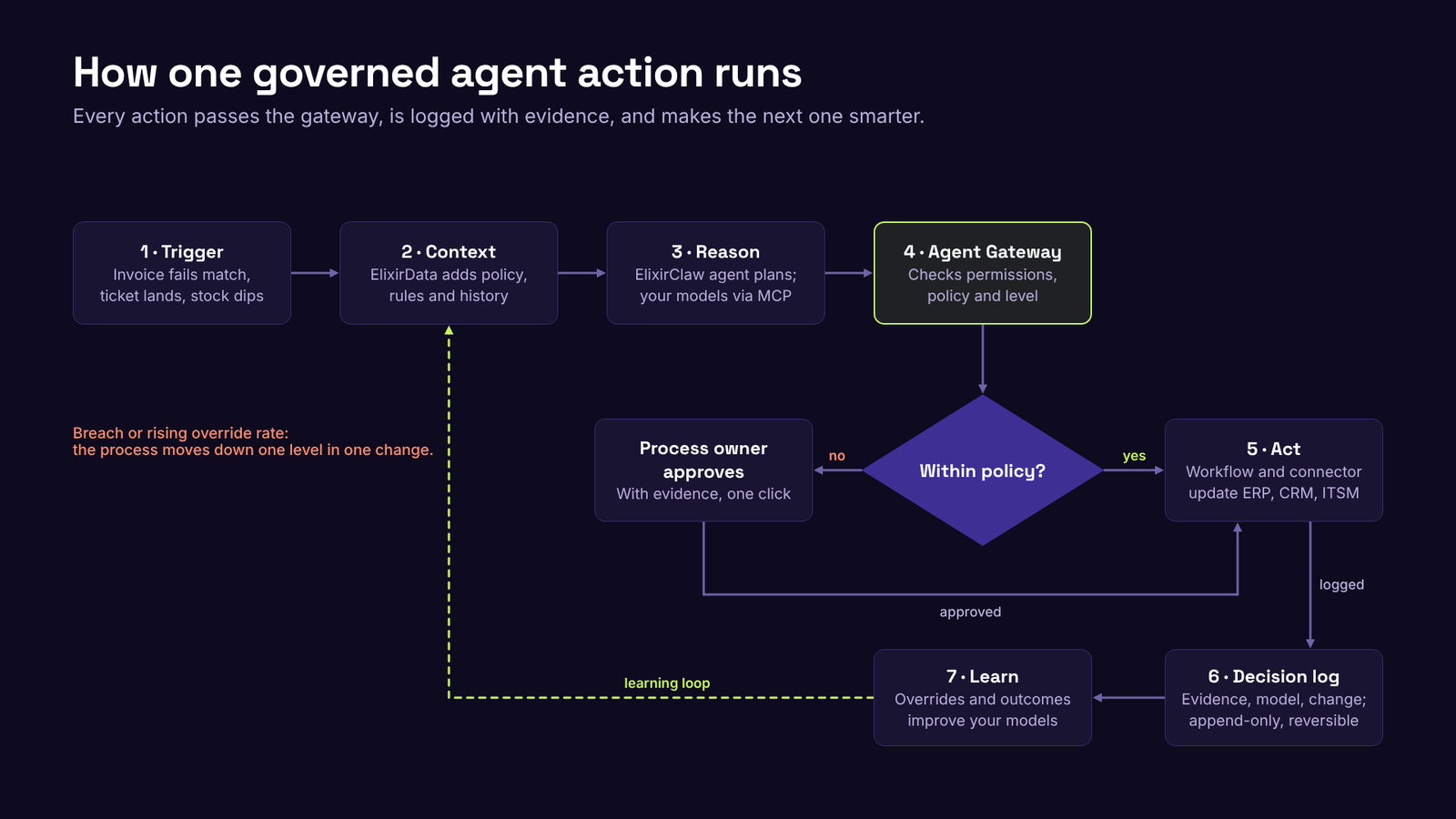
Steps 2, 4, 6 and 7 are identical for every agent in every department. Only the business logic changes, which is why the second and tenth agents cost far less than the first.
How is a governed AI stack different from an AI gateway or a GRC tool?
| Approach | What it covers | What it leaves open |
|---|---|---|
| AI or LLM gateway | One entry point for model calls, with access control, budgets and logging | Business context, agent workflows and per-process autonomy |
| AI governance or GRC platform | Inventories, risk assessments, policies and compliance reporting | Enforcement at the moment an agent acts |
| Vendor agents inside ERP or CRM | Agents that work well within one application | One policy and one log across every vendor's agents |
| Governed AI stack | Context, agents, skills and runtime governance as one system across vendors | Needs an owner per process and a review rhythm, like any operation |
How do AI agents earn autonomy?
Autonomy is set per process, not per company, and earned on evidence. Each process climbs four levels:
| Level | What the agent does | To move up |
|---|---|---|
| 1. Answer | Answers on live data and shows what it would do; changes nothing | Answers match your experts on an agreed sample |
| 2. Recommend | Prepares the full action with its evidence for review | Low override rate over an agreed period |
| 3. Act on approval | Executes once a person approves | Approvals given unchanged and no policy breaches |
| 4. Autonomous | Runs end to end inside policy and stops to ask outside it | Stays only while monitoring shows no breach |
Any breach moves the process down a level in one change. Invoice matching can run autonomously while credit decisions stay at Recommend, and high-stakes decisions stay with people. Compliance stops being the brake on autonomy and becomes the evidence for it: the decision log your auditor needs is the same record a process owner uses to promote the agent.
How do you run AI agents as an operation at scale?
At scale the unit of management is the process, not the agent. Three things turn a portfolio of governed processes into an operation:
- Clear owners. An executive sponsor sets objectives, a process owner sets limits and approves promotions, internal audit reviews the decision log, and super users build new agents from shared skills.
- One scorecard. Touchless rate, cost per transaction, override rate per agent and audit findings, each with one definition and one owner, reviewed monthly.
- A quarterly rhythm. Each process moves up, holds or moves down a level on its own numbers. Nothing is promoted on enthusiasm.
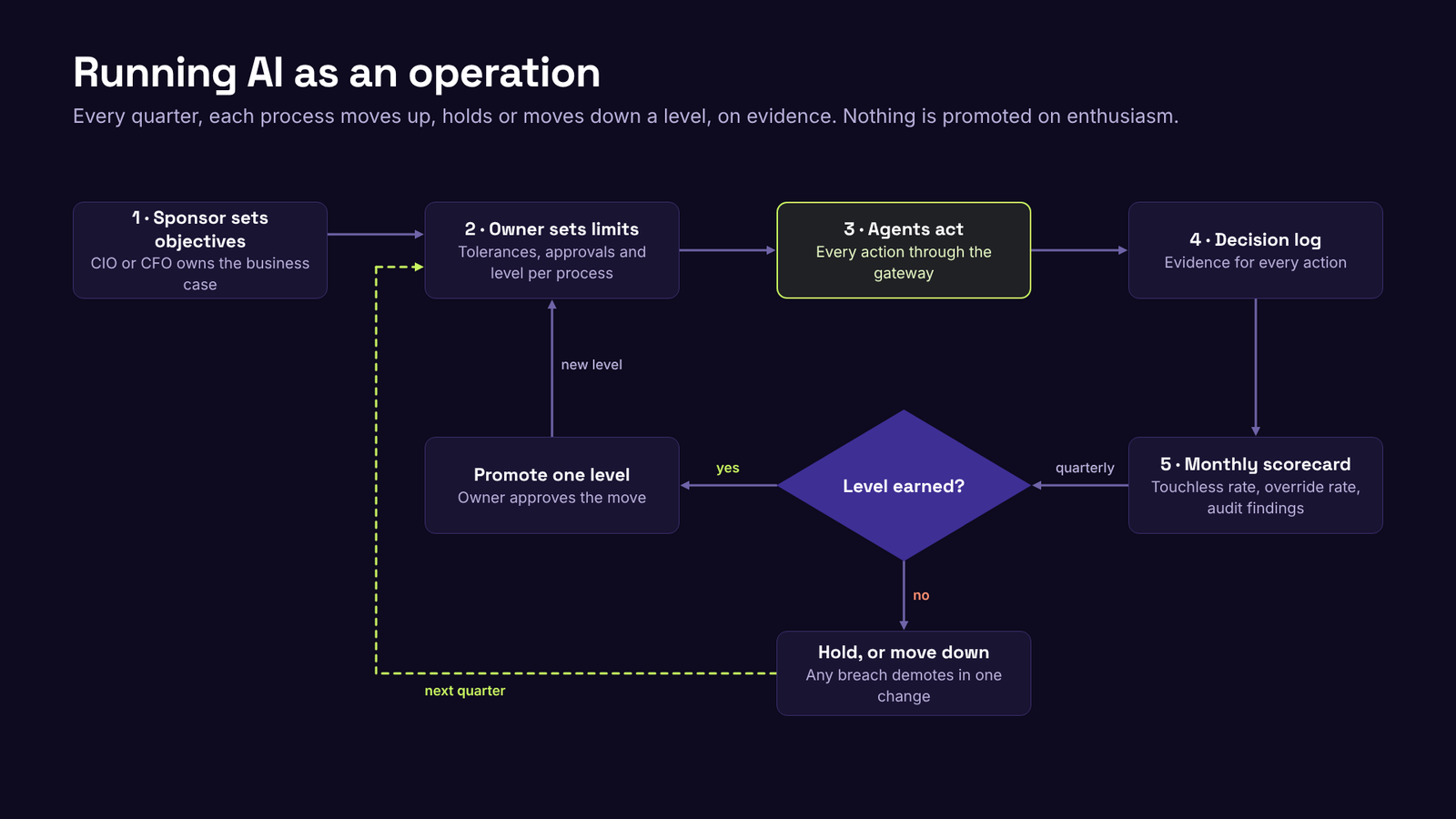
People stay in the picture; their work changes. Accounts payable teams resolve complex exceptions instead of matching invoices, buyers manage suppliers instead of raising requisitions, and IT designs agents instead of clearing tickets.
Which standards does a governed AI stack help you meet?
No architecture makes you compliant on its own, but a governed stack produces much of the evidence that the main frameworks ask for.
| Framework | What it asks for | Where the stack helps |
|---|---|---|
| NIST AI Risk Management Framework | Risk work organised around Govern, Map, Measure and Manage | Inventory of agents, mapped processes, measured override and accuracy rates, and managed autonomy levels |
| ISO/IEC 42001 | A management system for AI, with roles, controls and continual improvement | Named owners per process, enforced controls and a review cycle with records |
| EU AI Act | Risk-based obligations, including human oversight and record-keeping for higher-risk uses | Human approval paths, the autonomy ladder and an append-only decision log |
| Singapore Model AI Governance Framework for Agentic AI | Practices for managing the risks of agents that plan and act | Bounded permissions, human accountability and traceable agent actions |
How should an enterprise start?
You do not need the whole stack on day one. Start where the need is most urgent:
- Govern if risk and compliance are asking about the AI you already run: one gateway, one policy and one audit log across your agents and models.
- Operate if finance or operations want results: governed agents on two or three business processes, on shared context.
- Run if you want outcomes without building a team: the agents are operated for you and the cost falls as they absorb more work.
Whichever you choose, prove it in short steps that each end in a decision: a one-day workshop, a two-week assessment, a read-only trial on live data, then a 90-day pilot with a target for every measure.
What should you ask before choosing a platform?
- When we add the next agent, which parts do we reuse and which do we rebuild?
- Is there one gateway and one policy across every vendor's agents we use?
- Can we see every action an agent took, the evidence it used, and reverse it in one change?
- Can autonomy be set and changed per process, based on measured results?
- Does it run in our environment, on the systems we already have, without migration?
- When a person overrides an agent, does the system learn inside our environment, and do we own that learning?
For related reading, see how governance and audit shape government AI analytics platforms and bank AI fraud platforms.
To map which of your processes agents should run first, and what each must earn, book a Context Workshop or see what happens in the workshop. Want to scope a governed AI stack for your organisation? Book a strategy call.
Frequently asked questions
What is a governed AI stack?
A shared set of layers that every AI agent in an enterprise runs on: one context layer, one agent runtime, one skills registry, and governance built into each layer, so every agent action is permitted, logged and reversible.
How is a governed AI stack different from AI governance?
AI governance sets the policies, roles and risk processes. A governed AI stack is the architecture that enforces them at the moment an agent acts, and records the evidence that they were followed.
Do we need to replace our ERP or data platform?
No. The stack connects to the ERP, CRM, ITSM and data platforms you already run. Agents read and act through governed connectors, so there is no migration.
How do AI agents earn more autonomy?
Each process moves through four levels: answer, recommend, act on approval and autonomous. It moves up only when its record shows accuracy and a low override rate, and any policy breach moves it down one level.
Which standards does a governed AI stack support?
It helps produce the evidence that frameworks such as the NIST AI Risk Management Framework, ISO/IEC 42001 and the EU AI Act ask for: inventories, risk controls, human oversight and records of what AI systems did.
Where should an enterprise start?
With one business process or one governance gap, proved on live data in your own environment, in short steps that each end in a decision on your own numbers.
Follow XenonStack on LinkedIn: XenonStack on LinkedIn for new guides on agentic AI, data and platform engineering.
Explore the XenonStack platform family: ElixirData · ElixirClaw · ElixirHub · NexaStack · MetaSecure · Neural AI · AgentGRC · AgentSRE · AgentAnalyst · AgentInstruct · AgentRAI · AgentScrum · AgentSearch · AgentForce · AI Aviator · SAIF Aviator · CohortIQ · XenonStack AI · XenonStack UAE