
Key takeaway
- Compare six platforms for government AI governance and audit: traceability, approvals, deployment fit and watch-outs, plus a pilot plan and when to skip.
The best government AI analytics platform is the one that can prove, on demand, who approved an AI use, which data and model produced an output, which policy applied and who can stop it. Microsoft Fabric with Purview, Databricks Unity Catalog, Snowflake Horizon, Google Cloud's Knowledge Catalog, Palantir AIP and IBM watsonx.governance each cover part of that record. None covers all of it alone, so most agencies will pair one analytics platform with a clear decision-record layer and test the pair against one real decision.
Disclosure: XenonStack builds agentic AI and analytics solutions and does not resell any platform below.
Which criteria matter for AI governance and audit-ready automation?
Dashboards and query speed are not the hard part of government AI. The hard part is accountability when software starts recommending or taking action. Federal direction points the same way. The Office of Management and Budget's memorandum M-25-21 asks agencies to keep an AI use case inventory and to ensure human oversight, intervention and accountability for high-impact uses. The NIST AI Risk Management Framework organises the work into Govern, Map, Measure and Manage.
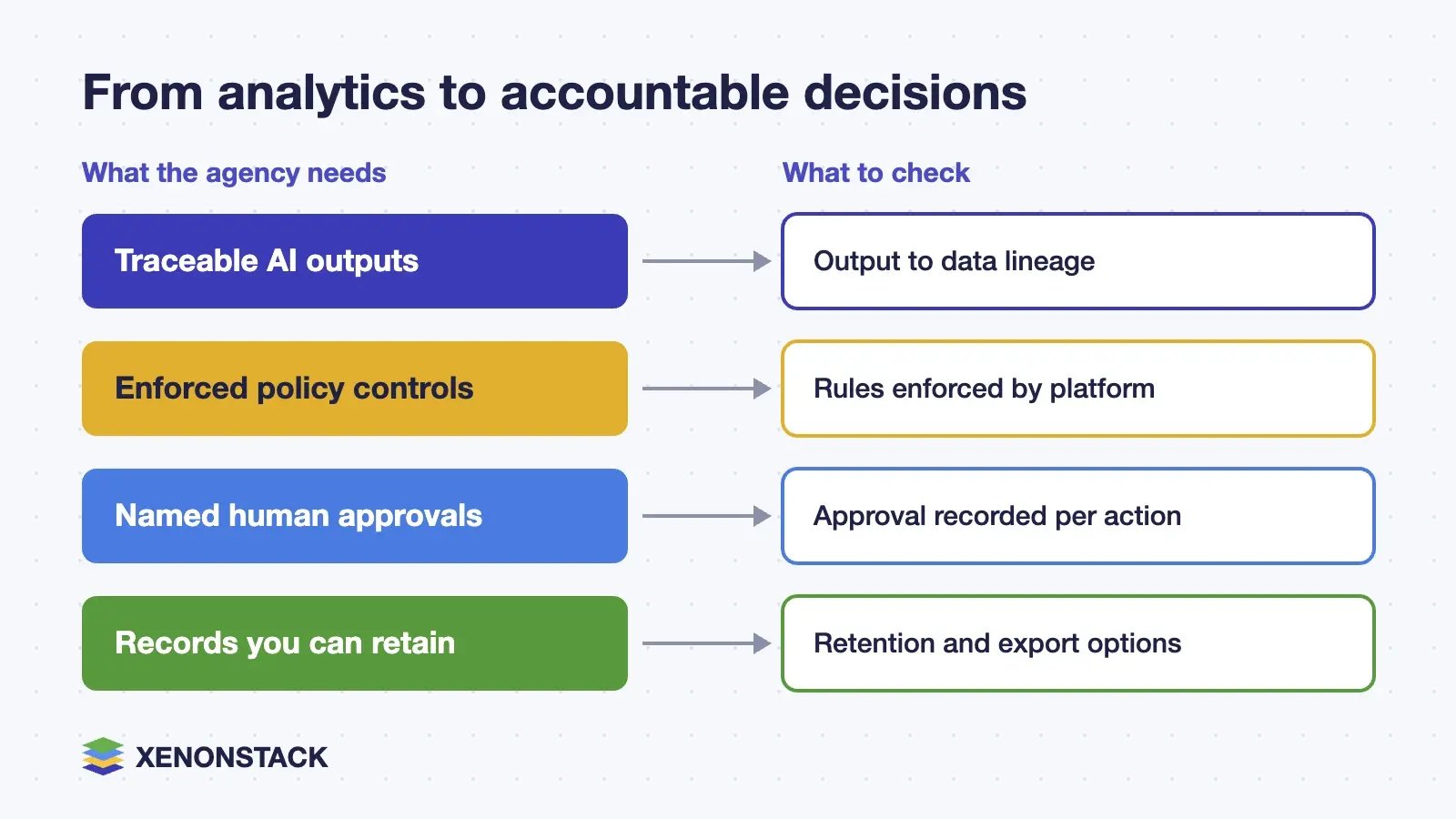
For a shortlist, turn those duties into five buyer tests.
- Traceability: can you follow an output back to its data, model version and query?
- Policy controls: are access rules, masking and guardrails enforced by the platform rather than by convention?
- Approvals: is there a record of who approved a use, and of who approved an individual action?
- Deployment fit: does the platform run inside the authorisation boundary your data requires?
- Evidence for reviewers: can an auditor, an inspector general or a member of the public see what happened without a data engineer translating?
For a wider buyer's framework, including scoring and a staged rollout, read our guide to government AI analytics platforms. This post stays on one question: how do named platforms compare on governance and audit?
How do six platforms compare side by side?
The table summarises what each vendor's own documentation describes. Treat it as a starting point for due diligence, not as proof. Authorisation status changes, so check the current listing on the FedRAMP Marketplace for the exact product and cloud region you plan to use.
| Platform | Best for | AI governance and audit | Deployment | Watch-outs |
|---|---|---|---|---|
| Microsoft Fabric with Purview | Agencies standardised on Microsoft 365 and Azure | Purview Audit records user activity on Fabric items; lineage and impact analysis; sensitivity labels; protections for Copilot and other AI apps | Microsoft cloud; confirm government availability for each Fabric feature | Sensitivity labelling needs extra Purview licensing; some AI data-security features were in preview when we checked |
| Databricks Unity Catalog | Engineering-led teams running data and machine learning together | Privileges, attribute-based policies, row and column filters; automatic lineage from data to models and dashboards; audit log table; AI Gateway for AI traffic | Cloud-hosted on the major clouds; check the listing for your region | Needs skilled engineers; business reviewers will want a friendlier view of the audit data |
| Snowflake Horizon | Governed data sharing and analytics across teams or agencies | Classification, masking and row-access policies; column-level lineage, including tracing AI answers to their data origin; access history; guardrails on agent outputs | Cloud-hosted; check government region coverage | Controls apply inside the platform; actions agents take elsewhere need their own record |
| Google Cloud Knowledge Catalog | Agencies on Google Cloud that need metadata, lineage and data products | Metadata workflow reviews; human review of AI-generated descriptions; column-level lineage; access through IAM and VPC Service Controls | Google Cloud; confirm assured-workload options | Audit logging detail sits in separate documentation; confirm what is captured |
| Palantir AIP and Foundry | Complex operational decisions that need tight data-to-action integration | Audit trails, explanations and evaluations of model decisions; mandatory access controls that travel with derived data | Vendor describes running models on a private network; check the listing for each environment | Strong platform dependency; human approval steps were not described on the pages we read, so test them |
| IBM watsonx.governance | A governance layer across AI systems from several vendors | Map of the AI estate; compliance evidence collection; monitoring for compliance and operational risk | Cloud and on-premises options; government cloud not stated on the page we read | Governs AI systems; it is not an analytics engine, so it sits beside one |
What does each platform do well, and where should you be careful?
Microsoft Fabric with Purview
The attraction is familiarity. Microsoft documents that administrators and compliance teams can track user activity on Fabric items through Purview Audit, and that Fabric shows lineage and impact analysis, so a change can be traced to the reports it affects. Purview also describes data security and compliance protections for generative AI apps, including Copilot and agents. The care point is coverage. Government availability varies by feature, and sensitivity labelling needs additional licensing, so ask for a written map of what is available in your tenant.
Databricks Unity Catalog
Databricks describes one catalogue that governs data and AI assets together. Lineage is tracked automatically from source data through models and services to dashboards, and data access is recorded in an audit log table. Its AI Gateway is described as governing AI traffic. This suits teams that build their own models and want one place for access rules. The care point is that the audit data is a table for engineers to query, so agencies should plan how inspectors and programme owners will read it.
Snowflake Horizon
Snowflake's documentation describes masking and row-access policies, automatic classification of sensitive columns and end-to-end column lineage. It also says AI answers can be traced back to their data origin, that agents operate under the same role-based access as people and that guardrails can detect, redact or block personal health information in agent outputs. That is a useful pattern for cross-agency sharing. The care point is scope: a record of what happened inside the platform does not automatically include what an agent then did in a case system or payment tool.
Google Cloud Knowledge Catalog
Google's catalogue, which earlier documentation called Dataplex, focuses on metadata and data products. It describes review workflows before metadata is published, human review of AI-generated descriptions, column-level lineage and access control through IAM, VPC Service Controls and customer-managed encryption keys. It is a sensible choice for agencies already on Google Cloud. The care point is that its overview lists audit logging as a separate topic, so confirm exactly which events are captured.
Palantir AIP and Foundry
Palantir describes built-in governance for accountability and historical lineage, plus audit trails, explanations and evaluations of model decisions. Foundry documentation describes mandatory controls that travel with each unit of data through derivation, so a restriction on source data follows it into outputs. This depth suits complex operational decisions. The care points are dependency and evidence of human approval, which the pages we read did not describe. Ask for a live demonstration of an approval and its record.
IBM watsonx.governance
IBM positions this as a living map of an organisation's AI ecosystem, with compliance evidence collection and monitoring for compliance, operational and emerging risks. It lists cloud and on-premises options. It is the one product here built mainly to govern AI systems rather than to analyse data, which makes it a candidate for agencies that run models from several vendors. The care point is fit: it needs an analytics platform and an action layer beside it, and government deployment details should be confirmed directly.
What do most platform comparisons leave out?
Comparisons of AI platforms usually list features and stop. Five points decide whether an agency can defend an AI-assisted decision a year later.
- A decision trace for AI outputs. Lineage shows where data came from. A decision trace shows what the model or agent saw, which rule applied, what it recommended and what happened next. Ask for both.
- Approval boundaries. Write down what an agent may do alone, what needs a named person and what it must never do. Then check the platform can enforce those lines.
- Sovereign or air-gapped deployment. Some data cannot leave a boundary. Ask each vendor how the product runs there, and what features are lost when it does.
- Records retention and public accountability. The National Archives lists guidance on applying the Federal Records Act to artificial intelligence materials. Decide which prompts, outputs and decisions count as records, how long they are kept and how a public request would be answered.
- A pilot plan and procurement questions. Without a time-boxed test, a shortlist becomes a slide deck. The pilot plan below fixes that.
Where does XenonStack fit?
XenonStack does not offer a replacement for the platforms above, and it does not resell them. Its focus is agentic analytics: software agents that act on analysed data under rules the agency sets. In that design, governed agents on ElixirClaw carry out policy-driven actions, route anything above their authority to a person for approval and leave an auditable record. ElixirData acts as the context and decision-trace layer, holding the meaning of data, the policies in force and the record of each decision, alongside the analytics platform the agency already runs. XenonStack also offers AgentGRC for governing enterprise AI agents.
This is a fit when the question has moved from "what does the data say?" to "what may an agent do about it, and who signed off?". It is not the right first purchase if your open problem is data quality, cataloguing or basic reporting. We have not made FedRAMP claims for ElixirData, so agencies with authorisation requirements should ask for current evidence and check the FedRAMP Marketplace before any commitment.
Which platform fits your agency?
| If your agency... | Start by testing | Why |
|---|---|---|
| Runs on Microsoft 365 and Azure | Fabric with Purview | Audit and labelling sit in tools staff already use, subject to licensing and government availability |
| Builds its own data and machine learning pipelines | Databricks Unity Catalog | One catalogue ties access rules, lineage and audit records together |
| Shares governed data across teams or agencies | Snowflake Horizon | Policies, lineage and access history apply to shared data |
| Is standardised on Google Cloud | Google Cloud Knowledge Catalog | Metadata review, lineage and access controls are native |
| Needs tightly integrated operational decisions | Palantir AIP and Foundry | Controls travel with data into decisions, if human approval is proven in a demonstration |
| Uses AI models from several vendors | IBM watsonx.governance | A single inventory and monitoring view across the AI estate |
| Wants agents to act with approvals and a decision record | A governed agent layer such as ElixirClaw with ElixirData, beside your analytics platform | Adds approval boundaries and decision traces without replacing existing analytics |
When should an agency not buy a new platform?
Do not buy yet if any of these is true.
- You have no AI inventory or named owners. A platform cannot assign accountability that nobody has accepted.
- Your current platform already offers the controls. Many agencies find lineage, audit and access policy are available but switched off or unlicensed.
- The use case is low impact. A simple internal report rarely justifies a new governance stack.
- Data quality is the real blocker. Fix definitions, ownership and sources first.
- Nobody will review the audit record. Logs that no person reads are storage, not oversight.
What does a short pilot plan look like?
Choose one real, modest-impact use case and run a time-boxed pilot with these steps.
- Set the boundary. Write what the AI may recommend, what it may do alone and what needs a named approver.
- Run in shadow mode. Let the system recommend while staff decide, and compare the two.
- Do a replay test. Pick one anonymised decision and reconstruct it end to end: data, model version, policy, approver and outcome.
- Test the stop. Confirm a named person can pause the system and that the pause is recorded.
- Review with an auditor. Ask someone outside the project team to read the record and say what is missing.
Put these procurement questions to every vendor. Which authorisation covers the exact product and region? Where are logs stored, and for how long? Can we export decision records in an open format? What happens to our data and prompts, and are they used for training? How are human approvals captured? What do we lose if we deploy inside a restricted boundary?
To agree what an agent may decide on its own and where the audit record lives, book a Context Workshop. Want a second opinion on your shortlist? Book a strategy call.
Frequently asked questions
What is the best AI analytics platform for government?
No single platform wins on every agency's needs. Choose the one that fits your cloud, data impact level and authorisation requirements, then test whether it can show who approved an AI use, which data and model produced an output and which policy applied. Many agencies pair an analytics platform with a separate decision-record layer.
Does FedRAMP authorisation mean an AI platform is audit-ready?
No. FedRAMP addresses the security of a cloud service. It does not show that an AI output can be traced, that approvals were recorded or that records are kept as your agency requires. Check the current FedRAMP Marketplace listing for the exact product and region, then test the audit record separately.
What is the difference between lineage and a decision trace?
Lineage shows where data came from and how it was transformed. A decision trace records what an AI system saw, which rule applied, what it recommended or did, who approved it and what happened next. Audit-ready automation needs both.
Can agencies run AI analytics in an air-gapped or sovereign environment?
Some vendors document on-premises or private-network options, but features and support differ. Ask each vendor which capabilities remain available inside your boundary, how updates are delivered and where logs are stored. Confirm the answers in writing before you shortlist.
How long should a government AI analytics pilot run?
Keep it short and time-boxed, with a single modest-impact use case. A pilot should set approval boundaries, run in shadow mode, complete a replay test of one real decision, test the stop control and end with an independent review of the audit record.
Follow XenonStack on LinkedIn: XenonStack on LinkedIn for new guides on agentic AI, data and platform engineering.
Ready to put AI agents to work? Explore ElixirClaw, the agentic OS platform to build, orchestrate and govern AI agents.
Explore the XenonStack platform family: ElixirData · ElixirClaw · ElixirHub · NexaStack · MetaSecure · Neural AI · AgentGRC · AgentSRE · AgentAnalyst · AgentInstruct · AgentRAI · AgentScrum · AgentSearch · AgentForce · AI Aviator · SAIF Aviator · CohortIQ · XenonStack AI · XenonStack UAE


