

Key takeaway
- Evaluate government AI analytics platforms on governance, auditability, compliance and automation, using NIST, OMB M-25-21 and FedRAMP, with a comparison.
A government AI analytics platform is worth buying only if it can answer four questions on demand: who approved this AI use, what data and model produced this output, which policy applied at the time, and who can switch it off. Agencies that evaluate platforms on dashboards and model accuracy alone tend to find the gaps later, during audit, ATO review or a public records request. Evaluate governance, auditability, compliance and automation first, and features second.
This guide gives state and federal technology leaders a scored framework built on the NIST AI Risk Management Framework, OMB memorandum M-25-21, the GSA AI Guide and the FedRAMP marketplace. It also includes a short comparison of platform types, which covers the "best government AI analytics platforms compared" question without a separate ranking. XenonStack sells one of the options discussed below, so every comparison uses stated criteria and every vendor claim is attributed to the vendor's own page.
What is a government AI analytics platform?
It is a data and analytics environment where AI models or agents analyse agency data, produce recommendations or actions, and do so under controls that a public body can defend. The AI part is rarely the hard part. The hard part is proving, months later, why a benefits flag, a fraud score or a case prioritisation came out the way it did.
That is why the market splits into three layers. Data and governance platforms manage access, catalogues and lineage. Analytics and BI tools present the results, often in a government cloud environment. A decision-control layer sits between AI agents and agency systems, checking policy before an action runs and keeping the trace. Most agencies need all three layers, but only some products cover more than one.
How should an agency evaluate AI analytics platforms?
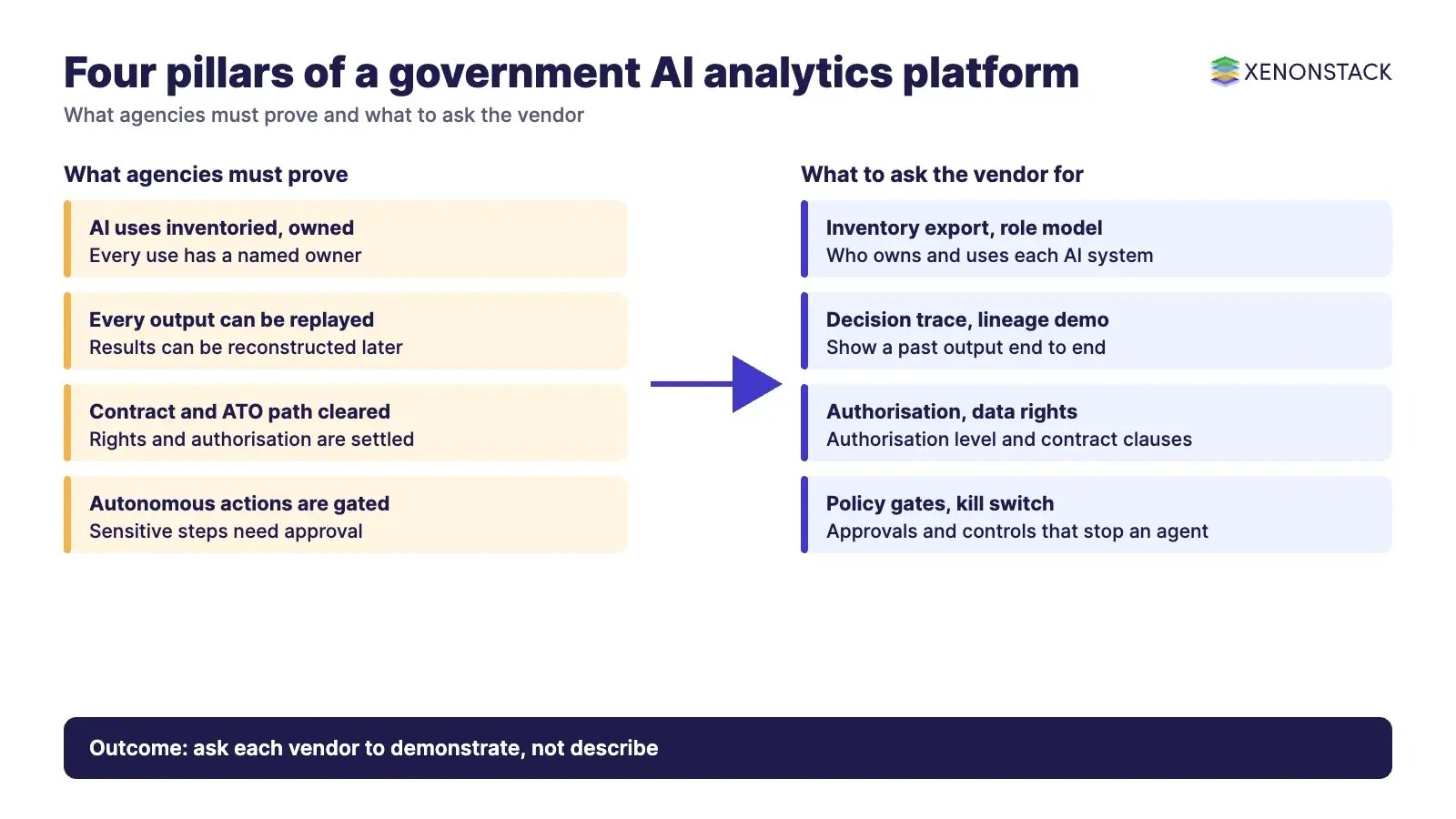
Use four pillars and score each from 0 to 3 against evidence, not demos. Weight them by your risk tier. A platform that informs a dashboard needs less than one whose output is a principal basis for a decision about benefits, licences or enforcement.
| Pillar | The question to ask | Evidence to request |
|---|---|---|
| Governance | Can we inventory, classify and assign an owner to every AI use? | Inventory export, role model, risk tiering, model documentation |
| Auditability | Can we reconstruct any output after the fact? | Sample decision trace, lineage view, retention settings, log export |
| Compliance | Does it fit our authorisation, data and contract rules? | FedRAMP or state equivalent status, data residency, contract clauses |
| Automation | Can it act on its own safely, and be stopped? | Policy gates, approval steps, staged autonomy, kill switch |
What should governance look like in a platform?
Start from the NIST AI RMF, published on 26 January 2023 with four functions: Govern, Map, Measure and Manage. NIST also published a Generative AI Profile (NIST-AI-600-1) on 26 July 2024, and its site says the framework is being revised as part of the White House AI Action Plan, so confirm the current version before you cite it in a procurement.
The Govern function maps neatly onto platform requirements:
- Inventory (GOVERN 1.6). NIST describes an AI system inventory as an organised database of artefacts about each system. The platform should hold, or export to, that inventory, with a named owner per entry.
- Documentation (GOVERN 1.4). Business justification, scope, assumptions, training data and test results should be recorded and kept current.
- Accountability (GOVERN 2.1 and 2.3). Roles should be documented, development should be separate from testing, and executive leadership owns risk-tolerance decisions.
- Third parties (GOVERN 6.1 and 6.2). Vendor models and data are governed like internal ones, with contingency plans if a high-risk third-party system fails.
The GSA AI Guide adds the data side. It points to the Chief Data Officer role created under the Evidence Act, an agency data governance body chaired by the CDO under OMB M-19-23, standardised metadata through data cards, and metadata that records source, collection authority and any transformations applied. A platform that cannot capture those fields forces your team to maintain them by hand.
For deeper background, see XenonStack's guides on AI governance strategy and data governance.
What does auditability mean for AI analytics?
Auditability means you can replay a decision. For a regulator, an inspector general or a court, a log that says "model ran at 14:02" is not enough. You need the input data, its lineage, the model version, the policy that applied, the human approvals and the outcome, linked together.
Check these five items in any platform:
- Lineage to source. Can you trace a figure back through transformations to the originating system? XenonStack explains the tooling in its data lineage guide.
- Decision-level traces. Not only data access logs, but a record of each AI-assisted decision.
- Explainability at the right depth. Reasons a caseworker and an auditor can both read. See transparent and explainable AI.
- Retention and export. Your records schedule decides how long traces live, and you should be able to export them in an open format.
- Tamper evidence. Who can edit or delete logs, and is that itself logged?
OMB M-25-21 makes this concrete for federal high-impact AI, meaning AI whose output is a principal basis for decisions with a legal, material, binding or significant effect on rights, safety or access to services. Its minimum practices include pre-deployment testing, an AI impact assessment, ongoing monitoring, human oversight with timely human review and appeals, and discontinuation of non-compliant systems. Agencies must also keep an annual AI use case inventory and designate a Chief AI Officer. State and local bodies are not bound by the memorandum, but it is a useful template. Confirm clause numbers on the official PDF before you cite them.
Which compliance checks decide a shortlist?
Run compliance as a gate, before scoring features. Four checks do most of the work.
- Authorisation status. The FedRAMP marketplace guide describes certification classes A to D, from pilot to high, and tells agencies to verify current certification status before finalising agreements. It also says FedRAMP does not grant an ATO: the agency issues its own, using the vendor's security package. A listing helps, but it does not replace your ATO.
- Data rights. M-25-21 procurement provisions say to protect government data, to prevent vendors from using federal data to train commercial products without express permission, and to avoid vendor lock-in. State guidance often asks for the same, including notice of material model changes and audit rights, according to one vendor guide from Keyspider that you should treat as a vendor view.
- Environment fit. Cloud variants differ. According to Microsoft's documentation, Power BI for US Government has GCC for federal, state and local bodies, GCC High for organisations holding controlled unclassified information, and a DoD environment, and some features differ between them. The same page does not state FedRAMP levels, so take those from Microsoft's trust documentation.
- State and accessibility rules. State AI laws and accessibility deadlines vary and change. Confirm each on the official legislature or Department of Justice page rather than a summary.
How much automation is safe in government?
Automate in stages, and tie each stage to evidence. A workable ladder has four rungs: observe only (shadow mode), recommend, act with human approval, and act within a policy envelope with sampling review. Move up a rung only when accuracy and policy-compliance benchmarks hold over a set period.
Look for platform controls that make this real: policy checks before an action executes, approval routing, a visible kill switch, and a rollback path. Agentic approaches raise the stakes, because an agent can act, not just report. XenonStack's overview of agentic analytics explains the pattern, and the governance requirement follows directly: the more an agent can do, the stronger the gate before it does it.
How do the main platform types compare?
This is a comparison of types, not a league table. XenonStack sells one of the options below, ElixirData Context OS, so weigh that claim like any vendor claim and test it in a pilot. Competitor statements come from their own pages.
| Option | Strongest at | What the vendor says on its own page | Check before you buy |
|---|---|---|---|
| Governed data platform, for example Databricks Unity Catalog | Data and AI asset governance, lineage | According to its site, a "unified governance solution for data, models, agents and apps", with "end-to-end automated column-level lineage" and a "complete audit trail of data access and usage" | Decision-level traces, your authorisation level, and the page itself gives no technical detail of how audit works |
| BI in a government cloud, for example Power BI GCC, GCC High or DoD | Reporting and self-service analytics inside Microsoft 365 Government | According to Microsoft's documentation, GCC is designed for federal, state and local government, and the goal is feature parity within 30 days of general availability | Feature gaps by environment, and AI decision controls, which the page does not cover |
| AI search and chat for agency content, for example Keyspider | Grounded answers over agency content | According to its guide, lower risk because it does not make consequential decisions, with NIST-mapped documentation offered | Vendor framing and unsourced statistics; test hallucination and accessibility yourself |
| Decision-control layer, ElixirData Context OS | Policy gates before agent actions, decision traces | According to its site, a context plane plus a control plane, staged autonomy from shadow mode to full autonomy, a trace with reasoning and lineage per decision, and SOC 2 and ISO 27001 credentials listed in its Trust Center | We saw no FedRAMP claim on the pages read, so confirm authorisation path and deployment model directly. Reported results are self-reported |
The practical reading: these options are often complementary. A governed data platform feeds trusted data, BI presents it, and a decision-control layer governs what AI agents may do with it. Choose by the gap in your stack, not by a single winner.
How do I score a shortlist?
| Criterion | Weight, low-risk use | Weight, high-impact use | Pass mark |
|---|---|---|---|
| Inventory and ownership | 15% | 20% | Exportable, owner per use |
| Decision-level audit trace | 15% | 30% | Replay of a sampled decision in a live demo |
| Compliance fit and data rights | 30% | 25% | Authorisation path and contract clauses agreed |
| Automation controls | 10% | 25% | Gates, approvals, kill switch shown |
| Analytics capability and usability | 30% | 0% (gate only) | Meets named use cases |
Insist on a replay test. Ask each vendor to take one real, anonymised decision and reconstruct it end to end. Platforms that cannot do this in a pilot will not do it for an auditor.
When should you not use an AI analytics platform?
- The decision has no human appeal route. If affected people cannot get timely human review, do not automate the decision.
- Your data is not ready. Without metadata, ownership and quality plans, a platform will scale the mess.
- You cannot assign an owner. An AI use with no named accountable person fails the basic Govern test.
- A simple rule or report does the job. Not every workflow needs a model.
- The vendor will not accept data-use limits. If training on your data is non-negotiable for them, walk away.
- The authorisation path is unknown. Pilot in a sandbox with non-sensitive data until it is clear.
What does a sensible 90-day plan look like?
Days 1 to 30: build the AI inventory, assign owners and tier each use by impact. Days 31 to 60: shortlist two or three options, request evidence for the four pillars and run the replay test. Days 61 to 90: pilot one low-risk use in shadow mode, review traces with your audit and legal teams, and set the promotion criteria for the next autonomy stage.
If you want to test one decision your agents keep getting wrong, the Context Workshop is a no-cost half-day session where your team and ElixirData architects trace that decision and map where its context breaks down. You can request a Context OS demo or book the Context Workshop. Learn more about ElixirData Context OS.
Frequently asked questions
What is the most important criterion when choosing a government AI analytics platform?
Auditability of decisions. If you can replay what data, model, policy and approval produced an output, governance and compliance reviews become far easier. Ask each vendor to demonstrate that on one real, anonymised case.
Does FedRAMP status mean an agency can use a platform immediately?
No. The FedRAMP marketplace guide says FedRAMP does not grant an ATO. It provides security materials, and the agency issues its own ATO. Verify current certification status and impact class for your data before signing.
What is high-impact AI under OMB M-25-21?
AI whose output is a principal basis for decisions or actions with a legal, material, binding or significant effect on rights, safety or access to government services. It carries minimum practices such as testing, impact assessment, monitoring and human oversight.
How should agencies handle vendor use of their data?
Write the limits into the contract. M-25-21 procurement provisions call for protecting government data and preventing vendors from using it to train commercial products without express permission. Add notice of model changes, audit rights and data return on termination.
Can agentic AI be used safely in government analytics?
Yes, with staged autonomy. Start in observe-only mode, require human approval for consequential actions, enforce policy before execution, and keep a trace of every action. Promote autonomy only when benchmarks hold.
Is this guide a ranking of the best platforms?
No. It compares platform types on stated criteria, using vendors' own published claims. Your best choice depends on your risk tier, authorisation needs and the gap in your existing stack.
Ready to put AI agents to work? Explore ElixirClaw, the agentic OS platform to build, orchestrate and govern AI agents.
Explore the XenonStack platform family: ElixirData · ElixirClaw · ElixirHub · NexaStack · MetaSecure · Neural AI · AgentGRC · AgentSRE · AgentAnalyst · AgentInstruct · AgentRAI · AgentScrum · AgentSearch · AgentForce · AI Aviator · SAIF Aviator · CohortIQ · XenonStack AI · XenonStack UAE


