

Key takeaway
- Compare Feedzai, NICE Actimize, FICO Falcon, SAS, Featurespace and Hawk for bank fraud detection on governance, audit, deployment and pilot readiness.
The best AI fraud platform for a bank is the one it can approve, explain and audit, not simply the one with the highest detection score. Feedzai, NICE Actimize, FICO Falcon Fraud Manager, SAS, Featurespace (which Visa has moved to acquire) and Hawk all use machine learning to detect fraud. They differ in how they handle governance, audit evidence, deployment control and the daily workload of investigators. This guide compares those six on those points and shows where a governed agent layer can sit beside them.
Disclosure: XenonStack builds agentic AI solutions and does not resell any platform below.
How should a bank compare AI fraud platforms?
Start with the questions your risk committee and your auditors will ask, because detection quality alone will not get a platform approved. Our broader guide to AI fraud detection platforms for banks explains the approval criteria in depth. This post uses a lighter scorecard so you can compare named platforms side by side.
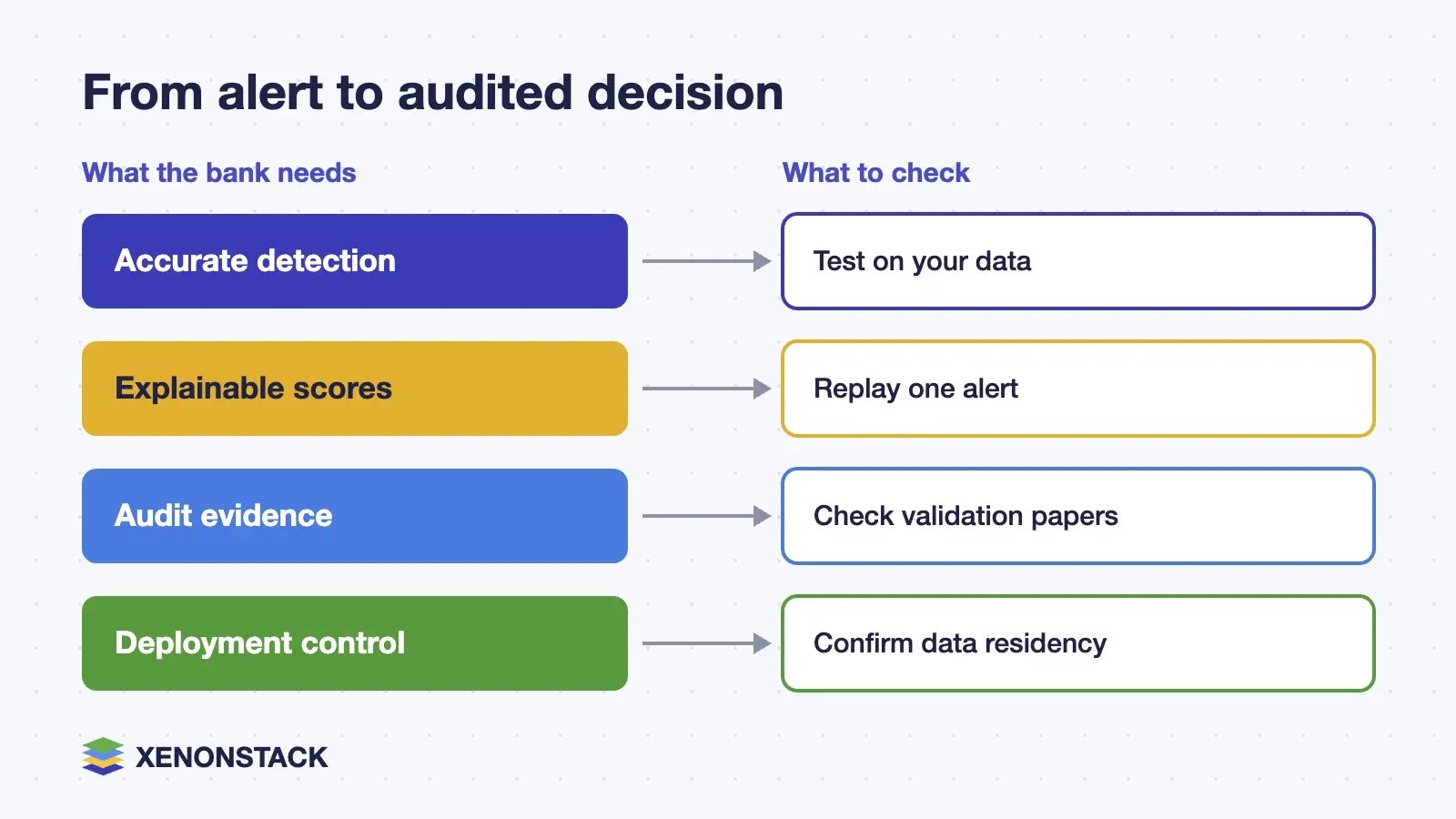
Score every platform from one to five on six criteria, then weight them to suit your bank. The weights below are a starting point, not a standard.
| Criterion | Suggested weight | Evidence to ask for |
|---|---|---|
| Detection and coverage | 20% | Results on your own historical data, across your channels |
| Decision trace and audit | 20% | A replayable record for one alert, from input to outcome |
| Explainability and model risk support | 20% | Reason codes, validation documentation, monitoring reports |
| Deployment and data control | 15% | Options for private cloud, on-premises, data residency |
| Integration and operations | 15% | Case management, APIs, effort to connect your core systems |
| Human review boundaries | 10% | Who can override, approve or switch off automated actions |
We have not scored the vendors for you. Honest scores depend on evidence from your own pilot, and public material rarely covers all six criteria.
What do most "best fraud platform" lists miss?
Many roundups are published by a vendor that ranks itself first, and most list audit trails as a criterion without checking any vendor against it. They also say little about what happens after the score. Five extras are worth adding to your own evaluation.
- Decision trace per alert. Can an investigator or examiner see the data, rule, model version and person behind each outcome?
- Model risk and explainability expectations. Can you explain a score to a customer, a regulator and your own validators?
- Human review boundaries. Which actions run automatically, which need approval, and who can stop them?
- False-positive operations cost. Count alerts per day, minutes per review and the cost of blocked genuine customers, not just the false-positive rate.
- Private or on-premises deployment and data residency. Many banks cannot send customer data to a shared cloud without conditions.
A sixth gap is a pilot plan. Few comparisons say how to test a platform before committing, so we include one below.
How do six leading bank fraud platforms compare?
The table below uses only what each vendor says publicly. These are vendor descriptions, not independent test results, and every row needs confirming in your own pilot.
| Platform | Best for | Detection approach | Governance and audit | Deployment | Watch-outs |
|---|---|---|---|---|---|
| Feedzai | Banks wanting packaged fraud and AML offerings with case management | Machine learning with real-time scoring and link analysis | Describes "whitebox" explanations for regulators and internal teams | Says banks can deploy and score in days rather than months | Published performance figures are vendor-reported; ask for results on your data |
| NICE Actimize | Large banks wanting one cross-channel financial crime estate | "Always on" adaptive models with consortium learning, across digital, real-time and open banking channels | Entity-centric investigation view; confirm explanation depth and audit export | Cloud-native X-Sight platform with containerised models | Breadth means more scoping; check what you would actually switch on |
| FICO Falcon Fraud Manager | Card and payment portfolios needing a long-established scoring model | Neural network scoring for payment transactions | Reason reporting explains the drivers behind a score | Confirm options for your environment directly with FICO | Public material is strongest on cards; check coverage of newer payment types |
| SAS | Banks wanting decisioning, model management and investigation in one stack | Machine learning with real-time decisioning and alert and case management | Includes model management and orchestration components | Customer example runs on managed cloud on AWS | A modular stack, so integration effort depends on which parts you adopt |
| Featurespace | Banks focused on customer behaviour and reducing friction | Adaptive behavioural analytics that learn individual customer patterns | Confirm explainability and audit features in demonstration | Confirm; Visa plans to fold its capabilities into a unified platform | Roadmap may shift under new ownership; ask for written commitments |
| Hawk | Banks combining AML and fraud with plain-language analyst insight | AI combined with traditional rules | Describes explainable AI and full audit trails | Says options can be customised to the bank | Public pages lean towards AML; verify fraud depth for your channels |
Which platform fits which bank?
Match the platform to the gap you actually have. A bank with strong detection and weak evidence needs something different from a bank still running rules.
| Your situation | Where to look first |
|---|---|
| You want one packaged fraud and AML offering with a case manager | Feedzai |
| You run many channels and want a single financial crime estate | NICE Actimize or SAS |
| Your exposure is mainly payment cards and you value a mature scoring model | FICO Falcon Fraud Manager |
| Customer friction and behavioural signals are the priority | Featurespace |
| AML and fraud teams share analysts and case work | Hawk |
| Detection is fine, but investigations and approvals are slow or poorly evidenced | A governed agent layer beside your current engine (see below) |
What does US model risk guidance say about fraud models?
For banks supervised in the US, the Federal Reserve's SR 26-2 letter of 17 April 2026 replaced the earlier SR 11-7 guidance. It is expected to be most relevant to banking organisations with over 30 billion US dollars in total assets, and practice should be tailored to the bank's model risk profile.
The guidance says model risk principles still apply when proprietary components limit access to code or data. A bank is expected to understand a vendor model, monitor it and document any customisation. Generative and agentic AI models are excluded from its scope, so banks should apply their own governance to them. Outside the US, check the equivalent supervisor's expectations with your compliance team.
Where does XenonStack fit?
XenonStack does not sell a fraud engine and does not replace one. Its approach is to add governed AI agents on ElixirClaw, with ElixirData as the context layer, beside the engine you already run. The engine scores transactions. The agents help with what comes next, such as gathering evidence, preparing cases and proposing actions.
The design principles are policy-driven actions, human approvals where your rules require them, and an auditable record of each decision. It suits banks whose detection is acceptable but whose investigation, approval and evidence workflows are the bottleneck. It is not the right choice if you need a new scoring engine. Our banking solutions page sets out the wider context.
We do not claim better detection than any platform above. We have no independent benchmark to cite, and you should treat any vendor's performance claim, ours included, as something to test.
What should a decision trace per alert contain?
Whichever platform you choose, ask to see one alert from start to finish. A useful trace shows:
- the inputs and data sources used at the time of the decision;
- the rule, model and version that produced the score;
- the reason codes or explanation shown to the analyst;
- any automated action taken and the policy that allowed it;
- the person who approved, overrode or closed the case, and when.
If the vendor cannot show this in a demonstration, expect to reconstruct it by hand at audit time.
When should a bank not buy a new platform?
A new platform is not always the answer. Pause if any of these apply.
- Your detection is adequate. If the real problem is slow investigations or weak evidence, a workflow or agent layer may cost less and carry less risk.
- Your data is not ready. A model trained on inconsistent or late data will disappoint, whichever vendor supplies it.
- You cannot validate it. If your model risk team has no capacity to review another vendor model, the approval will stall.
- Your contract has years to run. Ask whether the current vendor can close the gap first.
- You have no owner for the false-positive queue. A better model still needs someone accountable for how alerts are worked.
What does a short pilot plan look like?
- Weeks 1 to 2: define success. Agree measures such as confirmed fraud caught, alerts per analyst and evidence completeness, plus who signs off.
- Weeks 3 to 6: shadow mode. Run two shortlisted platforms on live or replayed traffic without taking action, and compare results on the same data.
- Weeks 7 to 9: validate and trace. Have your model risk team review documentation, then replay a sample of alerts to test the decision trace.
- Weeks 10 to 12: limited live run. Switch on one channel with a kill switch and named human approvers, then decide on scale-up.
To agree what an agent may decide on its own and where the audit record lives, book a Context Workshop. Want a second opinion on your shortlist? Book a strategy call.
Frequently asked questions
What is the best AI fraud platform for a bank?
There is no single best platform. The right choice depends on your channels, your model governance rules and your operations team. Score each shortlisted platform on detection, decision trace, explainability, deployment control, integration and false-positive operations, then test the top two in shadow mode on your own data.
Do vendor fraud models need to be validated by the bank?
Yes. US supervisory guidance on model risk management says its principles still apply when proprietary components limit access to code or data. A bank is expected to understand the vendor model, monitor it and document any customisation. Ask each vendor for validation documentation and performance monitoring support before you sign.
Does model risk guidance cover agentic AI?
The Federal Reserve's SR 26-2 excludes generative and agentic AI models from its scope in a footnote, because they are novel and evolving. It says banks should apply their own risk management and governance practices to such tools. In practice, that means writing your own approval, limit and audit rules for agents.
Can a bank add AI agents without replacing its fraud engine?
Yes. Many banks keep their existing detection engine and add a governed layer for triage, evidence gathering and case preparation. The engine still scores transactions. Agents work inside written policies, stop at human approval points and leave a decision record for every action.
How long should a fraud platform pilot run?
A common shape is a fixed pilot of about twelve weeks, with the first weeks in shadow mode so the platform scores live traffic without acting. Agree success measures, such as confirmed fraud caught, false-positive workload and evidence completeness, before the pilot starts.
Follow XenonStack on LinkedIn: XenonStack on LinkedIn for new guides on agentic AI, data and platform engineering.
Ready to put AI agents to work? Explore ElixirClaw, the agentic OS platform to build, orchestrate and govern AI agents.
Explore the XenonStack platform family: ElixirData · ElixirClaw · ElixirHub · NexaStack · MetaSecure · Neural AI · AgentGRC · AgentSRE · AgentAnalyst · AgentInstruct · AgentRAI · AgentScrum · AgentSearch · AgentForce · AI Aviator · SAIF Aviator · CohortIQ · XenonStack AI · XenonStack UAE


