

Key takeaway
- Compare AI fraud detection platforms for banks on governance, audit trails and production readiness, with SR 26-2 and EU AI Act checks and decision tables.
The best AI fraud detection platform for a bank is the one that catches fraud in real time, can explain every decision to an examiner, and survives production. Detection quality is now table stakes. What separates a platform that passes a model validation review from one that stalls in procurement is governance: who approved the model, what data it saw, which policy applied, and whether a human can override and replay the decision.
This guide helps enterprise leaders and architects evaluate platforms on those criteria. It covers what US supervisors expect after the April 2026 model risk guidance, what "audit-ready" should mean, a vendor comparison using only claims from their own pages, a decision table, a production checklist and when not to buy. XenonStack sells one of the options below, and we say so where it appears.
What should a bank look for in an AI fraud detection platform in 2026?
Start with eight criteria, in this order. The first four decide whether the platform can be approved. The last four decide whether it can be run.
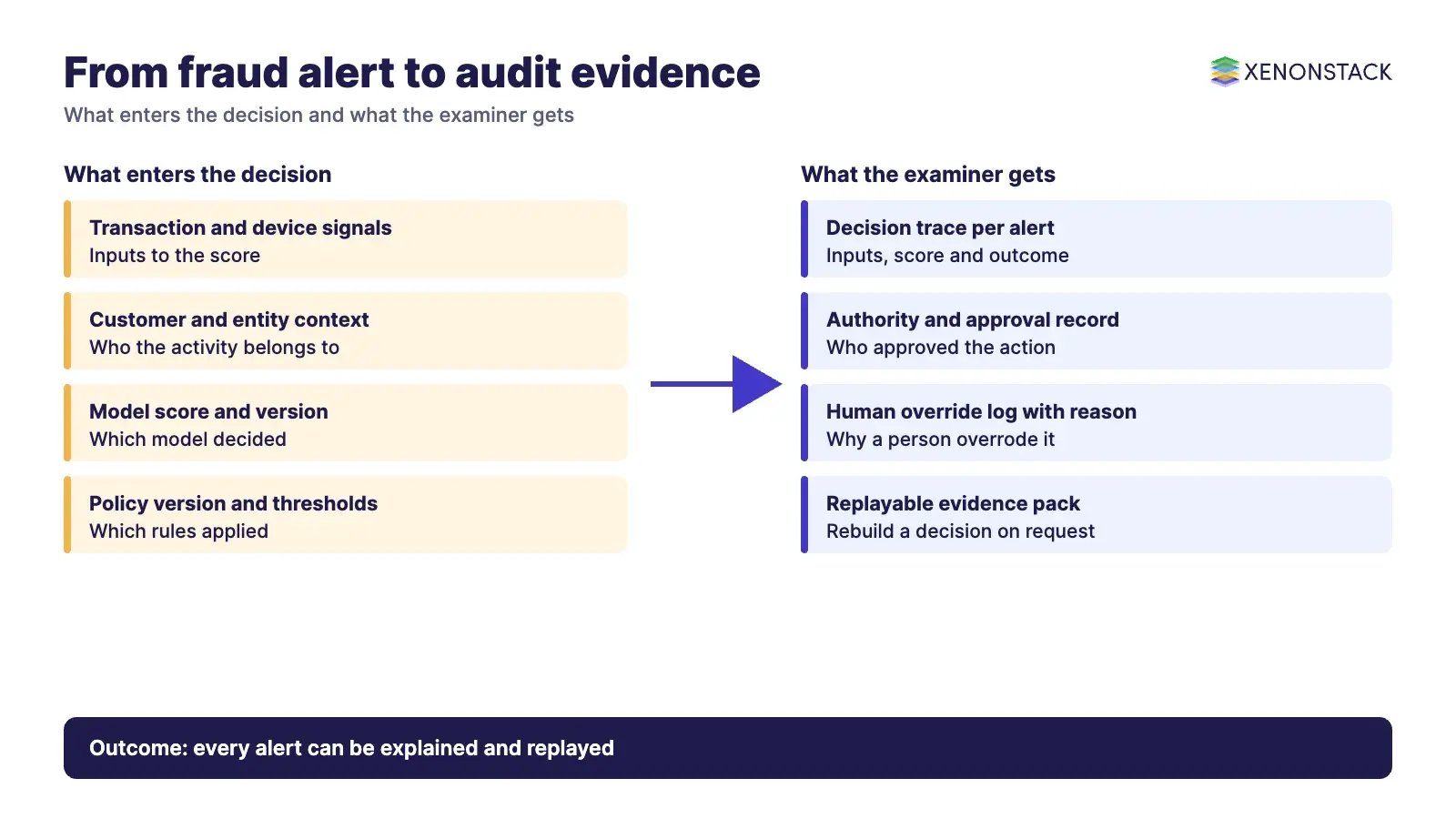
- Decision traceability. For any alert, block or release, can you reconstruct the inputs, the model version, the policy applied and the person or system that approved it?
- Explainability. Can an analyst and a validator see why a score was produced, in terms they can challenge?
- Human override and escalation. Can an investigator overrule the model, and is that override itself logged?
- Model lifecycle control. Versioning, validation evidence, drift monitoring and retraining approvals, including for vendor-supplied models.
- Integration. Real-time APIs into payments, core banking, onboarding, case management and KYC providers.
- Latency and scale. Scoring fast enough to act before funds move, at your peak volumes, not the vendor's demo volumes.
- Operations. Case management, analyst productivity, false positive handling and rule authoring that your own team can change.
- Commercial and exit terms. Data ownership, model portability, audit access and what you can take with you if you leave.
Vendor buyer guides publish similar lists, but most treat governance as one line item, while a bank's validator treats it as the gate.
What changed in US model risk guidance in 2026?
The long-standing reference, SR 11-7 (dated 4 April 2011), has been replaced. According to the Federal Reserve's SR 26-2 page, dated 17 April 2026, SR 26-2 "supersedes and replaces" SR 11-7, and also supersedes SR 21-8 on model risk in BSA/AML systems. The OCC's matching Bulletin 2026-13, "Model Risk Management: Revised Guidance", is a joint OCC, Federal Reserve and FDIC issuance. It rescinds OCC Bulletin 2011-12 and the Comptroller's Handbook model risk booklet.
Four points matter for a fraud platform purchase.
- Tiered by materiality. The guidance says model purpose and exposure together determine materiality, and higher-materiality models warrant more rigorous oversight. A model that blocks payments is a high-purpose model.
- Vendor models are in scope. The guidance expects banks to understand a vendor model's conceptual soundness, design, development data and performance even when the code is proprietary, to monitor outcomes, and to document and justify customisations.
- Validation, inventory and challenge. Validation generally occurs before first use, a model inventory should hold enough detail to assess risk, and effective challenge means critical analysis by objective experts with the standing to drive change.
- Generative and agentic AI are outside the guidance. OCC Bulletin 2026-13 states that generative and agentic AI models are not within its scope, and the attached guidance calls them "novel and rapidly evolving". The agencies say they plan a request for information on model risk management, including banks' use of AI.
Two cautions: the OCC bulletin describes the guidance as expected to be most relevant to banks with over $30 billion in total assets and says it does not set enforceable standards. And a gradient boosted fraud score or a neural network plausibly meets the definition of a model (a complex quantitative method applying statistical theory), while deterministic rules do not. Confirm how your model risk team classifies each component before you scope validation.
The practical reading: agentic components sit outside the written guidance, but your governance should still cover them.
What does audit-ready AI fraud detection actually mean?
"Audit-ready" is used loosely. For a bank, it should mean that evidence is produced at the moment of the decision, not reconstructed from logs weeks later. A practical definition has five parts.
- Context captured. The inputs, features and data sources used for the decision, with timestamps.
- Policy recorded. The policy or rule version in force, including thresholds.
- Authority verified. Who or what was allowed to take the action, and whether approval was required.
- Outcome and override logged. The result, any human override, and the reason given.
- Replayable and tamper-evident. You can re-run the decision under a different policy version and show the record has not been altered.
A model with better recall but no record of why it blocked a payment is a liability in a complaint, a SAR review or an internal audit. The FFIEC IT Examination Handbook has an Audit booklet on the characteristics of an effective IT audit function. Read it alongside the model risk guidance when you scope vendor evidence requests.
Ask each vendor to show all five parts on a live decision, not a slide.
How do the main AI fraud platforms compare?
Disclosure: XenonStack sells one of the options below (ElixirData). We compare on stated criteria and describe other vendors only with what their own pages say. Every claim is "according to its site", has not been independently verified, and the right next step for any row is a proof of concept on your data.
| Platform | Positioning, according to its own page | Explainability or audit claim, according to its own page | Ask for in a proof of concept |
|---|---|---|---|
| Feedzai | Machine learning on transaction, behavioural and network data in real time; behavioural biometrics, anomaly detection and graph AI. | Says AI systems "provide explainable decisions and audit trails"; points to its TRUST Framework for responsible AI. | A sample audit trail for one blocked payment, and the model change approval process. |
| DataVisor | Calls itself "the AI-native real-time decisioning engine for fraud and financial crime prevention"; unsupervised and supervised models, link analysis and AI agents. | Lists case management with "audit-ready decision trails" among its seven evaluation criteria. | How unsupervised model outputs are explained to a validator. |
| ThreatMark | Behavioural intelligence platform combining behaviour, device and threat data; pre-trained fraud models; scam detection in the banking app. | Its buyer guide asks for visibility into how models are trained and scored, and the ability to override outcomes. | Evidence of the training data behind the pre-trained models, for vendor model validation. |
| Alloy | Orchestration across "more than 270 data solutions and verification methods" through one console, with an AI Assistant for investigations. | Describes AI Assistant outputs as "explainable and auditable" and says inputs, outputs and reviewer feedback are logged. | Which logs are exportable, and how long they are retained. |
| Quantexa | Decision intelligence platform with entity resolution and graph analytics listed as capabilities; a cloud AML product for US mid-size and community banks. | The page we read gives no explainability detail and no Quantexa-specific metrics. | Entity resolution match logic, and how a network finding is evidenced in a case file. |
| Google Cloud | A real-time architecture and MLOps blueprint for building fraud detection on its data and AI platform; the guide is gated. | Frames the guide as an "opinionated perspective"; the page names no specific fraud product. | Who owns validation, monitoring and decision records when you assemble the parts yourself. |
| XenonStack ElixirData | A decision layer for AI agents: compiles context, enforces policy and authority before an action, and records Decision Traces. It sits above detection engines rather than replacing them. | Says each trace records the context consumed, policy evaluated, authority verified and outcome produced, stored in an immutable ledger with replay and exportable audit packs. | Replay of a past alert under a changed policy, and a mapping of its controls to SR 26-2 and your own validation standard. |
Read the table as categories as much as brands: detection engines, orchestration, entity networks and decision governance. Most banks need more than one.
On ElixirData: its site makes specific claims, including 100% decision traceability and a 90% reduction in audit preparation on its banking page, and a 60% false positive reduction in the banking FAQ. The pages do not say how those figures were measured, so test them in a proof of concept. See the ElixirData Decision Traces page and the banking and financial services page for what the platform says it does.
Which type of platform fits which situation?
| Your situation | Platform type to prioritise | Main risk to test |
|---|---|---|
| Detection is weak on new attack patterns (scams, mule accounts, account takeover) | Behavioural and ML detection engine | Explainability of unsupervised or pre-trained models during validation |
| Onboarding fraud and fragmented identity checks across many providers | Orchestration platform | Where decisions are logged when several providers contribute signals |
| Fraud rings and linked entities across products | Entity resolution and graph analytics | Match accuracy and how a network finding is evidenced |
| A working fraud engine, but audit and examiner requests take weeks | Decision trace and governance layer | Integration depth with your existing engine and case tools |
| Strong in-house data engineering and a cloud-first strategy | Cloud toolkit plus your own governance | Ownership of validation, monitoring and decision records |
For related reading, see how XenonStack describes agentic AI in banking, with use cases and controls, the risk and compliance AI agents, AI assurance services and the credit card fraud detection use case.
How do you take a fraud platform from pilot to production?
Most failures happen between a good proof of concept and a controlled launch. A workable path for architects:
- Register the platform in the model inventory. Separate scoring models, deterministic rules and any agentic components, and tier each by materiality.
- Run in shadow mode. Score live traffic without acting, and compare against your current engine and confirmed fraud outcomes.
- Validate before first use. Request conceptual soundness documentation, development data descriptions and performance evidence from the vendor, and have an independent party challenge it.
- Define override and kill switch rules. Decide who can pause automated blocks, how fast, and how it is logged.
- Set monitoring thresholds. Drift, false positive rates by segment, analyst override rates and latency, with named owners.
- Rehearse an audit. Pick ten past decisions at random and time how long it takes to produce full evidence for each.
If step six takes days, the platform is not audit-ready, whatever the brochure says. For governance patterns on the data side, see XenonStack's post on agentic AI for data analytics, governance and data trust, its buyer's checklist for agentic AI platforms and the earlier post on agentic analytics.
What does the EU AI Act mean for a bank's fraud platform?
If you operate in the EU, check the timeline against the European Commission's AI Act page. It states the Act entered into force on 1 August 2024 and became applicable on 2 August 2026, with some exceptions. It also states that obligations for high-risk systems listed in Annex III apply from 2 December 2027, following the AI Omnibus, which entered into force on 27 July 2026. It lists credit scoring as a high-risk use case.
Whether a fraud model is high-risk depends on the exact wording of Annex III point 5(b) in Regulation (EU) 2024/1689 on EUR-Lex. Our reading is that detecting financial fraud is carved out of the creditworthiness category, but confirm the wording on EUR-Lex with your counsel. A platform that also influences credit decisions may not be out of scope, so map each use, not the platform as a whole.
When should you not buy an AI fraud platform?
- Your data is the problem. If transaction, device and customer data is fragmented or late, a new engine will score bad inputs faster. Fix the data pipeline first.
- Your rules already work. A well-tuned deterministic rule set is easier to validate and explain than a model. Add machine learning only where rules demonstrably miss fraud.
- You cannot staff investigations. More alerts without analyst capacity increases risk. Size the case management side first.
- You cannot validate vendor models. If the vendor will not share conceptual soundness, development data or performance evidence, the bank cannot meet the vendor model expectations in SR 26-2. Walk away or ask for contractual access.
- You want full autonomy on day one. Automated blocking of customer payments needs a staged rollout, human review thresholds and a kill switch. Start with recommendations, then earn autonomy.
Want to test your own fraud decisions against the five parts of audit-ready evidence? Book a Context OS demo or join a Context Workshop where we walk through one of your real decision flows, including the policy, authority and evidence at each step. See also the ElixirData Audit Agent and Decision Review Agent pages.
Frequently asked questions
What is the best AI fraud detection platform for banks?
There is no single best platform. Choose by the gap you have: new detection signals, identity orchestration, entity networks or decision governance. Test candidates on your data in shadow mode, and require an audit trail for every decision.
Is SR 11-7 still the model risk standard for banks?
No. According to the Federal Reserve's SR 26-2 page, dated 17 April 2026, SR 26-2 supersedes and replaces SR 11-7. The OCC's Bulletin 2026-13 rescinds OCC Bulletin 2011-12. Use the 2026 guidance for new validation work.
Does the 2026 model risk guidance cover agentic AI?
According to OCC Bulletin 2026-13, generative and agentic AI models are not within the scope of the guidance, and the agencies plan a request for information on model risk management, including banks' use of AI. Your internal governance should still cover agentic components.
What makes AI fraud detection audit-ready?
Evidence created at decision time: the context used, the policy version applied, the authority checked, the outcome and any human override, stored so it can be replayed and shown to be unaltered. Test it by reconstructing ten past decisions.
Do vendor fraud models need validation?
Yes. The 2026 guidance expects banks to understand a vendor model's conceptual soundness, design, development data and performance, monitor outcomes, and document customisations, even when the code is proprietary.
Is a fraud detection system high-risk under the EU AI Act?
It depends on the use. The Commission lists credit scoring as high-risk, with Annex III obligations applying from 2 December 2027. Check Annex III point 5(b) on EUR-Lex for the treatment of fraud detection, and assess each use case separately.
Sources
- Federal Reserve, SR 26-2 (17 April 2026) and SR 11-7 (4 April 2011)
- OCC Bulletin 2026-13, Model Risk Management: Revised Guidance
- European Commission, AI Act regulatory framework and Regulation (EU) 2024/1689 on EUR-Lex
- FFIEC IT Examination Handbook InfoBase
- Vendor pages cited as their own claims: Feedzai, DataVisor, ThreatMark, Alloy, Quantexa, Google Cloud, ElixirData
Ready to put AI agents to work? Explore ElixirClaw, the agentic OS platform to build, orchestrate and govern AI agents.
Explore the XenonStack platform family: ElixirData · ElixirClaw · ElixirHub · NexaStack · MetaSecure · Neural AI · AgentGRC · AgentSRE · AgentAnalyst · AgentInstruct · AgentRAI · AgentScrum · AgentSearch · AgentForce · AI Aviator · SAIF Aviator · CohortIQ · XenonStack AI · XenonStack UAE


