Key takeaway
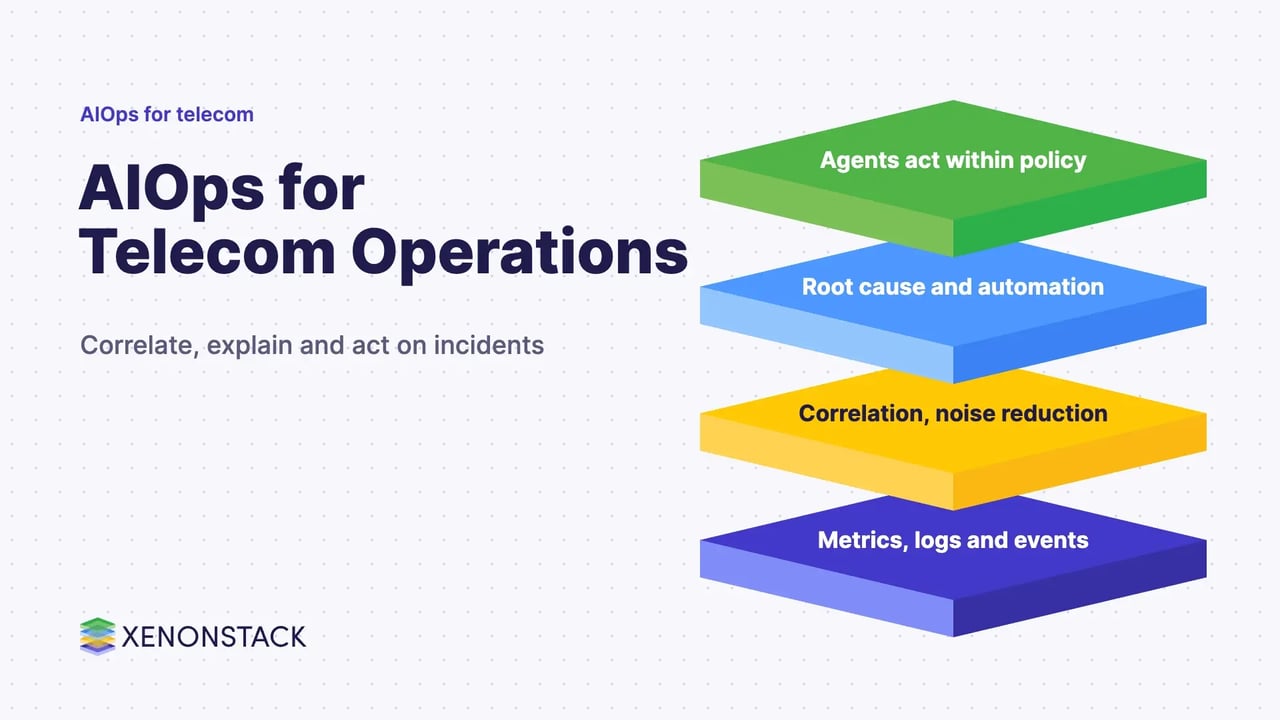
- AIOps for telecom applies AI to network and IT operations data to correlate alerts, find root causes and automate fixes. See capabilities and use cases.
AIOps for telecom is the use of artificial intelligence to automate and improve IT service management and operational workflows across a telecom operator's networks, platforms and support systems. It pairs large volumes of operational data with machine learning so that teams can correlate events, find causes and act faster than manual monitoring allows.
This guide is for operations, network and IT leaders at telecom operators who are deciding where AIOps fits. It explains what an AIOps platform does, the telecom use cases, how monitoring tools such as Prometheus fit in, how AI agents change the picture, and what to do first. For the wider concept, see our guide to Artificial Intelligence for IT Operations.
What is AIOps?
IBM's explainer on AIOps describes it as the application of artificial intelligence capabilities "to automate, streamline and optimize IT service management and operational workflows." The name joins AI and IT operations. It rests on data: telemetry, logs, tickets and events, gathered through data ingestion pipelines and analysed with big data and machine learning techniques.
IBM also separates AIOps from DevOps. DevOps focuses on accelerating and refining software development and deployment, while AIOps uses AI to optimise the performance of enterprise IT environments. The article says the two can work together as a complementary approach. Our guide on how to integrate AIOps for DevOps covers that pairing.
What capabilities does an AIOps platform have?
IBM names several core capabilities. The table maps each one to a telecom operations question.
| Capability | What it does (IBM's wording) | Telecom operations question |
|---|---|---|
| Event correlation | Consolidates and aggregates information | Are these hundreds of alarms one fault or many? |
| Anomaly detection | Discovers atypical data points within a dataset | Is this traffic or signalling pattern unusual for this hour? |
| Root cause analysis | Determines the root cause of problems so they can be remediated | Which change or element started the degradation? |
| Noise reduction | Shifts signals out of the noise to find significant events | Which alerts does the on-call engineer need to see first? |
| Automation | Lets systems act on real-time insights | Can a known fault be fixed without a manual ticket? |
Behind these sit two older ideas: performance baselining, which sets what normal looks like so that deviations can be measured, and predictive insight, which uses past behaviour to flag what is likely next.
How does AIOps help telecom operations?
Telecom is a customer-facing business with large, interdependent systems, so the value shows up in a few places.
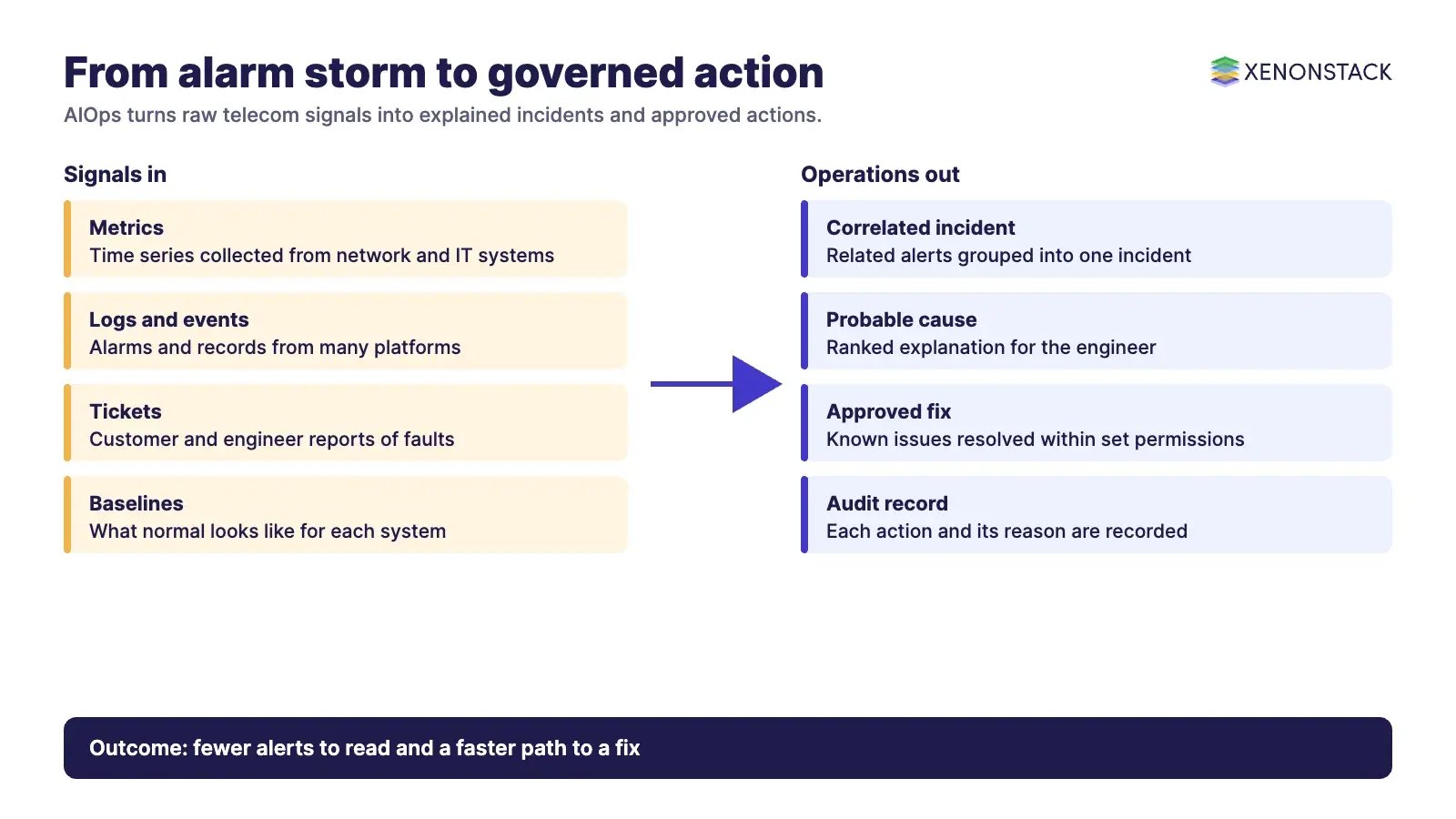
- Incident handling. Correlating alerts into a single incident and pointing to a probable cause shortens the path from alarm to fix. Smart alerting means operators spend attention on the issues that affect users.
- Customer support. Ticket routing and chatbots can shorten queues for technical support and billing queries. Treat any claimed improvement as something to measure against your own baseline, not assume.
- Fraud and security signals. Anomaly detection trained on historical data can surface unusual behaviour such as suspicious transactions for human review. It supports analysts rather than replacing them.
- Cohort analysis. With many distributed systems and datasets, outliers in configuration or application versions are hard to spot by hand. Grouping similar systems makes the odd one visible.
- Automated remediation. Known issues can be resolved through feedback loops that use earlier incidents to suggest the most effective fix.
Related reading: AIOps for monitoring Kubernetes and serverless, best open source AIOps platforms, and our AI-enabled solutions for telecom operations.
Where do monitoring tools such as Prometheus fit?
AIOps needs a reliable stream of metrics before any model can learn from it. The Prometheus overview describes Prometheus as an open-source systems monitoring and alerting toolkit that stores metrics as time series, with a multi-dimensional data model and a query language called PromQL. It says Prometheus suits purely numeric time series and highly dynamic, service-oriented architectures, and that it is designed to be the system you go to during an outage.
The same page gives a limit: if you need 100% accuracy, such as per-request billing, Prometheus is not a good choice. For a telecom operator that is a useful boundary. Use it for operational health, and keep charging and billing records in systems built for completeness.
| Layer | Job | Example |
|---|---|---|
| Collect | Gather metrics, logs and events | Prometheus server and exporters |
| Alert | Route alerts to people and systems | Alertmanager |
| Correlate and explain | Group events, rank causes | AIOps platform |
| Act | Run approved fixes with a record | Automation and agents |
How do AI agents change AIOps for telecom?
Classic AIOps ends at a recommendation or a fixed runbook. An AI agent can go further: read the correlated incident, gather extra context from several systems, propose a fix and, where policy allows, carry it out and record why. That makes the agent a participant in operations, so its permissions, data access and audit trail need to be designed, not assumed. Fixed automation still has a place for well-understood faults. Agents are better suited to cases where the next step depends on what the last step found. ElixirClaw is XenonStack's AI agents computing platform for building and running agents of this kind.
What should you do first?
- List the incident types that cost your operations team the most time, such as alarm storms or repeat faults.
- Check that metrics, logs and events for those systems are collected consistently.
- Set a baseline for incident handling time so you can measure change.
- Start with correlation and noise reduction before automated remediation.
- Decide which fixes an agent may run alone and which need human approval.
To map one operational decision your agents make, and the data and policy it depends on, book a Context Workshop. See what happens in the workshop.

Enhanced Visibility
Captures subtle changes in infrastructure every millisecond, aiding in precise problem tracking

Holistic Monitoring
Provides a holistic solution, covering everything from real-time data ingestion to anomaly detection

Root Cause Analysis
Automated root cause analysis is a leading AIOps application in the telecom industry. It pinpoints the underlying cause of an issue and leverages historical event data to determine the most likely reason for an incident, providing insights across various systems

Intelligent Alerting
AIOps gathers data from different IT systems and consolidates it into ‘incidents,’ preventing a surge of alerts triggered by related issues. Smart alerting reduces the number of critical alerts, allowing operators to focus on key issues that impact users and business outcomes

Cohort Analysis
Manually analyzing large datasets is challenging, especially with multiple datasets in action. In modern distributed architectures, hundreds of active datasets make it impossible for humans to spot outliers in configurations or versions of deployed applications

Automated Remediation
AIOps continuously resolves known issues through automated feedback loops. It detects problems by analyzing past incidents via root cause analysis (RCA) and then suggests the most effective and efficient methods for remediation
Frequently asked questions
What does AIOps stand for?
AIOps stands for artificial intelligence for IT operations. IBM describes it as applying AI to automate, streamline and optimise IT service management and operational workflows.
How is AIOps different from DevOps?
DevOps focuses on accelerating and refining software development and deployment. AIOps uses AI to optimise how enterprise IT environments perform, and the two can be used together.
Which AIOps capabilities matter most for telecom?
Event correlation, noise reduction and root cause analysis usually come first, because they cut the time between an alarm and a fix. Anomaly detection and automation follow once data quality is good.
Is Prometheus an AIOps tool?
Prometheus is a monitoring and alerting toolkit that stores metrics as time series. It supplies data that an AIOps platform can analyse, and it is not suited to uses that need exact completeness, such as per-request billing.
How do AI agents differ from automated runbooks?
A runbook follows fixed steps. An agent can gather context, choose the next step based on what it finds, and act within permissions that you set and record.
Ready to put AI agents to work? See an ElixirClaw demo: the agentic OS to build, orchestrate and govern AI agents across your enterprise systems.
Explore the XenonStack platform family: ElixirData · ElixirClaw · ElixirHub · NexaStack · MetaSecure · Neural AI · AgentGRC · AgentSRE · AgentAnalyst · AgentInstruct · AgentRAI · AgentScrum · AgentSearch · AgentForce · AI Aviator · SAIF Aviator · CohortIQ · XenonStack AI · XenonStack UAE