Key takeaway
- Agentic process automation in logistics and supply chain: where APA beats RPA, which processes suit it, the controls it needs and how to adopt it.
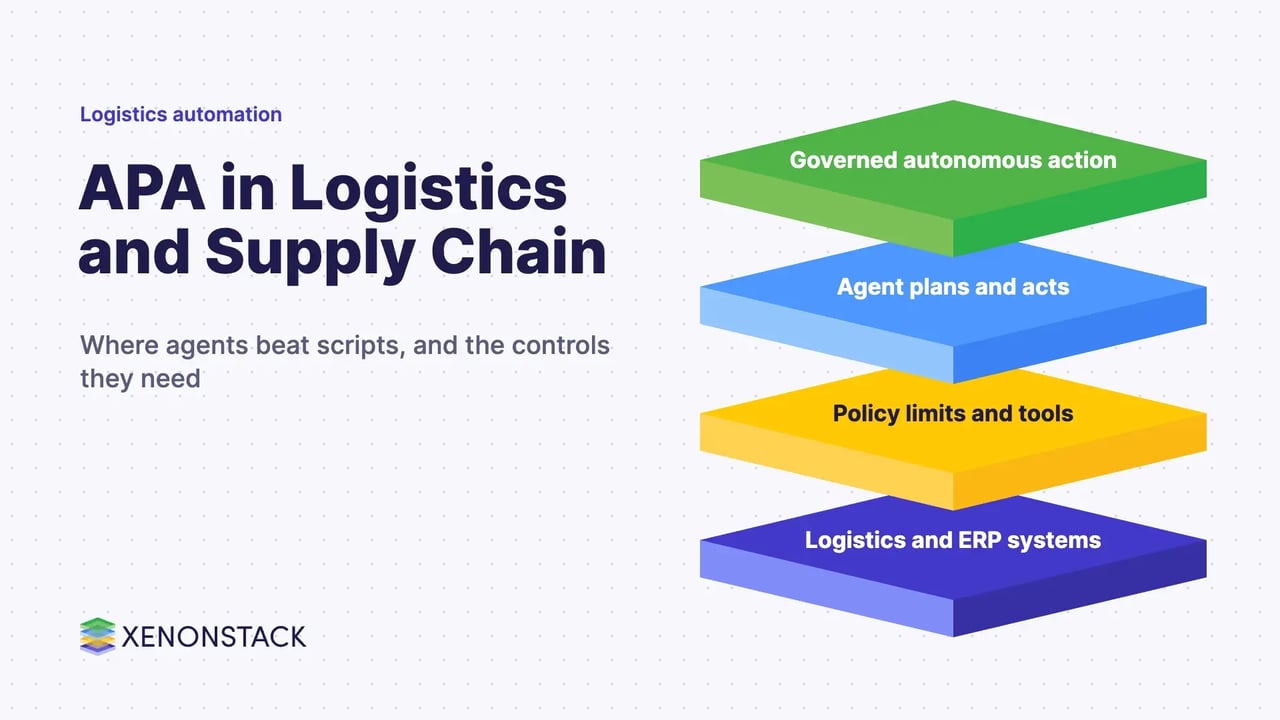
Agentic process automation (APA) in logistics and supply chain uses AI agents to carry a process from trigger to outcome: read a delayed-shipment alert or a mismatched invoice, decide the next step within set limits, act in the connected systems and hand the case to a person when it falls outside those limits. It differs from scripted robotic process automation (RPA), which repeats fixed steps and stops when the input changes.
This guide is for operations, finance and technology leaders. It focuses on the process layer: which logistics and supply chain processes suit APA, how it differs from RPA, what controls it needs and how to adopt it in stages. For the wider agent view see agentic AI in supply chain management; for pattern detail see agentic workflows; for the base concept see Agentic Process Automation.
What is agentic process automation in logistics and supply chain?
APA combines a language model, tool access and a policy boundary. The agent receives a goal in natural language or an event from a system, plans the steps, calls the tools it is allowed to call (for example a transport management system, an ERP or a carrier portal), checks the result and decides whether to continue, retry or escalate. The process owner defines the goal, the tools and the limits; the agent chooses the path inside them.
How is it different from RPA and traditional workflow automation?
| Aspect | Scripted RPA | Agentic process automation |
|---|---|---|
| Logic | Fixed rules and screen or API steps | Goal-driven planning within policy limits |
| Unstructured input | Needs a template or a prior extraction step | Can read emails, documents and free text, then check the result |
| When something changes | Usually breaks and waits for a developer | Re-plans, or escalates to a person with context |
| Best fit | Stable, high-volume, rule-bound tasks | Variable processes with exceptions and judgement calls |
| Main risk | Silent failure after a system change | Wrong action taken confidently, so limits and audit are essential |
APA does not replace every script. Keep RPA or plain integration for steps that never vary, and use agents where variation and exceptions are what cost time.
Which logistics and supply chain processes suit APA?
Look for processes with many exceptions, several systems and a person who currently stitches the pieces together. The table lists candidates in this post; it is a screening aid, not a promise of outcome.
| Process | What the agent does | What a person still decides |
|---|---|---|
| Demand and replenishment planning | Collects sales, stock and supplier signals, proposes revised forecasts and replenishment orders | Approves orders above value or risk limits |
| Inventory exceptions | Spots stockouts and overstock, checks stock records across systems, proposes transfers or reorders | Approves cross-site transfers and write-offs |
| Shipment delay handling | Reads carrier or tracking updates, checks the affected orders, drafts customer and supplier messages, proposes rebooking | Approves cost-bearing changes and key-customer messages |
| Invoice and freight audit matching | Extracts invoice data, matches it to purchase order and receipt or rate, routes mismatches | Resolves disputes and approves payment outside tolerance |
| Supplier onboarding and document checks | Collects documents, checks completeness, flags gaps | Accepts the supplier and any risk exceptions |
Each row maps to a problem the earlier post on Agentic Process Automation describes: static forecasting, rule-based inventory tracking and rigid invoicing automation. Sensor data from IoT in supply chain management and provenance records from blockchain in supply chain can feed these agents, but neither is required to start.
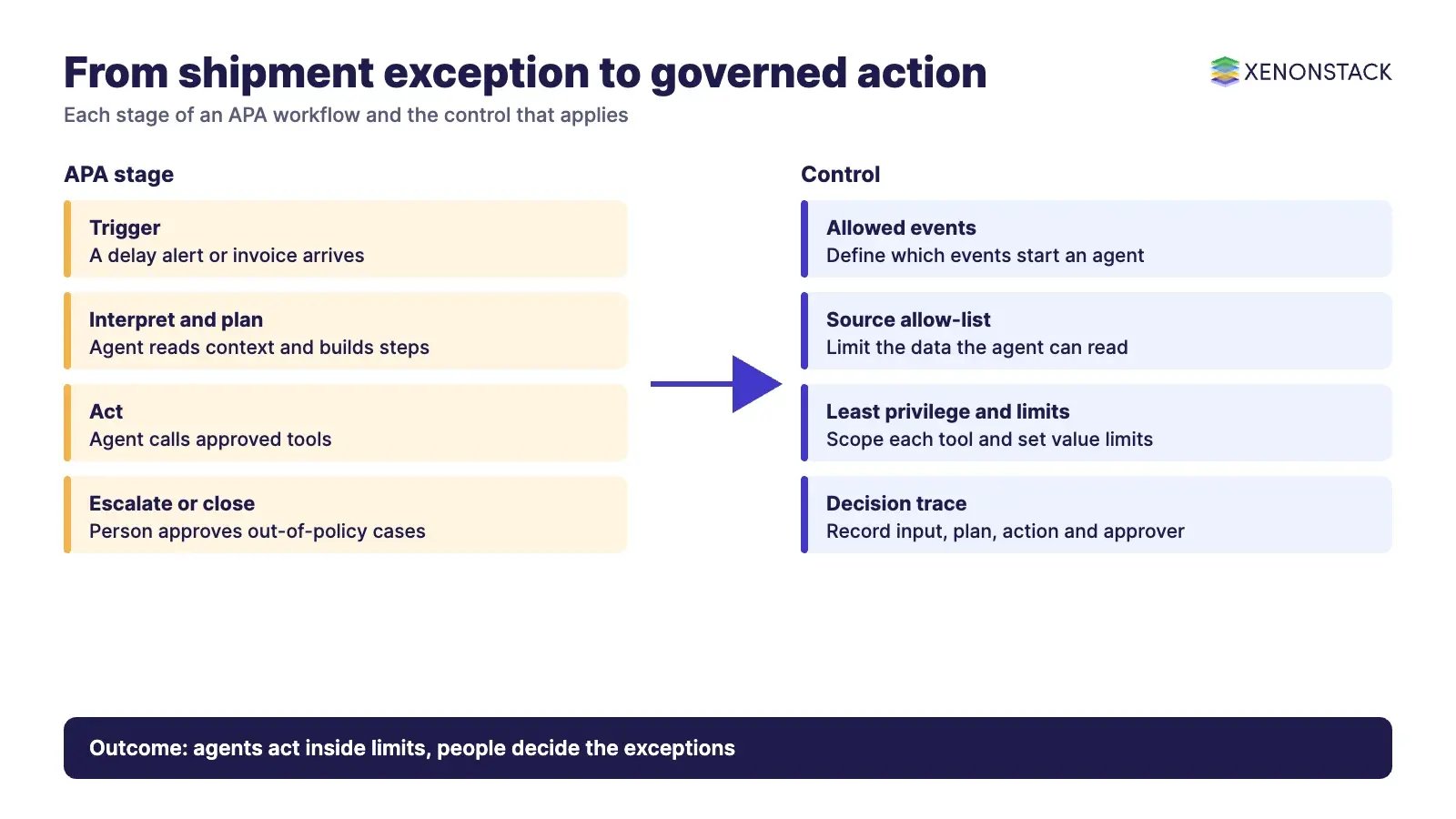
How does an APA workflow run end to end?
| Stage | What happens | Control to put in place |
|---|---|---|
| 1. Trigger | An event or request arrives, such as a delay alert or an invoice | Define which events may start an agent |
| 2. Interpret | The agent reads the task in natural language and gathers context | Limit which data sources it can read |
| 3. Plan | It builds the steps, often as structured output such as JSON | Log the plan before it runs |
| 4. Act | It calls approved tools in the TMS, ERP or portals | Scope each tool to least privilege and set value limits |
| 5. Check | It verifies the result and decides to continue, retry or stop | Define stop conditions and retry caps |
| 6. Escalate or close | A person approves out-of-policy cases; outcomes are recorded | Keep a decision trace for audit and learning |
Learning from outcomes should happen through reviewed changes to prompts, rules and tools, not through the agent silently rewriting its own limits. The Exception Handling Agent from ElixirData, according to its site, routes edge cases to the right person with context and evidence and records outcomes as Decision Traces, which is the pattern stage 6 describes.
What governance and security controls does APA need?
An agent that can place orders, move stock or approve payments needs the same discipline as a new employee with system access, and more logging. The NIST AI Risk Management Framework 1.0 (released 26 January 2023, voluntary) organises AI risk work into four functions: Govern, Map, Measure and Manage. They give a neutral structure for the controls below. Teams that use or place AI systems on the EU market should also check whether Regulation (EU) 2024/1689 (the EU AI Act) applies to their use case; this is not legal advice.
| Risk | Control | Where it sits |
|---|---|---|
| Agent takes an out-of-policy action | Value, quantity and counterparty limits; approval step above them | Tool layer and policy |
| Wrong data drives a decision | Source allow-list, freshness checks, reconciliation to system of record | Data and integration |
| No evidence of why an action happened | Decision trace: input, plan, tool calls, result, approver | Audit log |
| Excess access | Least-privilege credentials per tool; no shared admin accounts | Identity and access |
| Silent drift after changes | Regression tests on a fixed set of cases before each change | Release process |
Related reading: APA governance, APA testing and agentic AI risk management. For policy-bound approvals, ElixirData describes its Approval Agent as approving requests within policy boundaries and sending exceptions to the right person with supporting evidence, according to its site.
How should an enterprise adopt APA in stages?
| Stage | Scope | Exit test before moving on |
|---|---|---|
| 1. Select | One process with clear volume, exceptions and an owner | Baseline of cycle time, error and touch rate measured from your own data |
| 2. Assist | Agent drafts; a person approves every action | Reviewers accept most drafts without edits |
| 3. Act within limits | Agent acts below set limits; escalates above them | No limit breaches in a defined run period |
| 4. Extend | Add a second process or region using the same controls | Controls reused without redesign |
| 5. Operate | Monitoring, regression tests and owner review each quarter | Incidents and overrides reviewed and fed back |
A platform such as ElixirClaw, described on its site as an agentic OS platform to build, orchestrate and govern AI agents and automation workflows while keeping humans in control, can host this lifecycle. For the decision layer above the agents, ElixirData Context OS keeps governed context, versioned policy and decision traces in one decision layer above AI agents, according to its site.
When is APA not the right choice?
| Situation | Better option |
|---|---|
| Stable, rule-bound task with no exceptions | Plain integration or scripted RPA |
| Poor master data or no system of record | Fix data first; agents will amplify errors |
| Decisions with legal or safety consequences and no review step | Keep a person as decision-maker; use the agent for preparation only |
| No owner who can define limits | Do not start; assign an owner first |
Costs are real: integration work, testing, monitoring and model usage. Estimate them from your own volumes and vendor price pages rather than from generic figures.
To map one logistics or supply chain decision your agents should make, and the context and policy it depends on, book a Context Workshop. See what happens in the workshop.
Frequently asked questions
What is agentic process automation in logistics?
It is the use of AI agents that plan and carry out a logistics or supply chain process, such as delay handling or invoice matching, using approved tools and escalating to a person outside set limits.
How is APA different from RPA in a supply chain?
RPA repeats fixed steps and tends to stop when inputs change. APA plans toward a goal, can read unstructured input and re-plans or escalates when something changes, so it needs stricter limits and audit.
Which processes should we automate first?
Choose a process with high exception volume, several systems and a clear owner, such as shipment delay handling or invoice mismatches, and start with the agent drafting while a person approves.
What controls does an agent need before it acts?
Value and counterparty limits, least-privilege tool access, source allow-lists, stop conditions, regression tests and a decision trace of input, plan, actions and approver.
Which standards help structure AI risk work?
The NIST AI Risk Management Framework 1.0 (Govern, Map, Measure, Manage) is a voluntary structure. Check separately whether the EU AI Act applies to your use case; this is not legal advice.
Explore the XenonStack platform family: ElixirData · ElixirClaw · ElixirHub · NexaStack · MetaSecure · Neural AI · AgentGRC · AgentSRE · AgentAnalyst · AgentInstruct · AgentRAI · AgentScrum · AgentSearch · AgentForce · AI Aviator · SAIF Aviator · CohortIQ · XenonStack AI · XenonStack UAE