Key takeaway
- Agentic AI in logistics operations: how agents reroute freight, file customs declarations and resolve exceptions, governed on one shared AI stack.
Agentic AI in logistics operations uses goal-driven AI agents that sense real-time supply chain conditions, reason across many data sources and carry out multi-step work: rerouting shipments, rebalancing inventory, filing customs declarations and resolving delivery exceptions, with minimal human intervention. Unlike dashboards and copilots that only raise alerts or suggest next steps, agentic systems coordinate across the TMS, WMS, ERP and partner portals and execute approved actions within set cost, service and approval limits.
This guide is for supply chain, logistics and operations leaders at shippers, 3PLs and carriers. It covers where agents fit from inbound to last mile, a worked customs declaration example, the guardrails agents need, and how XenonStack's governed AI stack helps enterprises run logistics agents at scale. The direction is clear: Gartner predicts that 60% of supply chain disruptions will be resolved without human intervention by 2031.
What is agentic AI in logistics operations?
It is a set of AI agents, each with a clear role such as freight, inventory, warehouse or customs, that watch live conditions, decide what to do within their limits and act in your systems. When a vessel is delayed, an agent does not just raise an alert: it checks inventory cover, compares recovery options on cost and service, rebooks capacity within its limits, updates customer ETAs and escalates what it cannot settle.
How is agentic AI different from earlier logistics automation?
| Capability | Rule-based, RPA and alerts | Generative AI copilots | Agentic AI systems |
|---|---|---|---|
| Primary mode | Reactive, fixed-rule execution | Conversational summaries and recommendations | Goal-driven planning and execution |
| Handling disruptions | Triggers static alerts or pre-programmed steps | Explains risks and drafts options for people | Detects anomalies, weighs trade-offs and acts |
| System coordination | Single workflows or siloed scripts | Query-based lookups across tools | Multi-agent orchestration across TMS, WMS, ERP and portals |
| Human role | Manual exception handling | Reviewing summaries and triggering actions | Setting guardrails, governing edge cases and managing key relationships |
Where do AI agents work across the logistics value chain?
| Stage | What agents do | What stays with people |
|---|---|---|
| Inbound and procurement | Schedule supplier pickups, align dock appointments, track purchase-order fulfilment and estimate duties and multi-modal costs | Supplier relationships and sourcing decisions |
| Middle mile and freight | Optimise hub-to-hub routing, allocate linehaul capacity, balance network inventory and price LTL freight on live demand, weather and traffic | Carrier contracts and strategic network design |
| Warehousing | Coordinate order fulfilment, stage inventory and work with robots and autonomous mobile robots (AMRs) to adapt layouts and sorting | Safety, labour planning and layout changes |
| Last mile and exceptions | Re-sequence routes, reassign capacity, update customer ETAs and start recovery workflows after delays or missed appointments | Key-account escalations and service credits |
| Compliance and freight audit | Prepare customs declarations, retrieve hazardous-material safety data sheets, watch cold-chain thresholds and audit freight invoices against contracts | Policy-sensitive filings, excursion decisions and disputes |
Inbound links to buying and freight audit links to payables; see our guides to industrial procurement and finance operations with agentic AI.
How does a customs declaration run with AI agents?
Customs is a strong first use case. Teams download attachments, interpret customer emails and key data into portals by hand; layouts differ by customer, fields go missing, and import, export, transfer and transit declarations each have their own routing and validation. A governed multi-agent workflow handles it like this:
- Receive. The customer email, invoice and packing list are captured.
- Document agent. Identifies the customer, classifies the documents and extracts the data.
- Declaration agent. Applies the customer's mappings and the declaration rules for the declaration type.
- Agent Gateway. Checks approval policy, portal permissions and the process's autonomy level.
- Submit to portal. Validated, authorised declarations are filed by the customs agent, which captures proof of submission. Ambiguous or policy-sensitive cases go to the operations supervisor first.
- Track. Declaration status and related inventory movements are updated.
- Audit history. Source evidence, decisions, approvals and outcomes are recorded, and corrections improve the customer mappings.
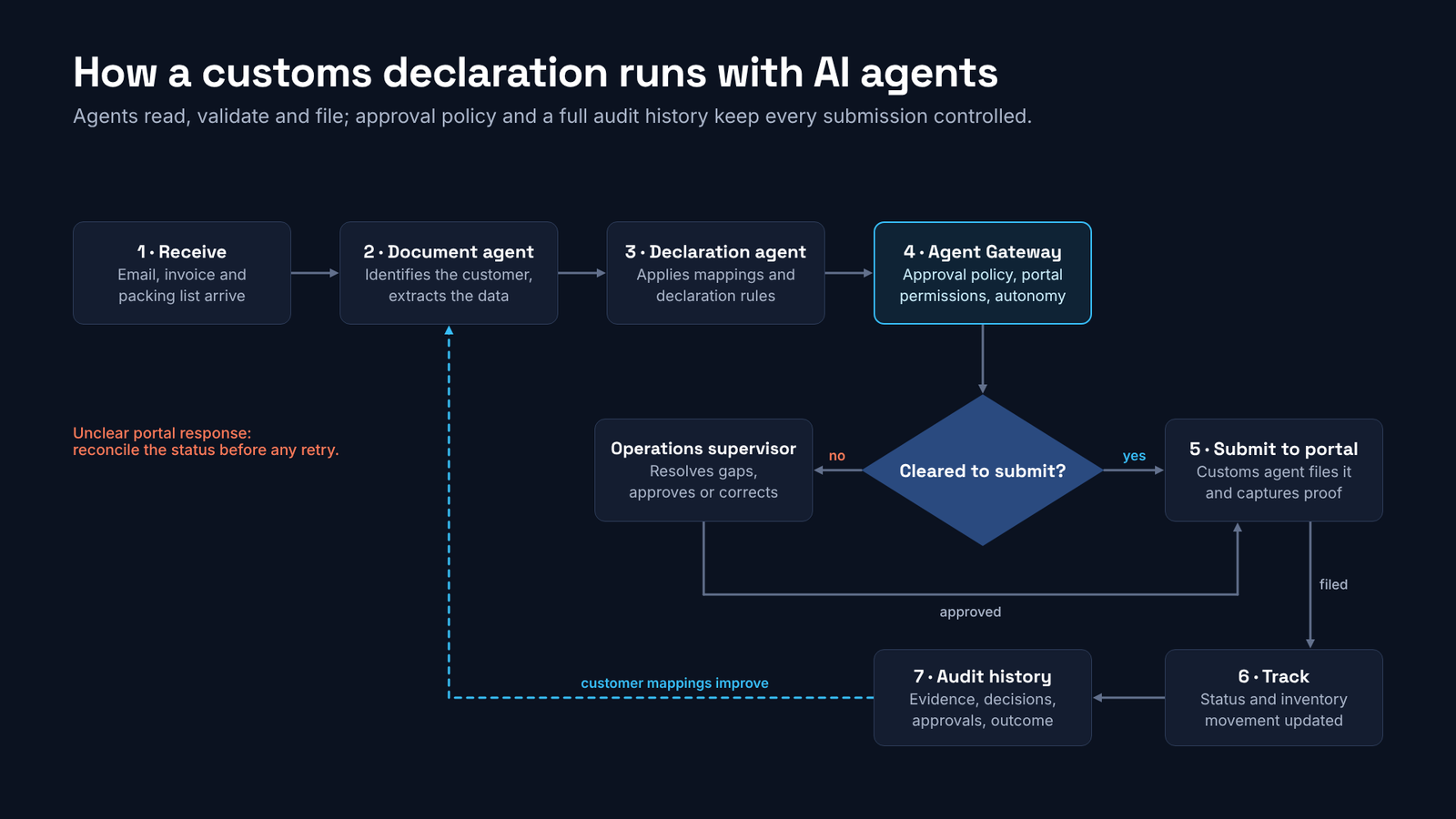
One rule matters more than any other: if the portal response is unclear, the agent reconciles the declaration's status before any retry, so nothing is filed twice.
What results can logistics teams expect?
For customs and similar document-heavy work, the gains are faster turnaround, more declarations completed without manual touches, more consistent data and clear audit evidence. Across logistics, agents cut the time between a disruption and the recovery action, which is where cost and service are lost.
The market is moving fast. Gartner forecasts that supply chain software with agentic AI will grow to $53 billion in spend by 2030, and expects 60% of enterprises using that software to have adopted agentic features by then, up from 5% in 2025. It also lists agentic AI and physical AI among the top supply chain technology trends for 2026. The risk is moving without control: Gartner has predicted that over 40% of agentic AI projects will be cancelled by the end of 2027, citing costs, unclear value and weak risk controls.
How does XenonStack's governed AI stack help logistics operations?
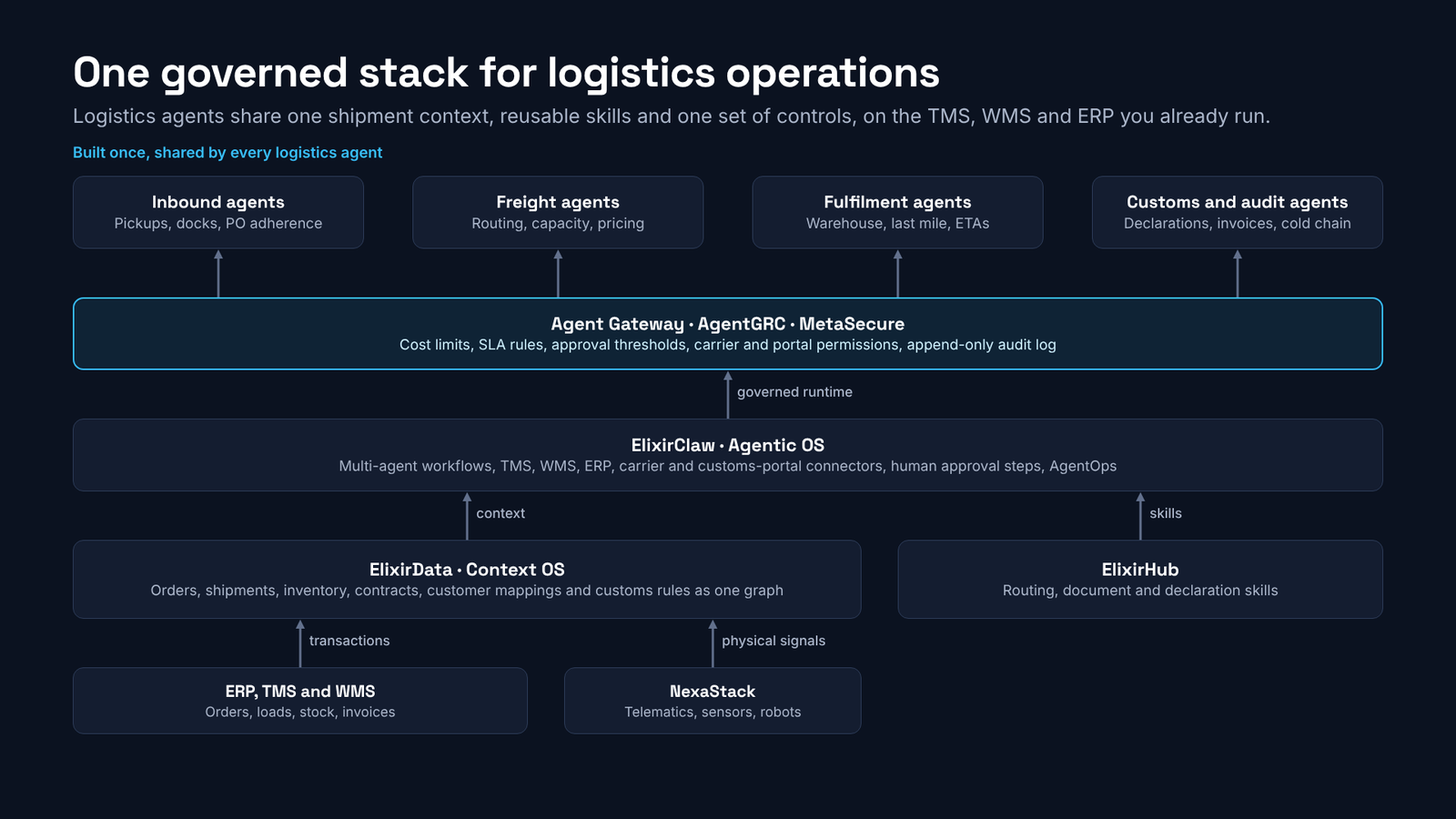
Logistics agents need one view of orders, shipments, inventory and contracts, and one set of controls across every carrier, portal and system they touch. A governed AI stack gives every agent shared context, reusable skills and one gateway, so the tenth agent costs far less than the first.
| Layer | What it does for logistics | XenonStack component |
|---|---|---|
| Context | Joins orders, shipments, inventory, contracts, customer mappings and customs rules into one graph | ElixirData Context OS |
| Agents and workflows | Runs multi-agent workflows with TMS, WMS, ERP, carrier and customs-portal connectors and human approval steps | ElixirClaw Agentic OS |
| Skills | Reusable routing, document and declaration skills shared by every agent | ElixirHub |
| Governance | Cost limits, SLA rules, approval thresholds, carrier and portal permissions and an append-only audit log | Agent Gateway, AgentGRC and MetaSecure |
| Physical operations | Connects telematics, sensors, robots and AMRs so agents act on what is happening in yards, fleets and warehouses | NexaStack |
See how this applies to supply chain teams on our supply chain AI agents page, and how agents connect to SAP and Oracle.
Which guardrails do logistics agents need?
- A clear role for each agent. A freight, inventory or customs agent with a defined scope gets only the permissions and data that role needs, which limits noise and keeps actions auditable.
- Cost and service limits. Spend caps per action, SLA rules and approval thresholds decide what an agent may change on its own.
- Human approval for high-impact changes. Dispatch changes at scale, carrier contracts and policy-sensitive filings go to a named owner.
- Safe retries. When an external system's response is uncertain, agents confirm the status before acting again.
- A complete audit trail. Every action records its evidence, the rule applied and who approved it.
How much autonomy should logistics agents have?
Autonomy is set per process and earned on evidence. A process moves up a level only when its record shows accuracy and a low override rate, and any breach moves it down.
| Process | Suggested starting level | Why |
|---|---|---|
| Customer ETA updates and dock rescheduling | Autonomous | High volume, low risk, easy to reverse |
| Validated customs declarations for configured customers | Autonomous | Clear rules, approval policy checked, proof captured |
| Last-mile re-sequencing within SLA and cost limits | Act on approval | Moves up once overrides stay low |
| Freight invoice discrepancies | Act on approval | Agents find the variance; people agree recovery with carriers |
| Spot capacity, carrier switches and network rebalancing | Recommend | Cost and relationship impact |
| Hazardous goods and cold-chain excursions | Recommend | Safety and product integrity; people decide |
How should a logistics team start?
- Pick one process with high volume and clear rules, such as customs declarations, freight invoice audit or dock scheduling.
- Connect read-only to the ERP, TMS, WMS and portals, and let agents prepare and recommend on live work.
- Measure turnaround time, touchless rate, exception rate and override rate against today's baseline.
- Run a 90-day pilot with a target for every measure, then promote, hold or stop on the numbers.
What should you ask before choosing a logistics AI platform?
- Does it work with our TMS, WMS, ERP, carriers and customs portals without migration?
- Can every agent action be traced to its evidence and reversed?
- Can we set cost limits, SLA rules and autonomy per process and change them on results?
- Do freight, warehouse and customs agents share one context and one set of controls?
- Can it act on physical signals from fleets, sensors and robots?
- Does it run in our environment, and do we own what the agents learn?
To map which logistics processes agents should run first, and the guardrails each needs, book a Context Workshop or see what happens in the workshop. Want to scope agentic logistics operations for your network? Book a strategy call.
Frequently asked questions
What is agentic AI in logistics operations?
Agentic AI in logistics operations uses goal-driven AI agents that sense real-time supply chain conditions, reason across TMS, WMS, ERP and external data, and carry out multi-step work such as rerouting shipments, rebalancing inventory, filing customs declarations and resolving delivery exceptions, inside cost, service and approval limits.
How is agentic AI different from a logistics control tower or copilot?
A control tower or copilot shows alerts, summarises data and suggests next steps for a person to act on. Agentic AI evaluates the trade-offs and executes approved actions across systems itself, escalating only what falls outside its guardrails.
Which logistics process should we automate with agents first?
Start with high-volume work that has clear rules and measurable outcomes, such as customs declarations for configured customers, freight invoice audit, dock scheduling or customer ETA updates. Expand to routing and capacity decisions once the record shows agents can be trusted.
Can AI agents file customs declarations automatically?
Yes, for declarations that pass validation and approval policy. Ambiguous documents, policy-sensitive cases and unexpected portal responses should go to an authorised operator, and an uncertain submission status should be reconciled before any retry.
Do logistics agents work with our existing TMS and WMS?
Yes. Agents connect to the ERP, TMS, WMS, carrier systems and customs portals you already run through governed connectors, so there is no migration. The main work is joining shipment, inventory, contract and customer data into one context.
How do agents work with warehouse robots?
Agents plan and coordinate the work, such as which orders to stage and how to re-sequence picks, while robots and AMRs carry it out. Physical AI platforms connect sensor, robot and telematics signals so agents act on what is actually happening on the floor.
Follow XenonStack on LinkedIn: XenonStack on LinkedIn for new guides on agentic AI, data and platform engineering.
Explore the XenonStack platform family: ElixirData · ElixirClaw · ElixirHub · NexaStack · MetaSecure · Neural AI · AgentGRC · AgentSRE · AgentAnalyst · AgentInstruct · AgentRAI · AgentScrum · AgentSearch · AgentForce · AI Aviator · SAIF Aviator · CohortIQ · XenonStack AI · XenonStack UAE