

Key takeaway
- Compare Descartes, Locus, Oracle and Blue Yonder TMS, Google, NextBillion.ai and OptimoRoute on constraints, re-routing, integration and cost.
The best route optimization platform depends on how complex your constraints are and how often plans change after the trucks leave. A courier with one depot and a fixed shift can use a light tool. A distributor with several depots, time windows, driver rules and live orders needs an engine that re-plans during the day. Large shippers often get routing inside a transportation management system (TMS) they already run. This guide compares six options on five criteria and says when not to buy.
It is written for logistics, supply chain and fleet leaders, and the architects who connect routing to order, warehouse and telematics systems.
Disclosure: XenonStack does not sell any platform below. Claims come from the vendor's own pages or named trade coverage and are worded as vendor claims. Where we could not confirm a point we say "confirm with the vendor". Figures are vendor claims, not our tests.
How should you evaluate a route optimization platform?
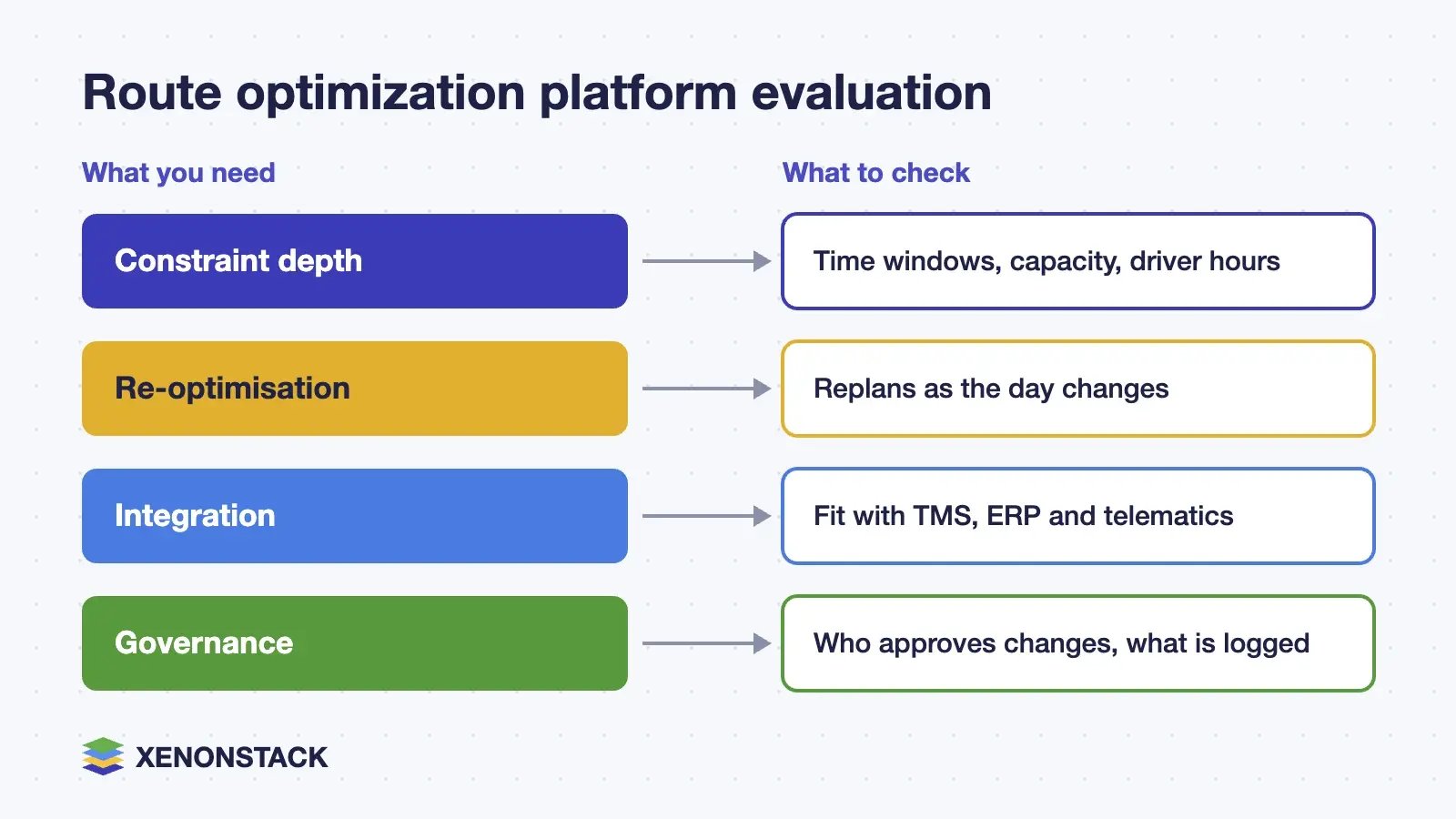
- Constraint depth: time windows, vehicle capacity, driver hours, multiple depots, skills, EV range and customer preferences.
- Re-optimization: does it only plan in the morning, or does it re-plan as orders, traffic and delays change?
- Integration: does it connect to your TMS, ERP, order and warehouse systems and telematics?
- Explainability and override: can a planner see why a route was chosen and change it?
- Cost and scale: pricing model, and behaviour at your order volume.
Which platforms are compared here?
| Platform | Type | Best fit | What to check |
|---|---|---|---|
| Descartes Route Planner | Dedicated routing and fleet suite | Distributors, retailers and 3PLs with complex delivery operations | Enterprise implementation; quote-based |
| Locus | Routing plus dispatch orchestration | Large last-mile and multi-depot networks | Platform rather than API; pricing is enterprise-only |
| Oracle and Blue Yonder TMS | Routing inside a transportation management system | Shippers with high freight volume across modes | Planning focus; fit with last-mile execution |
| Google Route Optimization API | Cloud API | Teams building their own routing application | Which constraints the current API supports, confirm with Google |
| NextBillion.ai | API-first routing platform | Teams embedding routing in their own product | Customers and scale limits, confirm with the vendor |
| OptimoRoute and Routific | Mid-market route planning apps | Small and mid-sized delivery fleets | Behaviour at your volume and constraints |
What does Descartes offer?
According to Descartes, its Route Planner uses AI and machine learning, runs continuously in the background rather than only in batches, and supports hybrid routing that blends fixed and dynamic plans. It supports multi-depot, compliance-aware routing. Descartes cites an average cost reduction, which is a vendor claim to test in a pilot. In April 2026 trade coverage reported an AI agent, René, for fleet data; confirm its status with Descartes.
Choose it when you expect to outgrow point tools and want a vendor with a wider logistics estate. Expect an enterprise implementation.
What does Locus offer?
According to Locus, its platform plans against a large set of real-world constraints, re-optimises as the day changes and connects routing to auto-dispatch through a control tower and an AI co-pilot. Locus says it has optimised a very large volume of deliveries for enterprise customers in many countries, and its site states it was acquired by Ingka Group (IKEA's largest retailer) in 2025.
Choose it when you run a large multi-depot network and want planning and dispatch in one system. Pricing is enterprise-only; ask for a reference customer with a network like yours.
What do Oracle and Blue Yonder offer?
Both describe routing as part of a wider TMS. Oracle and Blue Yonder each state they were named a Leader in Gartner's 2026 Magic Quadrant for Transportation Management Systems for the 19th time; these are vendor press releases. Blue Yonder describes multimodal planning and execution, freight audit and settlement, and end-to-end visibility. Oracle links routing with cost, disruption and carbon tracking.
Choose a TMS route when you plan freight across modes and carriers and already run the vendor's ERP or supply chain suite. For same-day, last-mile routing you may still need a dedicated engine alongside it.
What does Google's Route Optimization API offer?
Google Cloud's fleet routing offering lets operators plan routes for a fleet using Google Maps traffic data. Confirm with Google which vehicle and commercial constraints the current API supports, since that determines whether it fits a complex fleet.
Choose it when your developers want to build a routing application on a cloud API.
What does NextBillion.ai offer?
According to NextBillion.ai, it is an API-first routing platform built for enterprise logistics, covering last-mile, middle-mile and field service, with per-vehicle, per-order or per-call pricing options.
Choose it when you want to embed routing in your own product and prefer API flexibility. Ask for references at your order volume.
What do OptimoRoute and Routific offer?
These are mid-market route planning apps with an easy start, aimed at smaller fleets. Choose them when you run a smaller fleet with simpler constraints, and test them against your own order volume and constraints before committing.
How do the options compare on control and integration?
| Platform | Re-optimization | Integration | Planner control |
|---|---|---|---|
| Descartes | Continuous, hybrid fixed and dynamic | Confirm with the vendor | Role-based access, confirm with the vendor |
| Locus | Continuous with auto-dispatch | Confirm with the vendor | Confirm with the vendor |
| Oracle and Blue Yonder TMS | Planning-centred | Suite integration | Confirm with the vendor |
| Google Route Optimization API | Request-based | Cloud API | Built by your team |
| NextBillion.ai | API-based | Developer APIs | Built by your team |
| OptimoRoute and Routific | Confirm with the vendor | Connectors and APIs, to be validated | Planner app |
Ask each vendor to re-plan a day of your own orders with a late order and a vehicle breakdown, and to show why each route changed.
Which platform fits your situation?
- Complex delivery with several depots: Descartes or Locus.
- Freight planning across modes and carriers: a TMS from Oracle, Blue Yonder or SAP.
- You are building your own application: Google's API or NextBillion.ai.
- Small fleet, simple constraints: OptimoRoute or Routific.
- You want agents that re-plan and notify customers within your rules: pilot on one depot and review each automatic change.
When should you not buy a route optimization platform?
- Your addresses and time-window data are poor. Fix master data first.
- Drivers and planners will not accept automatic changes. The hard part of dynamic re-routing is often operational acceptance, not the maths.
- Your routes barely change from day to day and a fixed schedule works.
- Your fleet is small enough that planner time costs less than the licence.
How can you test a platform before committing?
Run a four-week pilot on one depot. Compare planned and actual distance, on-time rate, stops per route, planner overrides and late re-plans against your current method for the same days.
To agree which route changes an agent may make alone and what record each must leave, book a Context Workshop or see what happens in the workshop. Need help designing a pilot or the integration? Book a strategy call.
Frequently asked questions
What is AI route optimization?
Software that plans delivery or service routes using constraints such as time windows, capacity and driver hours, and re-plans when conditions change.
How is route optimization different from a TMS?
A TMS plans and manages freight across modes and carriers. Route optimization plans the sequence of stops for vehicles, often within a day.
Can routing software handle electric vehicles?
Some platforms model charging and range. Confirm support and test it on your routes.
How much can route optimization save?
Vendors cite their own savings ranges. Measure your own savings in a pilot.
Do I need dynamic re-routing?
If orders arrive during the day or delays are common, yes. If plans are fixed overnight, batch planning may be enough.
Which systems should it connect to?
Your order management, ERP, warehouse system, telematics and customer notifications.
Follow XenonStack on LinkedIn: XenonStack on LinkedIn for new guides on agentic AI, data and platform engineering.
Ready to put AI agents to work? Explore ElixirClaw, the agentic OS platform to build, orchestrate and govern AI agents.
Explore the XenonStack platform family: ElixirData · ElixirClaw · ElixirHub · NexaStack · MetaSecure · Neural AI · AgentGRC · AgentSRE · AgentAnalyst · AgentInstruct · AgentRAI · AgentScrum · AgentSearch · AgentForce · AI Aviator · SAIF Aviator · CohortIQ · XenonStack AI · XenonStack UAE


