Key takeaway
- Agentic AI in finance operations: how agents run AP, AR, close and FP&A inside your controls, and how a governed AI stack takes them to scale.
Agentic AI in finance operations uses software agents that plan, carry out, check and escalate multi-step finance work across the ERP, billing systems and banks. Instead of waiting for a person at every step, agents capture invoices, match cash, run reconciliations and draft variance commentary, then hand exceptions and judgement calls to people. Run on a governed AI stack, every agent action stays inside your materiality limits, segregation of duties and audit trail.
This guide is for CFOs, controllers and finance operations leaders. It covers where agents fit across procure-to-pay, order-to-cash, record-to-report, FP&A and treasury, how a governed transaction runs end to end, which controls finance must keep, and how XenonStack's governed AI stack helps enterprises move from pilots to finance operations run by agents. There is ground to make up: IBM notes that in finance operations half of organisations have not yet begun their AI journey.
What is agentic AI in finance operations?
An AI agent works towards a goal with limited step-by-step instruction. The Corporate Finance Institute describes four traits that make a finance workflow agentic: it is goal-oriented, it reasons across several steps, it uses tools and systems, and it has escalation logic for exceptions. In practice, an agent does not just read an invoice; it matches it, finds why it does not match, fixes what policy allows and routes the rest to the right person.
How is agentic AI different from RPA and copilots?
| RPA and rule-based automation | Copilots | Agentic AI | |
|---|---|---|---|
| What it does | Follows fixed scripts and moves data faster | Surfaces insights and drafts for a person | Plans and completes multi-step goals across systems |
| When inputs change | Breaks or copies errors forward | Adapts, but a person must act | Diagnoses the discrepancy and adapts |
| Who acts | The bot, along a set path | A person, every time | The agent within policy; people on exceptions |
| Finance example | Keys invoice data into the ERP | Drafts a variance explanation | Reconciles, posts within limits and escalates breaks with evidence |
| Control needed | Script maintenance | Review of each output | Materiality limits, permissions, approvals and an audit trail |
Moving from copilots to agents is moving from advice to action. That is where the value is, and it is why governance has to be built in rather than added later.
Where do AI agents work in finance operations?
| Process | What agents do | What stays with people |
|---|---|---|
| Procure-to-pay and accounts payable | Capture invoice data, code accounts, match to purchase orders and receipts, route approvals, stop duplicate payments | New vendors, high-value payments and non-standard exceptions |
| Order-to-cash and accounts receivable | Apply cash, prioritise collection worklists, triage billing disputes, reconcile CRM, billing and ERP records | Credit decisions, write-offs and sensitive customer conversations |
| Record-to-report and month-end close | Prepare journal entries, run bank and intercompany reconciliations, flag anomalies, compile audit-ready workpapers | Judgements, estimates and financial statement sign-off |
| FP&A | Gather actuals across systems, find variance drivers, draft commentary, run scenarios | Forecast calls, plan choices and business partnering |
| Treasury | Monitor cash positions, liquidity and covenant thresholds, and alert early | Funding, hedging and investment decisions |
Procure-to-pay connects directly to buying. Our guide to industrial procurement with agentic AI covers the sourcing side of the same flow.
How does a finance transaction run with AI agents?
- Finance event. An invoice, payment, bank line or order arrives.
- Capture agent. Reads the document, codes it and checks for duplicates.
- Matching agent. Matches it to the purchase order, bank statement or ledger and, when it does not match, finds the cause.
- Agent Gateway. Checks the proposed entry or payment against materiality limits, segregation of duties and the process's autonomy level.
- Post in ERP. Within policy, the agent posts the entry or releases the payment, with its evidence attached. Outside policy, the controller approves or corrects it with the full evidence pack.
- Continuous close. Reconciliations, accruals and variance commentary are updated as transactions land, not only at month end.
- Audit trail. Who acted, on which evidence and under which rule is recorded, and overrides improve the next run.
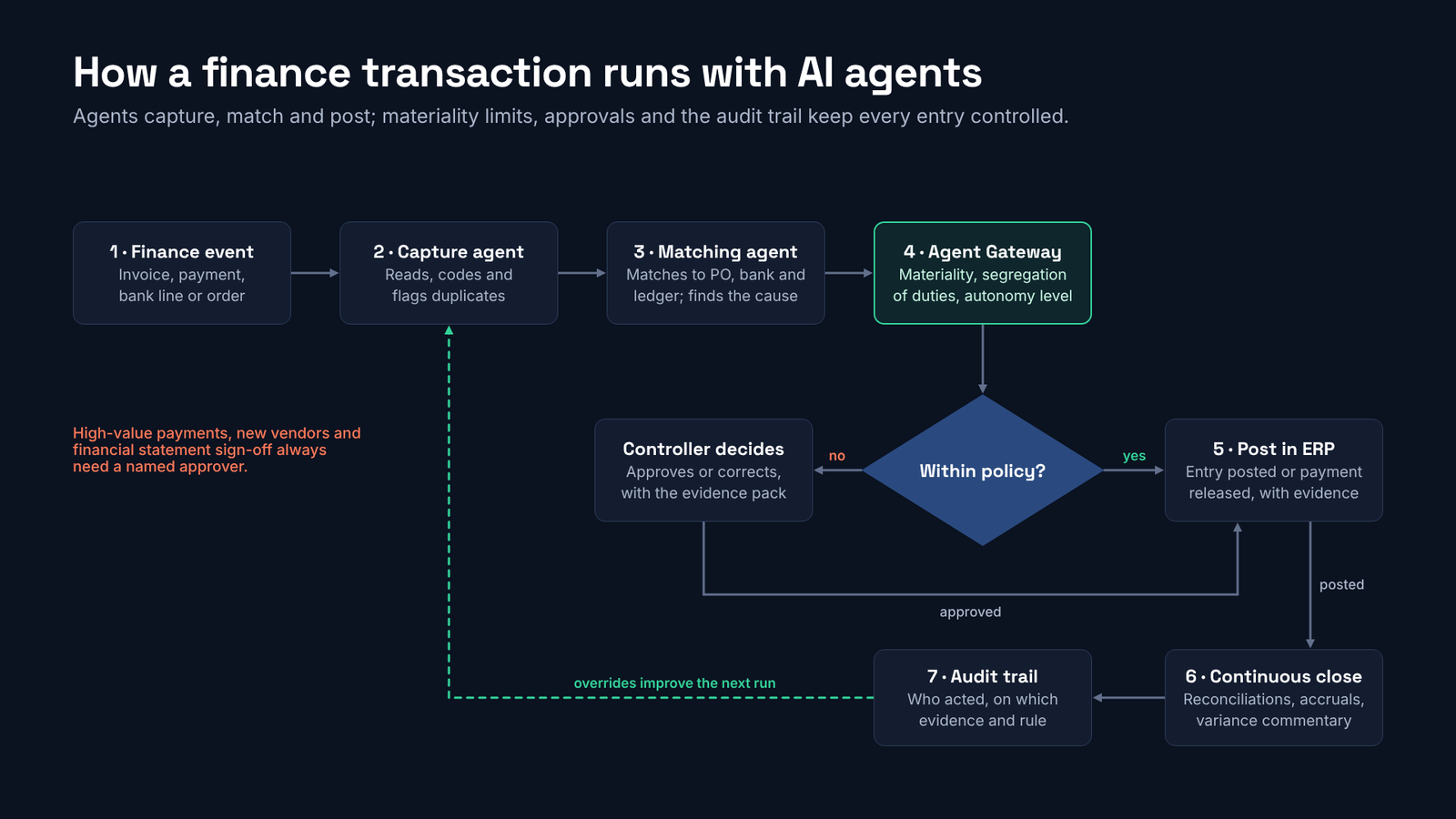
High-value payments, new vendors and financial statement sign-off always need a named approver, whatever the agent's autonomy level.
What results can finance teams expect?
The gains come from touchless processing, a faster close and analysts spending time on insight rather than gathering data. EY reports one of its finance leaders saying that end-to-end agentic AI can reduce costs by up to 40%; treat that as a ceiling, not a forecast. Workday points out that the average close has already fallen from ten days to six over 15 years, and agents push towards a continuous close.
The risk is stalling. Gartner has predicted that over 40% of agentic AI projects will be cancelled by the end of 2027, citing costs, unclear value and weak risk controls. Finance avoids that by measuring each process on its own numbers and governing every agent action from day one.
How does XenonStack's governed AI stack help finance operations?
Most finance teams end up with agents in the ERP, in AP software and in planning tools, each with its own permissions and logs. A governed AI stack gives every finance agent one ledger context, one set of reusable skills and one set of controls, across vendors.
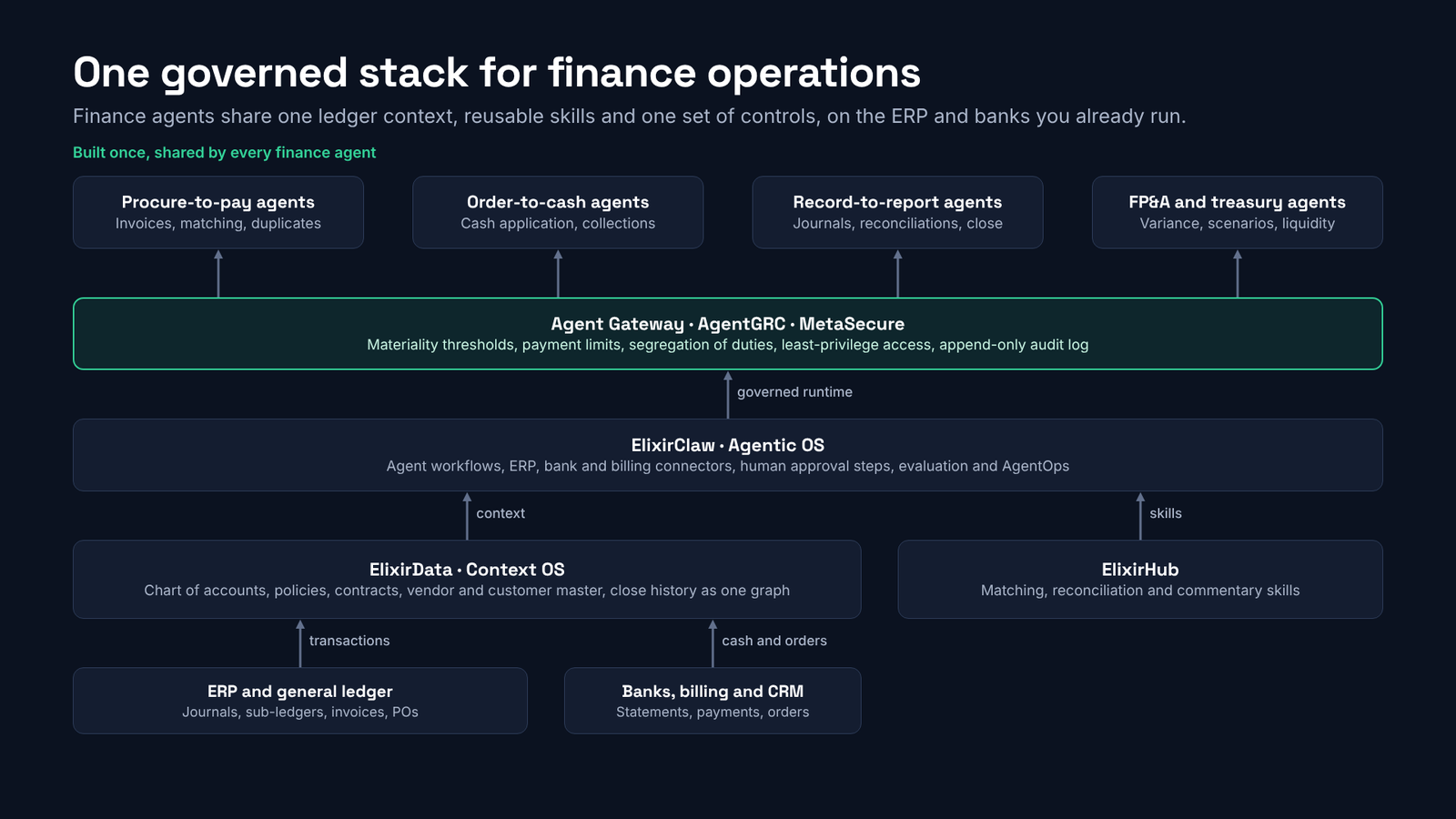
| Layer | What it does for finance | XenonStack component |
|---|---|---|
| Context | Joins the chart of accounts, policies, contracts, vendor and customer master data and close history into one graph | ElixirData Context OS |
| Agents and workflows | Runs AP, AR, close, FP&A and treasury agents with ERP, bank and billing connectors and human approval steps | ElixirClaw Agentic OS |
| Skills | Reusable matching, reconciliation and commentary skills shared by every agent | ElixirHub |
| Governance | Materiality thresholds, payment limits, segregation of duties, least-privilege access and an append-only audit log | Agent Gateway, AgentGRC and MetaSecure |
Agents work with the systems you already run, including SAP and Oracle, and the same controls extend to risk and compliance agents.
Which controls must finance keep when agents act?
- Human sign-off on what matters. Material outputs, high-value disbursements, new vendors and non-standard exceptions always go to a named approver.
- Least-privilege access. Each agent can read and do only what its process needs, and no agent can both create and approve the same transaction.
- An immutable audit trail. Every action is logged with its data sources, the rule applied and who approved it.
- Validation of model outputs. Outputs are tested and monitored, uncertain cases escalate, and agents sit inside existing model risk and internal control processes.
- Clean data and named owners. Ledger, contract and master data are fit for purpose, and every process has an owner accountable for scope, results and escalations.
How much autonomy should finance agents have?
Autonomy is set per process and earned on evidence. A process moves up a level only when its record shows accuracy and a low override rate, and any breach moves it down.
| Process | Suggested starting level | Why |
|---|---|---|
| Standard cash application | Autonomous | High volume, clear matching rules, every action logged |
| Invoice matching within tolerance | Autonomous | Tolerances are explicit and exceptions escalate |
| Bank and intercompany reconciliations | Act on approval | Agents clear matches; people review the breaks |
| Journal entries below materiality | Act on approval | Moves up once overrides stay low |
| Vendor master changes and payment release above threshold | Recommend | Fraud and segregation-of-duties risk |
| Financial statements, estimates and treasury funding | Recommend | Judgement and accountability stay with people |
How should a finance team start?
- Pick one process with high volume and clear rules, such as invoice matching, cash application or bank reconciliation.
- Connect read-only to the ERP, banks and master data, and let agents answer and recommend on live transactions.
- Measure touchless rate, exception rate, days to close and override rate against today's baseline.
- Run a 90-day pilot with a target for every measure, then promote, hold or stop on the numbers before moving to close or forecasting.
What should you ask before choosing a finance AI platform?
- Does it work with our ERP, banks and billing systems without migration?
- Can every agent action be traced to its evidence and reversed?
- Can we set materiality limits and autonomy per process and change them on results?
- Do AP, AR, close and FP&A agents share one ledger context and one set of controls?
- Will our auditors accept the decision log as evidence?
- Does it run in our environment, and do we own what the agents learn?
To map which finance processes agents should run first, and the controls each must work within, book a Context Workshop or see what happens in the workshop. Want to scope agentic finance operations for your organisation? Book a strategy call.
Frequently asked questions
What is agentic AI in finance operations?
Agentic AI in finance operations uses software agents that plan, carry out, check and escalate multi-step finance work, such as invoice matching, cash application, reconciliations and variance commentary, across the ERP, billing systems and banks, inside the controls finance sets.
How is agentic AI different from RPA in finance?
RPA repeats fixed steps and breaks when inputs change. Agents work towards a goal, adapt to new formats and exceptions, find the cause of a mismatch and escalate only when a policy threshold or a judgement call needs a person.
Which finance process should we start with?
Start with a high-volume process that has clear rules, such as invoice matching, cash application or bank reconciliation. These prove value fast and build the evidence needed before agents take on the close or forecasting.
Will AI agents replace accountants?
No. Agents take on capture, matching, reconciliation and first drafts. Accountants and controllers review exceptions, own judgements and estimates, sign off material outputs and partner with the business.
How do auditors get comfortable with AI agents?
Every agent action should be logged with the data it used, the rule it applied and who approved it, in an append-only record. Agents should run with least-privilege access and inside the same internal controls and segregation of duties as people.
Do we need to replace our ERP to use finance agents?
No. Agents connect to the ERP, banks, billing and CRM systems you already run through governed connectors, so there is no migration. The main work is connecting ledger, policy and master data so agents reason with full context.
Follow XenonStack on LinkedIn: XenonStack on LinkedIn for new guides on agentic AI, data and platform engineering.
Explore the XenonStack platform family: ElixirData · ElixirClaw · ElixirHub · NexaStack · MetaSecure · Neural AI · AgentGRC · AgentSRE · AgentAnalyst · AgentInstruct · AgentRAI · AgentScrum · AgentSearch · AgentForce · AI Aviator · SAIF Aviator · CohortIQ · XenonStack AI · XenonStack UAE