Key takeaway
- Decision infrastructure governs how AI agents decide: governed context, policy and authority checks, and decision traces. What it is and how to build it.
Decision infrastructure is the layer of an enterprise technology stack that governs how decisions are made and executed by AI agents and people: it compiles the governed context a decision needs, checks policy and authority before anything happens, routes actions that exceed an agent's limits to a named person, and keeps a durable decision trace of what was decided, why, by whom and with what result. Data infrastructure tells an organisation what is true. Decision infrastructure governs what is allowed to happen next, and remembers why it happened.
This guide explains why decision infrastructure has become necessary now that AI agents act on enterprise systems, its building blocks, how it differs from data platforms, decision intelligence, AI governance tools and context graphs, and how to build it one decision at a time. XenonStack builds decision infrastructure through ElixirData Context OS and ElixirClaw; the definitions here are written to apply whichever products you use.
Why do enterprises need decision infrastructure now?
For two decades, enterprise software recorded transactions and reported on them. People made the decisions in between, and their judgement, authority and reasoning lived in email, meetings and memory. AI agents change that. An agent that can raise a purchase order, change a customer record or close an incident is making decisions at machine speed, often across several systems at once.
That raises three questions no data platform answers on its own. What context was the agent allowed to use? Whose authority permitted this action, under which policy version? And after the fact, can anyone reconstruct why it happened? Without answers, organisations either keep agents in pilots or let them act without a record. Decision infrastructure is the layer that answers those questions by design.
The market is converging on the same idea from different directions. Cloverpop describes a "decision layer" that "connects AI intelligence to organizational action" with a decision system of record (Cloverpop, March 2026). Neo4j describes decision traces as "a structured record of how an AI agent reached a decision" (Neo4j, September 2026). Each covers part of the picture; decision infrastructure joins them into one governed path.
What are the building blocks of decision infrastructure?
| Building block | What it does | Question it answers |
|---|---|---|
| Context compilation | Assembles the data, definitions, entities, policies and past decisions a specific decision needs, scoped to who is asking | What does this decision depend on, and what may this agent see? |
| Policy and authority gates | Checks policy before the agent reasons and again before it acts; verifies whose authority applies and whether separation of duties holds | Is this action allowed, now, for this agent, at this value? |
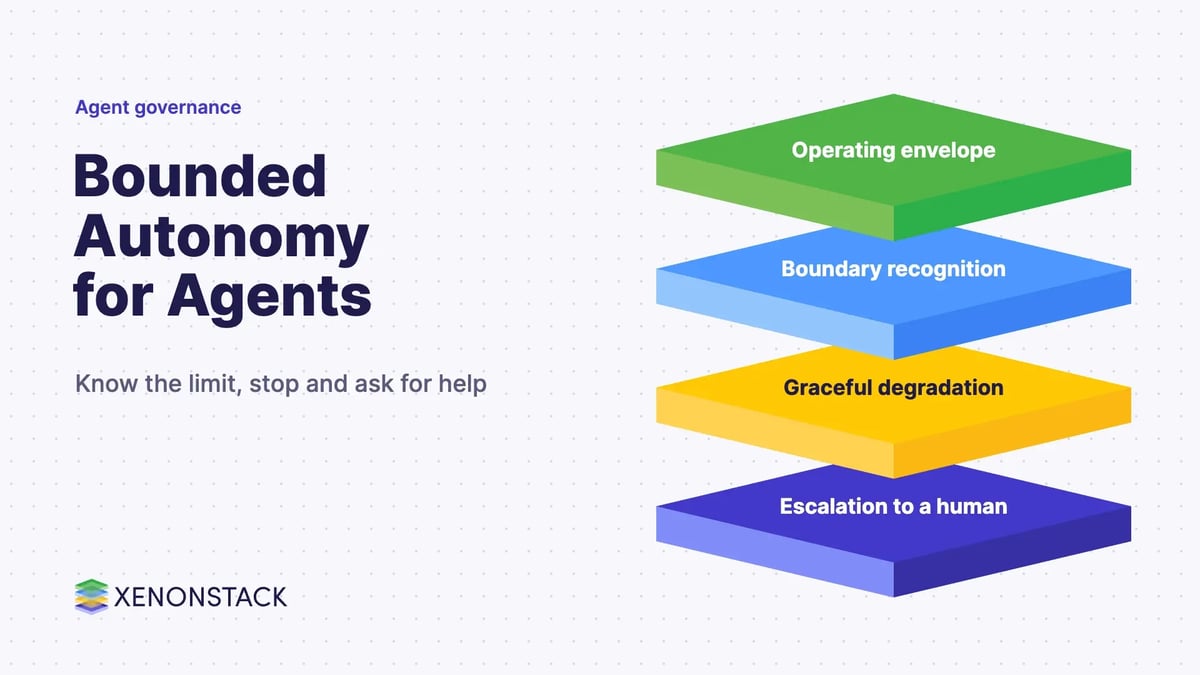
| Escalation and approval | Routes actions above an agent's limits to a named person with the full context, and blocks by default if nobody answers | Who must decide when the agent should not? |
| Decision traces | Records context, policy version, authority, action, approver and evidence for every decision, in full | Why did this happen, and who allowed it? |
| Decision memory and feedback | Makes past decisions and their outcomes available to future decisions and to policy review | What have we learned, and should the rules change? |
| Trust graduation | Moves each agent from shadow to supervised to bounded to full autonomy as it proves itself | How much should this agent do alone? |
How does a decision flow through decision infrastructure?
The two gates matter. Checking only after the agent has reasoned lets it see data it should not; checking only at the start misses what the agent actually tries to do. Policy should be evaluated by deterministic rules, not by the model, so that a prompt injection cannot talk its way past it. AWS's agentic AI guidance makes the same point for approval routing: implement the risk classifier "as deterministic logic rather than an LLM" (AWS Well-Architected agentic AI lens).
Where does decision infrastructure sit in the enterprise stack?
How is decision infrastructure different from related categories?
| Category | What it does well | What decision infrastructure adds |
|---|---|---|
| Data infrastructure (warehouse, lakehouse, catalogue) | Stores, integrates and describes data | Rules on what may be done with it, and a record of each decision taken on it |
| Decision intelligence | Models and recommends better decisions | Enforcement of policy and authority at the moment of action, and the audit trail |
| AI governance platforms | Inventory of AI systems, risk ratings and compliance evidence | Control over each individual action, in the path of execution |
| Agent observability | Traces of steps, tool calls, latency and errors for engineers | Policy version, authority and approver held with the action, for auditors |
| Context graphs | Connected memory of entities, conversations and past decisions | Gates that decide what may be used and done, not only what is remembered |
| Decision models (routing models) | Fast, bounded choices such as which tool or next step, as vendors including AWS, Cloudflare and OpenAI now offer (InfoWorld, October 2026) | Governance of what the chosen action is allowed to change, and a durable record |
For deeper comparisons, see our guides to decision intelligence platforms, AI agent governance platforms that enforce policy and AI agent audit trail platforms.
What does decision infrastructure look like in practice?
- Finance operations: an agent may approve supplier invoices that match purchase orders within a tolerance; anything above it goes to a named approver with the evidence, and every approval is traceable at audit.
- IT operations: a remediation agent may restart a service in its scope, but a change to production configuration needs a change approval, recorded with the incident. See decision infrastructure for IT operations.
- Public sector: AI-assisted case decisions keep a record of the data, model version, reviewer and appeal status, as covered in our guide to a decision-record layer for government AI.
- Healthcare administration: agents prepare prior authorisations and claims within rules, with clinicians and staff owning exceptions.
How do you build decision infrastructure?
| Step | What to do | Exit test |
|---|---|---|
| 1. Pick one decision | Choose a frequent, consequential decision with clear data and an owner | The decision, its owner and its success measure are written down |
| 2. Map its context | List the data, definitions, policies and past decisions it depends on | An agent and a person would see the same, permitted context |
| 3. Encode policy and authority | Write what may happen alone, what needs approval and what must never happen, as rules | Rules run outside the model, with versions |
| 4. Run in shadow mode | The agent proposes; people decide; both are traced | Agreement rate and exceptions are measured |
| 5. Graduate trust | Move from supervised to bounded autonomy where results justify it | Each step up has an owner's sign-off |
| 6. Add the next decision | Reuse the same context, gates and trace for the next decision | The second decision takes less effort than the first |
The NIST AI Risk Management Framework (Govern, Map, Measure, Manage) and the EU AI Act are useful references for the governance around these steps; check the official texts for how they apply to your use.
How does XenonStack provide decision infrastructure?
ElixirData Context OS is XenonStack's decision infrastructure platform. It compiles governed context from enterprise systems, enforces policy and authority at two gates (before the agent reasons and before it acts), decides whether each action is allowed, modified, escalated or blocked, and keeps full-lineage Decision Traces with audit-ready exports. Its trust graduation moves agents from shadow to supervised, bounded and full autonomy. ElixirClaw, XenonStack's Agentic OS, runs and governs agents, in-house and from vendors, on that foundation, and AgentGRC gives risk and compliance teams the same controls. See the ElixirData platform page.
To map one decision your organisation wants agents to make, and the context, policy and record it needs, book a Context Workshop. See what happens in the workshop.
Explore the Decision Infrastructure and Context guides
- Context Layer for AI Agents: Governed Data and Policy
- Decision Intelligence Platforms: 2027 Buyer's Guide
- Decision-Record Layer for Government AI Accountability
- AI Agent Audit Trail Platforms Compared for 2027
- AI Agent Governance Platforms That Enforce Policy
- AI Agents With Human Approval Gates and Audit Records
- Beyond Context Graphs: The Four Gaps Between Decision Traces and Better Decisions
- Semantic Layer for AI: Necessary, but Not Sufficient Without Decision Governance
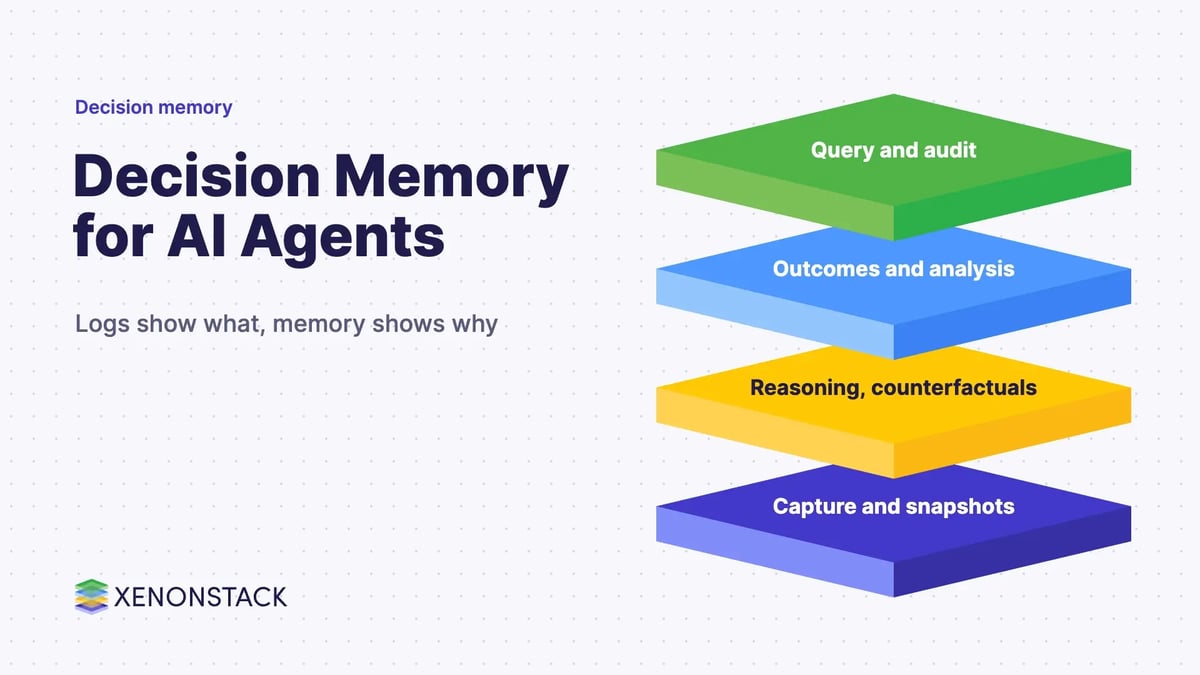
- Decision Memory: The Infrastructure That Makes AI Explainable
- Decision Infrastructure: The Next IT Operations Stack After the CMDB
- Governed AI Stack: How to Run AI Agents at Scale
Frequently Asked Questions (FAQs)
What is decision infrastructure?
Decision infrastructure is the layer of the enterprise stack that governs how decisions are made and executed by AI agents and people. It compiles governed context, checks policy and authority before action, escalates what exceeds an agent's limits, and records every decision in a durable trace.
How is decision infrastructure different from data infrastructure?
Data infrastructure stores, integrates and describes data. Decision infrastructure governs what may be done with that data, by whom and under which policy, and keeps a record of each decision taken.
Is decision infrastructure the same as decision intelligence?
No. Decision intelligence models and recommends better decisions. Decision infrastructure enforces policy and authority when a decision is executed and keeps the audit trail. Many organisations use both.
Why do AI agents need decision infrastructure?
Agents act on enterprise systems at machine speed. Without governed context, policy gates and decision traces, organisations cannot show what an agent was allowed to do, who authorised it, or why it acted, which keeps agents stuck in pilots or acting without accountability.
How do you start building decision infrastructure?
Start with one frequent, consequential decision. Map its context, encode its policy and authority as rules outside the model, run the agent in shadow mode with full traces, then graduate its autonomy as results justify it, and reuse the same foundation for the next decision.
Follow XenonStack on LinkedIn: XenonStack on LinkedIn for new guides on agentic AI, data and platform engineering.
Ready to put AI agents to work? Explore ElixirClaw, the agentic OS platform to build, orchestrate and govern AI agents.
Explore the XenonStack platform family: ElixirData · ElixirClaw · ElixirHub · NexaStack · MetaSecure · Neural AI · AgentGRC · AgentSRE · AgentAnalyst · AgentInstruct · AgentRAI · AgentScrum · AgentSearch · AgentForce · AI Aviator · SAIF Aviator · CohortIQ · XenonStack AI · XenonStack UAE