Key takeaway
- AI agents in education: which jobs they can take on, what UNESCO, the US Department of Education and the EU AI Act say, and how to govern them.
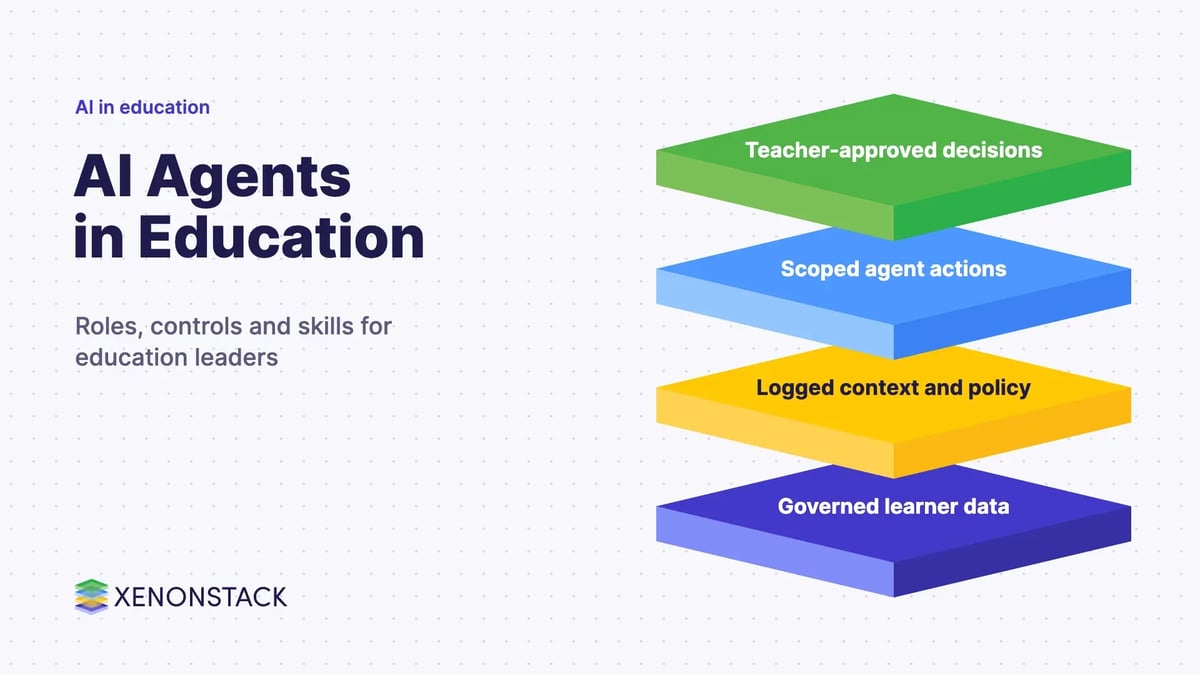
An AI agent in education is software that uses a generative AI model plus tools to work towards a goal set by a person, such as answering a learner's question, preparing a lesson resource or routing a student request. Schools, universities and training providers can use agents as tutors, teaching assistants, administrative helpers and research aids. The leadership decision is not which model to buy. It is which tasks an agent may do alone, which need a teacher or staff member to approve, and how each action is recorded.
UNESCO, the US Department of Education and the EU AI Act all point the same way: keep people in charge, protect learner data and treat systems that evaluate students as high risk. This guide sets out the roles agents can play, the controls each needs, the official sources and an adoption sequence. It complements our guides to AI personalised learning and agentic AI in education, and focuses on agent roles, skills for the workforce and governance.
What are AI agents in education?
Microsoft's documentation for its agent service defines an agent as an application or system that uses generative AI models with tools to access data sources, APIs and systems to achieve user-specified goals, with or without human supervision. In a school or university, that means an assistant that can look up course material, draft feedback or start a workflow, not only chat. Because agents can take actions, they need the controls described below, and the same documentation says users should be able to intervene if an agent behaves in an unintended way. They build on agentic workflows, where steps, tools and approvals are defined in advance.
Which education jobs can an agent take on, and who approves?
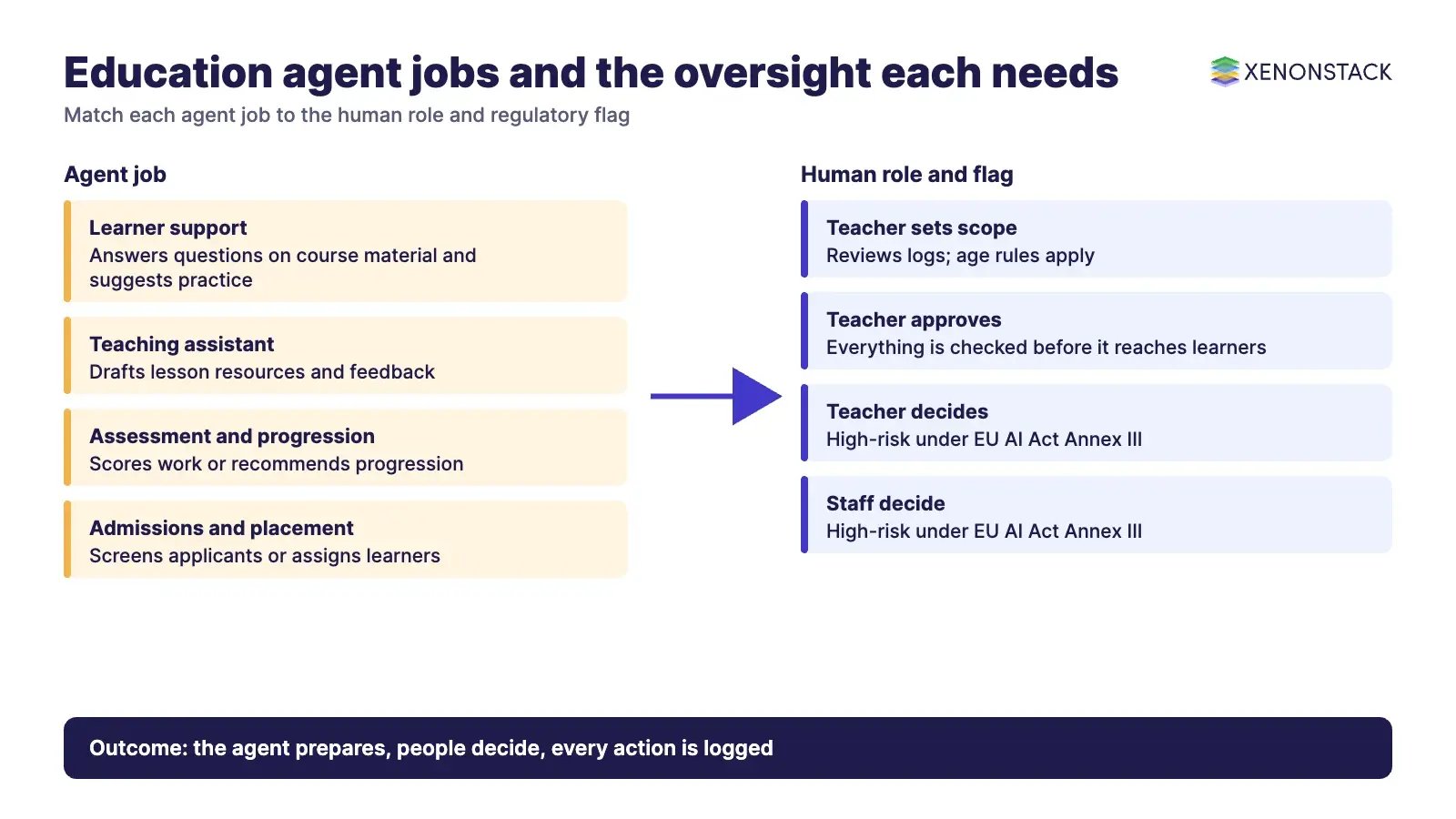
The table separates jobs by the level of oversight they need. It describes design choices, not the results of any product, and the last column reflects the high-risk list in the EU AI Act.
| Job | What the agent does | Human role | Regulatory flag |
|---|---|---|---|
| Learner support | Answers questions on course material and suggests practice | Teacher sets scope and reviews logs; age rules apply | Lower, unless it evaluates learning outcomes |
| Teaching assistant | Drafts lesson resources and feedback for a teacher to edit | Teacher approves everything before it reaches learners | Lower, if it only drafts |
| Administrative support | Handles schedules, attendance records and routine requests, as in automating administrative processes in schools | Staff approve exceptions and changes to records | Check data protection rules |
| Content preparation | Prepares learning content, as in AI-driven content generation for e-learning | Subject expert reviews accuracy | Lower |
| Assessment and progression | Scores work or recommends progression | A teacher decides; the agent only prepares evidence | High-risk where it evaluates learning outcomes (Annex III) |
| Admissions and placement | Screens applicants or assigns learners to programmes | Staff decide and applicants can ask for review | High-risk where it determines access or admission (Annex III) |
| Test supervision | Monitors behaviour during tests | Avoid or seek legal review first | High-risk where it detects prohibited behaviour (Annex III) |
What do UNESCO, the US Department of Education and the EU say?
The sources below are official pages, read on 12 November 2026. Where a page does not state something, this guide does not state it either.
| Body | What it says | Meaning for a leader |
|---|---|---|
| UNESCO, Guidance for generative AI in education and research (published 7 September 2023, updated 16 January 2026) | Calls for a human-centred approach that ensures "ethical, safe, equitable and meaningful use", an age limit for independent conversations with generative AI platforms, and mandated protection of data privacy | Design for human agency, set age rules and write privacy into contracts |
| UNESCO, Artificial intelligence in education | Centres its approach on inclusion and equity and has published AI competency frameworks for students and teachers | Use the frameworks to plan skills for staff and learners |
| US Department of Education, Dear Colleague Letter (page last reviewed 22 July 2025) | Covers AI-based instructional materials, AI-enhanced high-impact tutoring and AI for college and career pathway advising; says uses must align with applicable statutory and regulatory requirements; stresses engaging parents and teachers and attention to user privacy | Engage parents and teachers early and check that funded uses meet programme rules |
| FERPA (34 CFR Part 99) | Gives parents, and eligible students from age 18 or in postsecondary study, rights to inspect records, request amendment and consent to most disclosures. An outside contractor can count as a school official only under direct school control of records and redisclosure limits | Treat data an agent holds about a student as potentially part of education records and check the vendor contract |
| EU AI Act, Annex III point 3 | Lists as high-risk AI systems used to determine admission or assign people to institutions, to evaluate learning outcomes (including when they guide a learner's progress), to assess the level of education a person can access, and to monitor prohibited behaviour during tests | An agent that grades, places or supervises tests is likely in scope; seek legal advice for your case |
| EU AI Act, Article 4 and Article 5 | Article 4 requires providers and deployers to take measures to support AI literacy of their staff and others who use AI systems on their behalf. Article 5(1)(f) prohibits AI that infers emotions in educational institutions, except for medical or safety reasons | Plan AI literacy training and avoid emotion-reading features with learners |
The European Commission's AI Act page states that the Act entered into force on 1 August 2024 and became applicable on 2 August 2026 with some exceptions, that prohibitions and AI literacy applied from 2 February 2025, and that Annex III high-risk rules have been extended to 2 December 2027 under the AI Omnibus. This is a reading of published pages, not legal advice.
How should you govern AI agents in a school or university?
Governance turns the principles above into controls an auditor can check. Our guide to agentic AI risk management covers the general framework, and our guide to responsible AI covers the wider principles. The table applies them to education.
| Risk | Why it matters | Control |
|---|---|---|
| Learner data and privacy | Records of performance and behaviour may be education records or personal data | Data minimisation, contract limits on re-use, access logs and retention rules |
| Unsupervised actions | An agent can call tools and change records | Scoped tool access, approval steps for changes and a way for staff to stop the agent |
| Inaccurate answers | Generative models can produce wrong content | Teacher review of resources, source-grounded answers and a route to report errors |
| Bias and unfair outcomes | Placement or progression suggestions can disadvantage groups | Keep decisions with staff, test for equity and let learners contest results |
| Age and safeguarding | UNESCO recommends an age limit for independent use of generative AI platforms | Age rules, content filters and logging of learner conversations |
| No audit trail | Leaders cannot explain why an agent acted | Record the context, policy and action for each decision and review them regularly |
Where do cloud agent platforms such as Azure fit?
Institutions already using Microsoft services often look at Azure first. According to its site, Foundry Agent Service is a managed platform for building, deploying and scaling AI agents, with agent runtime, tool management, tracing and evaluation, and identity features including Microsoft Entra, role-based access control and content filters. The same documentation says that in its standard setup, agent data is stored in the customer's own Azure resources, and that Microsoft does not use customer data to train models. Microsoft's transparency note also says users are responsible for complying with applicable laws and should take extra care in sensitive domains where agent actions are irreversible or highly consequential. Check each claim on the vendor's pages against your own contract and region.
Agents in Microsoft Foundry and the Transparency Note for Foundry Agent Service give the full detail. ElixirClaw is an agentic OS platform to build, orchestrate and govern AI agents and automation workflows while keeping humans in control.
How do you build AI skills for educators and the workforce?
Agents change what staff and learners need to know. UNESCO has published AI competency frameworks for students and teachers, and it flags concerns such as over-reliance and declining deep reading skills while encouraging use of AI as "a thought partner, not a shortcut". The US Department of Education letter highlights teaching students to use AI appropriately. In the EU, Article 4 makes AI literacy a duty for providers and deployers. A practical programme therefore covers three groups.
| Group | What to build | Starting point |
|---|---|---|
| Teachers and staff | Judgement on when to trust, edit or reject agent output; how to read logs | UNESCO competency framework for teachers; institution's own approval rules |
| Learners | Appropriate use, checking sources and understanding limits | UNESCO competency framework for students; clear class rules on AI use |
| Leaders and IT | Procurement, data protection, risk review and audit evidence | Annex III list, FERPA or local data law, vendor documentation |
What is a sensible adoption sequence?
- Pick one low-risk job. Start with resource drafting or administrative support, not grading or admissions.
- Set the rules. Define the data the agent may use, the tools it may call, age limits and who approves its output.
- Check the high-risk list. Map each planned use to Annex III and to your local data protection law with legal advice.
- Pilot with a small group. Involve teachers, parents or guardians where the Department of Education letter asks for it.
- Log and review. Keep a record of each action and review samples with teachers.
- Train people. Run AI literacy sessions for staff and learners before wider rollout.
- Expand only with evidence. Add jobs one at a time and keep staff in charge of decisions that affect learners.
When should you not use an AI agent?
- To decide admissions, placement, grades or progression without a teacher or staff member making the decision.
- To infer learners' emotions in an educational institution, which Article 5(1)(f) prohibits except for medical or safety reasons.
- When you cannot say what learner data the agent holds, where it is stored and who can see it.
- When no teacher has time to review output, because unreviewed content reaches learners.
- For young learners without age rules that follow UNESCO's recommendation on independent use.
ElixirData Context OS keeps governed context, versioned policy and decision traces in one decision layer above AI agents, and AgentGRC keeps autonomous agent actions inside policy, with the audit trail risk teams need. To map one education decision your agents should make, and the context and policy it depends on, book a Context Workshop. See what happens in the workshop.
Frequently asked questions
What are AI agents in education?
Software that uses a generative AI model with tools to work towards a goal set by a person, such as answering learner questions, drafting resources or routing requests, with human oversight.
Are AI agents in education high-risk under the EU AI Act?
It depends on the use. Annex III lists systems that determine admission, evaluate learning outcomes, assess the level of education a person can access or monitor prohibited behaviour during tests. Seek legal advice for your case.
What does UNESCO recommend for generative AI in education?
Its guidance calls for a human-centred approach, an age limit for independent conversations with generative AI platforms and mandated protection of data privacy.
Does FERPA apply to AI agents in US schools?
FERPA covers education records at institutions that receive funds from programmes the Secretary of Education administers. Data an agent holds about a student may be part of those records, so check contracts against the rules.
Can an AI agent read learners' emotions?
Article 5(1)(f) of the EU AI Act prohibits AI that infers emotions in educational institutions, except for medical or safety reasons, so get legal review before using such features.
Where should an institution start?
Start with one low-risk job such as drafting resources, keep teachers in charge of decisions, log every action and run a small pilot with staff training.
Explore the XenonStack platform family: ElixirData · ElixirClaw · ElixirHub · NexaStack · MetaSecure · Neural AI · AgentGRC · AgentSRE · AgentAnalyst · AgentInstruct · AgentRAI · AgentScrum · AgentSearch · AgentForce · AI Aviator · SAIF Aviator · CohortIQ · XenonStack AI · XenonStack UAE