Key takeaway
- A 2025 view of Microsoft Azure: Foundry for AI agents, Arc for hybrid control, and what has been renamed or retired since. Plan your next Azure steps.
Microsoft Azure innovations in 2025 centred on building AI agents and models on one platform, and on managing hybrid and multicloud estates from a single control plane. The two clearest examples in Microsoft's own documentation are Microsoft Foundry (formerly Azure AI Foundry) and Azure Arc.
This guide is for cloud, data and AI leaders who use or plan to use Microsoft Azure and want an accurate picture of what is current. It explains Foundry and Arc from Microsoft's documentation, flags names and features that have changed, and points to our guides on the other themes from our 2025 list.
What is Microsoft Foundry, and what happened to Azure AI Foundry?
The Microsoft Foundry documentation describes it as "a trusted platform that empowers developers to build AI agents, models, and apps", and says it "unifies agents, models, and tools under a single management grouping with built-in enterprise-readiness capabilities including tracing, monitoring, evaluations, and customizable enterprise setup configurations."
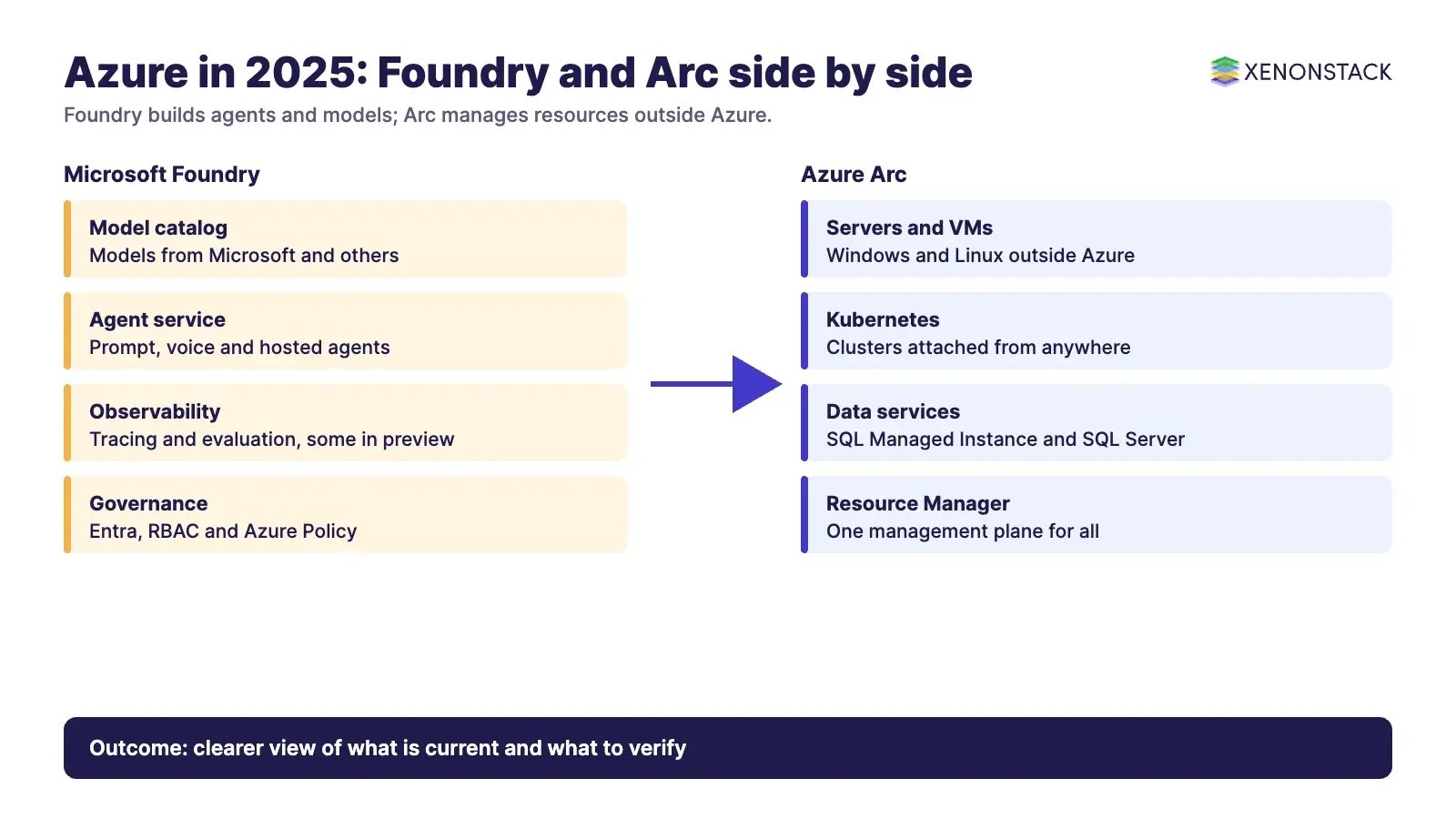
Names have changed. Microsoft states that "Azure AI Studio / Azure AI Foundry" is now "Microsoft Foundry" and "Azure AI Services" is now "Foundry Tools". It also lists a newer resource model, a newer portal, and an agent API that moved from the Assistants API to the Responses API. If you read older material, map the old names to the new ones before acting. For our overview of Azure AI services, see Azure AI platform.
What does Foundry offer for AI agents and models?
| Area | What the documentation says |
|---|---|
| Models | Access to "more than 10,000 models from Microsoft, OpenAI, Anthropic, Meta, and others" through the model catalog |
| Agents | Agents can be declarative prompt agents, voice-based prompt agents, or hosted agents that run your own code |
| Tools and knowledge | Extend agents with built-in tools, memory and retrieval using a Foundry Toolbox |
| Observability | Trace and evaluate agents and models, and monitor them with built-in dashboards (preview) |
| Governance | Apply Microsoft Entra identity, role-based access control, content filters, network isolation and Azure Policy |
Note the "preview" label on the dashboards: preview features can change, so check status before you rely on them in production. Our guides on generative AI use cases, neural network applications and MLOps and machine learning tools cover the build and operate sides.
What is Azure Arc and why does it matter for hybrid cloud?
The Azure Arc overview says it "simplifies governance and management by delivering a consistent multicloud and on-premises management platform." It projects non-Azure and on-premises resources into Azure Resource Manager so you can manage virtual machines, Kubernetes clusters and databases as if they ran in Azure.
Microsoft lists the resource types it manages outside Azure: Windows and Linux servers and virtual machines, Kubernetes clusters, Azure data services such as SQL Managed Instance, and SQL Server instances. The page also notes that indirectly connected mode is retired as of September 2025, so check any design that assumed it. For the placement question behind hybrid, read edge computing versus cloud computing.
Which other 2025 Azure themes should you verify before you act?
Our 2025 list also covered quantum computing, a low-cost open model, vision-based copilots, sustainability, IoT, edge analytics, Synapse and cloud security. We did not re-verify those against Microsoft's current documentation for this update, so treat them as topics to research, not as confirmed features.
| Theme | Where to read more | What to verify |
|---|---|---|
| Quantum | Our guide to Microsoft's Majorana 1 chip | Current research status on Microsoft's site |
| IoT and edge | Our guide to the Internet of Things | Service availability in your region |
| Analytics | Our big data analytics pages | Which services are current for new builds |
| Security | Our overview of Microsoft Sentinel | Current licensing and connectors |
| Data quality | Guides on Azure ML data quality, Data Factory workflows and Azure data quality automation | Tool names after the Foundry renames |
How do AI agents change the Azure picture?
Foundry makes it easier to build an agent. The harder question is deciding what the agent may do, with which data, and how each action is recorded. That is a governance and operations problem across Azure, on-premises systems and other clouds, which is exactly where Arc-style central management helps. XenonStack's ElixirClaw is the AI agents computing platform for building and operating agents. Our Azure services page describes related work.
What should you do first?
- Inventory your Azure AI resources and map old names to Microsoft Foundry and Foundry Tools.
- Check which features you use are in preview, legacy or retired.
- Decide which on-premises and other-cloud resources need central management, and test Arc on one.
- Pick one agent use case and define its data, limits and approval steps.
- Review identity, access and policy settings before any agent reaches production.
If you want help sequencing these steps, talk to a specialist or contact us.
To map one decision your agents make on Azure, and the data and policy it depends on, book a Context Workshop. See what happens in the workshop.
Frequently asked questions
Is Azure AI Foundry the same as Microsoft Foundry?
Yes. Microsoft states that Azure AI Studio and Azure AI Foundry are now called Microsoft Foundry, and that Azure AI Services is now Foundry Tools.
What does Azure Arc do?
Azure Arc projects non-Azure and on-premises resources into Azure Resource Manager, so you can manage virtual machines, Kubernetes clusters and databases as if they ran in Azure.
Which resources can Azure Arc manage outside Azure?
Microsoft lists Windows and Linux servers and virtual machines, Kubernetes clusters, Azure data services such as SQL Managed Instance, and SQL Server instances.
Is Azure Arc indirectly connected mode still available?
No. The Azure Arc overview notes that indirectly connected mode is retired as of September 2025.
Are all features in Foundry generally available?
Not necessarily. Microsoft labels some features, such as the built-in observability dashboards, as preview, so check each feature's status before production use.
Follow XenonStack on LinkedIn: XenonStack on LinkedIn for new guides on agentic AI, data and platform engineering.
Ready to put AI agents to work? Explore ElixirClaw, the agentic OS platform to build, orchestrate and govern AI agents.
Explore the XenonStack platform family: ElixirData · ElixirClaw · ElixirHub · NexaStack · MetaSecure · Neural AI · AgentGRC · AgentSRE · AgentAnalyst · AgentInstruct · AgentRAI · AgentScrum · AgentSearch · AgentForce · AI Aviator · SAIF Aviator · CohortIQ · XenonStack AI · XenonStack UAE