Key takeaway
- How schools can use responsible AI to automate admissions, attendance and financial aid work, with human review, privacy checks and a clear first step
Automating administrative processes in schools means using software, and increasingly artificial intelligence (AI), to handle repetitive office work such as admissions, attendance, scheduling and financial aid, while staff keep the decisions that affect students. The aim is to return time to teaching and student support, not to remove people from the process.
This guide is for school leaders, registrars, administrators and IT teams in schools and school groups. It covers what school administration involves, where manual processes break down, where AI and AI agents fit, and how to start with responsible AI controls in place.
What are administrative processes in school management?
Administrative processes are the recurring tasks that keep a school running outside the classroom. They include admissions and enrolment, attendance records, timetabling and room allocation, fee collection, financial aid and scholarship handling, staff records, and communication with families. Each one involves forms, checks, approvals and records that must be accurate and auditable.
These tasks matter because errors reach students and families directly: a missed attendance flag, a lost application or a delayed aid decision is felt as a service failure, not a back-office glitch.
What goes wrong with manual school administration?
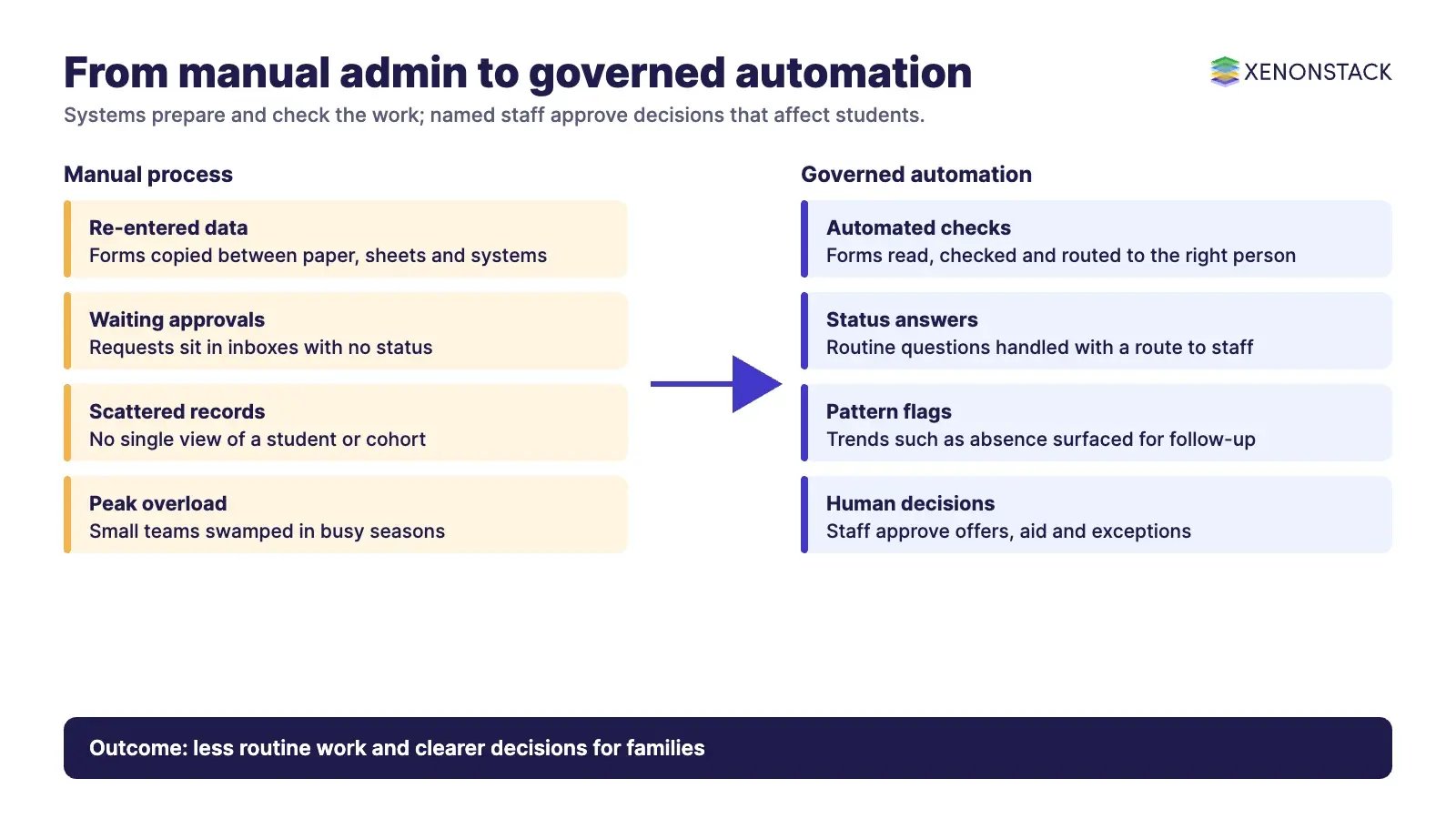
- Information is re-entered between paper forms, spreadsheets and student information systems, which invites mistakes.
- Approvals wait in inboxes, so applicants and parents chase for status updates.
- Records sit in separate files, so it is hard to see the full picture of one student or one cohort.
- Peak periods such as admissions season overload a small team, and routine work crowds out exceptions that need judgement.
None of these problems is unique to schools, which is why the same automation patterns used in other service organisations apply here, with extra care for children's data.
How can AI automate administrative processes in schools?
AI helps in three ways. It can automate repetitive steps, such as reading a submitted form, checking it for missing fields and routing it to the right person. It can surface patterns across data, such as attendance trends that suggest a student needs support. And it can answer routine questions from families, with a clear route to a person for anything unusual.
| Process | What AI can do | What staff should still decide |
|---|---|---|
| Attendance | Record and reconcile attendance, flag unusual absence patterns for follow-up | How to respond to a pattern and when to contact a family |
| Admissions | Check applications for completeness, sort documents, answer status queries | Offers and any case outside the published criteria |
| Financial aid | Collect documents, check them against stated requirements, prepare a summary | Eligibility decisions and appeals |
| Scheduling | Propose timetables and room plans that respect stated constraints | Final approval and exceptions |
| Family communication | Draft routine notices and answer common questions | Sensitive or individual conversations |
The pattern is the same in each row: the system prepares and checks, and a named person approves anything that affects a student.
What does responsible AI mean in a school setting?
UNESCO says its work calls for a human-centred approach to AI and that AI in education should be guided by the core principles of inclusion and equity. For administration, that translates into practical controls:
- Human review of any decision about admission, aid or discipline.
- Minimal use of student data, with access limited to people who need it.
- Testing on mock data before real records are used. The US Department of Education's own AI use page describes generating mock datasets to avoid real-world data in testing.
- A way for families to ask how a decision was reached and to appeal it.
How do AI agents change school administration?
IBM describes an AI agent as a system that autonomously performs tasks by designing workflows with available tools. Compared with a fixed script or a chatbot that only answers questions, an agent can break an admissions task into steps, call the school's systems to fetch or update records, and adjust when information is missing. IBM also notes risks that matter in a school: poorly managed integration with business systems can create data privacy concerns, and some real-time human monitoring helps prevent agents looping on the same action.
That is why governance comes first. ElixirClaw is the AI agents computing platform XenonStack builds for running agents under policy, and the same principle applies whichever tooling a school chooses: define what an agent may read, what it may change, and when it must stop and ask a person. For wider background, see our overview of artificial intelligence, our data and AI initiatives page and our AI services and consulting page.
What should a school do first?
- Pick one high-volume process, such as attendance reconciliation or application completeness checks.
- Write down each step, who owns it and which steps need a human decision.
- List the student data the process touches and remove anything it does not need.
- Pilot on mock or anonymised records, then run alongside staff before relying on it.
- Measure time saved and error rates against your current baseline, and review with staff and families.
If you want help scoping a first process, contact XenonStack or talk to a specialist.
To map one administrative decision your agents will make, and the student data and policy it depends on, book a Context Workshop. See what happens in the workshop.
Frequently asked questions
What are administrative processes in schools?
They are the recurring office tasks that keep a school running, such as admissions, attendance, scheduling, fee and financial aid handling, staff records and communication with families.
Can AI replace school administrative staff?
No. AI is best used to prepare, check and route routine work, while named staff approve decisions that affect students, such as admissions offers and aid eligibility.
Which school processes are best to automate first?
Start with high-volume, rule-based work such as attendance reconciliation or checking applications for completeness, where the steps are clear and exceptions can go to a person.
How should schools protect student data when using AI?
Use only the data a process needs, limit access, test on mock data before real records, keep a human review step, and document how decisions can be explained and appealed.
What is an AI agent in school administration?
An AI agent is a system that autonomously performs tasks by designing workflows with available tools. In a school it could gather documents, update records and flag exceptions, within limits set by the school.
Follow XenonStack on LinkedIn: XenonStack on LinkedIn for new guides on agentic AI, data and platform engineering.
Ready to put AI agents to work? Explore ElixirClaw, the agentic OS platform to build, orchestrate and govern AI agents.
Explore the XenonStack platform family: ElixirData · ElixirClaw · ElixirHub · NexaStack · MetaSecure · Neural AI · AgentGRC · AgentSRE · AgentAnalyst · AgentInstruct · AgentRAI · AgentScrum · AgentSearch · AgentForce · AI Aviator · SAIF Aviator · CohortIQ · XenonStack AI · XenonStack UAE