

Key takeaway
- Big data analytics tools compared by layer for 2026: warehouses, lakehouses, real-time engines, BI and AI analytics, semantic layers and how to choose.
Big data analytics tools are the software that turns large, fast or varied data into answers people and AI agents can act on. They sit above the infrastructure that ingests and stores data, and they fall into six layers: cloud warehouses and lakehouses, open-source query and OLAP engines, real-time analytics engines, BI and AI analytics tools, the semantic layer that defines business metrics, and the open table formats and catalogues that let all of them share one copy of the data.
To choose, start from the workload rather than the vendor: how fresh the answer must be, who asks the question (an analyst, a customer-facing app or an agent), which open formats you must keep, and how easily you could leave. Most enterprises in 2026 run one primary warehouse or lakehouse, one or two specialist engines, a BI tool and a governed semantic layer, all over Apache Iceberg or Delta tables.
This guide is written for CIOs, CDOs, Chief AI Officers and data and platform architects. It covers the analytics layer only. For ingestion, storage and orchestration tools such as Kafka Connect, object storage and workflow schedulers, see our companion guide to big data tools for ingestion, storage and orchestration. Product names, versions and statuses below were checked on official pages on 11 November 2026. XenonStack is a data and AI services firm and does not sell any of the tools named here.
What are big data analytics tools?
A big data analytics tool is any engine or application that queries, models, visualises or explains data at a scale where a single relational database or spreadsheet stops being practical. The category includes SQL engines that scan petabytes in object storage, stream processors that compute results as events arrive, and BI tools that put those results in front of business users, now often through a conversational agent.
The difference from general "big data tools" is purpose. Infrastructure tools move and keep data. Analytics tools answer questions about it. In a sound big data architecture the two are loosely coupled, so you can swap a BI tool or add a query engine without rebuilding pipelines.
Which layers make up a big data analytics stack?
| Layer | Job it does | Typical tools |
| Open table formats and catalogues | One governed copy of data that many engines can read and write | Apache Iceberg, Delta Lake, Apache Polaris, Unity Catalog |
| Cloud warehouse or lakehouse | Main SQL and AI workload platform, managed by a vendor | Snowflake, Databricks, BigQuery, Amazon Redshift, Microsoft Fabric |
| Open-source query and OLAP engines | Federated queries, low-latency dashboards, embedded or local analytics | Apache Spark, Trino, ClickHouse, StarRocks, Apache Doris, DuckDB |
| Real-time analytics | Results on data seconds or less after it arrives | Apache Kafka, Apache Flink, Apache Druid, Apache Pinot, OpenSearch |
| Semantic layer | Shared definitions of metrics and entities for people and agents | dbt Semantic Layer, Cube, LookML, Tableau Semantics |
| BI and AI analytics | Dashboards, self-service exploration and conversational agents | Power BI, Tableau, Looker, Qlik, ThoughtSpot, Sigma, Superset |
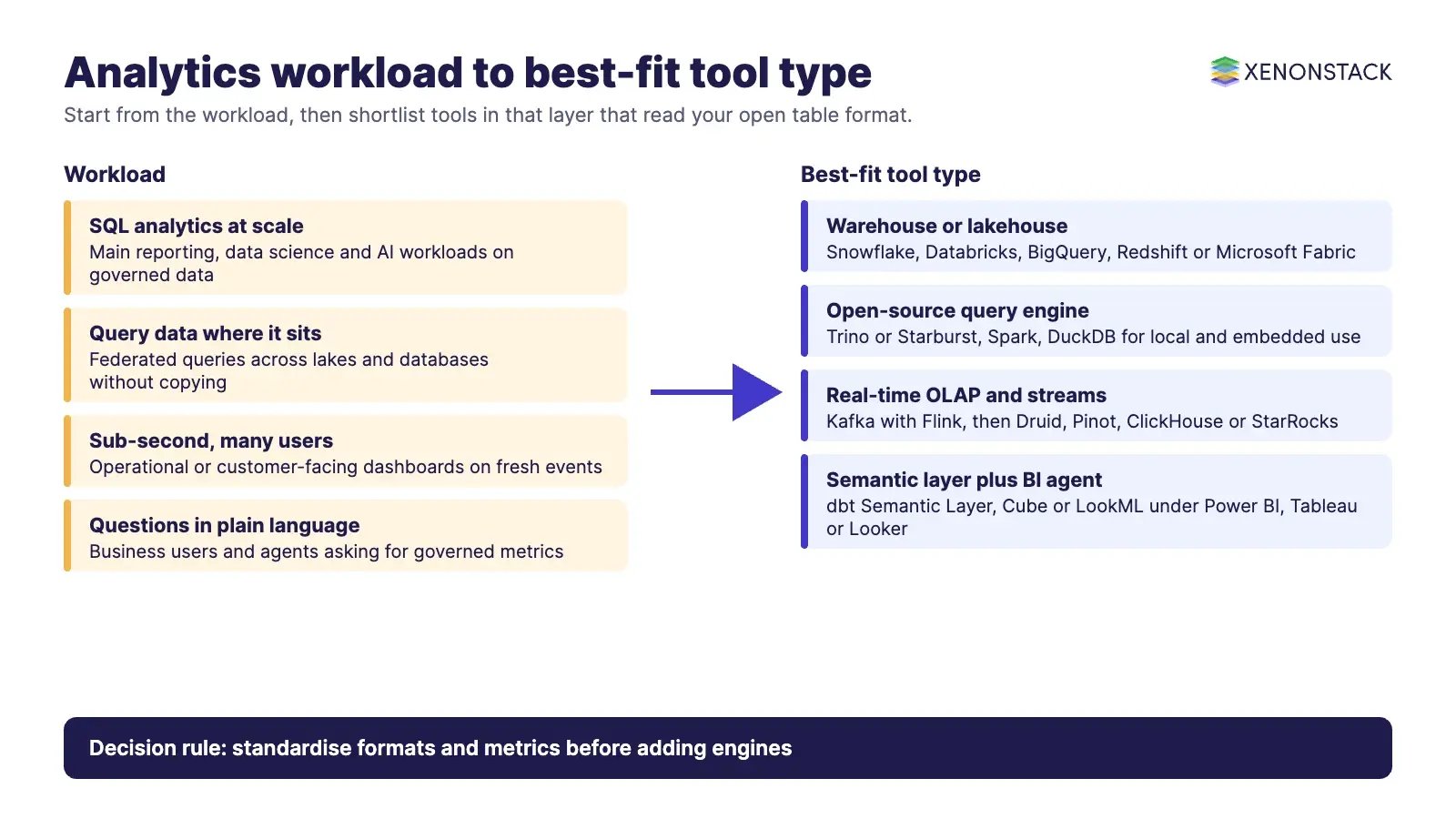
The order matters. Choices at the bottom (formats and catalogue) decide how many tools you can plug in at the top, and how hard it is to change vendors later. Our guide to choosing a big data platform covers the platform decision in more depth.
Which warehouse or lakehouse fits which workload?
All five major platforms now read and write Apache Iceberg in some form and all ship agents for natural-language analysis. The practical differences are the native format, the cloud you already run on and how each one packages its AI features.
| Tool | What it is | When it fits | 2026 status and AI features |
| Snowflake | Managed AI Data Cloud, delivered as a service | SQL-first teams that want minimal operations and governed data sharing | Iceberg spec v1 to v3 supported (v3 GA May 2026); external engines can read and write Snowflake-managed Iceberg tables through Horizon Catalog's REST API. Snowflake CoWork (formerly Snowflake Intelligence) is its conversational agent app; Cortex Agents, Cortex AI Functions and the CoCo coding agent (formerly Cortex Code) |
| Databricks | Lakehouse platform with serverless Databricks SQL warehouses | Mixed data engineering, data science and SQL on one platform, Spark-heavy teams | Delta Lake native; Unity Catalog manages Iceberg tables with Iceberg v3 GA and Iceberg REST APIs. Genie Agents (formerly Genie Spaces); Genie One launched June 2026 as a new agentic product; Lakebase serverless Postgres GA on AWS |
| Google BigQuery | Serverless warehouse that Google now positions as an "autonomous data to AI platform" | Google Cloud estates and teams that want no clusters to manage | Iceberg and Delta Lake queried directly through Lakehouse for Apache Iceberg (formerly BigLake). Data Engineering Agent GA; Conversational Analytics in BigQuery partly in preview; Knowledge Catalog (formerly Dataplex) |
| Amazon Redshift | AWS cloud warehouse, serverless or provisioned | AWS estates, zero-ETL from Aurora, RDS and DynamoDB | Reads and writes Iceberg v3 tables (August 2026). Amazon Q generative SQL; SageMaker Unified Studio and SageMaker Data Agent span Athena, Redshift and S3 |
| Microsoft Fabric | SaaS analytics platform built on OneLake, with Fabric Data Warehouse and Power BI | Microsoft 365 and Azure estates, teams that want warehouse and BI in one capacity | OneLake stores Delta or Iceberg and can expose each as the other. Fabric Data Agents and Copilot for Fabric. Microsoft calls Fabric its "strategic platform for new analytics innovation" |
| Azure Synapse Analytics | Earlier Azure analytics service (dedicated SQL pools, Synapse Spark) | Existing workloads only | No retirement or migration deadline announced by Microsoft. Microsoft advises new warehouse projects to start with Fabric Data Warehouse and offers migration assistants. Synapse Data Explorer (preview) was retired on 7 October 2025 |
Vendor performance and price-performance claims vary by benchmark and workload. Test your own top queries on two candidates before committing.
Which open-source engines are worth considering?
Open-source engines fill gaps the main platform does not cover well: querying data where it sits, serving dashboards to thousands of users, or running analytics on a laptop or inside an application. All of the engines below are open source; most also have a commercial managed service.
| Engine | What it is | When it fits | Latest release and notes |
| Apache Spark | Multi-language engine for data engineering, data science and ML (Apache 2.0) | Large batch transformations, ML feature work, streaming in the same code base | 4.3.0 (30 October 2026): stateful real-time mode, ASOF JOIN, VARIANT functions, Spark Connect REST endpoints. See our Apache Spark architecture guide |
| Trino and Starburst | Distributed SQL query engine (Apache 2.0); Starburst sells Galaxy (managed) and Enterprise | Federated queries across lakes and databases without moving data | Trino 484 (15 October 2026); connectors for Iceberg, Delta Lake and Hudi. Starburst AIDA agent GA with MCP support |
| ClickHouse | Column-oriented OLAP database (Apache 2.0); ClickHouse Cloud managed | Sub-second dashboards and log or event analytics at high volume | 26.10 (22 October 2026): Iceberg v3 deletion-vector reads, experimental embedded Iceberg REST catalogue |
| StarRocks | Real-time SQL engine under the Linux Foundation (Apache 2.0) | High-concurrency analytics directly on lakehouse tables | 4.1.7 (26 October 2026); external catalogues for Hive, Iceberg, Hudi, Delta Lake and Paimon |
| Apache Doris | Real-time MPP analytics database | Mixed analytics, full-text and vector search in one engine | 4.1.5 (16 October 2026); 4.1 added vector indexes, BM25 search and full DML on Iceberg v2 and v3 |
| DuckDB and MotherDuck | In-process SQL OLAP database (MIT); MotherDuck is a serverless cloud service built on it | Analyst laptops, embedded analytics, small to medium data, per-agent sandboxes | DuckDB 2.0.0 LTS (21 October 2026), supported to at least October 2027; can now run as a server; Iceberg and Delta extensions |
What tools handle real-time analytics?
Real-time analytics has two parts: a stream that carries events and an engine that answers queries on them. Kafka is the usual backbone, Flink or Spark computes on the stream, and a real-time OLAP store serves the results.
| Tool | Role | When it fits | Current status |
| Apache Kafka | Distributed event-streaming platform | Event backbone for most real-time use cases | 4.4.0 (22 October 2026). Since 4.0, Kafka runs without ZooKeeper, in KRaft mode by default |
| Apache Flink | Stateful stream and batch processing; Flink SQL over streams | Continuous aggregation, enrichment, fraud and anomaly rules | 2.3.0 (25 June 2026) |
| Spark Structured Streaming | Streaming inside Spark | Teams already on Spark that want one engine for batch and streams | Spark 4.1 gave first official support for real-time mode (sub-second, initially Scala and stateless); Spark 4.3 release notes add stateful real-time mode |
| Apache Druid | Real-time analytics database for sub-second queries on streaming and batch data | Operational dashboards with high concurrency and time-based slicing | 38.0.0 (1 October 2026). Background in our Apache Druid guide |
| Apache Pinot and StarTree | Real-time OLAP datastore for user-facing analytics; StarTree is a managed service built on it | Analytics shown to customers inside a product | Pinot 1.6.0 (28 October 2026) |
| OpenSearch and Elasticsearch | Search and log analytics | Text search, log and security analytics | OpenSearch 3.9.0 (Apache 2.0, Linux Foundation project). Elasticsearch source available under SSPL, AGPLv3 or Elastic License 2.0 |
Which BI and AI analytics tools lead in 2026?
If you are asking what the top 10 analytics tools are for business users, the short list most enterprises evaluate in 2026 is Power BI, Tableau, Looker, Data Studio, Qlik, ThoughtSpot, Domo, Sigma, Apache Superset and Grafana. They differ more in where they sit than in chart types: inside a cloud suite, on top of a semantic model, warehouse-native, open source or observability-first. Most tools on the list now ship an agent or chat interface, and several expose an MCP server so external assistants can query governed data.
| Tool | Best fit | AI features (2026) | Status notes |
| Power BI | Self-service and enterprise reporting; BI layer of Fabric | Copilot for report users, authors and model authors; standalone Copilot (preview) can use a Fabric data agent | Copilot needs Fabric F2+ or Premium P1+. Q&A retires December 2026. Microsoft reports a Leader placement in the 2026 Gartner Magic Quadrant for Analytics and BI Platforms |
| Tableau | Visual analytics; Tableau Next for agentic analytics on Salesforce Data 360 | Tableau Agent, Tableau Next MCP, Tableau Agent in Pulse GA | Tableau reports a Leader placement in the 2026 Magic Quadrant |
| Looker | Governed BI on the LookML semantic layer; embedded | Gemini in Looker, Conversational Analytics, Looker MCP Server | Google reports a Leader placement in the 2026 Magic Quadrant |
| Data Studio | Personal and ad hoc reporting | Data Studio Pro edition | Renamed from Looker Studio in April 2026 |
| Qlik | Associative self-service analytics | Qlik Answers, Discovery Agent, Qlik MCP server | Qlik reports a Leader placement in the 2026 Magic Quadrant. QlikView still receives releases (12.110, September 2026) |
| ThoughtSpot | Search and natural-language analytics; embedded | Spotter AI analyst, Spotter Semantics (reads Snowflake semantic views and dbt models) | ThoughtSpot reports a Leader placement in the 2026 Magic Quadrant |
| Domo | Cloud BI with built-in data integration and data apps | Agent Catalyst, AI Agent Builder, Domo MCP Server | Progress Software completed the acquisition of substantially all of Domo's assets (September 2026) |
| Sigma | Warehouse-native, spreadsheet-style BI; embedded | Sigma Agents, Sigma Assistant, Sigma MCP server | Building with Sigma Assistant is in beta |
| Apache Superset | Open-source dashboards and exploration | Superset MCP server (needs Superset 5.0+, admin-enabled) | 6.1.0 is the latest release seen |
| Grafana | Operational and time-series dashboards, observability | Grafana Assistant in Grafana Cloud | Grafana 13 released April 2026 |
Gartner placements above are as reported by each vendor on its own site; we did not read the Gartner report. For chart and dashboard design choices, see our guide to data visualisation tools.
Why does the semantic layer matter for AI agents?
An AI agent asked "what was net revenue last quarter?" will write its own SQL unless something tells it what "net revenue" means. A semantic layer defines metrics, joins and entities once, and every BI tool and agent queries through it. That is why Looker and Cube describe themselves as agentic platforms built on a semantic layer, and why Tableau, ThoughtSpot and Qlik have added semantic layer features (Tableau Semantics, Spotter Semantics and an extended Qlik semantic layer).
| Option | What it is | When it fits |
| dbt Semantic Layer and MetricFlow | Metrics defined in dbt projects; MetricFlow is the query engine, open-sourced under Apache 2.0 in October 2025; dbt MCP Server | Teams already modelling in dbt that want metrics usable from several BI tools and agents |
| Cube | Universal semantic layer with agentic analytics and embedded analytics; open-source Cube Core | Headless metrics for embedded apps and multiple front ends |
| Looker semantic layer (LookML) | Semantic model inside Looker, exposed to other assistants through the Looker MCP Server and Conversational Analytics API | Google Cloud estates and teams already on Looker |
| Tableau Semantics | AI-enhanced semantic layer in Salesforce Data 360 | Salesforce-centred organisations using Tableau Next |
Portability between these is improving. The Open Semantic Interchange (OSI) specification, which dbt Labs says is backed by Snowflake, Databricks, Salesforce and others, aims to let metric definitions move between tools. Treat it as early: confirm which of your tools can import and export it today. Our post on agentic analytics covers how agents use these definitions in workflows. If agents act on these metrics, ElixirData Context OS keeps governed context, versioned policy and decision traces in one decision layer above the agents, so each agent decision can be reconstructed later.
Which open table formats and catalogues should you standardise on?
Open table formats store data as Parquet files plus metadata that any compatible engine can read. A catalogue tells engines where tables are and who may access them. Standardising here is the single biggest lever on portability.
- Apache Iceberg: library 1.12.0 (29 September 2026). Spec versions 1, 2 and 3 are complete and adopted; v3 adds new types, default values and row lineage. Version 4 is under development and not adopted.
- Delta Lake: native format for Databricks and Fabric. Snowflake, BigQuery, Trino, StarRocks, Doris and DuckDB can read it, and Fabric OneLake can present Delta tables as Iceberg.
- Apache Polaris: open-source Iceberg REST catalogue, an Apache top-level project since February 2026; latest release 1.8.0.
- Unity Catalog OSS: Apache 2.0 catalogue for data and AI assets, currently a sandbox project with LF AI and Data Foundation; latest release 0.7.0.
What changed in 2025-2026?
Several product names and commercial terms changed in the past 18 months. Update procurement documents, architecture diagrams and training material accordingly.
| Change | Date | What it means for you |
| Snowflake Intelligence renamed Snowflake CoWork; Cortex Code renamed Snowflake CoCo | June 2026 | Same products, new names in contracts and docs |
| Genie Spaces renamed Genie Agents; Genie One launched | June and July 2026 | Genie One is a new agentic product, not a rename of AI/BI Genie |
| Looker Studio renamed Data Studio | April 2026 | Google positions Data Studio for ad hoc reports and Looker for governed BI |
| BigLake renamed Lakehouse for Apache Iceberg; Dataplex renamed Knowledge Catalog | Shown on Google Cloud pages by November 2026 | Google Cloud lakehouse and governance services under new names |
| Domo acquired by Progress Software | Announced July 2026, completed September 2026 | Review support, roadmap and renewal terms with the new owner |
| Fivetran and dbt Labs merger completed | 1 June 2026 | Ingestion and transformation now from one company; dbt Fusion being open-sourced as dbt Core v2.0 (alpha) |
| Power BI Q&A retires | December 2026 | Move Q&A users to Copilot; "Prep Data for AI" replaces Q&A Setup |
| Power BI Premium P SKUs move to Fabric F SKUs | At the end of each current agreement | No new P SKUs are sold; plan F SKU sizing before renewal. Power BI Report Server remains in support |
| Azure Synapse Data Explorer (preview) retired | 7 October 2025 | Migrate to Fabric Eventhouse |
How should you choose big data analytics tools?
Score each shortlisted tool against the criteria below, weighted by your top three workloads. A clear data strategy should already tell you which workloads matter most.
| Criterion | Question to ask | What good looks like |
| Workload | Is this batch reporting, interactive exploration, user-facing analytics, data science or agent queries? | The tool is designed for your dominant workload, not just able to run it |
| Latency | How fresh must the answer be, and how many users query at once? | Measured freshness and concurrency on your data, not a vendor benchmark |
| Open formats | Can it read and write Iceberg or Delta through an open catalogue? | Read and write, with the catalogue you choose rather than only its own |
| Governance | Does it enforce row and column security, lineage and audit through your catalogue? | Policies defined once and honoured by every engine and agent |
| AI readiness | Can agents query through a semantic layer with the user's permissions? | Agent answers grounded in governed metrics, with steps shown |
| Cost model | Is pricing per query, per capacity, per user or per compute second? | A model you can forecast, with budgets and auto-suspend |
| Exit and portability | How would you leave, and what would it cost? | Data in open formats, metrics in a portable definition, contractual switching terms |
What governance, security and regulation questions apply?
Analytics tools increasingly feed AI systems, so data governance rules now reach the analytics layer. Four instruments matter for most enterprises serving Europe or India. Data quality obligations also connect to the classic veracity problem in big data.
- EU AI Act, Article 10: training, validation and testing data for high-risk AI must follow data governance and management practices, including examination for possible biases, and be relevant, sufficiently representative and, to the best extent possible, free of errors and complete. The Digital Omnibus on AI, Regulation (EU) 2026/1744, published on 24 July 2026, moved the main high-risk obligations to 2 December 2027 for Annex III systems and 2 August 2028 for Annex I systems, and moved the rule on processing special-category data for bias detection to a new Article 4a.
- EU Data Act: applies from 12 September 2025. Cloud switching must complete within a maximum transitional period of 30 calendar days, and from 12 January 2027 providers may not charge switching charges. Use this when negotiating warehouse and lakehouse contracts.
- India DPDP Rules 2025: notified under the Digital Personal Data Protection Act 2023 (government release dated 14 November 2025), with an eighteen-month period for phased compliance. They cover consent notices, breach notification, verifiable parental consent and rights requests answered within 90 days.
- GDPR, Article 5: personal data must be adequate, relevant and limited to what is necessary (data minimisation) and kept identifiable no longer than necessary. In analytics, that argues for pseudonymised marts, column masking and retention policies enforced in the catalogue.
On security, check that agent and MCP access runs with the end user's permissions rather than a shared service account, and that every agent query is logged. To keep agent actions inside policy with an audit trail for risk teams, see AgentGRC. This is not legal advice; confirm obligations with counsel.
What adoption sequence works?
- Agree the table format and catalogue. Pick Iceberg or Delta (or both with interoperability) and one catalogue before adding engines.
- Choose the primary platform. Usually the warehouse or lakehouse closest to your main cloud and skills. Run a short proof of value on your top queries.
- Define your core business metrics in a semantic layer. Start with the metrics executives already argue about.
- Standardise one BI tool for most users, connected through the semantic layer.
- Add specialist engines only for proven gaps, such as real-time OLAP for a customer-facing product or Trino for federated access.
- Pilot agents last, on governed metrics, with logging and a human review step for any action that writes data. ElixirClaw is an agentic OS platform to build, orchestrate and govern AI agents and automation workflows while keeping humans in control, and NexaStack is an agentic operating platform for physical AI that runs across on-premises, cloud and hybrid environments.
When should you not add another tool?
- When the gap is a missing metric definition or poor data quality, not a missing engine.
- When your current platform already offers the capability, even if it is in preview, and the use case can wait.
- When the new tool cannot read your table format or honour your catalogue's access policies.
- When nobody owns it. Each extra engine needs patching, cost monitoring and skills.
- When the latency target is a preference rather than a requirement. Minute-level freshness is usually cheaper on the platform you already run.
If you would like an independent review of your analytics stack, talk to our big data analytics services team.
To map one analytics decision your agents should make, and the context and policy it depends on, book a Context Workshop. See what happens in the workshop.
Frequently asked questions
What are the top 10 tools for big data analytics?
No single ranking fits every workload, but a reasoned list by layer is: Snowflake, Databricks, Google BigQuery, Microsoft Fabric and Amazon Redshift as warehouse or lakehouse platforms; Apache Spark, Trino and ClickHouse as open-source engines; Apache Flink with Kafka for real-time analytics; and a BI tool such as Power BI, Tableau or Looker for business users.
What are the 5 types of big data analytics?
Descriptive analytics reports what happened. Diagnostic analytics explains why it happened. Predictive analytics estimates what is likely to happen. Prescriptive analytics recommends what to do. Real-time analytics answers these questions on data within seconds of it arriving.
What is the difference between big data tools and big data analytics tools?
Big data tools ingest, store and orchestrate data. Big data analytics tools query, model, visualise and explain it. Warehouses and lakehouses span both, but you choose them mainly on analytics workload, latency, open formats and governance.
Is Azure Synapse Analytics being retired?
Microsoft has not announced a retirement date or migration deadline for Azure Synapse Analytics. It calls Microsoft Fabric its strategic platform for new analytics innovation, advises new warehouse projects to start with Fabric Data Warehouse and offers migration assistants. Synapse Data Explorer (preview) was retired on 7 October 2025.
Do AI agents replace BI tools?
Not yet. In 2026 the major BI vendors have added agents inside their tools, such as Copilot in Power BI, Tableau Agent, Gemini in Looker, Qlik Answers and Spotter. Agents work best when they query through a governed semantic layer, which BI tools and semantic layer products provide. For plain-language questions over enterprise data sources, AgentAnalyst returns real-time insights without waiting on a report cycle.
Which open table format should we choose?
Apache Iceberg is supported for read and write by Snowflake, Databricks, BigQuery and Redshift, and Fabric OneLake can store Iceberg tables. Delta Lake is native to Databricks and Fabric. Fabric OneLake and Databricks Unity Catalog can expose tables in both formats, so many teams keep Delta where it is native and use Iceberg as the shared interface.


