Key takeaway
- Observability with AI agents watches data pipelines for quality problems and acts on them. See how CloudWatch and Glue Data Quality fit, and how to start.
Observability with AI agents means using software agents to watch the metrics, logs and quality checks of data pipelines, spot anomalies, and trigger investigation or a fix. On AWS, Amazon CloudWatch and AWS Glue Data Quality supply the signals, and the agent decides what they mean.
This guide is for data engineers and data leaders who run pipelines on AWS and are tired of static thresholds and manual checks. It explains the limits of traditional monitoring, what the AWS services provide, a four-stage integration pattern, and what to do first. For background, see XenonStack's guides to data quality management and cloud-native monitoring.
Why does data quality need observability?
Data quality is usually judged on dimensions such as completeness, accuracy, consistency, timeliness and uniqueness. A pipeline can run without errors and still deliver late, partial or duplicated data, so job success alone does not show that the data is fit for data-driven decision-making. Observability adds continuous measurement of the data itself, not only of the infrastructure that moves it.
What are the limits of traditional data quality monitoring?
Rule-based checks need someone to write each rule and set each threshold, and a fixed threshold cannot follow a metric that changes by hour, day or week. Reviews that run in batches find problems after downstream users have consumed the data. AWS has added features aimed at these limits, which the next section covers.
How do CloudWatch and Glue Data Quality detect problems?
The two services cover different layers. CloudWatch watches operational metrics, and Glue Data Quality evaluates rules on the data.
| Capability | What the AWS documentation says |
|---|---|
| CloudWatch anomaly detection | CloudWatch applies "statistical and machine learning algorithms" that "determine normal baselines, and surface anomalies with minimal user intervention." |
| Training and bands | The model "assesses both trends and hourly, daily, and weekly patterns" and trains on up to two weeks of metric data. It produces a range of expected values. |
| Anomaly alarms | These alarms "don't have a static threshold" and compare the metric to the expected value. You choose above the band, below it or both. |
| Glue Data Quality rules | Rules are written in Data Quality Definition Language (DQDL). A rule is an expression that checks a characteristic and returns a Boolean value. |
| Glue dynamic rules and anomalies | Dynamic rules allow thresholds such as RowCount greater than the average of the last 10 runs. ML-based anomaly detection became generally available on 7 August 2024. |
| Rule recommendations | Glue analyses data and creates rules for you. An ADVANCED mode uses Amazon Bedrock with table metadata and sampled rows. |
The Glue page lists integration with both Amazon CloudWatch and Amazon EventBridge as supported, but does not describe the wiring, so check the service documentation before you design alerts. Anomaly detection alarms on CloudWatch incur charges.
How do you integrate AI agents with CloudWatch for data quality?
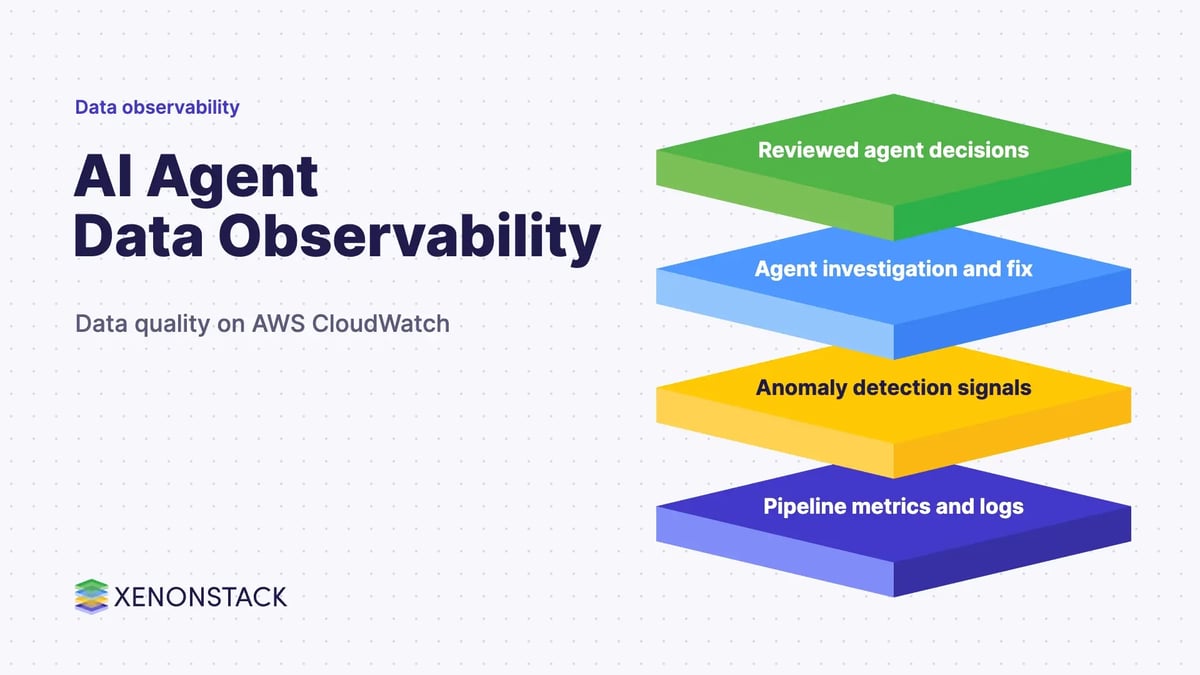
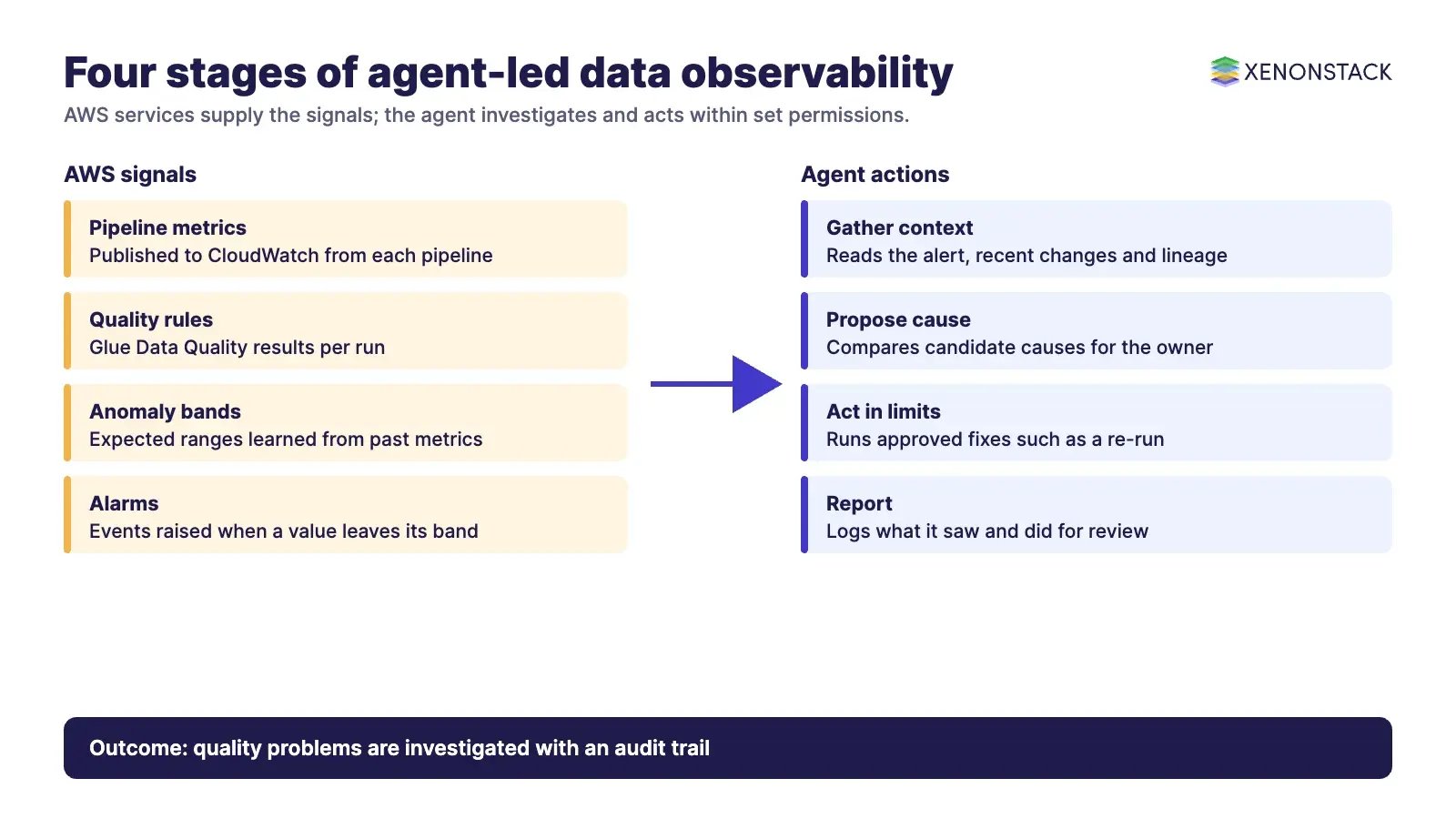
A practical pattern has four stages. Each stage uses documented AWS capabilities, and the agent sits on top.
- Ingest and log. Publish pipeline metrics, Glue Data Quality results and logs to CloudWatch.
- Detect. Use CloudWatch anomaly detection and Glue anomaly detection to flag departures from normal behaviour.
- Alert and respond. Route alarms to an agent through event-driven hooks. The agent gathers context, proposes a cause and, within set permissions, runs an approved fix such as a re-run.
- Report. Record what the agent saw and did on dashboards, so owners can review it.
How do AI agents change data quality observability?
Detection tools tell you that a metric left its band. An agent can go further: read the alert, query lineage and recent changes, compare candidate causes and open a ticket or start a remediation. That moves the work from watching dashboards to reviewing decisions, so permissions, approval points and an audit trail matter as much as the model.
XenonStack's ElixirData is its Context OS for data, analytics and governance, the layer where those decisions and their evidence are tied to policy. For AWS delivery context, see XenonStack on AWS services.
What should you do first?
- Choose three critical tables or pipelines and write down the quality dimension that matters most for each.
- Turn on Glue Data Quality rule recommendations and review each suggested rule before you accept it.
- Enable CloudWatch anomaly detection on the freshness and volume metrics of those pipelines.
- Decide which responses an agent may take alone and which need approval.
- Review every agent action weekly and adjust the rules.
To map one data decision your agents make, and the quality checks and policy it depends on, book a Context Workshop. See what happens in the workshop.
Frequently asked questions
What is observability with AI agents?
It is the use of software agents to watch the metrics, logs and quality checks of data pipelines, detect anomalies and trigger investigation or remediation, rather than relying on manual reviews alone.
How does CloudWatch anomaly detection work?
CloudWatch applies statistical and machine learning algorithms to a metric, learns trends and hourly, daily and weekly patterns from up to two weeks of data, and produces a band of expected values. An alarm can fire when the metric goes above or below that band.
What does AWS Glue Data Quality do?
It measures and monitors data quality using rules written in Data Quality Definition Language. It can recommend rules, use dynamic thresholds and apply machine learning to detect anomalies over time.
Can an agent fix data quality problems on its own?
It can, within the permissions you set. Start by letting it gather context and propose a cause, then allow low-risk actions such as a re-run, and keep approval for anything that changes or deletes data.
Follow XenonStack on LinkedIn: XenonStack on LinkedIn for new guides on agentic AI, data and platform engineering.
Ready to put AI agents to work? Explore ElixirClaw, the agentic OS platform to build, orchestrate and govern AI agents.
Explore the XenonStack platform family: ElixirData · ElixirClaw · ElixirHub · NexaStack · MetaSecure · Neural AI · AgentGRC · AgentSRE · AgentAnalyst · AgentInstruct · AgentRAI · AgentScrum · AgentSearch · AgentForce · AI Aviator · SAIF Aviator · CohortIQ · XenonStack AI · XenonStack UAE