Key takeaway
- A buyer's guide to Kubernetes managed services companies: what they cover, evaluation criteria, questions to ask, delivery models and warning signs.
A Kubernetes managed services company runs part or all of your container platform for you, from cluster setup and upgrades to monitoring, security and support. Choosing one means checking who is accountable for each layer, how changes are made and how you keep control of your own platform.
This guide is for engineering and operations leaders deciding whether to buy Kubernetes support or run it in-house. It covers the scope of managed services, the capabilities to check, an evaluation table, first-meeting questions, delivery models, risks, the effect of AI agents and what to do first.
What do Kubernetes managed services cover?
The Kubernetes documentation describes Kubernetes as a portable, extensible, open source platform for managing containerised workloads and services, with declarative configuration and automation. A managed service takes on running that platform. See our page on Kubernetes managed services and our notes on Kubernetes architecture components for what sits in each layer.
Typical scope includes cluster design and build, upgrades and patching, deployment pipelines, observability, backup and recovery, security hardening, cost control and round-the-clock support. Agree in writing which of these the provider owns and which stay with you.
Which capabilities should you check?
- Cluster operations: build, upgrade and patch processes with tested rollback.
- Delivery pipelines: how code moves from commit to cluster. See continuous integration and delivery and DevOps processes.
- Observability: metrics, logs and alerts you can see yourself.
- Security: access control, image scanning and secrets handling.
- Resilience: backup and disaster recovery that has been tested.
- Fit with your architecture: microservices, cloud native and hybrid cloud setups.
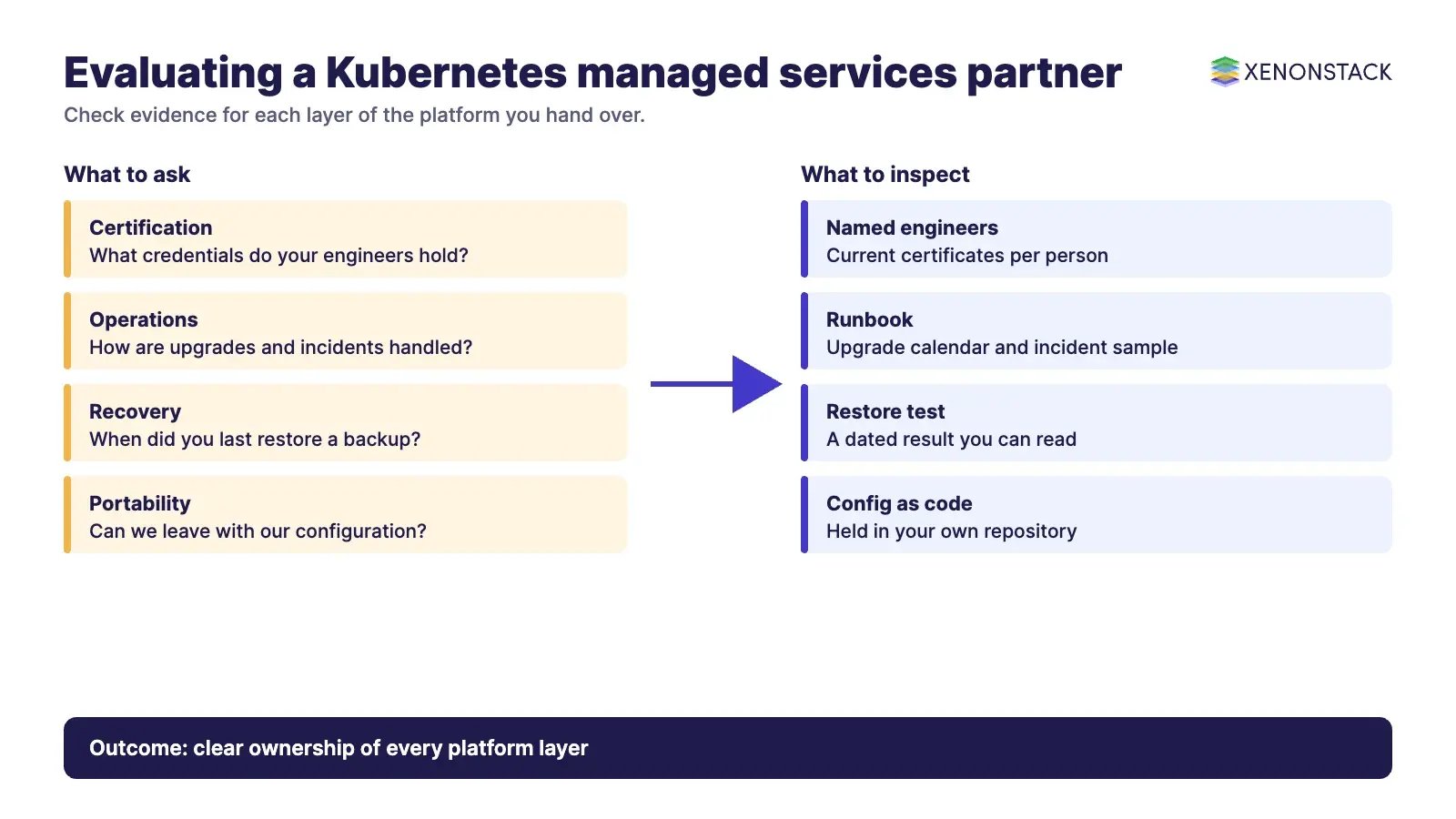
How should you evaluate a Kubernetes managed services partner?
| Criterion | What to ask | What good evidence looks like |
|---|---|---|
| Certification | What formal credentials do your engineers hold? | Named engineers and current certificates |
| Operations | How are upgrades and incidents handled? | A runbook, an upgrade calendar and a sample incident report |
| Security | How is access to clusters controlled? | Role design, audit logs and a patching policy |
| Observability | What can we see ourselves? | Dashboards and alerts running in your own tooling |
| Recovery | When did you last restore from backup? | A dated restore test result |
| Portability | Can we leave with our configuration? | Configuration held as code in your repository |
| Commercials | What is covered by the fee? | A service description with response times |
Formal programmes can help screen providers. The CNCF describes its Kubernetes Certified Service Provider programme as a pre-qualified tier of vetted service providers, and lists requirements that include three or more engineers who pass the Certified Kubernetes Administrator exam, a business model that supports enterprise end users and a Kubernetes professional services page. Treat it as a starting filter, then check the evidence above.
What should you ask in a first meeting?
- Who is on call for a cluster incident at 3 am, and what do they have access to?
- How do you plan and test a version upgrade?
- Which parts of the platform will we still own?
- How is our configuration stored, and can we take it with us?
- How do you handle security patches between upgrades?
- What would you advise against running on Kubernetes at all?
What delivery and commercial models are common?
| Model | How it works | Best when | Watch for |
|---|---|---|---|
| Fully managed | Provider runs clusters and support | No platform team in-house | Dependence and limited visibility |
| Co-managed | Provider and your team share duties | You have some platform skills | Unclear boundaries in an incident |
| Project and handover | Provider builds, then trains your team | You intend to run it yourself | Gaps after the handover |
| Advisory and audit | Provider reviews design and practice | The platform exists but needs review | Findings without follow-through |
What risks and warning signs should you watch for?
- No written split of responsibilities between you and the provider.
- Configuration held in the provider's tools rather than in code you own.
- Upgrades described as routine but never rehearsed.
- Backups that have never been restored.
- Credentials claimed but no named engineers.
- Contracts with no exit or transition terms.
How do AI agents change Kubernetes operations?
AI agents can read alerts, gather logs, propose a fix, draft a change and open a ticket, leaving a person to approve risky actions. They need scoped permissions and an audit trail, since a cluster agent holds real power. XenonStack is one option here: ElixirClaw is the AI agents computing platform.
What should you do first?
- Inventory your clusters, workloads and owners.
- Write down the incidents and upgrades that hurt most.
- Decide what you want to own and what to hand over.
- Agree how configuration will be stored as code.
- Score three partners on the table above.
- Start with one non-critical cluster as a trial.
To map one decision your platform agents make, and the data and policy it depends on, book a Context Workshop. See what happens in the workshop.
Frequently asked questions
What do Kubernetes managed services include?
Usually cluster build, upgrades, patching, monitoring, security hardening, backup and support. Scope varies, so get the split of responsibilities in writing.
Should I run Kubernetes myself or buy managed services?
If you lack engineers who can operate clusters around the clock, managed services can help. If platform control is core to your business, consider co-managed or a project with handover.
How do I check a provider's credentials?
Ask for named engineers and current certificates, and look at programmes such as the CNCF Kubernetes Certified Service Provider list as a first filter.
Can I move away from a managed provider later?
You can if configuration lives as code in your own repository and the contract has transition terms. Check both before you sign.
Where do AI agents fit in Kubernetes operations?
They can triage alerts and draft changes, with a person approving risky steps. Give them narrow permissions and keep an audit trail.
Follow XenonStack on LinkedIn: XenonStack on LinkedIn for new guides on agentic AI, data and platform engineering.
Ready to put AI agents to work? Explore ElixirClaw, the agentic OS platform to build, orchestrate and govern AI agents.
Explore the XenonStack platform family: ElixirData · ElixirClaw · ElixirHub · NexaStack · MetaSecure · Neural AI · AgentGRC · AgentSRE · AgentAnalyst · AgentInstruct · AgentRAI · AgentScrum · AgentSearch · AgentForce · AI Aviator · SAIF Aviator · CohortIQ · XenonStack AI · XenonStack UAE