Key takeaway
- Kubernetes federation manages deployments and services across clusters in different regions and clouds. See how it works, its limits and current options.
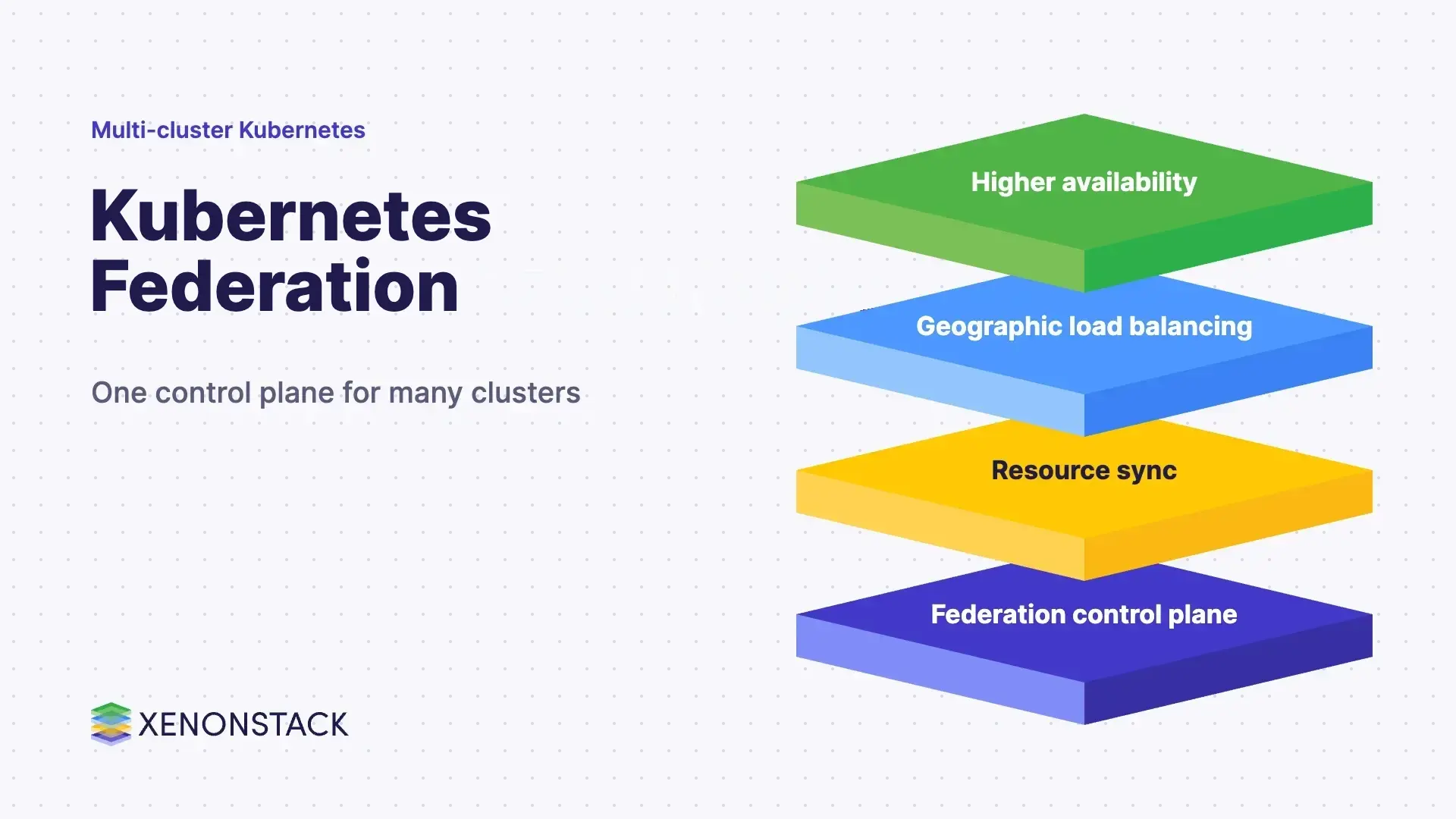
Kubernetes federation is a way to manage deployments and services across several Kubernetes clusters, in different regions or on different cloud platforms, from one control plane. It does two jobs: it keeps resources in sync across clusters and it lets clusters discover each other's services.
This page is for platform and infrastructure leads who run, or plan to run, more than one cluster. It covers the problem, how a multi-region setup is built, what federation gives you and what it does not, where AI agents fit and what to check first.
What is Kubernetes federation?
A team may run clusters on AWS, Microsoft Azure and Google Cloud, in several regions. Managing each one by hand does not scale. A federation control plane gives one place to define a workload and have it applied to every member cluster, and one way for services in one cluster to find services in another. For related reading, see XenonStack's Kubernetes consulting services and the Kubernetes native serverless framework.
What problems come with a federated setup?
- The control plane is a dependency. If the federation cluster goes down, you cannot use federation until it is back. Member clusters keep running as independent clusters.
- Alerting and auditing. Events, alerts and audit records are spread across clusters, so you need a plan to see them together.
- Drift between clusters. Synchronisation only helps if teams agree which resources are shared and which are local to a cluster.
How do you build a multi-region cluster?
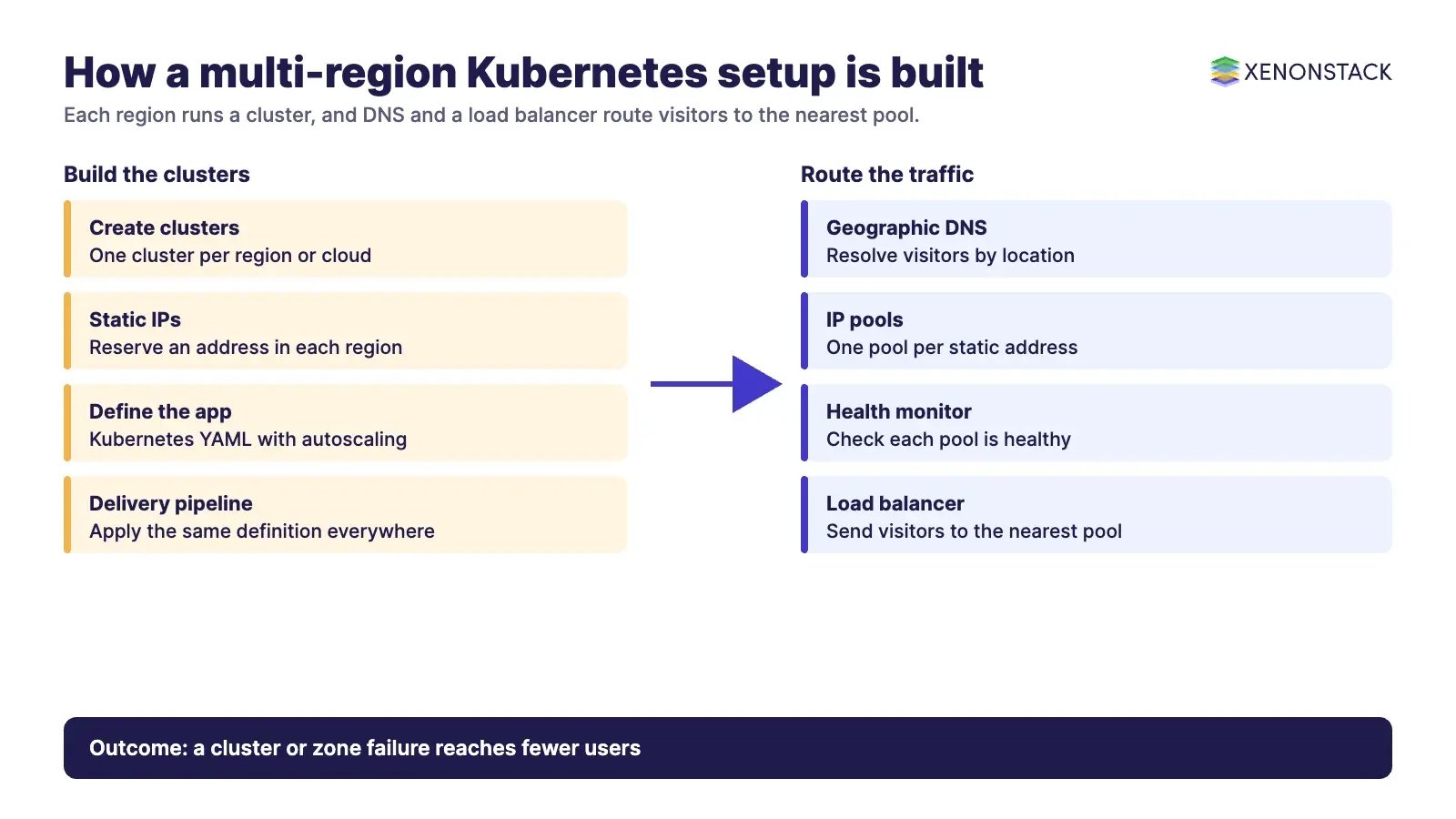
A common pattern spreads one application over clusters in more than one region and routes each visitor to the nearest healthy copy. The steps are:
- Create each Kubernetes cluster, for example with preemptible nodes to control cost.
- Reserve a static IP address in each region.
- Define the application in Kubernetes YAML, including autoscaling.
- Set up a continuous delivery pipeline that applies the same definition to every cluster.
- Configure a geographic DNS service and create a pool for each static IP.
- Add a health monitor and a load balancer that sends each visitor to a pool based on location.
What does federation give you, and where does it fall short?
| Benefit | What it means in practice | What to watch |
|---|---|---|
| Geographic distribution | Workloads run close to users in several regions | Data that must stay in one region needs separate rules |
| Higher availability | Load is spread across clusters, and a zone or cluster failure affects fewer users | Failover only works if capacity exists in the other clusters |
| Hybrid cloud | On-premises and cloud clusters can be used together | Each platform has its own networking and storage |
| Avoiding lock-in | Applications can move between providers | Provider-specific services still tie you in |
| Application migration | Move a workload by changing where it is applied | Test the move before relying on it |
| Fault isolation | A problem in one cluster stays there | Shared configuration can still spread a bad change |
Is the original Kubernetes federation project still maintained?
Check this before you plan. The KubeFed repository says the repository was archived on 25 April 2023 and is read-only, and that it is no longer in active development. It points readers to the current subprojects of the Kubernetes multicluster special interest group. Other open source projects now cover the same need. The Karmada documentation describes Karmada as a system for multi-cluster application management in multi-cloud and hybrid cloud scenarios, with support for clusters in public cloud, on-premises and edge environments.
The recorded walkthrough below shows the federation idea in practice.
Where do AI agents fit?
Federation decides where a workload runs. An AI agent can handle the operational questions around it: correlating alerts from several clusters, checking a proposed change against policy before it is applied everywhere, and preparing a failover plan for a person to approve. The agent works through the same control plane and audit trail as your engineers. ElixirClaw is the AI agents computing platform from XenonStack and is the product page to read for agent and automation use cases.
What should you check before you adopt it?
- Project status. Pick a maintained multi-cluster project and confirm its current release.
- Failure plan. Decide what happens when the control plane is unavailable.
- Shared and local resources. List what is synchronised and what stays local.
- Observability. Collect logs, alerts and audit records from every cluster in one place.
- Capacity. Confirm each cluster can absorb traffic from a failed one.
- Access. Decide who can change shared definitions.
To map one decision your cluster-operations agents make, and the data and policy it depends on, book a Context Workshop. See what happens in the workshop.
Frequently asked questions
What is Kubernetes federation?
It is a way to manage deployments and services across several Kubernetes clusters, in different regions or clouds, from one control plane. It synchronises resources across clusters and supports cross-cluster discovery.
What happens if the federation control plane fails?
You cannot use federation until it is back. The member clusters keep running as independent clusters.
Is KubeFed still maintained?
No. Its repository was archived on 25 April 2023 and is read-only. Look at the current multicluster subprojects, such as Karmada, before you plan.
Why run Kubernetes clusters in more than one region?
It places workloads closer to users, spreads load and reduces the effect of a zone or cluster failure. It also lets you extend an on-premises cluster into the cloud.
How can AI agents help with multi-cluster operations?
An agent can correlate alerts across clusters, check proposed changes against policy and draft a failover plan for a person to approve.
Ready to put AI agents to work? See an ElixirClaw demo: the agentic OS to build, orchestrate and govern AI agents across your enterprise systems.
Explore the XenonStack platform family: ElixirData · ElixirClaw · ElixirHub · NexaStack · MetaSecure · Neural AI · AgentGRC · AgentSRE · AgentAnalyst · AgentInstruct · AgentRAI · AgentScrum · AgentSearch · AgentForce · AI Aviator · SAIF Aviator · CohortIQ · XenonStack AI · XenonStack UAE